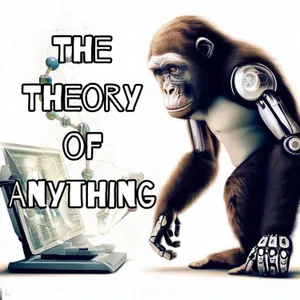
Free Daily Podcast Summary
The Theory of Anything: Daily Summaries Delivered
by Bruce Nielson and Peter Johansen
A podcast that explores the unseen and surprising connections between nearly everything, with special emphasis on intelligence and the search for Artificial General Intelligence (AGI) through the lens of Karl Popper's Theory of Knowledge. David Deutsch argued that Quantum Mechanics, Darwinian Evolution, Karl Popper's Theory of Knowledge, and Computational Theory (aka "The Four Strands") represent an early 'theory of everything' be it science, philosophy, computation, religion, politics, or art. So we explore everything.
Latest Episodes
The most recent episodes — sign up to get AI-powered summaries of each one.
- 6 days ago1h 14m
Episode 147: Decisionalism
This week Bruce asks more hard questions: Is our legal system “decisionalist”? In other words, are we outcome-based rather than reasoning-based creatures? Is there something deep in our brains they tells us to go with what feels correct, even if we are Supreme Court justices? Is our reasoning mostly de facto when we are really honest with ourselves? Does a careful look at the state of the critical discussion really help us decide between theories, especially in politics and morality?This episode is a review of Justin Driver’s The Insignificance of Judicial Opinions. Driver argues that when it comes to judicial opinions, it is the decisions that matter, not the reasoning used to justify them. But if that’s true, doesn’t it raise a deeper problem for the critical rationalist idea that explanatory power is king?Support us on Patreon
- 2 weeks ago41 min
Episode 146: The Put Up or Shut Up Principle
What Bruce has called the “put up or shut up principle” is the idea we should want our theories to take on the burden of explanation as must as we can. We need to "put up" an at least equally content filled theory as a competitor to another content filled theory. He argues that this may be central idea behind critical rationalism. We strengthen our theories by increasing the potential set of falsifiers. This is how knowledge grows. Bruce is pointing out that we all like to change the goal post when we look at our own pet theories. But shouldn’t we strive to not have double standards if we care about moving towards truth?Support us on Patreon
- Aug 18, 20261h 41m
Episode 145: Pascal’s Wager and Probability Theory
This week Bruce takes a deep dive into Pascal’s Wager. If there is even a small chance that God exists, and believing could lead to an infinite reward while disbelief risks an infinite loss, then believing is the rational choice... right?Blaise Pascal was one of the founders of probability theory back in the 17th century. Even aside from the potentially problematic theological point his famous wager makes, it also raises important questions about probability theory, Bayes’ theorem, and even modern Bayesian epistemology. How do we handle situations where the potential payoff is enormous—or even infinite?Pascal's Wager is also the thread we pull that unravels Bayesian Epistemology, while also showing why Bayesian Reasoning is really part of Critical Rationalism.Support us on Patreon
- Jul 28, 202627 min
Episode 144: Memes, Words, and Concepts
This week we talk about meaning memes, words, concepts, and conceptual leakage. How is a meaning meme turned into a broader concept and then a theory? What is the role of language in this process?And what is conceptual leakage? And why does it make it difficult to communicate to others?And was Popper right to eschew questions of meaning? And what does this have to do with AGI?Support us on Patreon
- Jul 7, 20261h 27m
Episode 143: Is AGI Possible? (State of the Debate)
Bruce returns to AGI through the lens of a critical rationalist debate about whether or not AGI is theoretically possible. Can human intelligence be replicated? Is this a physics question or a biology question? Is our universe and our minds like a compact disc or like a vinyl record?But really, Bruce is just using the AGI debate to explore an epistemological idea: that the state of a critical discussion is objective. If two people disagree about the state of a critical discussion, at least one of them must be misunderstanding that state—possibly both of them. It’s possible they are genuinely disagreeing over something factual, but more often than not they are really just disagreeing over epistemology.Support us on Patreon
- Jun 16, 20261h 18m
Episode 142: Self Deception and Dogmatism
Is so-called "self-deception" a real thing? How can one at once be aware that something is true and yet also be unaware of it? Is it even a coherent concept? Doesn't deception require at least two entities—the deceived and the deceiver? Can "self-deception" be explained as something much simpler, namely deception?Bruce summarizes his views on self-deception, moralizing, and dogmatism from a critical rationalist perspective, as well as it's relevance for AGI, "Super Intelligences", and human dogmatism.Support us on Patreon
- Jun 2, 20262h 28m
Episode 141: Probability and Reality (with Sam Kuypers)
This week we are joined for the 4th time by physicist Sam Kuypers. From his Conjecture Institute profile: “Quantum physicist, interested in foundational questions. In his research, published in reputable scientific journals, he explores the quantum theory of time, the many-worlds interpretation, and locality.”We discuss: Is probability theory true? Is it useful? What is the connection between probability theory and physics? Does the many worlds interpretation make probability theory more true or less true?Support us on Patreon
- May 19, 20261h 55m
Episode 140: Immunizing Stratagems
Ad hoc saves and immunizing stratagems are phrases Karl Popper used to describe moves humans make when we try to protect our theories from refutation. We all do this every day in one way or another.But immunizing stratagems hurts theories in that this move makes our ideas overall less convincing to other people. Marxism and psychoanalysis are the classic areas where Popper saw true believers bend over backward to save these theories from refutation from the real world. This was the main topic of The Myth of the Closed Mind by Ray Scott Percival, who we interviewed a few episodes ago. So when ideas come into contact with human minds, theories or memes that move us closer to truth have a survival advantage. So as flawed as we are, humans—all humans—cannot help but seek truth, fallibly of course. Bruce reads a lot from Ray’s book on this episode, especially from chapter 4, “Ideologies as Shapeshifters.” Please consider ordering Ray’s excellent book, which is also available on Audible. https://amzn.to/4tF1UXx
Get The Theory of Anything summaries in your inbox
Free AI-powered daily recaps. Key takeaways, quotes, and mentions — in a 5-minute read.
Get Free Summaries →Free forever for up to 3 podcasts. No credit card required.
You Might Also Like
Listeners also like.

Theories of Everything with Curt Jaimungal
Analyzes theoretical physics, consciousness, AI, and metaphysics with rigorous, unconventional depth.
Into the Impossible With Brian Keating
Brian Keating explores profound scientific and philosophical questions with leading thinkers in physics, technology, and beyond.
Political Theory 101
Explains foundational concepts and thinkers in political theory for a general audience.

COMPLEXITY
Santa Fe Institute

Possible
Explores optimistic, realistic futures through in-depth conversations with innovators in AI, science, health, and global affairs.

Artificial Intelligence Masterclass
Examines the impact of advanced artificial intelligence on ethics, society, and the future of human labor.

The Quanta Podcast
A deep dive into fundamental questions in science and math through conversations with researchers and Quanta Magazine editors.

Latent Space: The AI Engineer Podcast
Explores AI engineering breakthroughs in foundation models, code generation, and AI agents through interviews with researchers and developers.

Search Engine
Explores curious questions about the world with investigative storytelling and thoughtful analysis.

Forum Borealis
In-depth interviews with authors and thinkers on unconventional topics in history, science, philosophy, and politics.

The Joy of Why
Mathematicians and scientists explore fundamental questions in science and math through expert interviews.
Inquiring Minds
Explores the intersection of science and society through critical thinking and in-depth analysis.
About The Theory of Anything
A podcast that explores the unseen and surprising connections between nearly everything, with special emphasis on intelligence and the search for Artificial General Intelligence (AGI) through the lens of Karl Popper's Theory of Knowledge. David Deutsch argued that Quantum Mechanics, Darwinian Evolution, Karl Popper's Theory of Knowledge, and Computational Theory (aka "The Four Strands") represent an early 'theory of everything' be it science, philosophy, computation, religion, politics, or art. So we explore everything.
Customized Recaps
AI-powered recaps with compact key takeaways, quotes, and insights.
Straight to Your Inbox
Get key takeaways from The Theory of Anything in a 5-minute read.
Save Hours Every Week
Stay current on your favorite podcasts without falling behind.
Frequently Asked Questions
What is Podzilla's The Theory of Anything daily summary?
It's a free AI-powered email that summarizes new episodes of The Theory of Anything as soon as they're published. You get the key takeaways, notable quotes, and links & mentions — all in a quick read.
How does the The Theory of Anything podcast summary work?
When a new episode drops, our AI transcribes and analyzes it, then generates a personalized summary tailored to your interests and profession. It's delivered to your inbox every morning.
Is this an official The Theory of Anything product?
No. Podzilla is an independent service that summarizes publicly available podcast content. We're not affiliated with or endorsed by Bruce Nielson and Peter Johansen.
Can I get summaries of other podcasts too?
Absolutely! The free plan covers up to 3 podcasts. Upgrade to Pro for 15, or Premium for 50. Browse our full catalog at /podcasts.
What topics does The Theory of Anything cover?
The Theory of Anything covers topics including Philosophy, Culture, Society & Culture. Our AI identifies the specific themes in each episode and highlights what matters most to you.
Start getting The Theory of Anything summaries tomorrow morning.
Free forever for up to 3 podcasts. No credit card required.
Free forever for up to 3 podcasts. No credit card required.