Free Daily Podcast Summary
The Super Urban Podcast: Daily Summaries Delivered
by Super Urban Lab
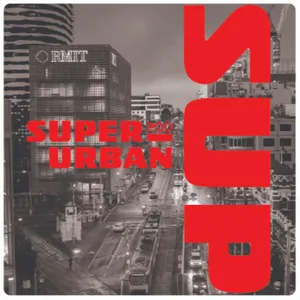
SUP – The Super Urban Podcast is a conversation about cities and how they’re designed; how we imagine them and how we could re-imagine them. Cities are the most complex things ever constructed and they are also our everyday, barely noticed environment. We’re here for a talk about cities from as many perspectives as possible. Each episode will focus on a specific theme, blending diverse viewpoints and engaging with broader contexts like history, economics, politics, and current social issues. The Super Urban Podcast is hosted by Ian Nazareth, Graham Crist and Christine Phillips.
Latest Episodes
The most recent episodes — sign up to get AI-powered summaries of each one.
- 3 days ago48 min
Cities as Projects with Pier Vittorio Aureli
What happens when architecture stops trying to solve the city and starts questioning it? In this episode, we speak with Pier Vittorio Aureli, architect, educator and co-founder of DOGMA, about the city as a project: a political and architectural proposition rather than simply a physical condition to be managed. Across two decades of work, DOGMA has developed a distinctive body of research that challenges conventional relationships between architecture, urbanism and collective life. From Stop City, a speculative proposal that uses the architectural limit as an instrument to question endless urbanisation, to the wall, the room, the villa and the collective dwelling, Aureli's work returns to a fundamental question: what agency does architecture have in shaping the city? His thinking draws on architectural form, political theory and urban history to consider how discrete architectural propositions can challenge the forces that increasingly determine urban development. We explore the relationship between architecture and politics, the role of drawing and writing as critical instruments, and the possibilities of alternative forms of housing, ownership and collective living. Against a contemporary urbanism increasingly driven by finance, optimisation, prediction and computation, we ask whether architecture can still establish a position, draw a limit or propose an alternative. What does it mean to think of the city as a project? And can architecture remain politically consequential by refusing to simply accommodate the city as it is? Check out the references for this episode.
- Sep 21, 202649 min
The Public Architect with Finn Williams
This episode of the Super Urban Podcast explores one of the most pressing questions facing architecture today: what happens to architectural agency when the architect becomes increasingly separated from the institutions and systems that produce cities? The conversation with Finn Williams traces the transformation of architecture from a public and civic practice towards a profession increasingly operating within market-driven systems of development, land value and investment. The discussion asks how architects might regain influence byengaging more directly with the systems through which urban futures are shaped.The conversation examines Williams’ work through Public Practice, an organisation established to rebuild design capacity within local government by embedding architects and urban designers inside public institutions. From here, the discussion moves to his role as City Architect of Malmö and the possibility of redefining what a city architect does: not simply designing projects, but creating the conditions, processes and institutional capacities through which better urban decisions can emerge. Planning, procurement, policy, regulation and administration are considered not merely bureaucratic constraints, but potential forms of urban design and, in Williams’ terms, a possible shift from bureaucracy towards ‘plureaucrocracy’.The episode also projects towards the future architect: a practitioner operating across policy, technology, governance, climate, procurement and civic systems. The discussionsuggests that its field of agency may be expanding, from designing buildings towards designing the conditions through which cities become possible.Finn Williams is an architect, urbanist and public sector design leader whose work focuses on rebuilding the relationship between architecture and civic institutions. He is the founder of Public Practice, an organisation established to address thedecline of design capacity within local government by embedding architects and urban designers within public institutions. He is currently City Architect of Malmö, where he continues to explore how architectural thinking can operatewithin complex civic systems. Williams’ work challenges conventional assumptions about architectural authorship, expertise and power, asking whether some of the most consequential architectural projects of the future might notbe buildings, but the institutions, processes and frameworks through which cities are made. The conversation was recorded in Melbourne during Williams’ visit for the Living Cities Forum, with support from the Naomi Milgrom Foundation.Check out the references from this episode.
- Jun 12, 20261h 4m
Hyper Cities with Winy Maas
This episode of the Super Urban Podcast ventures into one of the most expansive propositions in contemporary architectural thinking: that everything is urbanism. Drawing from Winy Maas's 2019 guest editorship of Domus, theconversation explores what it means when the city is no longer a bounded object but a total condition — absorbing climate systems, data networks, food production, finance, and human behaviour into a single, planetary field of design. The discussion moves through the long arc of MVRDV's data-driven and speculative work — from Metacity/Datatown and Pig City to FARMAX and KM3 — tracing how architecture shifted from describing objects to modelling systems,using data not as neutral optimisation but as a critical tool to expose contradictions and test urban limits.The conversation also tackles the concept of Biotopia — a future where buildings operate as living ecosystems — alongside the transformation of infrastructure into culture, asseen in projects like Depot Boijmans Van Beuningen. Threading through each of these themes is a consistent tension: does the expansion of architecture's scope intoecology, biology, economics, and atmosphere empower the discipline or risk dissolving its capacity to act and resist? The episode closes with a preview of Sky City, a project developed through The Why Factory currently being co-taught as a studio at RMIT University in Melbourne, which asks what urbanism becomes when the sky itself is treated as a designed, contested, and algorithmically governed urban layer.Winy Maas is a Dutch architect, urbanist, and co-founding partner of Rotterdam-based MVRDV, established in 1993 alongside Jacob van Rijs and Nathalie de Vries. His leadership has driven many of the office's award-winning projects, including Rotterdam's Markthal, the Tianjin Binhai Library, and Depot Boijmans Van Beuningen — the first publicly accessible art depot in the world. He is also the founder of The Why Factory, a research laboratory dedicated to speculativeurban futures, and holds professorships at both MIT and TU Delft. Check out the references from this episode.
- May 10, 202655 min
Senseable Cities with Fabio Duarte
This episode of the Super Urban Podcast turns to the city as a live, legible system — one that can be continuously read, measured, and acted upon in real time. The concept of the 'senseable city', as developed through the work of the MIT Senseable City Lab, is presented not simply as a technological proposition, but as a fundamental shift in how we understand, describe, and design urban environments. As layers ofsensors, networks, and data settle over urban space, the city ceases to be something we merely represent — it becomes something we can sense, interpret, and respond to as it unfolds. The conversation moves across a series of related provocations: the tension between legibility and overload as data multiplies; the question of who this new visibility actually serves — citizens, governments, or the algorithms increasingly acting on their behalf; and the implications of a shift from long-term planning toward continuous, real-time adjustment. The Lab's prototypical projects are framed as a particular mode of practice — neither purely speculative nor fully deployed — that makes new urban possibilities visible and tangible before they are absorbed into everydayinfrastructure. Alongside this, the episode surfaces the ethical dimensions of the datafied city: questions of ownership, power, and the risk that sensing infrastructures, however neutral in appearance, may quietly reinforce existing structures of control. The episode closes by holding open a space for uncertainty within the increasingly knowable city. If friction, delay, andunpredictability have historically generated social and cultural life, the question becomes: what should resist optimisation? As the city begins to resemble a feed — constantly refreshed, continuously informing and responding — the conversation asks whether anything can, or should, remain outside thesystem. It is a question as much about values as about technology, and one that sits at the heart of contemporary urban practice.Check out the references from this episode.
- May 7, 202649 min
Global Cities with Caroline Bos
This episode of the Super Urban Podcast centres on the evolving nature of urban practice — from the design of discrete forms toward the orchestration of complex systems. The conversation frames contemporary urbanism as a practice of alignment: between infrastructures andecologies, between global operations and local conditions, between the physical fabric of cities and the digital layers increasingly woven through them. Rather than a single authored vision, the city emerges as a negotiated, continuously updated condition — one shaped by logistical, environmental, financial, and technological forces that extend far beyond architecture's traditional reach. Against this backdrop, Caroline Bos reflects on decades of practice at UNS — formerly UNStudio — a networked firmwhose work spans architecture, infrastructure, and urban strategy across the globe. The conversation moves across several of the studio's defining interests: the role of infrastructure as a primary spatial generator (as seenin projects such as Arnhem Central Station and the Mercedes-Benz Museum); the studio's early engagement with diagrammatic and proto-digital thinking and its evolution into today's more immersive, data-driven environments; and thegrowing pressure on architecture to operate at territorial and regional scales — a condition exemplified by projects such as THE LINE and Expo City. Bos addresses the tension between global expertise and local specificity, and what authorship might mean within systems that no longer belong to any single discipline. The episode closes on questions of speculation and agency. Architecture, the conversation suggests, cannot simplyrespond to the conditions it finds itself within — it must work through its entanglement with governance, environment, technology, and infrastructure to identify new forms of influence, even as certain forms of control are relinquished. Sustaining space for radical ideas within the constraints ofglobal practice remains one of the central challenges — and, perhaps, one of the discipline's most defining responsibilities. Check out the references from this episode.
- May 7, 20261h 24m
Cineurbano
This episode is interested in cities in all their intensity and breadth—not just their realities, but how they exist in our imaginations and dreams. If we are to embrace the super urban, cities must excite our dreams and our nightmares.Cinema is of course a fabulous venue for these imaginations: whether science fiction dystopias, hyperreal dramas, or documentaries, the city can be re-imagined, invented, or observed with a heightened reality for even the mostprosaic moment. Today's episode takes the form of a film club—each participant selects a favourite film and explores how it connects to their mental image of the city. We are joined by Desirée Grunewald, a designer and illustrator from Mallorca who has lived in Vietnam for over eight years researching the vernacular architecture of Ho Chi Minh City. Interested incomics, animation, video games, and urban studies, her perspective brings a rich visual and cultural dimension to the discussion. Also joining us is Jésus Mayordomo, a geographer from Madrid who works for a Spanish chamber of commerceorganising trade missions to over 50 countries per year. Deeply interested in urban development, he seizes every opportunity on his travels to understand how cities work and function. Together, the three conversations trace how cinemahas shaped—and continues to shape—the way we see, feel, and imagine urban life.Check out the references from this episode.
- May 4, 202659 min
Kumbh Mela with Vaishnavi Laddha
In this episode, we speak with Vaishnavi Laddha about the Kumbh Mela—the world's largest experiment in ephemeral urbanism. Occurring every 12 years, it is a religious pilgrimage that manifests as a mega 'pop-up' city on the floodplains of India's sacred rivers, driven by religious mythology and collective devotion. With over 80 million visitors, the city emerges across 30 square kilometres of sandbanks, equipped with housing, temples, clinics, electricity, sanitation, and even governance structures—and then vanishes, leaving almost no trace. What does this extraordinary event reveal about the nature of cities? The Kumbh Mela challenges many of our assumptions about permanence, infrastructure, and planning. It is a city that is simultaneously ancient in its origins and radically temporary in its form—a place where millions of people live, worship, and move through space with remarkable efficiency, despite the scale and intensity of the gathering.Vaishnavi Laddha is an urban designer and graduate of the Master of Urban Design program at RMIT, currently working as a Junior Urban Designer at Dewan Architects and Engineers in Dubai. Her research brings a rigorous design lens to the question of ephemeral urbanism—and invites us to consider what lessons the Kumbh Mela might hold for the way we plan, design, and inhabit permanent cities.
- Mar 26, 202657 min
Singapore with Tat Haur Lee
In this episode, we turn our attention to Singapore—a city often described through the language of efficiency, optimisation, and control. A compact island state at the crossroads of trade routes and cultures, Singapore is frequently held up as a model of urban governance: clean, dense, green, orderly, and relentlessly planned. Yet beneath this carefully calibrated surface lies a far more intricate everyday urbanism. Corridors become living rooms. Void decks host weddings and wakes. Kopitiams anchor daily rituals across generations. In a city where nearly 80 percent of residents live in public housing, the spaces between buildings carry as much meaning as the buildings themselves. We are joined by Tat Haur Lee to explore how this officially ordered city is also a deeply improvised one—shaped as much by the habits, adaptations, and social life of its residents as by the master plans of its planners. The conversation explores what Singapore reveals about the limits and possibilities of top-down urban design, and what it means to build social cohesion through architecture and public space. Singapore is a city that has engineered much of its own reality—and yet the most compelling aspects of its urbanism are often those that exceed or escape the plan entirely. Check out the references from this episode.
Get The Super Urban Podcast summaries in your inbox
Free AI-powered daily recaps. Key takeaways, quotes, and mentions — in a 5-minute read.
Get Free Summaries →Free forever for up to 3 podcasts. No credit card required.
You Might Also Like
Listeners also like.

New Books in Urban Studies
New Books Network

Curb Enthusiasm
Explores innovations and challenges in transportation and urban planning with global experts and city leaders.

Talking Headways: A Streetsblog Podcast
A weekly podcast exploring sustainable transportation, urban planning, and economic development through expert interviews and analysis.

The Strong Towns Podcast
A weekly conversation exploring how urban design, economics, and community systems can strengthen cities and towns financially and socially.

Cosmos in a Pod
Explores space, science, philosophy, and technology to reveal the wonders of the universe and humanity's place within it.

A World With
Futures In Draft & Storythings
City Arts & Lectures
Onstage conversations with leading figures in literature, politics, science, and the arts exploring ideas and culture.

The Heart
Cinematic audio stories exploring love, intimacy, and human connection through immersive, boundary-pushing narratives.

Community Catalysts
Leaders from local government and nonprofits share hard-won lessons and practical strategies for building stronger communities.

Pod Save the UK
Comedians and journalists analyze UK politics with guests, offering insight and solutions on current events.

Unf*cking the Future
A scientist explores environmental crises and practical solutions to secure a sustainable future.

The Honest Designers Show
A candid look at building a successful creative career, covering client work, personal style, branding, and fulfillment in design.
About The Super Urban Podcast
SUP – The Super Urban Podcast is a conversation about cities and how they’re designed; how we imagine them and how we could re-imagine them. Cities are the most complex things ever constructed and they are also our everyday, barely noticed environment. We’re here for a talk about cities from as many perspectives as possible. Each episode will focus on a specific theme, blending diverse viewpoints and engaging with broader contexts like history, economics, politics, and current social issues. The Super Urban Podcast is hosted by Ian Nazareth, Graham Crist and Christine Phillips.
Customized Recaps
AI-powered recaps with compact key takeaways, quotes, and insights.
Straight to Your Inbox
Get key takeaways from The Super Urban Podcast in a 5-minute read.
Save Hours Every Week
Stay current on your favorite podcasts without falling behind.
Frequently Asked Questions
What is Podzilla's The Super Urban Podcast daily summary?
It's a free AI-powered email that summarizes new episodes of The Super Urban Podcast as soon as they're published. You get the key takeaways, notable quotes, and links & mentions — all in a quick read.
How does the The Super Urban Podcast podcast summary work?
When a new episode drops, our AI transcribes and analyzes it, then generates a personalized summary tailored to your interests and profession. It's delivered to your inbox every morning.
Is this an official The Super Urban Podcast product?
No. Podzilla is an independent service that summarizes publicly available podcast content. We're not affiliated with or endorsed by Super Urban Lab.
Can I get summaries of other podcasts too?
Absolutely! The free plan covers up to 3 podcasts, any in the catalog. Basic raises that to 15, Pro to 40 and Max to 100. Browse our full catalog at /podcasts.
How often does The Super Urban Podcast release new episodes?
The Super Urban Podcast publishes biweekly. Our AI generates a summary within hours of each new episode.
What topics does The Super Urban Podcast cover?
The Super Urban Podcast covers topics including Arts, Design. Our AI identifies the specific themes in each episode and highlights what matters most to you.
Start getting The Super Urban Podcast summaries tomorrow morning.
Free forever for up to 3 podcasts. No credit card required.
Free forever for up to 3 podcasts. No credit card required.