Free Daily Podcast Summary
The SLP Now Podcast: Daily Summaries Delivered
by SLP Now
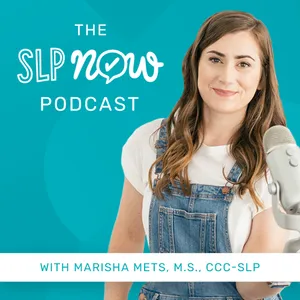
The SLP Now Podcast is your go-to resource for practical speech-language pathology tips. Through this podcast, you'll hear directly from Marisha Mets, a school-based SLP turned research nerd. She’ll be joined by expert guests to answer your biggest questions.
Latest Episodes
The most recent episodes — sign up to get AI-powered summaries of each one.
- 5 days ago16 min
Organizing Your Materials So Planning Actually Stays Simple
Show Notes: slpnow.com/276Planning gets so much easier when your materials have a home.In this episode, I share how I sort my therapy materials into two groups: core materials and unit materials. Core materials are the tools you use every session. That means goal cards, probes, and visuals. Set them up once, and most of your planning for the year is done. Unit materials are the activities tied to the book, article, or video you're using that month.I also share how I use student folders to tie it all together, plus my page number trick for the probe binder.Want the probe binder, visuals, and therapy plans ready to go? Start your free trial at slpnow.com/pod.
- 1 weeks ago8 min
How to Plan a Month of Therapy in One Sitting
Show Notes: slpnow.com/275You can plan a whole month of therapy in just a few clicks.In this episode, I walk you through what my monthly planning routine looks like inside SLP Now.You'll hear how the Therapy Plan Assistant suggests caseload segments and the top three units for each one. Every unit is already analyzed for common targets, with activities linked to each step of the literacy-based therapy framework.I also share why the best planning happens inside your sessions, and how one quick note helps your future self pick up right where you left off.Want to try it? Start your free trial at slpnow.com/pod.
- 2 weeks ago8 min
How to Segment Your Caseload and Plan in a Fraction of the Time
Show Notes: slpnow.com/274Planning for every student or every group can eat up your whole week. In this episode, I walk through the caseload segmentation strategy. You split your caseload into a few segments, and each segment gets one unit. You plan it once and use it with every group in that segment for the whole month.I share what this looks like for a preschool through 5th grade caseload and for a 6th through 12th grade caseload. We also talk about how to keep your segments flexible and why using the same text across groups makes your clinical thinking sharper.
- 3 weeks ago7 min
Why Therapy Planning Takes So Long (It's Not a You Problem)
Show Notes: slpnow.com/273Therapy planning can take over nights and weekends when every session starts from scratch. In this episode, Marisha explains how large caseloads, session by session planning, and missing systems can lead to inconsistent sessions, decision fatigue, and reactive therapy.She shares a better approach: plan by units that cover a full month. For most SLPs, three to four units can cover an entire caseload, while a streamlined data system and the right teaching tools make it easier to individualize instruction and bring your clinical magic into the mix. Sign up for a free trial of SLP Now at slpnow.com/pod!
- Oct 6, 20267 min
Making It Work With Expository Text (for Upper Elementary + Secondary)
Show Notes: slpnow.com/272 How do I make literacy-based therapy work with expository text for older students? In this episode, I walk through the simple swaps I make to keep the framework relevant for upper elementary and secondary students.I share how I adapt the five steps of Dr. Ukrainetz's framework, and how I use structure-matched graphic organizers to help students organize what they read. We also talk about repurposing the text through newscasts, debates, and other age-appropriate activities, plus how clinical judgment helps us choose the best fit for each group.Sign up for a free trial of SLP Now at slpnow.com/pod!
- Sep 29, 20266 min
Using One Book to Target Every Goal in Your Group
Show Notes: slpnow.com/271In this episode, I break down how I use one book or article to target every goal in a mixed group. Every activity in a literacy-based therapy framework is language-rich, so I do not need a different activity for every student. One activity can work for everyone.I walk through a real example of using WH question cards to target articulation, past tense verbs, and categories in the same session. I also share how I choose texts for different age bands so therapy planning feels simpler and more sustainable.Sign up for a free trial of SLP Now at slpnow.com/pod!
- Sep 22, 202618 min
The 5-Step Literacy-Based Therapy Framework, Step by Step
Show Notes: slpnow.com/270What does literacy-based therapy actually look like in a real session? In this episode, I walk through Dr. Ukrainetz's five-step framework and share how I use it across about a month of therapy. We cover Pre-Story Knowledge Activation, Shared Reading, Post-Story Comprehension, Focused Skill Activities, and the Parallel Story. I also share a real example from my work with sixth graders and explain why background knowledge can make or break comprehension. If you want a simple, practical way to plan mixed groups, this framework can help you work smarter, not harder.Sign up for a free trial of SLP Now at slpnow.com/pod!
- Sep 15, 20268 min
What Literacy-Based Therapy Actually Is (and Why It Works)
Show Notes: slpnow.com/269In this episode, I break down what literacy-based therapy actually is. I share how I use one text, like a picture book, article, or reading passage, to anchor a full unit of therapy. That gives students meaningful, language-rich practice instead of isolated drills.I also talk about why this approach works. We look at Dr. Ukrainetz's framework, repeated exposure, background knowledge, and one study showing stronger gains in comprehension and story retell with contextualized intervention. I also share how this helped me plan for a triple-digit caseload while still individualizing sessions.Resources mentioned:Dr. Ukrainetz's literacy-based therapy frameworkGillam, Gillam, and Reese (2012)Sign up for a free trial of SLP Now at slpnow.com/pod
Get The SLP Now Podcast summaries in your inbox
Free AI-powered daily recaps. Key takeaways, quotes, and mentions — in a 5-minute read.
Get Free Summaries →Free forever for up to 3 podcasts. No credit card required.
You Might Also Like
Listeners also like.

The Middle School Mary Poppins Podcast
Practical strategies for supporting kids ages 10–15 through the challenges of early adolescence.
Therapist Uncensored Podcast
Explores mental health and secure relationships through science-backed insights, clinical expertise, and neuroscience.

Speaking of Psychology
Explores recent psychological research and its applications to daily life.

The Middle School Mary Poppins Podcast
An educator and social worker discusses middle schoolers' emotional and social development to support students, parents, and teachers.

Studio 5
Conversations with experts and friends aimed at improving home life, relationships, and personal well-being.

Parenting With Psychology
A clinical psychologist offers practical parenting advice based on psychological research to help families manage challenges and strengthen relationships.
Swimming Ideas Podast
Practical tips and interviews for swimming instructors and aquatic professionals to improve swim programs and teaching methods.

Nursing School Week by Week
A nursing student shares weekly tips on studying, passing exams, mastering clinicals, and landing a first nursing job.
Stanford Psychology Podcast
Students interview psychologists about recent research and its real-world applications.
Care and Feeding | Slate's parenting show
Parents discuss real-life challenges and solutions for raising children from toddlers through teens.
Psychiatry & Psychotherapy Podcast
Explores psychiatry and psychotherapy through interviews with experts, trainees, and individuals sharing lived mental health experiences.

Mind If We Talk?
Two people share raw, intimate conversations about emotional struggles while a therapist guides understanding and growth.
About The SLP Now Podcast
The SLP Now Podcast is your go-to resource for practical speech-language pathology tips. Through this podcast, you'll hear directly from Marisha Mets, a school-based SLP turned research nerd. She’ll be joined by expert guests to answer your biggest questions.
Customized Recaps
AI-powered recaps with compact key takeaways, quotes, and insights.
Straight to Your Inbox
Get key takeaways from The SLP Now Podcast in a 5-minute read.
Save Hours Every Week
Stay current on your favorite podcasts without falling behind.
Frequently Asked Questions
What is Podzilla's The SLP Now Podcast daily summary?
It's a free AI-powered email that summarizes new episodes of The SLP Now Podcast as soon as they're published. You get the key takeaways, notable quotes, and links & mentions — all in a quick read.
How does the The SLP Now Podcast podcast summary work?
When a new episode drops, our AI transcribes and analyzes it, then generates a personalized summary tailored to your interests and profession. It's delivered to your inbox every morning.
Is this an official The SLP Now Podcast product?
No. Podzilla is an independent service that summarizes publicly available podcast content. We're not affiliated with or endorsed by SLP Now.
Can I get summaries of other podcasts too?
Absolutely! The free plan covers up to 3 podcasts, any in the catalog. Basic raises that to 15, Pro to 40 and Max to 100. Browse our full catalog at /podcasts.
How often does The SLP Now Podcast release new episodes?
The SLP Now Podcast publishes weekly. Our AI generates a summary within hours of each new episode.
What topics does The SLP Now Podcast cover?
The SLP Now Podcast covers topics including Education, Courses. Our AI identifies the specific themes in each episode and highlights what matters most to you.
Start getting The SLP Now Podcast summaries tomorrow morning.
Free forever for up to 3 podcasts. No credit card required.
Free forever for up to 3 podcasts. No credit card required.