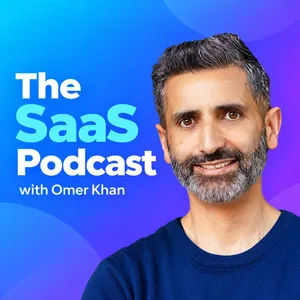
Free Daily Podcast Summary
The SaaS Podcast: How B2B SaaS & AI Founders Get Customers: Daily Summaries Delivered
by Omer Khan
Building software got easier. Getting customers didn't. Every week, a founder building B2B SaaS or an AI product tells you how they got their first customers, and how they kept them: what worked, what didn't, and what they'd do differently.You'll hear how founders find a channel that works, price their product, sell without a sales team, and stop churn. That includes founders building AI startups and AI agents.Host Omer Khan has interviewed almost 500 founders since 2014, including Calendly's Tope Awotona and Fyxer's Richard Hollingsworth. The SaaS Podcast is part of SaaS Club, which helps early-stage B2B SaaS and AI founders go from first customers to 7 figures, through the podcast, a weekly newsletter and coaching.New episodes every week.
Latest Episodes
The most recent episodes — sign up to get AI-powered summaries of each one.
- 4 days ago50 min
SaaS Marketing Without Ads: Word of Mouth to $10M ARR
Render spent nothing on paid marketing on its way to $10M ARR. Anurag Goel grew it on word of mouth, even after launching with no free tier, one of the most expensive mistakes he made. Now chatbots and coding agents recommend Render, and signups have gone from 5,000 a month to almost 500,000. Anurag explains what drove Render's word of mouth, why a credit-card trial kept developers away, and how Render raised prices with team seat fees that customers didn't like but paid. He also shares how to get LLMs to recommend your product, and why products that AI agents can operate convert better. Plus: the internal coding agent at SaaStr that picked Render over Vercel, and why Anurag says that if you can do one thing, it should be marketing to LLMs. Anurag was one of the first engineers at Stripe. He built the first version of Render on his own over the 2017 holidays, launched it at TechCrunch Disrupt in 2019 with a team of four, and took it to $10M ARR in roughly four years. 🔑 Key Lessons Word of mouth needs a product worth telling people about: Render spent $0 on paid marketing on its way to $10M ARR. Developers told other developers because Render was easy to use and kept getting better. Ask what stops people trying your product: Render's weeklong trial needed a credit card, and many developers wouldn't hand one to an unknown company. A free tier removed that hesitation, and signups climbed fast. Design a free tier you can afford: Anurag waited until Render could offer a free tier without draining the bank. It stayed a reasonable share of revenue and shrank as a percentage over time. If you're thinking about raising prices, you probably should: Render added team seat fees to bring margins up to industry levels. Customers said they weren't happy but would pay, and they did. Get five users before anything else: Anurag believes any founder can get five users in their ICP to try a product. If you can't, the problem is the product, so change it first. Market to LLMs first: Anurag tells early-stage founders that getting LLMs to recommend you is the one marketing job that matters. Make your pricing and features pages easy for agents to read. Make your product operable by agents: Render's signups through MCP OAuth convert four to five times better than other channels. An agent that can't operate your product will pick one it can. Chapters What Render does From Stripe to Render Founder-market fit and selling Crestle through a tweet Starting with one Python web service Arm-twisting the first 10 users Launching at TechCrunch Disrupt with a team of four Why anyone can get five users Building billing months after the first users The $7 price point Launching without a free tier The free tier and Heroku's exit From 5,000 to almost 500,000 signups a month The margin problem and team seat fees How to think about raising prices $10M ARR with $0 paid marketing What drove Render's word of mouth Marketing to LLMs Making Render operable by agents Lightning round Resources Full show notes: https://saasclub.io/501 Join 5,000+ SaaS founders: https://saasclub.io/email
- 1 weeks ago55 min
Enterprise Sales Without Salespeople: How a SaaS Hit $10M
A Fortune 100 retailer put out an RFP for an ad server and didn't like any of the answers. Then they found AdButler online. Rajiv Khaneja had never sold to an enterprise, and AdButler had 12 people. He showed up at the retailer with a laptop and a demo, and signed his first Fortune 100 customer. Rajiv explains how AdButler sells enterprise deals with no salespeople: inbound leads from a contact form, product-led demos, missing features built in weeks, and month-to-month contracts instead of lock-in. He also shares the pricing mistake he made for 15 years. Plus: why he thinks AI will kill the settings page and give every customer their own version of your software. Rajiv started AdButler as a teenager after DoubleClick hung up on him. It ran as a side project for a decade, with plans from $9.95 a month, before he went all in and built it into a $10M SaaS. 🔑 Key Lessons Let the demo be your sales process: AdButler has no salespeople. Product people show the software screen by screen, and Rajiv watches the room to see what excites buyers. That demo won the retailer and AdButler's next enterprise deals. Answer the gap before the buyer asks: At the end of every demo, AdButler shows how it will fill whatever is missing. Promising three weeks against a competitor's six months, then shipping in two, won long-term enterprise contracts. Price on value, not on your costs: For 15 years, Rajiv charged a multiple of what it cost to serve an ad. His first enterprise deal was many orders of magnitude bigger than his SMB plans. Don't lock customers in with contracts: AdButler offers enterprise clients month-to-month terms and signs longer ones only when asked. If a contract is the only thing keeping a customer, Rajiv says you've already lost them. Put an enterprise door on your website: After that first deal, AdButler added an enterprise tier with a contact form. Its first 10 enterprise customers all came through inbound leads, with no outbound sales team at all. Split features into one-person pieces: AdButler breaks every big feature into the smallest units one engineer can ship alone, like single API endpoints. Fewer people syncing means fewer meetings and much faster custom builds. Treat AI like the tractor next door: Rajiv tells his team the farmer with a tractor sells carrots cheaper than the one with an ox. Founders who won't adopt AI will get priced out the same way. Chapters What AdButler does and the size of the business How AdButler differs from Google Ad Manager A polls website and the call to DoubleClick at 14 Building his own ad server Close to seven figures before finishing high school Turning down a $2.5 million acquisition offer The dot-com crash and the pivot to paid software 10 years as a side project at $9.95 a month Going all in on AdButler A Fortune 100 retailer's email and the 29-tab RFP A laptop demo for a room of 25 Enterprise customers 2 through 10 Building custom features in weeks, not months Why AdButler offers month-to-month contracts Shared Slack channels and one-engineer features Why AI makes configurable software obsolete Lightning round Resources Full show notes: https://saasclub.io/500 Join 5,000+ SaaS founders: https://saasclub.io/email
- 2 weeks ago56 min
Selling an AI SaaS Platform After 200 Buyers Called It Crazy
He asked buyers to rip out their whole Salesforce stack. The first 200 to 300 called him crazy. David Zhu, co-founder and CEO of Reevo, built an all-in-one AI sales platform and learned the hard way how to sell it. He kept the platform and changed the ask: buyers start with one piece, like the dialer, the sequencer or the AI-native CRM. David explains why Reevo spent two years in stealth before selling, how a founder he met at an AWS program became the first paying customer before seeing the product, and how Reevo got to $1M ARR in 6 months while an introvert ran founder-led sales. He also shares the Mom Test mistake he made early on. Plus: why the startups that happily adopted his whole platform turned out to be false validation. David ran engineering teams at DoorDash and worked with Keith Rabois at OpenStore before founding Reevo, his fifth startup, with a founding team of 14. Reevo now serves hundreds of customers without paid marketing. 🔑 Key Lessons Be strict on architecture, flexible on the sale: Reevo kept its all-in-one platform but stopped demanding rip-and-replace. Letting a buyer start with one tool asks for a much smaller first yes than throwing out Salesforce. Give buyers three doors, not the whole menu: Reevo groups its land motions into pipeline generation, deal progression and manager reporting. Prospects pick their biggest pain instead of facing every module and integration at once. Watch out for false validation: Startups with no RevOps leader or security review adopted Reevo's whole platform easily. That said little about the entrenched mid-market buyers Reevo actually wanted to win. Play to your strength, not someone else's game: David had no sales brand, so he built on what he did have, a dense engineering team. Copying founders who have distribution you lack is how you lose. Open the deal, then hand off the close: David, an introvert, sent the first email and ran the intro call. A founding sales leader from HubSpot closed, and Reevo copied his talk tracks across 12 to 15 AEs. Ask for payment to test your discovery: Early prospects praised David's pitch, then said no when he asked them to pay. The Mom Test's non-leading questions get you to the honest answer sooner. Don't outsource ICP discovery: Paying a vendor $50,000 to run your outbound skips the learning. David says founders without product-market fit have to do discovery themselves or risk a false start. Chapters What Reevo does and who it's for Founding team of 14 and the size of the business From DoorDash and OpenStore to the idea for Reevo Why Reevo built in stealth for two years The first paying customer from an AWS program The Mom Test mistake and winning without a sales brand Founder-led sales as an introvert Platform vs point solution 200 buyers called the rip-and-replace pitch crazy Selling the platform one piece at a time Why startup customers were false validation Three land motions instead of an a la carte menu Vibe coding, outsourced SDRs and enterprise bake-offs Lightning round Resources Full show notes: https://saasclub.io/499 Join 5,000+ SaaS founders: https://saasclub.io/email
- 3 weeks ago53 min
ChatGPT Should Have Killed His AI SaaS. Instead, He's Nearing $10M
ChatGPT turned his product into a commodity at close to $1M ARR. Alon Talmor rebuilt Ask-AI into Mosaic AI, an AI platform for technical support, by narrowing into a market rivals called too hard and selling measurable cost reduction instead of features. The company is now at multiple seven figures in ARR, approaching eight. Alon breaks down how six months of listening to enterprises produced the product idea, how he closed a $6.5M seed after his co-founder quit in the middle of the round, and how 5-day pilots built on technical support automation turn skeptical enterprise buyers into six-figure customers. Plus: why he believes the next phase of enterprise AI is agents orchestrating people, not people orchestrating agents. Alon sold his first startup, BlueTail, to Salesforce, went back for a PhD in AI and question answering, and founded Ask-AI in 2021, a full year before ChatGPT. Today Mosaic AI serves about 100 enterprise customers, with go-to-market in Toronto and R&D in Tel Aviv. 🔑 Key Lessons Find a blue pond, not a blue ocean: When funded giants crowd your market, narrow into a segment they cannot serve well. Mosaic left enterprise assistants to own technical support and grew past seven figures. Talk to customers six months before investors: Alon pitched no VCs until enterprises had told him their problem. Yotpo's knowledge chaos became the product, and the seed closed on that proof. Tell investors bad news before they find it: His co-founder quit mid-raise; he disclosed it immediately and still closed $6.5M. Prettifying reality reads as mistrust, and investors sense it every time. Sell the cost reduction, not the feature list: Support is a cost center with a known price tag. Mosaic pitches 50-70% savings on a seven-figure budget instead of arguing about features. Pick the metric your buyer cannot argue with: Tickets per engineer per day survived scrutiny where time-to-resolution failed. One customer measured an 80% lift in a week of the pilot. Treat build vs buy as your real competitor: With AI coding cheap, enterprises default to building. Win by showing the end state their side project becomes obsolete against, not a feature comparison. Chapters What Mosaic AI does and who it's for The real cost of technical support BlueTail, Salesforce and the PhD detour Founding Ask-AI a year before ChatGPT Losing a co-founder in the middle of the seed round Radical honesty with investors Six months of listening before pitching VCs Yotpo and the design partner playbook Founder-led sales to the first 25 customers ChatGPT turns the product into a commodity Agents orchestrating people Finding the blue pond: technical support Build vs buy: the number one competitor The 5-day pilot and the metric that closes deals Lightning round Resources Full show notes: https://saasclub.io/498 Join 5,000+ SaaS founders: https://saasclub.io/email
- Oct 1, 202652 min
Founder-Led Sales: He Learned to Sell SaaS and Closed 50 Customers
He walked into his first pricing call asking for $100,000 and walked out with $10,000 a year. Shahar Azulay had never sold anything before co-founding groundcover, and the product he was selling had no user interface yet, just a sensor and some dashboards. He took it anyway, and still argues that was the right call. Shahar explains why founders should close their first dozen customers at almost any price, how he published a per-host list price and then discounted it up to 70 percent, and how his first 50 to 100 customers came from his own network plus 10 to 15 LinkedIn messages a day. Plus: the moment customers started ripping Datadog out on their own, before groundcover had built anything to help them do it. Shahar Azulay is the co-founder and CEO of groundcover, an eBPF observability platform that lets engineering teams monitor production without changing their code. He has grown it to eight-figure ARR with more than 250 customers, competing head-on with Datadog and New Relic. 🔑 Key Lessons Close your first dozen deals at any price: Early contract value teaches you nothing. The reps, the reference logos, and learning to survive security and legal reviews are what make the next twenty deals closeable. Publish your price when you sell to mid-market: A public number per host anchors the conversation and skips a negotiation a first-time founder will lose. groundcover listed $30 per host, then discounted up to 70 percent. Don't expect to grow your earliest accounts: Shahar never planned to 10x those first contracts. Chasing them traps you in old relationships when the rest of the market is still unsold and will pay more. Your first sales calls are really feedback calls: Prospects treat a founder as someone to advise, not buy from. Shahar framed early meetings as "we'd love to show you what we're building" and converted from there. Selling the deal is not replacing the incumbent: groundcover closed customers who still kept Datadog running. The post-sale migration motion only got built after those early displacement attempts visibly failed. A remote first hire with no local team will fail: The first SDR in North America was hired alone, remote, under marketing, with no one around him. Shahar calls it a failure of gravity, not of the person. Bet on the technology your team can already build: eBPF worked for groundcover because the founders came from cybersecurity and knew how to ship a safe kernel agent. Incumbents selling SDKs still struggle to copy it. Chapters Introduction What groundcover does and who buys it Why observability pricing stopped making sense Bring your own cloud and charging per host From Apple and cybersecurity to founding groundcover Discovering eBPF and betting the company on it Why no other observability vendor was using eBPF The first customer, three months in Asking $100K and closing at $10K Why founders should close at any price Publishing list pricing and discounting 70% Being the entire sales function Prospecting on LinkedIn, 10 to 15 a day Getting out of the friend zone on sales calls Hiring the first AEs, SDRs and sales engineers When customers decided it could replace Datadog Failing to rip out the incumbent Learning when you have no leverage Lightning round Resources Full show notes: https://saasclub.io/497 Join 5,000+ SaaS founders: https://saasclub.io/email
- Sep 24, 202642 min
Bootstrapping a SaaS From a $500K Goal to a $50M Company
He closed most of the deals himself. It took him ten years to stop. Ross Andrew Paquette bootstrapped Maropost to around $50 million in ARR, and for most of that run he was the discovery call, the demo and the follow-up. It worked well enough to take the business from $300,000 to $27 million in 28 months with six or seven people. Then the thing that built the company became the thing capping it. Ross breaks down how he won accounts paying $10,000 a month on a five-minute response time rather than features, how two people signed brands like Rolling Stone and Mercedes off a conference floor, and why seven or eight experienced sales leaders all failed at Maropost before he changed what he hired for. Plus: why he took investor money he did not need, and what it felt like to write a $37 million check three years later to buy it back. Ross Andrew Paquette is the founder and CEO of Maropost, a commerce and marketing platform with roughly 300 people and 5,000 customers. He started it in 2011 out of his apartment while still selling Oracle ERP software full time, planning on ten customers and a quieter life. 🔑 Key Lessons 🤝 Win on service before you can win on product: Ross offered 24-hour live chat and a five-minute reply when Maropost had ten or fifteen customers, and landed accounts paying $10,000 a month without the deepest feature set. 🎯 Sell to people who already trust you: Three or four customers from Ross's previous jobs signed almost immediately, which is why Maropost had real revenue before it had a finished product or any marketing spend. ⚡ Founder demos beat decks: Ross ran simple discovery then a personalized demo with no slides, and credits his edge to having designed the features himself rather than to any sales methodology. 🚀 Concentrate spend where your buyers already are: Buying top-tier sponsorships at a handful of conferences let two people sign brands like Rolling Stone and Mercedes off the floor, helping take Maropost from $300,000 to $27 million. 🧠 Hire for tenacity, not logos: Seven or eight sales leaders with strong resumes failed at Maropost because their experience came from different engines, price points and company sizes that did not transfer. 💰 Capital you do not need still costs you: The 2016 secondary brought expectations rather than money Maropost required, and growth fell from around 400 percent to 6 to 10 percent before Ross bought the investors out. 📉 Getting out of founder-led sales takes longer than you think: Ross spent about ten years moving from what he called "Ross and Co" to an actual organization, and says it was the hardest part of building the company. Chapters What Maropost does and who it serves The ten-customer lifestyle plan Getting the first customers from old relationships The developer who kept disappearing His mother's advice and the oDesk hire Charging $10,000 a month with a small product Why most founders cannot sell From $300K to $27M in 28 months Why seven or eight sales leaders failed Writing the $37 million check Resources Full show notes: https://saasclub.io/496 Join 5,000+ SaaS founders: https://saasclub.io/email
- Sep 17, 202638 min
Inbound Marketing That Grew a Fintech SaaS to $100M
He never bought a keyword, never ran content marketing, and the big outbound sales force he tried did not work. Rodney Robinson still grew TabaPay to $100 million in revenue, almost entirely through inbound, on a single $2.5 million seed round that stayed the company's only outside money for nine years. Rodney explains how he found a problem Mastercard could not solve, why he chased small fintechs instead of big logos, how his inbound marketing came from banks and the card networks rather than ads, and why he believes outbound sales no longer works in B2B. Plus: the six-month lawsuit that cost TabaPay its sponsor bank, and what Rodney had personally put on the line to get that bank in the first place. TabaPay is payment processing infrastructure that gives fintechs one API to move money instantly in both directions, and processes payments for companies like Dave. The company runs at $100 million in revenue with about 150 people, profitable, growing 35 to 40 percent a year. On the day this interview was recorded, Rodney announced a $155 million raise and the acquisition of a bank. 🔑 Key Lessons Build what the incumbent is forbidden to build: Mastercard would not add pull payments because it would compete with its biggest processors. That structural refusal, not a missed feature, was the opening TabaPay walked through. Make the trusted party your sales channel: Fintechs do not know a new processor, but they trust their bank and Visa. TabaPay processes for about 20 banks and lets those relationships generate its inbound pipeline. Solve revenue before expense: Rodney paid vendors above market to reach the market in a year, charged what it would bear, then displaced the vendors later. Getting to revenue outranked protecting early margin. Chase minnows, not whales: The first ten customers were small fintechs where the founders already knew each other. Those minnows grew into whales, and the relationship carried through the growth. Reliability is the product for infrastructure: Three vendors at 99 percent availability leaves you down about 3 percent of the time. Customers bet their business on payments working, so TabaPay took the stack in house. Expect arrows in year one: Six months in, another company claimed TabaPay stole its software and the sponsor bank dropped them. They won, but only because there was nothing to find. Chapters What TabaPay does $100M in revenue with 150 people The $2.5M round that lasted nine years Raising $155M and buying a bank The problem Mastercard would not solve Finding the wedge by listening How the money actually moves A year to build the first version Solving revenue before expense Pledging his house for a sponsor bank Landing the first ten customers Chasing minnows instead of whales When vendors go down Owning the stack end to end Channels that wasted time Why outbound sales is dead in B2B Building the inbound engine Pricing against commoditization Fraud data as a value-add The lawsuit that cost them their bank Making every customer feel like the biggest Why buy a bank Lightning round Resources Full show notes: https://saasclub.io/495 Join 5,000+ SaaS founders: https://saasclub.io/email
- Sep 10, 202645 min
Founder-Led Sales: A SaaS to $1 Million ARR With Just 10 Customers
He needed a big retailer's data to build the product. No big retailer gives data to a company with no product. Felix Hoffmann solved it sideways: 7Learnings sold a paid consulting project, kept the right to use the data, and built its predictive pricing product on top of it. Ten customers later it was at $1M ARR, and he had closed every one himself.Felix explains why a demand forecasting product cannot start with a small customer, how he structured the first pilot as an A/B test so a retailer could hand over half its prices without betting the business, and what happened when the first run came back far too expensive.Plus: how a pricing optimization company prices itself, and why he refuses success-based fees even though he can prove the uplift.7Learnings is a Berlin company whose software forecasts demand for each product at each price, then sets the price that hits a retailer's goal. It is now at multiple seven figures in ARR with around 40 customers. Felix spent six years as a pricing consultant at Kearney and two years running price optimization at Zalando before founding it.This episode is brought to you by:🤖 Hobbes → Don't book a demo. Take one.🔑 Key Lessons🎯 Solve the data cold start by selling something else first: 7Learnings could not train a forecasting model without a large retailer's sales history, so it sold a paid consulting project and kept the right to use that dataset.🤝 Shrink a scary ask into a reversible test: Retailers would not hand pricing to an algorithm outright, so 7Learnings ran an A/B test on half the assortment while the retailer's own team priced the rest.📉 Pick an early customer who can survive a failure: The first live pricing run was badly wrong on high-priced products. It survived because the buyer had a big enough problem, no alternative, and understood they were working with a startup.💰 Price high enough to lose some deals: His test is blunt. If nobody is walking away because you are too expensive, you are too cheap, especially for a complex product carrying real delivery cost.🚀 Founder-led sales lasts longer than founders expect: Felix closed all ten customers behind the first $1M ARR himself, and stayed closely involved through the next forty, because handing off enterprise sales is genuinely hard.⚡ Pick the technology after the problem, not before: Felix argues founders are all digging in the same technical space, and that decisions needing determinism, low cost and explainability should not be handed to an LLM.ChaptersWhere the idea came from: Kearney, then ZalandoThe hardest part was finding co-foundersThe consulting project that funded the productFinding the first paying customerStructuring the first deal as an A/B testThe first upload was a disasterHow a pricing company prices itselfTen customers to $1M ARRThe price matching objectionWhy LLMs don't belong in the pricing decisionResourcesFull show notes: https://saasclub.io/494Join 5,000+ SaaS founders: https://saasclub.io/email
Get The SaaS Podcast: How B2B SaaS & AI Founders Get Customers summaries in your inbox
Free AI-powered daily recaps. Key takeaways, quotes, and mentions — in a 5-minute read.
Get Free Summaries →Free forever for up to 3 podcasts. No credit card required.
You Might Also Like
Listeners also like.

The Official SaaStr Podcast: SaaS | Founders | Investors
Interviews with top SaaS founders and investors on scaling from $0 to $100M ARR, hiring, and the metrics that drive growth and investment.

Right About Now - Legendary Business Advice
Raw business insights from founders and industry leaders, revealing real wins, failures, and actionable strategies without the fluff.

The AI in Business Podcast
Interviews with AI executives reveal practical applications and strategic insights for business leaders adopting AI.

Founder's Story
Raw conversations with entrepreneurs about the struggles, doubts, and pivotal moments behind their ventures.
The Koerner Office - Business Ideas and Deep Dives with Chris Koerner
A serial entrepreneur shares practical business growth tips, side hustle ideas, and deep dives on startups, AI tools, and mobile home park investing.
Lenny's Podcast: Product | Career | Growth
Conversations with top product and growth leaders offering practical strategies for building, launching, and scaling successful products.

What Comes Next with Arun
Explores how data and AI strategy create competitive advantage in business, based on real-world enterprise experience.

The Vault Unlocked
Founders share hard-earned lessons on what actually worked, what failed, and the pivotal decisions behind growing successful companies.

The Room Podcast
Tech founders and funders share behind-the-scenes stories from pivotal moments in their careers.

Silicon Valley Girl: AI, Tech and Career Growth
Marina Mogilko interviews tech leaders and AI founders about career growth, entrepreneurship, and navigating the AI revolution.

Y Combinator Startup Podcast
Founders and Y Combinator partners discuss building startups, from idea to scale, sharing real-world lessons and strategies.
Consulting Success Podcast
Strategies for building a profitable, scalable consulting business, from client acquisition to team management and marketing that works.
About The SaaS Podcast: How B2B SaaS & AI Founders Get Customers
Building software got easier. Getting customers didn't. Every week, a founder building B2B SaaS or an AI product tells you how they got their first customers, and how they kept them: what worked, what didn't, and what they'd do differently.You'll hear how founders find a channel that works, price their product, sell without a sales team, and stop churn. That includes founders building AI startups and AI agents.Host Omer Khan has interviewed almost 500 founders since 2014, including Calendly's Tope Awotona and Fyxer's Richard Hollingsworth. The SaaS Podcast is part of SaaS Club, which helps early-stage B2B SaaS and AI founders go from first customers to 7 figures, through the podcast, a weekly newsletter and coaching.New episodes every week.
Customized Recaps
AI-powered recaps with compact key takeaways, quotes, and insights.
Straight to Your Inbox
Get key takeaways from The SaaS Podcast: How B2B SaaS & AI Founders Get Customers in a 5-minute read.
Save Hours Every Week
Stay current on your favorite podcasts without falling behind.
Frequently Asked Questions
What is Podzilla's The SaaS Podcast: How B2B SaaS & AI Founders Get Customers daily summary?
It's a free AI-powered email that summarizes new episodes of The SaaS Podcast: How B2B SaaS & AI Founders Get Customers as soon as they're published. You get the key takeaways, notable quotes, and links & mentions — all in a quick read.
How does the The SaaS Podcast: How B2B SaaS & AI Founders Get Customers podcast summary work?
When a new episode drops, our AI transcribes and analyzes it, then generates a personalized summary tailored to your interests and profession. It's delivered to your inbox every morning.
Is this an official The SaaS Podcast: How B2B SaaS & AI Founders Get Customers product?
No. Podzilla is an independent service that summarizes publicly available podcast content. We're not affiliated with or endorsed by Omer Khan.
Can I get summaries of other podcasts too?
Absolutely! The free plan covers up to 3 podcasts, any in the catalog. Basic raises that to 15, Pro to 40 and Max to 100. Browse our full catalog at /podcasts.
What topics does The SaaS Podcast: How B2B SaaS & AI Founders Get Customers cover?
The SaaS Podcast: How B2B SaaS & AI Founders Get Customers covers topics including Technology, Business, Entrepreneurship. Our AI identifies the specific themes in each episode and highlights what matters most to you.
Start getting The SaaS Podcast: How B2B SaaS & AI Founders Get Customers summaries tomorrow morning.
Free forever for up to 3 podcasts. No credit card required.
Free forever for up to 3 podcasts. No credit card required.