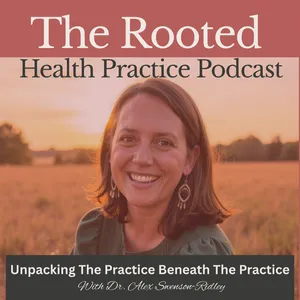
Free Daily Podcast Summary
The Rooted DC- Reclaim Your Legitimacy: Daily Summaries Delivered
by Dr. Alexandra Swenson-Ridley
You became a chiropractor because you believed in something. But somewhere between the skeptics, the insurance battles, and the business advice that never quite fit — you started to lose connection to the dream that brought you here. The Rooted DC is a podcast for chiropractors who are done trying to fit inside a system that was never designed for them. Hosted by Dr. Alex Swenson — fellow DC, PhD researcher in organizational development and change, and someone who built a seven-figure practice, lost everything, and rebuilt it with an entirely new foundation — this is where we go beneath the surface and reclaim what was always ours: our identity, our worth, and our legitimacy as a profession.
Latest Episodes
The most recent episodes — sign up to get AI-powered summaries of each one.
- 2 days ago19 min
Reclaiming the Dream: How I Fell Back in Love with Chiropractic After Leaving for 3 Years
New Workshop Series Coming In January-Reconnect to Your Joy in Practice: Join the waitlist rootedpractice.co/joyThis episode maps a practical emotional recovery plan for chiropractors feeling disillusioned: acknowledge the grief, revisit the initial dream, and redesign practice to honor both community and practitioner. Dr. Alex describes the vision that inspired her to buy a large building — a wellness hub with a library, kid-friendly space, and healthy food — and why scale, timing, and physical limits forced a smaller, wiser iteration. She emphasizes that metrics matter but must be rooted in personal meaning. Listeners are encouraged to make space for hard feelings, redefine success from within, and take next steps toward a more sustainable, joy-filled practice.Join the waitlist for the new workshop series-rootedpractice.co/joyTake the Burnout Blindspot Quiz: rootedpractice.co/burnout-quiz
- 3 weeks ago23 min
S3E9 Checking the “Other” Box: Chiropractic Identity and Burnout
There was no box for us.On a survey from the National Board of Health and Wellness Coaches, every health profession had a checkbox except mine. I clicked “other,” typed in Doctor of Chiropractic, and couldn’t stop thinking about what that tiny moment says about where we stand as a profession.We survived a medical establishment that formed a committee to destroy us. We won Wilk v. AMA. And we still spend so much energy proving we belong inside a system that was never built for us.What is that costing us? I see it in the most common burnout pattern I come across in DCs: resignation. We give up, a little at a time, on the dream that brought us to chiropractic in the first place.This episode connects our profession’s collective history to the exhaustion so many of us carry in our own practices. It also asks a question only you can answer: why is chiropractic your vehicle?What you’ll hear in this episodeRecognize how the AMA’s legacy still shapes the way you explain, defend, and value your work, decades after Wilk v. AMASee the crossroads our profession faces: absorption into Western medicine, or defining standards of our ownSpot the “resigned practice owner” pattern in yourself, the slow surrender that passes for acceptanceUnderstand why the fight between “philosophy” chiropractors and “evidence-based” chiropractors grows from the same root of collective traumaUse the lens of organizations as psychic prisons to see our profession’s shadow side and where it shows up in your practiceReconnect with your own reason for choosing chiropractic, the root that can hold you steady when the system won’tResources mentionedBurnout Blind Spot Quiz: rootedpractice.co/burnout-quizAligned Authority workshop: https://rootedpractice.co/aligned-authorityThe Practice Beneath the Practice on Substack, including my article on Wilk v. AMA: https://practicebeneaththepractice.substack.com/Images of Organization by Gareth MorganReach out: dralex@rootedpractice.coChapter Summary[00:00] The Box That Wasn’t There A routine survey with no checkbox for chiropractors opens a bigger conversation. Dr. Alex looks at the profession in its ecological context and at the leftovers of a history that was built to erase us.[02:39] Absorbed or Distinct: How Professions Organize Drawing on her PhD studies, Dr. Alex explains how professions form around sameness, standards, and control over who belongs. She traces how the AMA built a monopoly and why chiropractic, born in an era open to spiritual approaches to healing, still sits on the outside.[05:38] We Won Wilk, Then Kept Asking Permission Winning the lawsuit should have changed everything. Instead, the profession kept trying to prove itself by medicine’s standards, while bias continues to show up in medical and PA education today.[08:46] A Career Interview With My Son, and the Resigned Practice Owner When her 13-year-old asks what it’s really like to be a chiropractor, Dr. Alex gives an honest answer that surprises even her. That leads to the most common archetype in her burnout quiz, the resigned practice owner, and a parallel she sees in Indigenous communities trying to hold onto their values inside Western systems.[13:23] Two Reactions, One Wound A social media post about D.D. Palmer’s mystic roots draws two predictable camps, and Dr. Alex shows how both come from the same collective trauma. She makes the case for defining legitimacy through the people we serve, shares her own story of healing through chiropractic, and challenges a research model that leaves out the art of what we do.[16:28] The Practice Beneath the Practice Under every frustration in practice sits a deeper layer: your identity, your values, your strengths. Dr. Alex asks each listener to get clear on why chiropractic, out of every path to healing, is the one they chose.[17:53] Our Profession’s Shadow Using Gareth Morgan’s metaphor of organizations as psychic prisons, Dr. Alex looks at the collective shadow shaping our profession’s decisions and our personal fulfillment. She closes with her own three years away, why she came back, and where to start this deeper work.
- Sep 24, 202625 min
S3E8 Reclaiming Our Spine: Identity, Worth, and Chiropractic’s Future
This episode unpacks the identity crisis many chiropractors face: feeling squeezed between Western medicine’s expectations and the original chiropractic philosophy. Dr. Alex draws parallels between Indigenous cultural revitalization and chiropractic’s need to reclaim its unique voice—rather than trying to mimic medicine for legitimacy. She explores how bureaucracy, insurance systems, and professional politics erode practitioner worth, creating burnout and disillusionment. Listeners are invited to consider reciprocity—how the profession gives back—and to experiment with new ways of practicing that honor core values. The episode closes with an open invitation to connect, reflect, and generate more creative, coherent choices for practice.To connect with Dr. Alex find her on social media or send an email to dralex@rootedpractice.co. You won't end up on an email list and she won't try to sell you anything.
- Sep 10, 202624 min
S3E7- Stop Fitting In: Build the Practice and Life You Actually Want
Dr. Alex digs into a core problem many chiropractors face: a fractured professional identity built reactively in response to critics, insurance systems, and contextually charged and confusing (but not lacking merit) language like “subluxation.” Using personal stories—from her son’s toe injury to building and losing a clinic—she contrasts reactive identity (shaped by outside pressure and fear) with generative identity (built from internal values and clear boundaries). She challenges listeners to stop borrowing legitimacy and instead design practices and lives from the inside out. The episode closes with a practical challenge: identify where you’re reactive versus generative and start choosing who you want to be.Referenced in this episode:Glucina, T. T., Krägeloh, C. U., Spencer, K., & Holt, K. (2023). Defining chiropractic professional identity: A concept analysis. Journal of Bodywork and Movement Therapies, 35, 75–83. https://doi.org/10.1016/j.jbmt.2023.04.047The Practice Beneath the Practice on SubstackLet's connect! dralex@rootedpractice.co
- Aug 27, 202621 min
S3 EP6 Why We Keep Chasing Western Validation (And What to Do)
This episode challenges chiropractors to let go of the need for external validation—particularly Western medicine’s version of ‘evidence’—and to reclaim their original purpose: supporting the body's ability to heal. Dr. Alex draws on her PhD work in the humanities and research methods to critique the gold-standard obsession, explain qualitative versus quantitative approaches, and highlight creative research avenues that align with chiropractic philosophy. She encourages practitioners to take responsibility, engage in research on their own terms, and consider what truly defines chiropractic value rather than trying to fit a square hole that may never accept them.
- Aug 11, 202631 min
S3E5-Unhooking Chiropractic: How to Shift Infighting to A Shared Vision for the Future
Dr. Alex explores why chiropractors often turn on each other—rooted in long-standing identity wounds, scarcity mindsets, and external skepticism. She connects personal stories (including a chaotic early-career job in Alaska) with current institutional stressors—school closures, accreditation shifts, and merger news—that threaten the profession. Drawing on her academic work in positive psychology, organizational change, and a qualitative study of women chiropractors, she argues we must move from reactivity to coherent, heart-centered action. She outlines practical steps for “unhooking,” fostering curiosity and compassion, and building a shared vision that can sustain chiropractic beyond crisis.
- Jul 24, 202625 min
S3E4 Why Practice Change Doesn't Stick: Going Below the Iceberg
We learned the iceberg in chiropractic school as a way to picture the nervous system: symptoms above the surface, root cause below. What most of us were never told is that the model didn't start there. It started in organizational change theory, and it maps almost exactly onto why our practices keep circling back to the same problems no matter how many times we try to fix them.In this solo episode, Dr. Alex traces that iceberg back to Otto Scharmer's Theory U and uses it to unpack three of her own practice pivots: the insurance contract that cost her half her income overnight, the $12,000 virtual offer that succeeded and still didn't fulfill her, and the current pull toward niching down to pediatric-only care that she keeps almost, but not quite, committing to.What you'll hear in this episode:Where the iceberg model actually came from, and why chiropractic school only ever taught the surface version of itHow an insurance audit in Alaska forced a change Dr. Alex had wanted to make for years, and why external crises are usually the only thing that moves usWhy a successful $12,000 virtual care package still left her repeating the exact burnout patterns she thought she'd escapedThe real reason so many chiropractors resist niching down, and why it's a worth conversation more than a marketing oneHow a coaching program that didn't fit her practice preempted her eventual bankruptcy, and what that reveals about outsourcing your own discernmentThe four layers beneath the surface of the iceberg, and which one actually has to move for change to stickConnect / Resources [Links to be added by user]CHAPTER SUMMARY1. The Iceberg Isn't Just a Chiropractic Metaphor Dr. Alex revisits the iceberg most of us met in school and reveals where it actually came from: Otto Scharmer's Theory U, a model built to explain how organizations change. She sets up the rest of the episode by asking what's really underneath our own practices.2. When the Insurance Company Made the Decision For Her She tells the story of contracting with Blue Cross Blue Shield in Alaska, the audit that erased more than half her income in a weekend, and the 90-day contract that wouldn't let her leave even after they stopped paying. It took that crisis to finally move her toward the cash-based model she'd wanted from day one.3. The $12,000 Package That Still Wasn't It After burnout forced her out of insurance, she built a successful virtual functional medicine offer and sold it well. But she packed her coaching days so tightly she didn't have time for the bathroom, the same pattern that had broken her body in the first place. Success didn't equal fulfillment.4. Niching Down and the Worth Conversation Underneath It She names why chiropractors resist serving one population: not a business problem, but a fear that saying no means the practice won't survive. She uses her own pull toward pediatric-only care, and the men who keep walking in anyway, as the live example.5. Why the Coaching Model Didn't Fit, and What That Cost She unpacks joining a three-year coaching contract that didn't match her own strengths or vision, and how trying to force her practice into someone else's model preempted the bankruptcy that came later.6. Four Layers Below the Surface She walks through the full iceberg: the reactive events we see and put out like fires, the repeating patterns and cycles underneath those events, the structures and rules that produce the patterns, and the unconscious beliefs at the foundation that actually have to shift for anything to change and hold.7. The Practice Beneath the Practice She closes with a challenge: notice one repeating pattern in your own practice this week, download the free iceberg graphic, and reach out with what's surfacing for you as she steps more fully into her emerging work as a change consultant for practice owners.
- Jul 9, 202624 min
S3E3 What It Actually Takes to Change a Profession From the Inside Out
A chiropractor I've never met posted on Facebook this week: she's done. Not looking for how to fall back in love with the profession — just how to leave it. Over two hundred comments later, it was clear she isn't alone. This episode is about what that post cracked open in me, and what I believe we actually have to do if we want our profession to stop losing good people to burnout.What you'll hear in this episode:Why a viral "leaving chiropractic" post told me more about our profession's missing vision than about one person's burnoutThe story behind my own license renewal battle, and the blunt advice from a colleague that's stuck with me since: "If you don't like it, join the board"What my chiropractic college's "global paradigm shift" mission taught me about the gap between the vision a profession preaches and the reality it practicesA model from organizational change theory for how two opposing sides of a profession actually merge into something newWhy acknowledging the current reality, without shame or spin, is the first real step toward changeThe limiting belief I'm actively dismantling in my own practice this week, and what it means to stop being the productConnect / Resources: dralex@rootedpractice.coCHAPTER SUMMARY[00:45] The Post That Started This Episode I read an anonymous "leaving chiropractic" post that drew over 200 comments — and most of them weren't advice. They were other practitioners quietly admitting they're barely surviving too. That's the moment this episode became necessary.[03:21] What This PhD I'm Working On Is Actually For I connect my organizational development research directly to our profession's crisis, and name the real problem underneath the burnout: we don't have a shared vision for where we're going.[05:36] The License Board and the Reprimand That Stuck A frustrating renewal battle with my state board leads to a comment from a colleague who'd served on the board herself — one that reframed how I think about complaining versus stepping in.[08:27] Funnel Cakes and the Global Paradigm Shift I tell the story of my chiropractic college's lofty mission colliding with vending machines and deep-fried candy bars on campus, and what that taught me about the cost of preaching a vision you're not living.[13:13] Two Things We're Missing: A Vision and the Courage to Face Our Current Reality I introduce a dialectical model of organizational change, where opposing sides eventually merge into something new, and name why our profession keeps avoiding the mirror instead.[17:28] Leading Yourself First I share the limiting belief I'm actively working through this week — "I have to show up to make money" — and what it's looked like to stop being the product in my own business.[21:09] What Comes Next I close with an invitation: acknowledge current reality without shame, take radical responsibility instead of blame, and I preview the action research I'm planning as part of my dissertation.
Get The Rooted DC- Reclaim Your Legitimacy summaries in your inbox
Free AI-powered daily recaps. Key takeaways, quotes, and mentions — in a 5-minute read.
Get Free Summaries →Free forever for up to 3 podcasts. No credit card required.
You Might Also Like
Listeners also like.

Chiro Hustle Podcast Archives - Chiro Hustle
A podcast providing a free speech platform for the chiropractic profession.
Get Better Faster
Doctors and researchers discuss functional medicine and root-cause approaches to chronic illness and health optimization.
Activate Your Practice Podcast
A chiropractor discusses spinal health and interviews experts on topics related to chiropractic care and wellness.

The Conscious Edge Podcast: Redefining Wealth as a Whole Human Experience
Alecia St. Germain

The Resurrected Identity with Kelli Shaw | Rewire Your Brain & Renew Your Mind
Blends neuroscience and faith to help women over 40 rewire their minds, shift identity, and change lifelong patterns.

The Balanced, Beautiful and Abundant Show - Rebecca Whitman
A coach helps high-achieving women overcome burnout using a framework centered on spiritual, emotional, physical, and financial well-being.

Private Practice Startup Podcast
Dr. Kate Campbell & Katie Lemieux

Paul Saladino MD podcast
A physician explores the root causes of chronic disease and optimal health through science and personal experimentation.

Grounded Wellness by Primally Pure
Conversations with experts on holistic health, non-toxic living, and regenerative agriculture from a working farm.

The Wellness Process
Explores holistic wellness through candid conversations on mental, physical, and spiritual health with practitioners and thought leaders.
Becoming UnDone
Explores how high-achievers rebuild after hitting rock bottom, facing burnout, or losing their identity.

The Dr. Hyman Show
Explores root causes of chronic disease and promotes functional medicine, nutrition, and preventive health through expert discussions.
About The Rooted DC- Reclaim Your Legitimacy
You became a chiropractor because you believed in something. But somewhere between the skeptics, the insurance battles, and the business advice that never quite fit — you started to lose connection to the dream that brought you here. The Rooted DC is a podcast for chiropractors who are done trying to fit inside a system that was never designed for them. Hosted by Dr. Alex Swenson — fellow DC, PhD researcher in organizational development and change, and someone who built a seven-figure practice, lost everything, and rebuilt it with an entirely new foundation — this is where we go beneath the surface and reclaim what was always ours: our identity, our worth, and our legitimacy as a profession.
Customized Recaps
AI-powered recaps with compact key takeaways, quotes, and insights.
Straight to Your Inbox
Get key takeaways from The Rooted DC- Reclaim Your Legitimacy in a 5-minute read.
Save Hours Every Week
Stay current on your favorite podcasts without falling behind.
Frequently Asked Questions
What is Podzilla's The Rooted DC- Reclaim Your Legitimacy daily summary?
It's a free AI-powered email that summarizes new episodes of The Rooted DC- Reclaim Your Legitimacy as soon as they're published. You get the key takeaways, notable quotes, and links & mentions — all in a quick read.
How does the The Rooted DC- Reclaim Your Legitimacy podcast summary work?
When a new episode drops, our AI transcribes and analyzes it, then generates a personalized summary tailored to your interests and profession. It's delivered to your inbox every morning.
Is this an official The Rooted DC- Reclaim Your Legitimacy product?
No. Podzilla is an independent service that summarizes publicly available podcast content. We're not affiliated with or endorsed by Dr. Alexandra Swenson-Ridley.
Can I get summaries of other podcasts too?
Absolutely! The free plan covers up to 3 podcasts, any in the catalog. Basic raises that to 15, Pro to 40 and Max to 100. Browse our full catalog at /podcasts.
How often does The Rooted DC- Reclaim Your Legitimacy release new episodes?
The Rooted DC- Reclaim Your Legitimacy publishes biweekly. Our AI generates a summary within hours of each new episode.
What topics does The Rooted DC- Reclaim Your Legitimacy cover?
The Rooted DC- Reclaim Your Legitimacy covers topics including Business, Management, Entrepreneurship, Fitness, Health & Fitness, Alternative, Mental Health. Our AI identifies the specific themes in each episode and highlights what matters most to you.
Start getting The Rooted DC- Reclaim Your Legitimacy summaries tomorrow morning.
Free forever for up to 3 podcasts. No credit card required.
Free forever for up to 3 podcasts. No credit card required.