Free Daily Podcast Summary
The Reading Instruction Show: Daily Summaries Delivered
by Dr. Andy Johnson
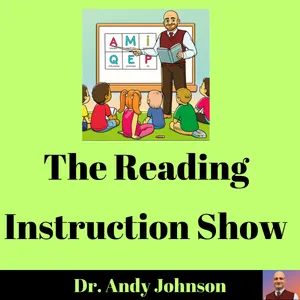
The Reading Instruction Show is a podcast about reading instruction (and other things) with a little bit of attitude. There is plenty here to inform and entertain all. And, by the way, I'm not trying to sell any books. I don't have any curriculum or programs to market. I don't accept speaking fees. And, I don't ever want to be a consultant.
Latest Episodes
The most recent episodes — sign up to get AI-powered summaries of each one.
- 2 weeks ago24 min
The Importance of Context and the Science of Reading
The Science of Reading seems to refer to a general consensus related to the strategies and practices that lead to improved reading outcomes. These strategies and practices have been determined to be effective using experimental or quasi-experimental research and conducted in authentic learning environments. Also, this research has established a causal link between strategies or practices and student outcomes (reading achievement). Thus, the Science of Reading can be thought of as a process that uses these standards when making decisions related to reading instruction and policy. However, the SoR might best be described today as a movement that advocates these standards be used for making decisions related to reading policy and instruction.
- 2 weeks ago28 min
Structured Literacy: Forward to the Past
Using Blanche DuBois’s tragic reliance on the "kindness of strangers" as a central metaphor, this article critiques the recurring cycle of corporate-driven reading mandates and the reduction of literacy instruction to rigid compliance. Drawing upon autobiographical reflections from early career teaching in 1983 and connecting them to current "Science of Reading" and structured literacy policies, the author demonstrates that contemporary commercial basal programs repackage historical scope-and-sequence routines under modern educational jargon. Rather than advancing teacher expertise, these prepackaged curricula deskill educators into mere direction-followers while serving corporate profit margins. The article synthesizes empirical and theoretical research to challenge the superiority of isolated, systematic phonics over balanced, meaning-centered approaches. It argues that reading instruction is fundamentally an intellectual endeavor requiring deep teacher knowledge of cognitive development, the reading process, and responsive pedagogy. Ultimately, the author urges educators to resist mandated fidelity to commercial scripts and instead reclaim their professional autonomy by adopting, adapting, and supplementing basals with authentic writing, self-selected reading, and dialogic engagement.
- Oct 6, 202632 min
Conversation with Kathy Brown, Master Educator
If you’re looking for accessible, research-based information that slices through the endless loads of overly worded baloney, I would encourage you to subscribe to my free Substack, The Reading Instruction Show. Substack: The Reading Instruction Showhttps://thereadinginstructionshow.substack.com/
- Sep 19, 202614 min
Reading Instruction, Word Confirmation, and Confirmation Bias
Purpose statement: The reader will become more effective in evaluating online sources related to reading instruction. Behavioral objective: Readers will be able to identify instances in which confirmation bias results in an over-use of quotations and a misrepresentation of authors’ original ideas. Important Terms• Word recognition – encountering a word in print and instantly knowing what it is. • Word identification – encountering a word in print that is not recognized and using a strategy to figure out what it is.• Decoding – identifying a word using letters and letter patterns.• Strategy - a cognitive process that one consciously applies to a task. • Skill - a cognitive process that has become automated.• Penguin - a bird living in the Antarctic that is thought to be the cause of most reading problems.• Confirmation bias – starting with a belief and selection only information that supports that predetermined belief.• Academic discourse – sharing and evaluating ideas using reason and research.• Context – something that matters.
- Aug 14, 202611 min
Quiet, Piggy: A Trumpian Response to Science of Reading Critics
If you’re looking for accessible, research-based information that slices through the endless loads of overly worded baloney, I would encourage you to subscribe to my free Substack, The Reading Instruction Show. Substack: The Reading Instruction Showhttps://thereadinginstructionshow.substack.com/
- Jul 31, 202613 min
Recognizing Words, the Three-Cueing System, and Identifying Words
• Purpose: Readers will understand how the three cueing system is used to recognize words.• Behavioral objective: After reading this chapter, the reader will throw a pie in the face of any clown who suggests that the three-cueing system (a) is a strategy, (b) is an approach to reading instruction, or (c) that it teaches students to guess at words.
- Jul 17, 20266 min
How NAEP Created a Perpetual Reading Crisis
The NAEP proficiency levels were arbitrarily defined (Bracey, 2008; Ravitch, 2012; Reinking, Hruby, & Risko, 2023). These levels should be interpreted with extreme caution (Vaulton, 2025). The National Center for Education Statistics website provides three reasons for this (NCES, 2025):1. Proficiency levels are based on desired expectations. Meaning that these levels are aspirational not mathematical.2. These proficiency levels are currently being used on a trial basis.3. Further evidence is needed to determine if these proficiency levels are “reasonable, valid, and informative”.If you’re looking for accessible, research-based information that slices through the endless loads of overly worded baloney, I would encourage you to subscribe to my free Substack, The Reading Instruction Show. Substack: The Reading Instruction Showhttps://thereadinginstructionshow.substack.com/
- Jul 7, 202616 min
Reading and the Information Processing Model: Why Penguins Continue to Mishear What I Say
Reading is a thinking process, not a responding-to-stimuli process or a sounding-out-words process. And since cognitive psychology studies human thinking; it makes good sense to examine the reading process from a cognitive or thinking perspective using the information processing model.• Purpose statement: The reader will develop a basic understanding of reading from a cognitive perspective.• Behavioral objective: After reading this chapter, the reader will be able to explain why penguins continue to insist the Dr. Johnson doesn’t believe in direct and explicit phonics instruction.https://thereadinginstructionshow.substack.com/p/reading-and-the-information-processing
Get The Reading Instruction Show summaries in your inbox
Free AI-powered daily recaps. Key takeaways, quotes, and mentions — in a 5-minute read.
Get Free Summaries →Free forever for up to 3 podcasts. No credit card required.
You Might Also Like
Listeners also like.
The Currently Reading Podcast
Two hosts discuss their current reads and offer genre-spanning, spoiler-free book reviews to help listeners choose what to read next.
Reading Glasses
Two authors share practical tips and humorous advice for improving your reading habits and solving common book lover problems.
People Who Read People: A Behavior and Psychology Podcast
Explores human behavior through interviews with experts in psychology, law, sports, and poker.

The Literary Life Podcast
Three readers discuss classic literature, reading practices, and the role of stories in intellectual and spiritual life.
Sold a Story
An investigative podcast exploring how children learn, the science of teaching, and why proven methods often don’t reach classrooms.
Close Readings
Literary critics explore key works across genres and themes, offering deep dives into literature, philosophy, and narrative.
Zero to Well-Read
A weekly exploration of famous books, covering plot, themes, and significance, from classics to modern literary hits.
She Reads Truth Podcast
A podcast offering encouragement and insights to help women engage with daily Bible reading and deepen their faith.
Ryers Readers
Children’s stories read aloud to build listening skills and comprehension while giving parents a moment of calm.
The Story Seeds Podcast
Kids team up with children's authors to turn their story ideas into read-aloud adventures, celebrating creativity and diverse voices.
What Should I Read Next?
A reader shares their literary preferences and gets personalized book recommendations from a knowledgeable host.
Julie’s Library
Julie Andrews and her daughter read children's books with sound, music, and guest guests.
About The Reading Instruction Show
The Reading Instruction Show is a podcast about reading instruction (and other things) with a little bit of attitude. There is plenty here to inform and entertain all. And, by the way, I'm not trying to sell any books. I don't have any curriculum or programs to market. I don't accept speaking fees. And, I don't ever want to be a consultant.
Customized Recaps
AI-powered recaps with compact key takeaways, quotes, and insights.
Straight to Your Inbox
Get key takeaways from The Reading Instruction Show in a 5-minute read.
Save Hours Every Week
Stay current on your favorite podcasts without falling behind.
Frequently Asked Questions
What is Podzilla's The Reading Instruction Show daily summary?
It's a free AI-powered email that summarizes new episodes of The Reading Instruction Show as soon as they're published. You get the key takeaways, notable quotes, and links & mentions — all in a quick read.
How does the The Reading Instruction Show podcast summary work?
When a new episode drops, our AI transcribes and analyzes it, then generates a personalized summary tailored to your interests and profession. It's delivered to your inbox every morning.
Is this an official The Reading Instruction Show product?
No. Podzilla is an independent service that summarizes publicly available podcast content. We're not affiliated with or endorsed by Dr. Andy Johnson.
Can I get summaries of other podcasts too?
Absolutely! The free plan covers up to 3 podcasts, any in the catalog. Basic raises that to 15, Pro to 40 and Max to 100. Browse our full catalog at /podcasts.
How often does The Reading Instruction Show release new episodes?
The Reading Instruction Show publishes weekly. Our AI generates a summary within hours of each new episode.
What topics does The Reading Instruction Show cover?
The Reading Instruction Show covers topics including Education, Courses, Kids & Family, Family. Our AI identifies the specific themes in each episode and highlights what matters most to you.
Start getting The Reading Instruction Show summaries tomorrow morning.
Free forever for up to 3 podcasts. No credit card required.
Free forever for up to 3 podcasts. No credit card required.