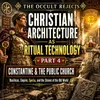
Christian Architecture As Ritual Technology Part 4-Constantine & the Public Church Basilicas, Empire, Spolia, & the Stones of the Old World
Thank you and enjoy the episode!Links For The Occult Rejectshttps://linktr.ee/theoccultrejectsOccult Research Institutehttps://www.occultresearchinstitute.org/Substackhttps://substack.com/@theoccultreject...Cash Apphttps://cash.app/$theoccultrejectsVenmo@TheOccultRejectsBuy Me A Coffeebuymeacoffee.com/TheOccultRejectsPatreon@theoccultrejects Krautheimer, Richard. Early Christian and Byzantine Architecture. 4th ed. New Haven: Yale University Press, 1986. Essential. This is the backbone source for early Christian basilicas, liturgical space, urban context, and the development of Christian architecture after Constantine. Krautheimer is especially useful for not treating churches as isolated floor plans, but as part of city, ritual, bishop, patronage, and memory.Krautheimer, Richard. Rome: Profile of a City, 312–1308. Princeton: Princeton University Press, 1980. Very useful for Rome as a layered city: imperial remains, Christian churches, papal authority, public space, and the transformation of Roman urban memory.Krautheimer, Richard, Wolfgang Frankl, and Spencer Corbett. Corpus Basilicarum Christianarum Romae: The Early Christian Basilicas of Rome. 5 vols. Vatican City: Pontificio Istituto di Archeologia Cristiana, 1937–1977. Heavy academic reference work. Best for the Lateran, Old Saint Peter’s, early Roman churches, plans, architectural evidence, and dating.Mathews, Thomas F. The Early Churches of Constantinople: Architecture and Liturgy. University Park: Pennsylvania State University Press, 1971. More focused on Constantinople, but excellent for connecting architecture and liturgical movement.White, L. Michael. Building God’s House in the Roman World: Architectural Adaptation among Pagans, Jews, and Christians. Baltimore: Johns Hopkins University Press, 1990. Great for the transition from house settings and adapted spaces into larger public Christian architecture.Brandenburg, Hugo. Ancient Churches of Rome from the Fourth to the Seventh Century: The Dawn of Christian Architecture in the West. Turnhout: Brepols, 2005. Very useful for Rome, the Lateran, Santa Maria Maggiore, Santa Sabina, and the formation of Christian public architecture.Snyder, Graydon F. Ante Pacem: Archaeological Evidence of Church Life Before Constantine. Macon: Mercer University Press, 2003. Best for the “before Constantine” contrast: house churches, burial spaces, symbols, and pre-public Christian material culture.Elsner, Jaś. Imperial Rome and Christian Triumph: The Art of the Roman Empire AD 100–450. Oxford: Oxford University Press, 1998. Excellent for the transformation from Roman imperial art and space into Christian visual culture and triumphal imagery. Elsner’s work is especially useful for your “empire becomes the bones of the church” angle.Constantine, Legal Shift, and Imperial PatronageEusebius. Life of Constantine. Translated by Averil Cameron and Stuart G. Hall. Oxford: Clarendon Press, 1999. Primary source. Use carefully because it is highly pro-Constantine and partly panegyric, but it is essential for Constantine’s Christian image, patronage, and sacred building projects. Eusebius is one of the key ancient witnesses for Constantine’s role in Christian imperial memory.Eusebius. Ecclesiastical History. Translated by Kirsopp Lake. Loeb Classical Library. Cambridge, MA: Harvard University Press, 1926–1932. Useful background for the pre-Constantinian church, persecution memory, martyr tradition, and Christian self-understanding before public imperial patronage.Barnes, Timothy D. Constantine and Eusebius. Cambridge, MA: Harvard University Press, 1981. Major scholarly source on Constantine, Eusebius, politics, Christian patronage, and imperial ideology.Drake, H. A. Constantine and the Bishops: The Politics of Intolerance. Baltimore: Johns Hopkins University Press, 2000. Excellent for the political complexity of Constantine’s relationship with bishops and Christian institutions.Lenski, Noel, ed. The Cambridge Companion to the Age of Constantine. Cambridge: Cambridge University Press, 2006. Good edited volume for Constantine’s world: religion, politics, empire, law, cities, and Christianization.Odahl, Charles Matson. Constantine and the Christian Empire. 2nd ed. London: Routledge, 2010. Useful general scholarly overview, especially for readers/listeners who need the historical framework.MacMullen, Ramsay. Christianizing the Roman Empire: A.D. 100–400. New Haven: Yale University Press, 1984. Classic work on Christianization as a social and political process.Brown, Peter. The Rise of Western Christendom: Triumph and Diversity, A.D. 200–1000. 3rd ed. Malden, MA: Wiley-Blackwell, 2013. Excellent big-picture framing. Helps avoid the cartoon version where
Podzilla Summary coming soon
Sign up to get notified when the full AI-powered summary is ready.
Free forever for up to 3 podcasts. No credit card required.
Listen to This Episode
More from The Occult Rejects
The Mechanics Of Magick: The Ecstatic Body Episode 2- The Ancient Medical Body
Willows Weep: The Cursed House That Wouldn’t Die Featuring Weekly Bizarre.

WHO IS FINALSPARK? Inside the Company Building Computers with Living Neurons
Inside the Order of the Eastern Star | With Jacqueline of Universe Unveiled
Get summaries like this every morning.
Free AI-powered recaps of The Occult Rejects and your other favorite podcasts, delivered to your inbox.
Free forever for up to 3 podcasts. No credit card required.