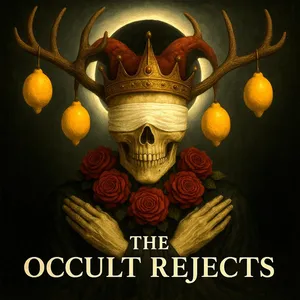
Free Daily Podcast Summary
The Occult Rejects: Daily Summaries Delivered
by The Occult Rejects
Occultists, Rejects, and Mystics trying to educate others about magick and occultism so others can figure out who they are and the world around them.
Latest Episodes
The most recent episodes — sign up to get AI-powered summaries of each one.
- Today58 min
The Seven Governors: Who Are the Olympic Spirits?
Links For The Occult Rejectshttps://linktr.ee/theoccultrejectsOccult Research Institutehttps://www.occultresearchinstitute.org/Substackhttps://substack.com/@theoccultrejects?r=7auau0&utm_campaign=profile&utm_medium=profile-pageCash Apphttps://cash.app/$theoccultrejectsVenmo@TheOccultRejectsPatreonhttps://www.patreon.com/TheOccultRejectsPRIMARY AND EARLY SOURCESAnonymous. Arbatel de magia veterum: summum sapientiae studium**. Basel: [Peter Perna], 1575.**This is the principal primary source for the episode and the earliest known printed appearance of Aratron, Bethor, Phaleg, Och, Hagith, Ophiel and Phul as the seven Olympic governors. The surviving 1575 copy held by the Universitätsbibliothek Basel is especially important because it allows comparison of the original Latin against later translations. The Basel catalogue identifies the edition as printed in Basel in 1575 and attributes the printing to Peter Perna.Most heavily used: Aphorisms 14–21, particularly 15–18 for the definition of Olympic Spirits, their names and governments, planetary provinces, characters, the 490-year periods, “Olympic speech,” and the warning concerning the temporary efficacy of spirit names.Turner, Robert, trans. “Arbatel of Magick.” In Henry Cornelius Agrippa, His Fourth Book of Occult Philosophy; Of Geomancy; Magical Elements of Peter de Abano; Astronomical Geomancy; The Nature of Spirits; Arbatel of Magick**. London: J.C. for John Harrison, 1655.**Turner’s translation became one of the principal routes through which English-speaking occultists encountered the Arbatel. It is also important for tracing later translation problems—particularly Turner’s rendering of the duration of efficacious Olympic names as forty years rather than the 140 given in the Latin. The Library of Congress preserves and digitizes the 1655 volume.Trithemius, Johannes. De Septem Secundeis, id est, Intelligentiis sive Spiritibus Orbes post Deum Moventibus**. Written 1508; first printed 1522/early sixteenth-century editions.**Essential for the planetary-governor system preceding the Arbatel. Trithemius describes seven secondary intelligences governing the world beneath God for periods of 354 years and four months. His Saturnian governor Orifiel is explicitly described as bearing a “name of office, not of nature” — nomen est officii, non naturae, an extraordinary conceptual parallel to the Arbatel’s later emphasis upon office over permanent names.Pietro d’Abano [Peter of Abano]. Conciliator differentiarum philosophorum et praecipue medicorum**. Early fourteenth century.**Important for the earlier planetary-spirit tradition underlying Trithemius. The planetary names associated with this current include Cassiel, Sachiel, Samael, Michael, Anael, Raphael and Gabriel. Peterson’s research traces Trithemius’s planetary-age doctrine back through this material.Paracelsus [Theophrastus von Hohenheim]. De causis morborum invisibilium [On the Causes of Invisible Diseases]. Written c. 1531–1532; first printed posthumously in the sixteenth century.One of our most important pre-Arbatel sources. Paracelsus uses Olympic Spirit / Olympic Spirits in connection with invisible celestial operations and the relationship between the stars of the macrocosm and those within the human microcosm. Peterson identifies this as a key source for understanding the Arbatel’s Paracelsian vocabulary.Paracelsus. Philosophia Sagax**. Written c. 1537; first printed 1571.**Particularly important because Paracelsus projected a third book concerning Olympici Novi. That portion is not preserved as part of the authentic work. Its absence has led scholars—including Joseph Peterson—to consider whether the Arbatel’s Olympic material emerged partly within the intellectual space created by Paracelsian ideas about Olympic magic. This should remain presented as a historical possibility rather than proven authorship or direct derivation.The Holy Bible, Genesis 10:25, Latin Vulgate.Used specifically in our discussion of Phaleg. The Latin biblical tradition uses the form Phaleg for Peleg and explicitly associates his name with the division of the earth. The correspondence with the Martial Olympic governor is therefore historically real at the level of vocabulary, although the Arbatel never states that its Phaleg was intentionally named for the biblical figure.The Holy Bible, Daniel 9:24–27.Used when discussing the possible significance of the Arbatel’s 490-year planetary governments. Daniel’s seventy symbolic “weeks” generate a traditional 70 × 7 = 490-year chronological framework. We treat this only as a possible numerical background because the Arbatel never explicitly derives its 490-year cycle from Daniel.Also want to remind people about the website, if you're into reading we have tons of information by multip
- 2 days ago2h 11m
Back To Basics: Creating and Using Sigils Part 1
Links For The Occult Rejectshttps://linktr.ee/theoccultrejectsOccult Research Institutehttps://www.occultresearchinstitute.org/Substackhttps://substack.com/@theoccultrejects?r=7auau0&utm_campaign=profile&utm_medium=profile-pageCash Apphttps://cash.app/$theoccultrejectsVenmo@TheOccultRejectsPatreonhttps://www.patreon.com/TheOccultRejectsAlso want to remind people about the website, if you're into reading we have tons of information by multiple contributors, and we got t-shirts up on the site if you're interested. Fun fact, the art is all based on the eyeball.
- 4 days ago1h 2m
The Mechanics of Magick: The Ecstatic Body Episode 3: From Humors to Hysteria
Links For The Occult Rejectshttps://linktr.ee/theoccultrejectsOccult Research Institutehttps://www.occultresearchinstitute.org/Substackhttps://substack.com/@theoccultrejects?r=7auau0&utm_campaign=profile&utm_medium=profile-pageCash Apphttps://cash.app/$theoccultrejectsVenmo@TheOccultRejectsPatreonhttps://www.patreon.com/TheOccultRejectsPrimary and Foundational Medical TextsAvicenna. The Canon of Medicine of Avicenna. Translated by O. Cameron Gruner. London: Luzac & Company, 1930.Breuer, Josef, and Sigmund Freud. Studies on Hysteria. Translated and edited by James Strachey, with Alix Strachey. New York: Basic Books, 1957. Originally published 1895.Charcot, Jean-Martin. Leçons sur les maladies du système nerveux faites à la Salpêtrière. 3 vols. Paris: Adrien Delahaye and Émile Lecrosnier, 1872–1887.Colombo, Realdo. De re anatomica. Venice: Nicolò Bevilacqua, 1559.Descartes, René. The Passions of the Soul. Translated by Stephen H. Voss. Indianapolis: Hackett Publishing, 1989. Originally published 1649.Descartes, René. Treatise of Man. Translated by Thomas Steele Hall. Cambridge, MA: Harvard University Press, 1972.Falloppio, Gabriele. Observationes anatomicae. Venice, 1561.Ficino, Marsilio. Three Books on Life. Translated by Carol V. Kaske and John R. Clark. Binghamton, NY: Medieval & Renaissance Texts & Studies, 1989.Freud, Sigmund. Three Essays on the Theory of Sexuality. In The Standard Edition of the Complete Psychological Works of Sigmund Freud, vol. 7, translated and edited by James Strachey, 123–246. London: Hogarth Press, 1953. Originally published 1905.Galvani, Luigi. Commentary on the Effects of Electricity on Muscular Motion. Translated by Robert Montraville Green. Cambridge, MA: Elizabeth Licht, 1953. Originally published 1791.Haller, Albrecht von. “De partibus corporis humani sensilibus et irritabilibus.” Commentarii Societatis Regiae Scientiarum Gottingensis 2 (1753): 114–158.Harvey, William. An Anatomical Disputation Concerning the Movement of the Heart and Blood in Living Creatures. Translated by Gweneth Whitteridge. Oxford: Blackwell Scientific Publications, 1976. Originally published 1628.Janet, Pierre. L’Automatisme psychologique: Essai de psychologie expérimentale sur les formes inférieures de l’activité humaine. Paris: Félix Alcan, 1889.Mesmer, Franz Anton. Mesmerism: A Translation of the Original Medical and Scientific Writings of F. A. Mesmer. Translated by George Bloch. Los Altos, CA: William Kaufmann, 1980.Paracelsus. Selected Writings. Edited by Jolande Jacobi. Translated by Norbert Guterman. Princeton, NJ: Princeton University Press, 1951.Vesalius, Andreas. The Fabric of the Human Body: An Annotated Translation of the 1543 and 1555 Editions of “De humani corporis fabrica libri septem.” Translated by Daniel H. Garrison and Malcolm H. Hast. 2 vols. Basel: Karger, 2014.Medieval Islamic Medicine and Its TransmissionBurnett, Charles, and Danielle Jacquart, eds. Constantine the African and ʿAlī ibn al-ʿAbbās al-Maǧūsī: The Pantegni and Related Texts. Leiden: Brill, 1994.Jacquart, Danielle, and Claude Thomasset. Sexuality and Medicine in the Middle Ages. Translated by Matthew Adamson. Princeton, NJ: Princeton University Press, 1988.McGinnis, Jon, ed. Interpreting Avicenna: Critical Essays. Cambridge: Cambridge University Press, 2013.McVaugh, Michael R. Medicine Before the Plague: Practitioners and Their Patients in the Crown of Aragon, 1285–1345. Cambridge: Cambridge University Press, 1993.Pormann, Peter E., and Emilie Savage-Smith. Medieval Islamic Medicine. Edinburgh: Edinburgh University Press, 2007.Siraisi, Nancy G. Avicenna in Renaissance Italy: The Canon and Medical Teaching in Italian Universities after 1500. Princeton, NJ: Princeton University Press, 1987.Siraisi, Nancy G. Medieval and Early Renaissance Medicine: An Introduction to Knowledge and Practice. Chicago: University of Chicago Press, 1990.Medieval and Early Modern Gender, Reproduction, and SexualityGreen, Monica H. Making Women’s Medicine Masculine: The Rise of Male Authority in Pre-Modern Gynaecology. Oxford: Oxford University Press, 2008.King, Helen. The Disease of Virgins: Green Sickness, Chlorosis, and the Problems of Puberty. London: Routledge, 2004.Laqueur, Thomas. Making Sex: Body and Gender from the Greeks to Freud. Cambridge, MA: Harvard University Press, 1990.Murray, Jacqueline. “The Law of Sin That Is in My Members: The Problem of Male Embodiment.” In Gender and Holiness: Men, Women and Saints in Late Medieval Europe, edited by Samantha J. E. Riches and Sarah Salih, 9–22. London: Routledge, 2002.Park, Katharine. Secrets of Women: Gender, Generation, and the Origins of Human Dissection. New York: Zone Books, 2006
- 5 days ago2h 2m
The Occult Rejects with David Beth
Links For The Occult Rejectshttps://linktr.ee/theoccultrejectsOccult Research Institutehttps://www.occultresearchinstitute.org/Substackhttps://substack.com/@theoccultrejects?r=7auau0&utm_campaign=profile&utm_medium=profile-pageCash Apphttps://cash.app/$theoccultrejectsVenmo@TheOccultRejectsPatreonhttps://www.patreon.com/TheOccultRejectsAlso want to remind people about the website, if you're into reading we have tons of information by multiple contributors, and we got t-shirts up on the site if you're interested. Fun fact, the art is all based on the eyeball.
- 6 days ago38 min
The History of Baphomet Part 2: How Baphomet Became Satan: From Lévi’s Goat to the Modern Sigil
Links For The Occult Rejectshttps://linktr.ee/theoccultrejectsOccult Research Institutehttps://www.occultresearchinstitute.org/Substackhttps://substack.com/@theoccultrejects?r=7auau0&utm_campaign=profile&utm_medium=profile-pageCash Apphttps://cash.app/$theoccultrejectsVenmo@TheOccultRejectsPatreonhttps://www.patreon.com/TheOccultRejectsBIBLIOGRAPHY — EPISODE TWOÉLIPHAS LÉVI AND THE NINETEENTH-CENTURY FOUNDATIONLévi, Éliphas. Dogme de la haute magie. First installments, Paris, 1854. Earliest publication context for Lévi’s Baphomet drawing.Lévi, Éliphas. Dogme et Rituel de la Haute Magie. Paris, 1855–1856.Lévi, Éliphas. Dogme et Rituel de la Haute Magie. 2nd, greatly expanded ed. Paris/London/New York: Germer Baillière, 1861.Lévi, Éliphas. Transcendental Magic: Its Doctrine and Ritual. Translated by Arthur Edward Waite. London, 1896.Strube, Julian. “The ‘Baphomet’ of Eliphas Lévi: Its Meaning and Historical Context.” Correspondences 4 (2016): 37–79.Du Potet de Sennevoy, Jean. La magie dévoilée. Paris, 1852. Important to the spiritualistic-magnetic context from which Lévi developed his theory of the magical agent.Khunrath, Heinrich. Amphitheatrum Sapientiae Aeternae. First edition, 1595; expanded later edition, 1609. Directly relevant because Lévi explicitly invoked Khunrath’s androgyne while explaining the mixed-sex anatomy of Baphomet.Forshaw, Peter J. The Mage’s Images: Heinrich Khunrath in His Oratory and Laboratory. Leiden: Brill, 2025. Detailed modern analysis of Khunrath’s Adam Androgyne and Rebis imagery, including the 1595 Solve / Coagula detail.Hesteau de Nuysement, Clovis. Traittez de l’harmonie et constitution généralle du vray sel, secret des philosophes, et de l’esprit universel du monde. The Hague: Théodore Maire, 1639. Relevant for another alchemical print identified by Strube among the visual influences surrounding Lévi’s Baphomet.Ragon, Jean-Marie. Orthodoxie maçonnique, suivie de la Maçonnerie occulte et de l’initiation hermétique. Paris: E. Dentu, 1853. Important immediate precursor linking alchemical matter, the Goat of Mendes, Kabbalistic ideas, and “specific magnetism”; Lévi reviewed the work in the year before his Baphomet appeared.Decker, Ronald, Thierry Depaulis, and Michael Dummett. A Wicked Pack of Cards: The Origins of the Occult Tarot. London: Duckworth, 1996. Useful background for Lévi’s use of the Tarot of Marseille and the Devil card.Wilkinson, Richard H. The Complete Gods and Goddesses of Ancient Egypt. London: Thames & Hudson, 2003. Useful for distinguishing the ram deity Banebdjedet and the ancient religious context of Mendes from later European “Goat of Mendes” constructions.THEOSOPHY AND EARLY RECEPTIONBlavatsky, Helena Petrovna. Isis Unveiled. 2 vols. New York: J. W. Bouton, 1877. Important for the early esoteric reception of Lévi, the Astral Light, and the wider nineteenth-century occult synthesis.Waite, Arthur Edward. Translator’s introduction and notes to Lévi’s Transcendental Magic. London, 1896. Useful for the Anglophone reception and criticism of Lévi.DE GUAITA, WIRTH, AND THE GOAT-PENTAGRAMde Guaita, Stanislas. La Clef de la Magie Noire. Paris, 1897. Primary source for the famous inverted goat-headed pentagram with Leviathan, Samael, and Lilith.Wirth, Oswald. Le Symbolisme hermétique dans ses rapports avec l’alchimie et la Franc-Maçonnerie. Paris: Librairie Initiatique, 1909.Wirth, Oswald. La Franc-Maçonnerie rendue intelligible à ses adeptes: Le Livre du Compagnon. 3rd ed. Paris, 1924. Important for Wirth’s goat-pentagram and his discussion of inverted polarity.Wirth, Oswald. Le Tarot des imagiers du Moyen Age. Paris: Le Symbolisme / Émile Nourry, 1927. Important for Wirth’s identification of the Devil card with the Baphomet of the Templars.ALEISTER CROWLEY AND THELEMACrowley, Aleister. The Confessions of Aleister Crowley. Edited by John Symonds and Kenneth Grant. London: Jonathan Cape, 1969.Crowley, Aleister. Liber XV: Ecclesiae Gnosticae Catholicae Canon Missae, commonly known as The Gnostic Mass.Crowley, Aleister. The Book of Lies. London, 1913.Crowley, Aleister. Magick in Theory and Practice and Magick: Liber ABA, Book 4. Various editions.O.T.O. manifestos and institutional documents. Useful for the Order’s constructed genealogies linking modern initiation with Templar, Masonic, Rosicrucian, Gnostic, and related traditions.MAURICE BESSY AND MODERN SATANISMBessy, Maurice. Histoire en 1000 Images de la Magie. Paris, 1961.Bessy, Maurice. A Pictorial History of Magic and the Supernatural. English ed., 1964.LaVey, Anton Szandor. The Satanic Bible. New York: Avon Books, 1969.LaVey, Anton Szandor. The Satanic Rituals. New York: Avon Books, 1972.Church of Satan. “The History of the Ori
- 6 days ago42 min
The History of Baphomet Part 1: Before The Goat
Links For The Occult Rejectshttps://linktr.ee/theoccultrejectsOccult Research Institutehttps://www.occultresearchinstitute.org/Substackhttps://substack.com/@theoccultrejects?r=7auau0&utm_campaign=profile&utm_medium=profile-pageCash Apphttps://cash.app/$theoccultrejectsVenmo@TheOccultRejectsPatreonhttps://www.patreon.com/TheOccultRejectsPRIMARY AND MEDIEVAL SOURCESAnselm of Ribemont. Letter concerning the First Crusade and Antioch, 1098. Important for the early form Baphometh and the Crusading context in which the word first appears.Gavaudan. Senhors, per los nostres peccatz. Late twelfth-century Occitan crusading poem. Consult the critical text and commentary available through RIALTO, especially the occurrences of Bafometz in an explicitly Christian-Muslim polemical context.Austorc d’Aorlhac. Ai Dieus, per qu’as facha tan gran maleza. Mid-thirteenth-century Occitan lament. RIALTO’s commentary identifies Bafomet as probably referring to Muhammad and discusses the deformation of Muhammad’s name.Ramon Llull tradition / Occitan Doctrina pueril. Medieval Occitan material containing the heading De Bafomet, useful as part of the broader linguistic history of forms associated with Muhammad and Islam.Michelet, Jules, ed. Le Procès des Templiers. Paris: Imprimerie Royale, 1841–1851. Major published collection of the French Templar proceedings and an important source for testimony involving heads, idols, Baffometi, Baphometi, and related accusations.Clement V. Vox in excelso, 22 March 1312. Papal decree suppressing the Order of the Temple.The Chinon Parchment, August 1308. Papal record concerning the interrogation, penitence, absolution, and reconciliation of senior Templar leaders.MODERN SCHOLARSHIP ON THE TEMPLARSBarber, Malcolm. The Trial of the Templars. 2nd ed. Cambridge: Cambridge University Press, 2006.Barber, Malcolm. The New Knighthood: A History of the Order of the Temple. Cambridge: Cambridge University Press, 1994.Demurger, Alain. The Last Templar: The Tragedy of Jacques de Molay, Last Grand Master of the Temple. London: Profile Books, 2009.Demurger, Alain. The Knights Templar: A New History. Translated by Teresa Lavender Fagan. London: Profile Books, 2007.Nicholson, Helen J. The Knights Templar: A New History. Stroud: Sutton Publishing, 2001.Partner, Peter. The Knights Templar and Their Myth. Rochester, VT: Destiny Books, 1990.Frale, Barbara. “The Chinon Chart: Papal Absolution to the Last Templar, Master Jacques de Molay.” Journal of Medieval History 30, no. 2 (2004).Wright, Thomas. Narratives of Sorcery and Magic. London, 1851. A nineteenth-century secondary compilation preserving discussion of the Templar testimony involving “Baffomet,” “Baphomet,” “Yalla,” and “Mahomet”; useful as a reception source and pointer back toward the trial editions rather than as a substitute for the medieval records.RENAISSANCE ALCHEMY AND THE PRE-LÉVI VISUAL LANGUAGERosarium Philosophorum. Frankfurt, 1550. Important for the illustrated alchemical conjunction of solar and lunar, masculine and feminine principles and for the hermaphroditic imagery that predates Lévi by three centuries.Khunrath, Heinrich. Amphitheatrum Sapientiae Aeternae. First edition, 1595; expanded later edition, 1609. Essential for the Adam Androgyne and the Alchemical Hermaphrodite or Rebis, including the paired Solve / Coagula language later recalled by Lévi.Forshaw, Peter J. The Mage’s Images: Heinrich Khunrath in His Oratory and Laboratory. Leiden: Brill, 2025. Major modern study of Khunrath’s engravings; especially useful for the sequence of the 1595 circular images, the Rebis, and the detail explicitly catalogued as “Solve [et] Coagula.”Hesteau de Nuysement, Clovis. Traittez de l’harmonie et constitution généralle du vray sel, secret des philosophes, et de l’esprit universel du monde. The Hague: Théodore Maire, 1639. The volume contains a print identified in modern scholarship as another visual source relevant to Lévi’s later synthesis.Guazzo, Francesco Maria. Compendium Maleficarum. Milan, 1608. Useful for the broader early-modern demonological visual environment in which goat-headed and winged devil imagery circulated, without treating those images as earlier Baphomets.TEMPLAR SURVIVAL MYTHS AND ESOTERIC REINTERPRETATIONLe Forestier, René. La Franc-maçonnerie templière et occultiste aux XVIIIe et XIXe siècles. Paris/Louvain: Aubier-Montaigne/Editions Nauwelaerts, 1970.Nicolai, Christoph Friedrich. Versuch über die Beschuldigungen, welche dem Tempelherrenorden gemacht worden, und über dessen Geheimniß. Berlin, 1782.Hammer-Purgstall, Joseph von. “Mysterium Baphometis Revelatum.” 1818.Also want to remind people about the website, if you're into reading we have tons of information by multiple
- 1 weeks ago1h 8m
Homunculus: The Occult History of Creating Artificial Life
Links For The Occult Rejectshttps://linktr.ee/theoccultrejectsOccult Research Institutehttps://www.occultresearchinstitute.org/Substackhttps://substack.com/@theoccultrejects?r=7auau0&utm_campaign=profile&utm_medium=profile-pageCash Apphttps://cash.app/$theoccultrejectsVenmo@TheOccultRejectsPatreonhttps://www.patreon.com/TheOccultRejectsBibliographyPRIMARY AND HISTORICAL SOURCESApollonius Rhodius. Argonautica. Especially Book IV for the story of Talos.Aristotle. Generation of Animals.Aristotle. History of Animals. Relevant to ancient theories of reproduction and spontaneous generation.Babylonian Talmud. Sanhedrin 65b. Rava's creation of an artificial man and the encounter with Rabbi Zeira.Besetzny, Emil, ed. Die Sphinx: Freimaurerisches Taschenbuch. Vienna: Rosner, 1873. Especially “Die wahrsagenden Geister des Brs. Joh. Ferd. Grafen von Kueffstein,” beginning around p. 111. This is an important early printed source for the later story of Kueffstein's alleged “prophesying spirits” or homunculi.Hartmann, Franz. The Life of Philippus Theophrastus Bombast of Hohenheim, Known by the Name of Paracelsus, and the Substance of His Teachings. London: George Redway, 1887. Hartmann reproduces the Kueffstein story while explicitly tracing it to Besetzny's 1873 Sphinx and alleged Masonic manuscripts and Kammerer's diary.Hartsoeker, Nicolaas. Essay de dioptrique. Paris: Jean Anisson, 1694. Contains Hartsoeker's famous speculative depiction of a miniature preformed organism associated with spermist preformationism.Homer. Iliad. Book XVIII. Relevant passages include Hephaestus's intelligent golden attendants and his self-moving tripods.Ovid. Metamorphoses. Book X. Pygmalion and the animation of the manufactured human form.Pseudo-Paracelsus / Paracelsian tradition. De natura rerum. Particularly the section traditionally cited for the generation of the homunculus. Modern scholarship makes the authorship and textual history substantially more complicated than older occult editions suggest.Sefer Yetzirah / Book of Formation. Various recensions and translations. Foundational for later Jewish mystical traditions involving creation through letters, numbers, and divine language.ALCHEMY, HOMUNCULI, AND ARTIFICIAL LIFENewman, William R. Promethean Ambitions: Alchemy and the Quest to Perfect Nature. University of Chicago Press, 2004. Particularly Chapter 4, “Artificial Life and the Homunculus.” This is one of the most important scholarly sources for the entire episode and for the larger medieval/early-modern debate over art versus nature.Newman, William R. “The Homunculus and the Mandrake: Art Aiding Nature versus Art Faking Nature.” In Genesis Redux: Essays in the History and Philosophy of Artificial Life. University of Chicago Press, 2007. Especially useful for the relationship between the Paracelsian homunculus, mandrake/Alraun traditions, and artificial generation.Newman, William R. “Bad Chemistry: Basilisks and Women in Paracelsus and pseudo-Paracelsus.” Ambix 67, no. 1 (2020): 30–46. DOI: 10.1080/00026980.2020.1720341.Gantenbein, Urs Leo. “Real or Fake? New Light on the Paracelsian De natura rerum.” Ambix 67, no. 1 (2020): 4–29. DOI: 10.1080/00026980.2020.1720339. Essential for the disputed authorship, multiple-author evidence, and the 1571 earliest presently identified manuscript of De natura rerum.Hirai, Hiro. “Into the Forger's Library: The Genesis of De natura rerum in Publication History.” Early Science and Medicine 24 (2019): 485–503. Important for the pseudo-Paracelsian publication context surrounding the text.Murase, Amadeo. “The Homunculus and the Paracelsian Liber de imaginibus.” Ambix 67, no. 1 (2020): 47–61. DOI: 10.1080/00026980.2020.1720359. Useful for showing that the biological bottle-creature was not the only homunculus concept found within the broader Paracelsian textual tradition.THE LIBER VACCAE / BOOK OF THE COWSaif, Liana. “The Cows and the Bees: Arabic Sources and Parallels for Pseudo-Plato's Liber Vaccae (Kitāb al-Nawāmīs).” Journal of the Warburg and Courtauld Institutes 79 (2016): 1–47. Essential for the Arabic context, surviving fragments, textual transmission, and artificial-generation experiments.Van der Lugt, Maaike. “‘Abominable Mixtures’: The Liber vaccae in the Medieval West, or The Dangers and Attractions of Natural Magic.” Traditio (2016). Particularly valuable for the Western reception of the Liber Vaccae, its controversial operations, and medieval arguments over natural versus illicit magic.Page, Sophie. Magic in the Cloister: Pious Motives, Illicit Interests, and Occult Approaches to the Medieval Universe. Especially the chapter “The Liber Vaccae: Magical Uses of Monstrous Creations.” Useful for manuscript culture and the practical reception
- 1 weeks ago1h 2m
Adrenochrome: The Chemical, The Scientists, and The Blood-Harvesting Legend
Links For The Occult Rejectshttps://linktr.ee/theoccultrejectsOccult Research Institutehttps://www.occultresearchinstitute.org/Substackhttps://substack.com/@theoccultrejects?r=7auau0&utm_campaign=profile&utm_medium=profile-pageCash Apphttps://cash.app/$theoccultrejectsVenmo@TheOccultRejectsPatreonhttps://www.patreon.com/TheOccultRejectsRESEARCH BIBLIOGRAPHY I. CHEMISTRY, MEDICINE, AND EXPERIMENTS1. Weinstein, S., and R. J. Manning. “Intermediate Oxidation Products of Epinephrine.” Proceedings of the Society for Experimental Biology and Medicine 32, no. 7 (1935): 1096–1097. doi:10.3181/00379727-32-7983P.Link: https://doi.org/10.3181/00379727-32-7983PAccess/evidence: Publisher text available. Episode use: Early adrenaline oxidation; do not describe this as proven isolation of modern adrenochrome.2. Green, David Ezra, and Derek Richter. “Adrenaline and Adrenochrome.” Biochemical Journal 31, no. 4 (1937): 596–616. doi:10.1042/bj0310596.Link: https://pmc.ncbi.nlm.nih.gov/articles/PMC1266980/Access/evidence: Full article accessible. Episode use: Foundational chemistry and historical nomenclature.3. Osmond, Humphry, and John Smythies. “Schizophrenia: A New Approach.” Journal of Mental Science 98, no. 411 (1952): 309–315. doi:10.1192/bjp.98.411.309.Link: https://pubmed.ncbi.nlm.nih.gov/14917992/Access/evidence: Citation verified; full text not reviewed. Episode use: Original proposed biochemical hypothesis.4. Hoffer, Abram, Humphry Osmond, and John Smythies. “Schizophrenia: A New Approach. II. Result of a Year’s Research.” Journal of Mental Science 100, no. 418 (1954): 29–45. doi:10.1192/bjp.100.418.29.Link: https://pubmed.ncbi.nlm.nih.gov/13152519/Access/evidence: Citation and publisher extract verified; full paper not reviewed. Episode use: Early follow-up research.5. Hoffer, Abram. “Adrenochrome in Blood Plasma.” American Journal of Psychiatry 114, no. 8 (1958): 752–753. doi:10.1176/ajp.114.8.752.Link: https://psychiatryonline.org/doi/10.1176/ajp.114.8.752Access/evidence: Citation verified; full paper paywalled. Episode use: Hoffer’s claimed measurement, not an accepted consensus.6. Szára, Stephen, Julius Axelrod, and Seymour Perlin. “Is Adrenochrome Present in the Blood?” American Journal of Psychiatry 115, no. 2 (1958): 162–163. doi:10.1176/ajp.115.2.162.Link: https://psychiatryonline.org/doi/abs/10.1176/ajp.115.2.162Access/evidence: Publisher abstract available. Episode use: Reports nondetection using the researchers’ method; a direct historical contrast with Hoffer.7. Cohen, Gerald, Bernard Holland, and Marcel Goldenberg. “The Stability of Epinephrine and Arterenol (Norepinephrine) in Plasma and Serum: A Comparison of Normal and Schizophrenic Subjects.” AMA Archives of Neurology & Psychiatry 80, no. 4 (1958): 484–487. doi:10.1001/archneurpsyc.1958.02340100084020.Link: https://jamanetwork.com/journals/archneurpsyc/article-abstract/652760Access/evidence: Publisher abstract/introduction available. Episode use: A related but distinct experimental question about catecholamine behavior.8. Heacock, R. A. “The Chemistry of Adrenochrome and Related Compounds.” Chemical Reviews 59, no. 2 (1959): 181–237. doi:10.1021/cr50026a001.Link: https://pubs.acs.org/doi/10.1021/cr50026a001Access/evidence: Bibliographic record and period text identified. Episode use: Comprehensive contemporary chemistry review.9. Payza, A. N., and M. E. Mahon. “Spectrofluorometric Estimation of Adrenochrome in Human Plasma.” Analytical Chemistry 31, no. 7 (1959): 1170–1174. doi:10.1021/ac60151a028.Link: https://pubs.acs.org/doi/10.1021/ac60151a028Access/evidence: Citation verified; full paper paywalled. Episode use: Analytical-method dispute and measurement limitations.10. Payza, A. N., and Margaret Mahon. “Modification of Spectrofluorometric Determination of Aminochromes in Human Plasma.” Analytical Chemistry 32, no. 1 (1960): 17–19. doi:10.1021/ac60157a005.Link: https://pubs.acs.org/doi/10.1021/ac60157a005Access/evidence: Citation verified; full paper not reviewed. Episode use: Follow-up modification to assays.11. Grof, Stanislav, M. Vojtěchovský, V. Vítek, and S. Pranková. “Clinical and Experimental Study of Central Effects of Adrenochrome.” Journal of Neuropsychiatry 4 (1963): 33–50.Link: https://pubmed.ncbi.nlm.nih.gov/14089791/Access/evidence: PubMed bibliography verified; full study not reviewed. Episode use: Historical publication and experimental research context; no specific numerical outcomes in the final script pending original paper.12. Throne, M. L., and C. W. Gowdey. “A Critical Review of Endogenous Psychotoxins as a Cause of Schizophrenia.” Canadian Psychiatric Association Journal 12 (1967). doi:10.1177/0706
Get The Occult Rejects summaries in your inbox
Free AI-powered daily recaps. Key takeaways, quotes, and mentions — in a 5-minute read.
Get Free Summaries →Free forever for up to 3 podcasts. No credit card required.
You Might Also Like
Listeners also like.

Witches Ritual | Witchcraft, Paganism & Spiritual Exploration
Rhiannon Reign

Forum Borealis
In-depth interviews with authors and thinkers on unconventional topics in history, science, philosophy, and politics.
Skeptoid
Examines urban legends, paranormal claims, and science myths with critical analysis and evidence-based research.

Hex Rated
Hex Rated Witches
The Haunted Objects Podcast
Researchers explore haunted objects, cursed artifacts, and paranormal phenomena through history and folklore.

The Confessionals
Firsthand accounts of supernatural encounters, cryptids, UFOs, and unexplained phenomena explored through in-depth interviews.

Ghost Church by Jamie Loftus
Jamie Loftus examines American spiritualist camps, exploring how people cope with grief and seek connection through mediumship and religious practices.

American Alchemy with Jesse Michels
Explores radical and unconventional ideas shaping contemporary thought in America.

Blurry Creatures
Explores biblical perspectives on UFOs, cryptids, the Nephilim, and supernatural phenomena through theology and witness testimony.
My Family Thinks I'm Crazy
Explores unconventional ideas and lifestyles through conversations with people who embrace alternative paths.

Witch
A modern exploration of witchcraft through history, folklore, and contemporary practice.

Tin Foil Hat With Sam Tripoli
A conspiracy podcast hosted by Sam Tripoli with contributors XG and Johnny Woodard.
About The Occult Rejects
Occultists, Rejects, and Mystics trying to educate others about magick and occultism so others can figure out who they are and the world around them.
Customized Recaps
AI-powered recaps with compact key takeaways, quotes, and insights.
Straight to Your Inbox
Get key takeaways from The Occult Rejects in a 5-minute read.
Save Hours Every Week
Stay current on your favorite podcasts without falling behind.
Frequently Asked Questions
What is Podzilla's The Occult Rejects daily summary?
It's a free AI-powered email that summarizes new episodes of The Occult Rejects as soon as they're published. You get the key takeaways, notable quotes, and links & mentions — all in a quick read.
How does the The Occult Rejects podcast summary work?
When a new episode drops, our AI transcribes and analyzes it, then generates a personalized summary tailored to your interests and profession. It's delivered to your inbox every morning.
Is this an official The Occult Rejects product?
No. Podzilla is an independent service that summarizes publicly available podcast content. We're not affiliated with or endorsed by The Occult Rejects.
Can I get summaries of other podcasts too?
Absolutely! The free plan covers up to 3 podcasts, any in the catalog. Basic raises that to 15, Pro to 40 and Max to 100. Browse our full catalog at /podcasts.
How often does The Occult Rejects release new episodes?
The Occult Rejects publishes daily. Our AI generates a summary within hours of each new episode.
What topics does The Occult Rejects cover?
The Occult Rejects covers topics including Science, Education, Religion & Spirituality, Spirituality, Culture, Society & Culture. Our AI identifies the specific themes in each episode and highlights what matters most to you.
Start getting The Occult Rejects summaries tomorrow morning.
Free forever for up to 3 podcasts. No credit card required.
Free forever for up to 3 podcasts. No credit card required.