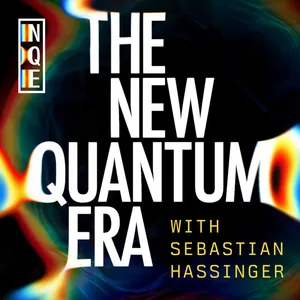
Free Daily Podcast Summary
The New Quantum Era - innovation in quantum computing, science and technology: Daily Summaries Delivered
by Sebastian Hassinger
Your host, Sebastian Hassinger, interviews brilliant research scientists, software developers, engineers and others actively exploring the possibilities of our new quantum era. We will cover topics in quantum computing, networking and sensing, focusing on hardware, algorithms and general theory. The show aims for accessibility - Sebastian is not a physicist - and we'll try to provide context for the terminology and glimpses at the fascinating history of this new field as it evolves in real time.
Latest Episodes
The most recent episodes — sign up to get AI-powered summaries of each one.
- 6 days ago49 min
Classical Reversible Computing on Quantum Dots with Daniel Loss
Daniel Loss is RDIA Chair Professor of Quantum Computing and Director of the Quantum Center at King Fahd University of Petroleum and Minerals in Saudi Arabia, where this work was done. He is also one of the most influential theorists in quantum computing. The 1997 Loss-DiVincenzo proposal — that electron spins in quantum dots could serve as qubits — now has more than 9,000 citations and is the conceptual foundation for the semiconductor spin-qubit platforms that Intel, HRL, Diraq, and a wave of European startups are actively building toward. In 2025, Loss was named a Clarivate Citation Laureate in Physics, a designation with a strong historical track record as a Nobel Prize predictor. The reason to listen now is that Loss has turned his attention to a question that predates quantum computing itself: can reversible, energy-efficient classical logic be physically realized? His 2026 paper argues that the spin-qubit hardware the field has spent decades developing is, almost incidentally, the ideal platform to do exactly that — and that the energy advantage over room-temperature CMOS could be so large it would matter enormously for AI inference workloads and data-center power budgets. This episode is for anyone following the spin-qubit roadmap, the energy crisis in classical computing, or the deeper question of what semiconductor quantum hardware is ultimately good for. What We Get Into Why reversible computing is having a moment now: The ideas of Landauer, Bennett, Fredkin, and Toffoli have been around since the early 1980s — Loss explains what changed experimentally that makes the proposal feel like engineering rather than philosophy. The core energy claim, unpacked: Loss walks through why a spin-qubit Toffoli gate operating near 4 Kelvin could cost roughly 10⁵ times less energy than its CMOS equivalent, even after accounting for refrigeration overhead — and where the accounting is still incomplete. What makes the computation classical and the hardware quantum: The gate uses coherent quantum dynamics internally, but inputs and outputs are classical spin states. No superposition is required between gate operations, which dramatically relaxes the error-correction burden. The iToffoli gate and why it works for classical logic: Loss describes how a target spin hopping between quantum dots, controlled by two neighboring spins, implements a universal reversible gate using only DC voltage pulses — no radio-frequency drives required. The Quantum Zeno trick for classical memory: Frequent projective measurement of a spin state can stabilize it against relaxation, turning one of quantum computing's central headaches into a feature for classical storage. Why AI inference is the natural first application: Error tolerance, parallelizability, and the absence of a need for new algorithms make AI inference workloads a compelling early target — and Loss argues this de-risks the spin-qubit enterprise regardless of whether fault-tolerant quantum computing arrives on schedule. The dual-use platform argument: The same germanium/silicon quantum-dot array could, in principle, run quantum algorithms when superposition is useful and classical reversible logic when it is not — a flexibility that changes the economic calculus for building the hardware. What the experimental community needs to do next: Loss describes the first falsifiable tests — a three-spin iToffoli truth table, energy budget measurements, and a five-dot reversible adder — and names the groups best positioned to run them. How the brain comparison reframes the stakes: Loss notes that his energy estimates put spin-qubit classical computing roughly four orders of magnitude below the energy cost of a biological synapse, which has implications for how we think about the physical limits of AI. Resources & Links Guest & Lab Daniel Loss' profile at King Fahd University of Petroleum and Minerals Daniel Loss — University of Basel, Condensed Matter Theory & Quantum Computing Group — Loss's lab page; lists current research areas, group members, and leadership roles including NCCR SPIN. Daniel Loss — Wikipedia — Comprehensive biographical overview, career history, and awards list for listeners who want background before or after listening. Papers & Articles Classical Reversible Computation by Quantum Coherence — arXiv:2607.06219v3 (2026) — The
- 1 weeks ago40 min
Quantum-Inspired AI and Tensor Network Compression with Román Orús
Román Orús is one of the rare physicists who built a foundational mathematical tool — tensor networks — and then watched it become the engine of a unicorn. His 2013 introduction to tensor networks has been cited over 2,000 times; his company, Multiverse Computing, just announced a $570 million Series C at a $1.7 billion pre-money valuation. That arc — from condensed matter theory to Europe's largest quantum software company — is worth understanding on its own terms. But what makes this conversation particularly timely is a May 2026 paper Orús co-authored demonstrating that individual layers of Meta's Llama 3.1 8B language model can be encoded as quantum circuits and executed on IBM's 156-qubit Quantum System Two while the model generates text. It's a proof of concept, not a product — but it's a real result, and Orús is honest about what it does and doesn't prove.This episode is for listeners who want a technically grounded, hype-free account of the quantum-AI intersection: what tensor networks actually are, why they keep getting rediscovered across different fields, where classical simulation of quantum systems genuinely competes with quantum hardware, and what it looks like to build a company at the boundary between those two worlds.Sponsor MessageThe Capital of Quantum is a people story. Built on a top-five quantum PhD program and 35-plus years of quantum research leadership. It's the billion-dollar initiative behind Discovery Center, launching this month with Microsoft, IQM, and Quantum Motion inside. That's why IonQ was born and is headquartered here, and why global companies keep choosing a spot minutes from Washington, D.C. This is where quantum is transforming the world. Come see it at the Quantum World Congress, September 23rd through 25th, College Park, Maryland. CapitalOfQuantum.com.What We Get IntoWhat tensor networks actually are — Orús explains the core idea without equations: tensors as the "DNA" of a quantum state, and how a network of them lets you see and quantify the internal correlations (entanglement) that matter versus the ones you can safely ignore.Why the same math keeps appearing in different fields — from condensed matter simulation to quantum computing simulation to machine learning, and why Orús sees that recurrence as a sign of something deep rather than a coincidence.How ChatGPT changed Multiverse's trajectory — the company was already applying tensor networks to machine learning before 2022; the emergence of large language models gave them a problem where the fit was obvious and the market was enormous.What "90–95% compression with minimal accuracy loss" actually means — Orús explains the overparameterization problem in current AI models and why he believes tensor networks address a genuine structural inefficiency, not just a tuning opportunity.The IBM kicked Ising model episode — Orús describes how his team rapidly produced a classical tensor network simulation of an experiment IBM had presented as evidence of quantum utility, and what that kind of competition between classical and quantum methods actually does for the field.The Cayley Unitary Adapter experiment — how Multiverse sliced individual layers out of Llama 3.1 8B, encoded them as quantum circuits, ran them on a 156-qubit IBM processor, and achieved a 1.4% perplexity improvement — and why Orús argues the improvement-per-parameter ratio is the number that matters, not the headline percentage.Why edge deployment is the real commercial driver — drones, satellites, vehicles, and industrial devices that cannot rely on cloud connectivity are the market pulling Multiverse toward smaller, more efficient models, not just benchmark competition with frontier labs.How Orús thinks about Multiverse's identity — he calls it a "quantum AI company," not a quantum company or an AI company, and explains what that distinction means for how they allocate research effort and where they expect to be when fault-tolerant quantum hardware matures.What he'd tell a PhD student today — a genuinely honest answer about the trade-offs between academic research and deep-tech industry, from someone who has lived both simultaneously.Resources & LinksGuest & CompanyRomán Orús — Personal Site — Lists talks, reviews, affiliations, and awards including the 2024 Physics, Innovation and Technology Prize from the Royal Spanish Society of Physics.Multiverse Computing — Official Website — Home page for CompactifAI, Singularity, and Multiverse's full produ
- 2 weeks ago46 min
Quantum Workforce Intelligence from qubitsok.com with Piotr Lewandowski
Piotr Lewandowski is a software engineer based in Poland who, as a side project, has built something that no well-funded research institute has: a continuously updated, ontology-tagged intelligence platform that ingests the entire quant-ph archive, tracks thousands of open quantum roles across hundreds of companies, parses patents and grants and open-source repositories, and links all of it to individual researcher profiles. He is not a tenured academic or a hardware engineer. He is an independent data practitioner, and that outsider position gives him a vantage point on the quantum workforce that insiders rarely have — or rarely share.This conversation matters now because the quantum industry is simultaneously claiming a generational workforce opportunity and struggling to fill highly specialized roles. Lewandowski's data offers a rare ground-truth check on both claims. If you work in quantum hiring, research, policy, or investment — or if you're a student trying to understand what the field actually looks like from the outside — this episode will give you a more honest picture than almost anything else currently available.What We Get IntoHow qubitsok's 500-tag ontology was built from scratch — why Lewandowski chose a tree-structured, parent-child tag system rather than relying on existing academic metadata infrastructure, and how it steers AI toward the most specific and useful classification rather than broad category labels.What the full quant-ph corpus reveals about researcher mobility — which countries are gaining quantum talent (Germany and China are notable winners) and which are losing it (the US and Australia are among the top brain-drain sources), based on tracking affiliation changes over time in published papers.The rising share of industry authorship in quantum research — industry-affiliated authors have grown from roughly 3.4% of quant-ph papers in 2005 to nearly 14% in 2026, and what that structural shift might mean for what gets published — and what doesn't.Why the platform tracks open-source contributions alongside papers — when researchers join industry and their publication rate drops, their open-source activity becomes a meaningful proxy for continued technical engagement, and qubitsok indexes both.The "qubie" talent-matching tool Lewandowski is building — rather than keyword overlap, qubie dispatches sub-agents to extract specific, claim-level evidence from a researcher's papers, dissertations, and other public writing, then returns a structured profile and interview guide for each candidate.Why sourcing quantum talent is a fundamentally different problem than general tech recruiting — the evidence of what a quantum researcher can actually do is largely public and published, but no one has had the infrastructure to read it systematically at scale until now.The two product directions Lewandowski is weighing — analytics and competitive intelligence for investors and companies versus talent matching for quantum hiring — and why he's currently prioritizing the latter.What it means to build a field-level intelligence platform as an outsider — Lewandowski is neither employed by a quantum company nor affiliated with a university, and that independence shapes both what he can see and what he can say.Resources & LinksGuest Linksqubitsok.com — The platform itself: quantum job board, daily arXiv paper digest with semantic tagging, and researcher collaboration search. All free for researchers and job seekers.qubitsok.com/collaborate — Search for quantum researchers by expertise, ontology tag, and affiliation — useful for finding collaborators or co-authors.Piotr Lewandowski on LinkedIn — The best place to reach him directly, especially if you're a company interested in early access to the qubie talent-matching product.Piotr Lewandowski on YouTube — His channel covering quantum computing job market analysis and platform updates.Papers & ReportsEPJ Quantum Technology — "The quantum technology job market: data-driven analysis of 3,641 job posts" (March 2026) — Lewandowski's peer-reviewed paper on the quantum job market, the most rigorous published treatment of the data underlying qubitsok.2026 Quantum Computing Salary Report — Analysis of 194 salary data poi
- 3 weeks ago35 min
Quantum Risk, Readiness, and the Enterprise Boardroom with Richard Entrup
Richard Entrup is unusual in quantum circles: he's not a physicist, and he doesn't pretend to be. He spent decades as a CIO, CTO, CDO, and CISO at organizations including Verizon, Christie's, Disney/ABC, Time Warner, and Tiffany & Company before joining KPMG to lead its Emerging Solutions practice. That background — deep operational experience on the client side — shapes everything about how he thinks about quantum. He's not selling a hardware roadmap; he's thinking about what it actually takes to get a large, complex organization to change its cryptographic infrastructure before a threat materializes.The conversation matters now because the signals are accelerating. NIST has finalized its first post-quantum cryptography standards, executive orders in the US are pushing federal agencies toward PQC migration, and the algorithmic efficiency gains that reduce the qubit threshold for breaking RSA-2048 keep coming. Listeners who work in enterprise technology, cybersecurity, or quantum strategy — or who advise organizations that do — will find Entrup's practitioner perspective a useful counterweight to the more hardware-focused conversations that dominate the field.What We Get IntoWhy Q-Day's exact date is the wrong question — and why the more important issue is how long it will take enterprises to even inventory their cryptographic exposure, let alone remediate itThe scale of the cryptographic migration problem, including why a single laptop may contain hundreds of individual cryptographic components and why upstream/downstream API dependencies make this a supply-chain-wide challenge, not just an internal IT projectWhy "harvest now, decrypt later" creates urgency today, regardless of when fault-tolerant quantum computers arrive — and how compliance and regulatory timelines interact with that threat modelWhat crypto agility actually means in practice — moving from a "set it and forget it" cryptographic posture to a dynamic, continuously monitored framework, including the pressure SSL certificate renewal windows are already creatingHow KPMG built its PQC practice, incubated it within the firm, and handed it off to the cybersecurity advisory team as a core service offeringThe "good quantum" side of the ledger — how KPMG's emerging research function is approaching quantum computing as a source of competitive advantage, not just risk, and what sectors are furthest along in exploring itThe AI-quantum convergence, including Entrup's observation that AI is already being used to read and crack code — and what that means for the urgency of cryptographic modernizationWhy the enterprise quantum opportunity still has a long tail, and how the current moment compares to the early infrastructure phase of the internet — when everyone was talking about TCP/IP and DNS, not Uber or NetflixResources & LinksGuest & OrganizationRichard Entrup — Worth Magazine Profile — Career arc from CIO/CISO roles at major global brands to KPMG's Emerging Solutions practiceKPMG Quantum Dawn (2025) — KPMG's enterprise quantum readiness hub, introducing the Q-PREP framework and PQC implementation services, with Entrup as named leadReports & ResearchKPMG — "The Quantum Threat Is No Longer Theoretical" (2026) — The threat brief discussed in this episode, charting the rapid decline in qubits needed to crack RSA-2048 and urging immediate PQC migrationKPMG — "From Theory to Impact: Real-World Results in Quantum Machine Learning" (2026) — KPMG's joint report with IBM and Kipu Quantum on measurable quantum ML results on real hardwareKPMG — "Prepare Now for Quantum Cyber Risk" — Board Leadership Article (2026) — C-suite and board-level guidance on integrating quantum risk into enterprise oversightarXiv — "Quantum-enhanced satellite image classification" (2026) — The underlying research paper behind the KPMG/IBM/Kipu Quantum ML resultsEcosystem & EventsChicago Quantum Exchange — KPMG Joins CQE (October 2024) — Announcement of KPMG's formal CQE membership, referenced in the episode as part of the firm's
- Aug 17, 202644 min
Silicon Spin Qubits and the IBM–HRL Acquisition with Thaddeus D. Ladd
Thaddeus Ladd has spent seventeen years at HRL as the theoretical anchor of its silicon spin qubit program — co-authoring the 2023 Nature paper that demonstrated universal logic with encoded spin qubits, and contributing to the 2026 QPU paper that integrated qubits, a cryo-CMOS controller, and a new superconducting ribbon cable into a single digitally controlled system. He is not a commentator on this acquisition; he is one of the people whose work made it happen.The conversation is recorded eleven days after IBM announced a definitive agreement to acquire HRL from Boeing and General Motors — a deal that has not yet closed. That timing makes this one of the few technically grounded, insider-adjacent conversations available about what IBM is actually buying, why the exchange-only spin qubit architecture is strategically distinctive, and what the combination of HRL's research culture with IBM's fabrication ambitions could produce. Listeners who follow quantum hardware, quantum computing strategy, or the evolution of industrial research labs will find this episode unusually substantive.What We Get IntoWhy the 2026 QPU paper is a systems story, not just a fidelity story — the qubit chip, the cryo-CMOS controller operating at four Kelvin, and the new superconducting ribbon cable are all part of one integrated QPU, and that framing is central to understanding what IBM acquired.What "exchange-only" actually means — why using only voltage-controlled exchange interactions (no microwaves, no local oscillators, no phase tracking during idle) is both a technical constraint and a significant engineering advantage for scaling.Why the jump from six dots to fifty-four dots happened so fast — and what was happening in HRL's fabrication program that wasn't being published.What EUV lithography has to do with spin qubit scaling — and why the connection between HRL's process and IBM's Anderon 300 mm quantum foundry is one of the clearest pieces of strategic logic in the acquisition announcement.How HRL's cryo-CMOS work could benefit IBM's superconducting program — and why the control-and-interconnect bottleneck is a shared problem across modalities, not a spin-qubit-specific one.The "chandelier" reframe — Thaddeus's argument that the cables, filters, and control electronics surrounding a superconducting qubit chip are not overhead; they are part of the QPU, and understanding that changes how you read the HRL acquisition.Which modality Thaddeus thinks will reach commercially useful scale first — and why he still believes spin qubits are the long-term answer, using an analogy to vacuum tubes and silicon microprocessors that is worth hearing in full.What the acquisition means for HRL as an institution — the context of lost program funding, the December 2025 Q2B meeting, and what it means for a defense-oriented industrial research lab to find a commercial path through IBM.Resources & LinksGuestThaddeus D. Ladd — Personal Website & Publications — Self-curated, annotated bibliography; the best single source for his research arc across spin qubits and quantum communication.Thaddeus Ladd — Hertz Foundation Profile — Biographical overview of his career and role at HRL.Thaddeus D. Ladd — Google Scholar — Full citation record.Papers & ArticlesA Digitally Controlled Silicon Quantum Processing Unit — arXiv (April 2026) — The QPU paper discussed at length in this episode: 54-dot device, cryo-CMOS controller at 4 K, superconducting ribbon cable, and error correction experiments — all working as one integrated system.Universal Logic with Encoded Spin Qubits in Silicon — Nature (2023) — The landmark result demonstrating universal logic with exchange-only encoded qubits; Ladd was co-author and lead theorist.Two-Dimensional Si Spin Qubit Arrays with Multilevel Interconnects — PRX Quantum (2025) — Scalable 2D spin-qubit arrays achieving greater than 99.9% single-qubit gate fidelity; the step between the 2023 and 2026 results.Silicon Encoded Spin Qubits Achieve Universality — HRL (2023) — HRL's public announcement of the
- Aug 10, 202644 min
Quantum in the Big Four with Aaron Kemp
Aaron Kemp sits at an unusual intersection. He holds a doctorate in cybersecurity, spent years in DoD classified environments running SCI and SAP facilities, and now leads KPMG's quantum research practice — where he's a co-author on a recent hybrid QML paper with Kipu Quantum and IBM. He's also the lead author of KPMG's Q-PREP framework, which pushes enterprises to treat post-quantum cryptography migration as an operational risk problem right now.If you've wondered how quantum actually lands inside a Fortune 200 boardroom — not the hype cycle version, but the "what do you actually tell the CFO" version — this episode maps that territory honestly. It's also useful listening if you're trying to understand the emerging talent gap, why the quiet in enterprise research publications may itself be a signal, and how a firm known for audit and advisory ends up doing multispectral analysis of chestnut trees on IBM quantum processors.What We Get IntoWhy KPMG split quantum into distinct practices — PQC, sensing, optimization, and research — and what that structural choice signals about market timingHow a PBS documentary about the American chestnut tree led to a peer-reviewed quantum ML paper with Kipu Quantum and IBMThe honest case for a 3% accuracy gain over classical ResNet-50 baselines — and why Aaron treats it as a positive-sum signal rather than a victory lapWhy "what makes a good quantum problem" remains the most important question in the field, and how KPMG's client base shapes their answerThe seven-step Q-PREP framework for post-quantum cryptography readiness, and why step one — knowing what you actually have — is the hardest stepHow data-centric thinking (not cryptography-centric thinking) reframes the PQC migration challengeWhy the quiet in enterprise research publications from major financial institutions may itself be a market signalThe talent bottleneck: ~16,500 quantum researchers on the planet against a coming wave of enterprise demandHow AI tooling is compressing quantum research timelines, and what that means for who can enter the fieldWhy the compute stack of the next decade will be heterogeneous — quantum, neuromorphic, thermodynamic, and mechanical computing all coexistingResources & LinksGuest & OrganizationDr. Aaron Kemp — KPMG People Profile — Official bio covering Aaron's DoD/classified cybersecurity background and current role as US Quantum Leader.Papers & ResearcharXiv:2602.18350 — Quantum-enhanced satellite image classification — The peer-reviewed KPMG/Kipu Quantum/IBM paper Aaron co-authored, demonstrating hybrid quantum-classical accuracy gains on IBM processors.From Theory to Impact: Real-World Results in Quantum Machine Learning — KPMG's editorial summary of the satellite imagery research, framed for enterprise readers.From Theory to Impact — Full Technical Report (PDF) — The detailed technical companion walking through the hybrid pipeline step by step.PQC & Enterprise FrameworksQ-PREP: Seven Steps to Post-Quantum Cryptography Readiness (PDF) — KPMG's prescriptive PQC migration framework, with Aaron as lead author.The Quantum Threat Is No Longer Theoretical (PDF) — Aaron's board-level brief on Q-Day urgency.Prepare Now for Quantum Cyber Risk (KPMG Board Leadership Center) — Aaron's article for corporate directors, originally in NACD Directorship Online.Related Coverage & CommentaryKipu Quantum: Quantum-Enhanced AI Deployable in Production — Announcement of the production framework that removes quantum hardware from the inference loop; Aaron quoted as enterprise champion.KPMG's Seven Steps Build Quantum Resilience for Businesses (Quantum Zeitgeist) — Third-party coverage of Q-PREP.A Framework Can Tell You What to Do. It Cannot Tell You What You Have. (Qtonic Substack) — A critical response arguing that advisory f
- Aug 3, 202640 min
Investing in the Quantum Frontier and the Road to Fault Tolerance with Barak Bussel
Barak Bussel is one of the few people operating simultaneously at three levels of the quantum stack: deploying private capital into hardware and software companies through 7i Capital, chairing the strategic board of a major university quantum center, and helping stand up the physical infrastructure — a 700,000 square foot research park on the site of the former Westside Pavilion — meant to convene academia, industry, national labs, and startups in one place. He is also a physicist by training, which changes the kind of diligence questions he asks.We recorded this at the KPMG Tech and Innovation Symposium in Deer Valley, only weeks after the most consequential stretch of quantum news in years: Oratomic's $300M Series A (the largest first institutional round in quantum history, with 7i in the syndicate), a Google Quantum AI paper cutting Shor's algorithm resource estimates to around 500,000 physical qubits on superconducting hardware, and two June 2026 White House executive orders on quantum innovation and post-quantum cryptography. If you want to understand how a serious investor is actually pricing risk, timelines, and ecosystem-building in this moment, this is the conversation.What We Get IntoWhy 7i backed Oratomic's aggressive "no intermediate product, straight to fault tolerance" strategy, and how Barak thinks about betting on teams versus theses in deep techHow recent architecture and QLDPC error correction advances have compressed physical-to-logical qubit ratios, and what that means for near-term resource estimates for Shor's algorithmWhy a lesser-noticed April 2026 Google Quantum AI paper on quantum-assisted memory reduction for classical AI workloads may matter as much as the Shor's-focused headlinesWhat "patient capital" actually looks like when a connector problem eats two years of a portfolio company's roadmapThe Bell Labs template as a serious operating model for the UCLA Research Park: convening academia, industry, government, and startups in a single physical footprintThe historical resonance of UCLA sending the first ARPANET packet in 1969 and what that suggests about where quantum networking work should be anchoredHow Kedma's error mitigation work with IBM's Heron II and RIKEN pushed a 51-qubit Ising model simulation to the edge of what's classically tractableHow Barak reads the June 2026 executive orders and the federal role — enabling infrastructure rather than picking winners — against the scale of Chinese government fundingResources & LinksGuest & OrganizationsBarak Bussel bio — UCLA CQSE Strategic Board — Official page covering Barak's role as Board Chair and his physics and venture background.7i Capital — Barak's deep tech venture firm, investing across quantum, AI, semiconductors, cybersecurity, robotics, clean energy, and space.UCLA Center for Quantum Science and Engineering (CQSE) — The multidisciplinary center Barak chairs, spanning physics and engineering research.Barak Bussel on LinkedIn — Where Barak has publicly flagged the Oratomic investment and the June 2026 executive orders.The Oratomic Round and Recent BreakthroughsOratomic raises $300M Series A — The Quantum Insider — Confirms 7i Capital in the syndicate for the largest-ever first institutional round in quantum computing.Oratomic Series A deep dive — Quantum Computing Report — Technical breakdown of the reconfigurable neutral-atom architecture and full investor syndicate.Oratomic's "no intermediate product" strategy — MLQ.ai — Analysis of Oratomic's bet against the QuEra/Pasqal early-revenue playbook.QEDMA raises $26M Series A — Quantum Zeitgeist — 7i portfolio company Kedma's error mitigation round with IBM participation, referenced in Barak's Ising model results.Policy and Market ContextWhite House EO: "Ushering in the Next Frontier of Quantum Innovation" — One of the two June 22, 2026 executive orders Barak discusses.<a href="https:
- Jul 27, 202641 min
Building the U.S. Quantum Supply Chain with Kate Timmerman
Kate Timmerman is the CEO of the Chicago Quantum Exchange (CQE), and she is arguably one of the most consequential ecosystem builders in quantum today. Under her leadership, the CQE has grown from three founding institutions in 2017 to a coalition of more than 50 industry and academic partners, and the region has secured designation as a top global quantum ecosystem through The Bloch Quantum U.S. EDA Tech Hub and an NSF Regional Innovation Engine development award.If you care about how emerging deep-tech industries actually get built — the unglamorous work of coordinating universities, startups, national labs, small manufacturers, workforce agencies, and federal policy — this episode is a masterclass. It's especially valuable for listeners trying to understand how quantum moves from bespoke, hand-built prototypes to real industrial-scale production, and what that transition means for jobs, national security, and U.S. competitiveness.What We Get IntoWhy the CQE started 18 months before the National Quantum Initiative Act — and how that head start translated into winning multiple NQI research centers (SQMS, Q-NEXT, HQAN, and Q-NEXT-adjacent efforts)What the $55M Bloch Tech Hub award actually funds in the next 12 months, and why the money targets manufacturing rather than more researchThe severity of U.S. dependence on foreign and single-sourced quantum components — from nano-positioners to optics, photonics, and vacuum systems — and why that's slowing product delivery todayHow small and mid-sized Midwest manufacturers (in states that already rank top-10 in U.S. manufacturing) can pivot into the quantum supply chain without full re-toolingWhy the BCG projection of ~$80B in regional economic impact and up to 191,000 quantum jobs by 2035 is more credible when you understand the full supply-chain vision, not just quantum computer vendorsThe five pillars of the CQE's NSF-backed "Advancing Together" workforce strategy — awareness, preparation, mobility, employer leadership, and coordination — and why employers themselves often can't forecast their own hiring needsWhat the Quantum Law Navigator™ is actually for, who uses it, and why first-time quantum founders often don't know what "export control" means until it's too lateWhy Q2B is relocating its North America conference from Silicon Valley to Chicago in December 2026 — and what that signals about where the center of gravity is movingResources & LinksGuest & OrganizationKate Waimey Timmerman — Chicago Quantum Exchange ProfileChicago Quantum Exchange — About — Overview of CQE's 2026 milestones, member institutions, and program portfolioThe Bloch Quantum Tech Hub ($55M EDA Award)UChicago News — CQE-led Bloch Quantum Tech Hub raises $55 million — Primary announcement of the July 2026 EDA awardQuantum Computing Report — Bloch Quantum Tech Hub Secures $55M — Technical analysis of the award and its manufacturing focusThe Quantum Insider — Bloch Raises $55M — Coverage including corporate commitments from IBM, IonQ, and InfleqtionThe Quantum Insider — Bloch Advances in EDA Competition — Background on the tri-state coalition structure across Illinois, Wisconsin, and IndianaWorkforce & Economic DevelopmentHPCwire — CQE Releases Unified Strategy to Scale Midwest Quantum Workforce — Coverage of the NSF-backed "Advancing Together" report referenced in the conversationArgonne National Laboratory — Quantum Prairie Economic Symposium — Includes BCG's regional workforce and economic impact projectionsIllinois Economic Development Corporation — Kate Timmerman — Context on CQE's growth and Illinois' quantum strategyPrograms & Tools Mentioned<a href="https://pme.uchicago.edu/news/quantum-enabling-startup-founde
Get The New Quantum Era - innovation in quantum computing, science and technology summaries in your inbox
Free AI-powered daily recaps. Key takeaways, quotes, and mentions — in a 5-minute read.
Get Free Summaries →Free forever for up to 3 podcasts. No credit card required.
You Might Also Like
Listeners also like.

The Quanta Podcast
A deep dive into fundamental questions in science and math through conversations with researchers and Quanta Magazine editors.

The Joy of x
A mathematician explores the lives and ideas of leading scientists through in-depth conversations.
TechSurge: Deep Tech Podcast
Explores emerging technologies, startup challenges, and investment trends through interviews with tech leaders, founders, and investors.
Into the Impossible With Brian Keating
Brian Keating explores profound scientific and philosophical questions with leading thinkers in physics, technology, and beyond.
Smart Talks with IBM
Conversations with leaders leveraging AI, quantum computing, and emerging tech to transform business operations and drive innovation.

Technology Now
A podcast exploring cutting-edge technology trends and innovations through interviews with industry leaders and HPE experts.
Summation with Auren Hoffman
Auren Hoffman explores unconventional ideas with leaders in tech, business, markets, and government.

Latent Space: The AI Engineer Podcast
Explores AI engineering breakthroughs in foundation models, code generation, and AI agents through interviews with researchers and developers.

The AI XR Podcast.
Industry insiders interview top founders and executives on AI, spatial computing, VR/AR, and synthetic media.

Search Engine
Explores curious questions about the world with investigative storytelling and thoughtful analysis.

The a16z Show
Explores technology and cultural shifts shaping the future through conversations with industry leaders and innovators.

Theories of Everything with Curt Jaimungal
Analyzes theoretical physics, consciousness, AI, and metaphysics with rigorous, unconventional depth.
About The New Quantum Era - innovation in quantum computing, science and technology
Your host, Sebastian Hassinger, interviews brilliant research scientists, software developers, engineers and others actively exploring the possibilities of our new quantum era. We will cover topics in quantum computing, networking and sensing, focusing on hardware, algorithms and general theory. The show aims for accessibility - Sebastian is not a physicist - and we'll try to provide context for the terminology and glimpses at the fascinating history of this new field as it evolves in real time.
Customized Recaps
AI-powered recaps with compact key takeaways, quotes, and insights.
Straight to Your Inbox
Get key takeaways from The New Quantum Era - innovation in quantum computing, science and technology in a 5-minute read.
Save Hours Every Week
Stay current on your favorite podcasts without falling behind.
Frequently Asked Questions
What is Podzilla's The New Quantum Era - innovation in quantum computing, science and technology daily summary?
It's a free AI-powered email that summarizes new episodes of The New Quantum Era - innovation in quantum computing, science and technology as soon as they're published. You get the key takeaways, notable quotes, and links & mentions — all in a quick read.
How does the The New Quantum Era - innovation in quantum computing, science and technology podcast summary work?
When a new episode drops, our AI transcribes and analyzes it, then generates a personalized summary tailored to your interests and profession. It's delivered to your inbox every morning.
Is this an official The New Quantum Era - innovation in quantum computing, science and technology product?
No. Podzilla is an independent service that summarizes publicly available podcast content. We're not affiliated with or endorsed by Sebastian Hassinger.
Can I get summaries of other podcasts too?
Absolutely! The free plan covers up to 3 podcasts. Upgrade to Pro for 15, or Premium for 50. Browse our full catalog at /podcasts.
How often does The New Quantum Era - innovation in quantum computing, science and technology release new episodes?
The New Quantum Era - innovation in quantum computing, science and technology publishes weekly. Our AI generates a summary within hours of each new episode.
What topics does The New Quantum Era - innovation in quantum computing, science and technology cover?
The New Quantum Era - innovation in quantum computing, science and technology covers topics including Science, Technology, Physics. Our AI identifies the specific themes in each episode and highlights what matters most to you.
Start getting The New Quantum Era - innovation in quantum computing, science and technology summaries tomorrow morning.
Free forever for up to 3 podcasts. No credit card required.
Free forever for up to 3 podcasts. No credit card required.