Free Daily Podcast Summary
The Matt Walker Podcast: Daily Summaries Delivered
by Dr. Matt Walker
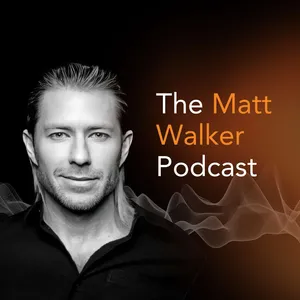
The Matt Walker Podcast is all about sleep, the brain, and the body. Matt is a Professor of Neuroscience at the University of California, Berkeley. He is the author of the book, Why We Sleep and has given a few TED talks. Matt is an awkward British nerd who adores science and the communication of science to the public.
Latest Episodes
The most recent episodes — sign up to get AI-powered summaries of each one.
- 6 days ago23 min
#151 - The Geography of Sleep
Matt breaks down the conflict between wall clocks and our biological rhythms, explaining how latitude and longitude dictate our rest. Latitude alters seasonal daylight and melatonin - though artificial light mutes this natural cycle - and broad time zones create "social jet lag." People on the western edge of a time zone face later sunsets and chronic sleep loss, a problem worsened by the physiological disruption of Daylight Saving Time. Warmer climates also rob us of deep sleep. To r...
- 1 weeks ago31 min
The Neuroscience of Déjà Vu
Matt digs into the neuroscience of déjà vu, reframing it as a sign of a healthy brain performing real-time error correction. Using a "doorman" (familiarity) vs. "concierge" (recollection) analogy, Matt explains how memory systems misfire. When the rhinal cortex signals recognition for new scenes, the frontal "fact-checker" flags the mismatch, creating a mental "tilt" that proves the brain is actively monitoring reality rather than experiencing a premonition. Matt connects these structures to ...
- 2 weeks ago35 min
The Night Ferryman: A Sleep Story Read by Matt Walker
Join Matt for a serene excursion across a valley lake under the cover of night. After finding a comfortable position and centering your breath, you will step onto the deck of a weathered ferry. Marcus, the pilot, unties the lines, steering you away from the daily bustle and into a world where the only clock is the steady vibration of the hull against the water. Feel the cool evening breeze as the boat glides across the dark mirror of the lake. Experience a profound stillness as the engine sto...
- 3 weeks ago27 min
#149 - The 11 largest Sleep Myths
Debunking 11 sleep myths, Matt begins by explaining that the brain remains active, not "off," during rest. He goes on to argue that 7-9 hours of sleep is vital and warns that "adapting" to less is a delusion that masks performance deficits and long-term health risks. Matt also shows how alcohol, warm rooms, and staying in bed while restless ruin sleep quality. He concludes with a practical, evidence-based toolkit for better rest, emphasizing the importance of a consistent seven-to-nine-hour s...
- Aug 17, 202632 min
#148 - Psychedelics for Mental Health
Matt delves into how psychedelics like psilocybin and LSD quiet the "Default Mode Network" to boost neuroplasticity. He describes these molecules as a "crowbar" that allows therapy to break deep-seated patterns of depression and reorganize the mind. Matt also reviews MDMA and ketamine trials for PTSD and trauma. While noting the brain's capacity for rapid change, he addresses research risks like the "blinding problem" and debunks microdosing myths. In essence, today’s episode presents a balan...
- Aug 10, 202625 min
#147 - Does Sleep Really Clean Your Brain?
Matt explores the brain's secret plumbing, a waste-clearance network once ignored for over a century. He explains how the glymphatic system flushes metabolic toxins like amyloid-beta during sleep. This "night shift" allows fluid to cleanse neurons, offering a key defense against cognitive decline. He also examines the latest debates, including norepinephrine’s role in pumping fluid through rhythmic arterial squeezing, and contrasts natural sleep with drug-induced sedation, warning that aids...
- Aug 3, 202620 min
#146 - How Sleep Changes Across the Human Lifespan
Matt tracks sleep across the human lifespan, from newborn "active sleep" to the shifts of healthy aging. He explores how biological milestones - like puberty, pregnancy, and menopause - impact rest, reframing disruptions as responses to life pressures rather than personal failings. He goes on to examine the roles of trauma, grief, and retirement, highlighting the clinical efficacy of CBT-I. Matt concludes that while sleep naturally evolves, severe insomnia remains treatable and requires suppo...
- Jul 27, 202632 min
#145 - How to get More Deep Sleep
Matt explains the science of deep sleep, emphasizing that this front-loaded stage is vital for physical and mental repair. To boost it, he recommends "builders" like consistent wake times, daily exercise, and pre-bed warming to trigger core cooling. These habits help align the body's clock and maximize the restorative cycles occurring early in the night. Matt also warns against "saboteurs" like caffeine, alcohol, and cannabis, which fragment sleep architecture despite appearing to help. He ...
Get The Matt Walker Podcast summaries in your inbox
Free AI-powered daily recaps. Key takeaways, quotes, and mentions — in a 5-minute read.
Get Free Summaries →Free forever for up to 3 podcasts. No credit card required.
You Might Also Like
Listeners also like.

Sleep Tight Science - A Bedtime Science Podcast For Kids
A bedtime science podcast for kids that answers their big questions about the natural world in a calming, family-friendly way.

Huberman Lab
Explores neuroscience and science-based tools for understanding and improving brain function, behavior, and health.

The Model Health Show
Shawn Stevenson explores health and fitness topics including nutrition, sleep, hormones, and exercise with expert guests.
The Psychology Podcast
Explores human potential and possibility through conversations with scientists, thinkers, and self-actualized individuals.

Modern Wisdom
Discussions with experts on psychology, philosophy, and self-improvement to help navigate life’s challenges.

Brain Science with Ginger Campbell, MD: Neuroscience for Everyone
Explores neuroscience discoveries and how the brain shapes human identity through interviews and book discussions.
I Can’t Sleep
A soothing voice narrates slow, factual stories from science and history to help listeners fall asleep.
Stuff To Blow Your Mind
Explores the strange edges of science, consciousness, and reality through neuroscience, cosmology, evolution, and emerging technology.

Hidden Brain
Explores human behavior and the unconscious patterns that shape our decisions, relationships, and society through science and storytelling.

Sean Carroll's Mindscape: Science, Society, Philosophy, Culture, Arts, and Ideas
Conversations with leading thinkers exploring fundamental ideas in science, philosophy, culture, and the arts.

FoundMyFitness
A podcast exploring health, science, nutrition, aging, and fitness.
The NoSleep Podcast
Original horror stories presented as an immersive audio experience with atmospheric music.
About The Matt Walker Podcast
The Matt Walker Podcast is all about sleep, the brain, and the body. Matt is a Professor of Neuroscience at the University of California, Berkeley. He is the author of the book, Why We Sleep and has given a few TED talks. Matt is an awkward British nerd who adores science and the communication of science to the public.
Customized Recaps
AI-powered recaps with compact key takeaways, quotes, and insights.
Straight to Your Inbox
Get key takeaways from The Matt Walker Podcast in a 5-minute read.
Save Hours Every Week
Stay current on your favorite podcasts without falling behind.
Frequently Asked Questions
What is Podzilla's The Matt Walker Podcast daily summary?
It's a free AI-powered email that summarizes new episodes of The Matt Walker Podcast as soon as they're published. You get the key takeaways, notable quotes, and links & mentions — all in a quick read.
How does the The Matt Walker Podcast podcast summary work?
When a new episode drops, our AI transcribes and analyzes it, then generates a personalized summary tailored to your interests and profession. It's delivered to your inbox every morning.
Is this an official The Matt Walker Podcast product?
No. Podzilla is an independent service that summarizes publicly available podcast content. We're not affiliated with or endorsed by Dr. Matt Walker.
Can I get summaries of other podcasts too?
Absolutely! The free plan covers up to 3 podcasts. Upgrade to Pro for 15, or Premium for 50. Browse our full catalog at /podcasts.
How often does The Matt Walker Podcast release new episodes?
The Matt Walker Podcast publishes weekly. Our AI generates a summary within hours of each new episode.
What topics does The Matt Walker Podcast cover?
The Matt Walker Podcast covers topics including Science, Medicine, Fitness, Health & Fitness, Social Sciences. Our AI identifies the specific themes in each episode and highlights what matters most to you.
Start getting The Matt Walker Podcast summaries tomorrow morning.
Free forever for up to 3 podcasts. No credit card required.
Free forever for up to 3 podcasts. No credit card required.