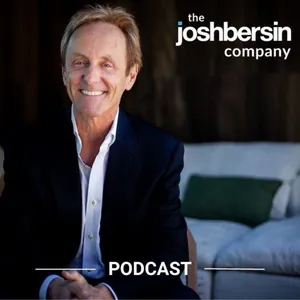
Free Daily Podcast Summary
The Josh Bersin Company: Daily Summaries Delivered
by Josh Bersin
Insights on Corporate Talent, Learning, AI, and HR Technology. I discuss new research on all areas of management, leadership, economics, and HR, informed by our proprietary research and deep discussions with clients, vendors, and technology providers. We also publish interviews and case studies from some of the most fascinating and innovative leaders in HR and business.
Latest Episodes
The most recent episodes — sign up to get AI-powered summaries of each one.
- Yesterday19 min
Perspectives On Jensen Huang, AI Maturity, Why The AI Market Is So Crazy
This has been a big week for the AI industry, NVIDIA, US politics, and our partnership with Workday. In this podcast I give you some bigger historic perspectives on Jensen Huang’s transition, and also explain why this kind of thing happens. I hope this helps you make sense of this exciting, over-hyped industry. Per my many meetings with clients this week, AI is just as transformational as you think – it’s just going to take longer than we hoped to see this technology play out in real-world corporate solutions. In HR, our HR2030® project now has 50+ companies joining in this process, let us know if you’d like to participate. And I could not be more excited about our important partnership with Workday. Read more about it in today’s news release (demo included) and my article with more details. If you want to understand the real business implications of AI on your job, company, and career, read our new book “Superpowered: How AI Unlocks the Superpower of People, Leadership, and Teams,” now available. More Information HR 2030: How AI Superagents Transform HR From Service Delivery to Dynamic Business Enablement The Leader’s Guide To Multi-Agent AI Architecture What is Galileo Jupiter Release And How Does it Integrate with Workday? Chapters - Introduction and Galileo on Workday announcement - The Jensen Huang/Nvidia controversy unfolds - Chip sales to China and political fallout - Business, profit, and Milton Friedman's capitalism debate - Lobbying, regulation, and the AI politics parallel - Growth at any cost: lessons from corporate failures - Growth as outcome, not strategy - Companies as citizens and societal accountability - Hyperbolic AI executive rhetoric examined - Connecting corporate failures to political upheaval - Looking ahead: rational AI adoption and HR 2030 - Closing remarks and Workday Rising invite
- 4 days ago20 min
Lessons From The Blue Wave: People Win in the End
This week I give you my perspectives on the business lessons from the Blue Wave elections last week. As you’ll hear, the big message is all about what I call “Citizenship.” We are citizens within our companies, cities, states, and country. Citizens have responsibilities and important roles, seperate from “profit seeking.” And what I’ve learned from my book Irresistible, is that individuals always win at the end. Listen up – this is a series of lessons for us as leaders, workers, job seekers, and professionals. The Blue Wave shows us how individuals eventually rise up to do “the right thing,” and this same lesson applies to our companies. To understand the power of individuals in business, please read my book “Irresistible” and our new book explaining the role of AI in empowering people, “Superpowered.” Big announcement coming later this week. Additional Information Why The Blue Wave Will Be Good for Business, AI, and Tech US Workforce In 2035: A Few More Workers, A Lot More Output Corporate Citizenship Redefined: Trust, Inclusion, and Responsibility Chapters - Introduction and Travel Update - The Blue Wave: People Always Win - Two Years of Political and Economic Turmoil - Lessons for Leaders from the Election - Why Stability Benefits Business - Wages, Wealth Gaps, and Consumer Struggles - Interest Rates, Debt, and Labor Shortages - The Trust Crisis in Institutions - Debunking AI Job Loss Fears - Companies as Institutions and Internal Politics - Leadership, Listening, and Autonomy - Citizenship as a Business Concept - Stakeholders Beyond Shareholders - Employees as the True Stakeholders - Citizenship, Bias, and Business Culture - Competitors, Customers, and Final Thoughts - Closing Remarks and Teaser
- 1 weeks ago31 min
HR Pacesetter Story: Cisco's "Edge Up" Learning Transformation
Skills are changing faster than traditional learning models can keep up — especially as AI continuously reshapes jobs and work. For Cisco, a global technology company with more than 80,000 employees, that reality demanded a more agile, strategy-aligned, and unified approach to development. Enter Edge Up: the brand behind Cisco’s bold learning transformation. In this episode, we speak with Marci Paino, Chief Learning Officer at Cisco — a 2026 HR Pacesetter Award winner — about how her team moved from fragmented legacy learning to a unified, AI-powered skilling ecosystem. Marci walks through four key pillars of Cisco’s learning transformation: AI-powered lifelong learning mindset, Cisco’s strategic capabilities, always-on modern learning, and a unified skilling environment. She also shares the results Cisco has seen: from replacing a 20-year-old tech stack three times faster than the industry average to a culture where employees embrace continuous learning. Marci Paino is Cisco’s Chief Learning Officer, driving AI-era workforce readiness for 80,000+ employees and leading the cross-industry AI Workforce Consortium, backed by 20+ years shaping talent development and digital transformation at companies like American Express, Accenture, and Western Digital. We awarded Marci a JBC Pacesetter award in 2026 for her leadership and strong AI-centric focus. If you have an innovative solution you’d like to share, join our Pacesetters Program. Additional Information Download the Pacesetter Research Irresistible 2027: The Global HR Conference for Leaders and Teams (Sign up now: May 17-19, 2027) Research: From Training to Dynamic Enablement Your Learning: The Global HR Excellence Certification Galileo goes Enterprise: The Jupiter Release Chapters - Introduction and Guest Welcome - Marcy's Role and Cisco Learning Priorities - State of Learning Before Transformation - Overview of the Four Strategic Pillars - Defining Guiding Principles and Culture - Building the Skills Intelligence Engine - Modernizing the Technology Stack - Enabling Modern, AI-Driven Learning Experiences - EdgeUp Labs and Time to Grow - Measuring Success and Results - What's Next: Agentic AI and the Skills Flywheel - Key Takeaways and Closing Thoughts
- 1 weeks ago37 min
Guild Unlocks Opportunity for America's Workforce: Bijal Shah, CEO
More than 70% of US workers are frontline workers and most of our workforce is worried about AI. How do we as a country and we as employers help our people reskill, upskill, and educate themselves as adults? Well Guild, which started its life as a tuition reimbursement management company, has pioneered a new model. By working with employers and credentialed education institutions, Guild gives employers a set of solutions to train, educate, certify, and license people for new, higher paying jobs. For companies in manufacturing, healthcare, airlines, and other regulated sectors Guild also helps “up-license” the technicians and specialists we need. The solution to this problem is complex, and Guild took on this entire problem. The company works with many types of training and learning providers and also provides coaching, career pathways, and their own learning programs to help. For any company looking to fill critical talent gaps with new skills or new licensed workers, Guild is an amazing solution. Guild also focuses on giving employees a new sense of engagement and opportunity. Clients include Amazon, Pepsico, Lowes, and many other large organizations. Bijal explains the market and solution in a comprehensive way, this is a good conversation to help you understand the entire scale of this challenge. She also unlocks some of the secrets of broad reskilling and behavior change programs, including AI transformation. Additional Information Guild Jumps Headfirst Into The Corporate Learning Market The Capability Academy: Where Corporate Training Is Going What Is Task or Work Intelligence And Can We Decompose Every Job For AI? The Global HR Excellence Certification: Learn to be an AI HR Expert Chapters - Introduction to Bijal Shah and Guild - Bijal's Background and Path to Guild - Guild's Original Model and Evolution - Problems Employers Are Solving Today - The Role of Education and Degrees Today - From Good Deed to ROI-Driven Solutions - Coaching, Human Connection, and Fragile Workforce - Guild's Core Solution Framework - Guild Academy and Behavior Change - Navigator and Local Pipeline Solutions - Amazon Case Study: Advanced Maintenance Technicians - Disrupting the L&D Industry Model - Managing Complexity as a Marketplace - Cross-Employer and Cross-Geography Aggregation - State and Government Partnerships - Motivation, Fear, and Career Reinvention - Durable Jobs and Economic Rebalancing - Stitching Together Benefits, L&D, and Talent - The Future of L&D and Capabilities - Closing Thoughts on AI and Behavior Change
- 1 weeks ago25 min
Draup CEO Vijay Swami Helps Companies Transform Work for AI
Vijay Swami, co-founder and CEO of Draup, believes the future of workforce planning is not about studying people; it’s about studying work itself. After nearly a decade pioneering talent intelligence, Draup has pivoted toward the most urgent question every enterprise faces: how do you redesign work for the age of AI? In this episode we sit down with Vijay to find out exactly how this works and why it’s more important today than ever. The centerpiece of this evolution is a new product called Etter — named from Norwegian mythology, meaning “always in pursuit of” — because AI transformation is never finished. Insights from Etter help companies model their workforce not around job titles and skills taxonomies, but around processes, workflows, and tasks, then simulate what AI automation would actually mean for each one — quantifying the opportunity in dollar terms for the CFO. For one hospital client, Draup sized the AI opportunity at $2.6–2.8 billion. The interesting part of this story is that Draup reveals a data problem lurking inside most enterprises: HCM systems are disconnected from where work happens — in ERP, Salesforce, Jira, and other operational systems. Draup closes that gap by integrating across HCMs, operational systems, and an evidence layer built on Microsoft WorkIQ, which captures how people actually spend their time. But all of this is not just a technology exercise: Vijay and his team take a consultative approach to solving customer problems, supported by technology. Vijay argues you cannot redesign work if you only know the skills people have, you have to start with understanding the work itself and then redesigning workflows and processes with the outcomes in mind. We call this dynamic work design. Work intelligence platforms like Etter are becoming a critical part of the HR 2030 architecture, and this new market is growing quickly. It’s important to learn about solutions like Draup as you build your AI transformation strategy. Additional Information What Is Task or Work Intelligence And Can We Decompose Every Job For AI? Introducing HR 2030: A Vision For Agentic Human Resources How To Take A Pragmatic (and winning) Approach To Skills AI Transformation From the Frontlines (pod) Chapters - Introduction and Welcome - Meet Vijay Swamy and Drop's Origins - The Meaning Behind Drop and Etter - Five Key Use Cases for Work Redesign - AI Sandbox and Simulating Automation Costs - Skills Architecture and Business Model Shifts - Industry Convergence and Disruption Examples - Building the Etrontology and Data Integration - Integrating with Enterprise Systems - Data Health and Hidden Enterprise Gaps - HCM vs ERP Disconnect and Workforce Twin - HR's New Muscle: Owning Work, Not Just Jobs - Reframing the Story: Processes Over Tasks - Layered Skills Framework: Root, Core, Tech, Soft - The Future: Visual Factory Modeling - Final Advice: Start with the Analyst, Not the VP - Closing Thoughts and Wrap-Up
- 2 weeks ago13 min
Understanding Microsoft's Voluntary Exit Program
As I discuss in this week’s article, Microsoft introduced a “voluntary exit offer” that teaches us some lessons in modern management. It’s not a layoff by any means, despite the flurry of headlines. Listen to me explain why these kinds of programs are part of what I consider “the new model of management.” The old model was “hire to grow.” The new model is more of “grow to hire,” and it focuses on talent density, not the supply chain model of talent management. Additional Information Understanding Talent Density Galileo® goes Enterprise: The Jupiter Release HR 2030®: The New Architecture for Human and Agents Our New Book: Superpowered: How AI Unlocks the Superpower of People, Leadership, and Teams Chapters - Debunking the Microsoft AI Layoff Myth - How the Voluntary Departure Program Works - Talent Density as a Management Strategy - Personal Story: Stuck at Sybase - Making It Easy for Employees to Leave - Why Most Layoffs Aren't About AI - Outdated Hiring Models and Growth Myths - Grow to Hire, Not Hire to Grow - Microsoft's Legacy and Misreading Headlines - The Human Side of Layoffs - Microsoft's Strong Performance and Industry Interest - Netflix, Amazon, and the Origins of Talent Density
- 2 weeks ago21 min
A New, Reinvented HCM Market Has Arrived, And It's Hot.
The HCM (human capital management) market is being reinvented by AI. In this podcast I explain why and how HCM may become the center of the corporate AI revolution. Why? There are many reasons, but perhaps the biggest is that AI agents are like people, and the HCM platform will help us manage, optimize, train, align, and leverage these new digital workers. This impacts the revenue and strategies of Workday, SAP, Oracle, UKG, HiBob, Dayforce, Gloat, Darwinbox, ADP, and other vendors who make up more than $70 billion in IT spending. Listen more for details, or read the article published today. Additional Information AI Makes The HCM Market Hot Again: Workday, SAP, Oracle, and More. Galileo® goes Enterprise: The Jupiter Release HR 2030®: The New Architecture for Human and Agents Our New Book: Superpowered: How AI Unlocks the Superpower of People, Leadership, and Teams
- 3 weeks ago27 min
Economics of AI: Prices will Fall, Wages will Rise, and Lessons from 1873
Today I summarize my keynote from Unleash Paris this week, where I draw a line between generative AI’s birth in November of 2022 and the Railroad Era of 1873. Not only are the parallels uncannily similar, it points out that AI’s takeover of our economy has impacted employment, politics, and our teetering stock and bond market. Here is the article detailing the story. I recommend you read two books after you listen to this. The first is 1873: The First Great Recession, which describes the global financial disaster brought on by the railroad boom. The second is our new book Superpowered: How AI Unlocks The Power of People, Leadership, and Teams. These two books will teach you what is likely to happen in our confusing new AI era, and how you should proceed. I also describe why the economics of AI are about to change, how NVIDIA has become a monopolist, and why there is no such thing as an “AI transformation,” rather a “Business transformation.” And I explain HR 2030 and how to think about your AI architecture before you rush out and buy dozens of new agents. Finally I also explain the four big use-cases for AI in HR, so you can stay focused in your investments. PS: Galileo is now available integrated with Workday, HiBob, Ema, Microsoft Copilot, Gloat, and ServiceNow. New executive compensation benchmarking data from Equilar is now added! Additional Reading Material Time to re-frame HR as an integrated OS? Josh Bersin makes his case Workday and Josh Bersin Company Partner on HR 2030 Education and Research Despite Massive AI Investments, HR Jobs Are Booming. Why? Introducing The Leader’s Guide To Multi-Agent AI Architecture Galileo Jupiter Release goes Enterprise Chapters - Back from Europe: Unleashed Conference Recap - The AI Buildout Boom and the Railroad Parallel - AI Costs, Nvidia's Dominance, and Market Growth - Inflation, Energy Crisis, and Worker Unrest - Wage Stagnation, Labor Share, and Employee Engagement - HR's Confusion and Vendor Landscape (Workday, SAP, Oracle, etc.) - Wall Street Pressure and Buying AI the Right Way - AI as Growth Driver, Not Cost Cutter - Productivity Needs and GDP Growth Math - Building AI as an Enterprise Architecture - Build vs Buy and Managing AI Agents - Big Vendors' Advantage and Data Ownership - Framing AI as Business Projects, Not Tech Projects - The J Curve and Vendor Market Shakeout - HR 2030 Resources and European Riots Context - Frontier Vendor Hype vs Market Reality - Four High-ROI HR AI Project Areas - Learning, L&D, and Galileo Learn - Redesigning HR Business Partner Roles - Other Opportunities: Onboarding, Payroll, Compensation - Skepticism Toward AI Hype Figures - Data Center Overbuild and Economic Outlook - Superpowered Vision: Wages, Growth, and HR 2030 - Europe's Pragmatic AI Approach and Closing Thoughts
Get The Josh Bersin Company summaries in your inbox
Free AI-powered daily recaps. Key takeaways, quotes, and mentions — in a 5-minute read.
Get Free Summaries →Free forever for up to 3 podcasts. No credit card required.
You Might Also Like
Listeners also like.
The AI in Business Podcast
Interviews with AI executives reveal practical applications and strategic insights for business leaders adopting AI.

Sources with Alex Heath
Candid conversations with tech leaders and founders about AI, innovation, and the future of Silicon Valley.
Me, Myself, and AI
Leaders from top companies share real-world strategies for turning artificial intelligence into measurable business results.

Silicon Valley Girl: AI, Tech and Career Growth
Marina Mogilko interviews tech leaders and AI founders about career growth, entrepreneurship, and navigating the AI revolution.
Training Data
Discussions with AI researchers and builders exploring the technological, business, and societal impacts of artificial intelligence.

Digital Disruption with Geoff Nielson
Industry leaders and innovators discuss how to adapt to and leverage digital transformation in the evolving technological landscape.

Becker Business
Scott Becker

The AI XR Podcast
Insightful interviews with tech founders and executives on AI, virtual reality, augmented reality, and the future of spatial computing.

What Comes Next with Arun
Explores how data and AI strategy create competitive advantage in business, based on real-world enterprise experience.
The AI Daily Brief: Artificial Intelligence News and Analysis
A daily analysis of artificial intelligence news, exploring its creative potential, industry impacts, and ethical challenges.
HBR IdeaCast
Features leading thinkers in business and management discussing key ideas and trends.

Your Undivided Attention
Explores how technology reshapes human behavior, society, and thought with insights from experts and innovators.
About The Josh Bersin Company
Insights on Corporate Talent, Learning, AI, and HR Technology. I discuss new research on all areas of management, leadership, economics, and HR, informed by our proprietary research and deep discussions with clients, vendors, and technology providers. We also publish interviews and case studies from some of the most fascinating and innovative leaders in HR and business.
Customized Recaps
AI-powered recaps with compact key takeaways, quotes, and insights.
Straight to Your Inbox
Get key takeaways from The Josh Bersin Company in a 5-minute read.
Save Hours Every Week
Stay current on your favorite podcasts without falling behind.
Frequently Asked Questions
What is Podzilla's The Josh Bersin Company daily summary?
It's a free AI-powered email that summarizes new episodes of The Josh Bersin Company as soon as they're published. You get the key takeaways, notable quotes, and links & mentions — all in a quick read.
How does the The Josh Bersin Company podcast summary work?
When a new episode drops, our AI transcribes and analyzes it, then generates a personalized summary tailored to your interests and profession. It's delivered to your inbox every morning.
Is this an official The Josh Bersin Company product?
No. Podzilla is an independent service that summarizes publicly available podcast content. We're not affiliated with or endorsed by Josh Bersin.
Can I get summaries of other podcasts too?
Absolutely! The free plan covers up to 3 podcasts, any in the catalog. Basic raises that to 15, Pro to 40 and Max to 100. Browse our full catalog at /podcasts.
How often does The Josh Bersin Company release new episodes?
The Josh Bersin Company publishes 2x weekly. Our AI generates a summary within hours of each new episode.
What topics does The Josh Bersin Company cover?
The Josh Bersin Company covers topics including Technology, Business. Our AI identifies the specific themes in each episode and highlights what matters most to you.
Start getting The Josh Bersin Company summaries tomorrow morning.
Free forever for up to 3 podcasts. No credit card required.
Free forever for up to 3 podcasts. No credit card required.