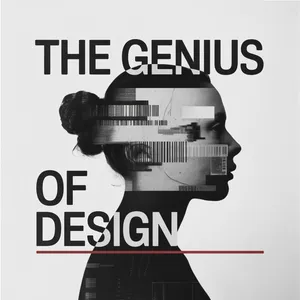
Free Daily Podcast Summary
The Genius Of Design: Daily Summaries Delivered
by Ousman Diallo
The place where creatives/builders find inspiration, discover tools, and develop the mental models they need to thrive in a digital world.
Latest Episodes
The most recent episodes — sign up to get AI-powered summaries of each one.
- 1 weeks ago2h 1m
This 1 Book Has Produced More Geniuses Than Any University in History
Richard Feynman reportedly had an IQ of 125, below the cutoff most tests use for "gifted." Abraham Lincoln sharpened his reasoning by studying a 2,000-year-old geometry book, Euclid's Elements. And according to Stephen Petro, there's no such word as genius in psychometrics at all. So what are we actually describing when we call someone a genius, and how much of it can the rest of us build?Stephen Petro is an educator and YouTuber with a background in philosophy and business. His channel, closing in on a quarter of a million subscribers, digs into the books, curriculums and habits behind history's greatest minds; his breakdown of the one book that's produced more geniuses than any university has been watched over a million times. He runs Critical Thinking Academy, a course for startup founders and executives, and tests his ideas in live public debates.In this conversation, Stephen and I get into why most self-help tells you what to think instead of how to think, what the investment theory of intelligence says about people who out-learn those with higher IQs, and why critical thinking skills rarely transfer to real life unless they're named and taught explicitly, which is how someone ends up brilliant academically and terrible with money. We talk about René Girard's mimetic desire, the status treadmill, and the deathbed test for whether you're chasing the right things.Then we get practical. Stephen explains why two equally bright people can end up worlds apart fifteen years later, why it takes an almost obsessive commitment (and when you should actually give up), and why 50 failures are really 50 data points. We take on AI: how to use it without outsourcing your mind, why AI detectors won't save the essay, and why Goodhart's Law means you can't blame students for optimizing for the grade. And we close with Lev Landau's Theoretical Minimum, the brutal curriculum and exam the Nobel Prize-winning physicist set for anyone who wanted to work with him.If genius isn't something you're simply born with, what's stopping you from building it?If you're a designer, creator or builder who wants to sharpen how you think in the age of AI, this one's for you.Find Stephen on YouTube and TikTok (Stephen Petro) and on Instagram (@thinkitthrough411).
- 3 weeks ago18 min
The Most Dangerous Kind of Procrastination Looks Like Ambition
The most dangerous kind of procrastination doesn't look like procrastination. It looks like ambition. You're building, preparing, grinding, sacrificing now for later. But what if the life you're waiting to start is the one you're already living?Franz Kafka spent his days at a workers' accident insurance office in Prague and wrote at night, convinced his real life was happening somewhere else. He asked his friend Max Brod to destroy much of his work after his death. Brod didn't, and the writing Kafka squeezed into the margins became the work that defined him. Fernando Pessoa went further. Through Bernardo Soares, the Lisbon bookkeeper of The Book of Disquiet, he turned postponement into an identity: "I've always lived on the edge of things."In this episode, I look at what Carl Jung called the provisional life:- why ambitious people give waiting respectable names: focus, discipline, sacrifice- how keeping every possible life open becomes a way to avoid choosing one- the Harvard study that found our minds wander 46.9% of the time, and the "end of history illusion"- Kafka's parable Before the Law, and a door built for only one manYou can build an audience while waiting to feel legitimate. You can make art while waiting to feel like an artist. So what part of your life have you decided doesn't count yet?If you're a designer, creator or builder who keeps telling yourself the real thing starts after the next launch, this one's for you.
- Oct 13, 202617 min
She Never Showed Anyone: Vivian Maier & the Case for Creating Without an Audience
What if some of the greatest work of the 20th century was made for no one?For about forty years, Vivian Maier worked as a nanny, most of that time in Chicago. On her days off she walked the streets with a Rolleiflex around her neck and photographed strangers, children,shop windows and her own shadow. She took more than 100,000 photographs and showed almost none of them to anyone. Thousands of rolls were never even developed. In 2007, a box of her negatives sold at a Chicago storage auction. Two years later she died, unknown, just before the world started calling her one of the great street photographers.In this episode, I look at what Maier's life says about why we make things:- the difference between making work and building an audience- what it means to have an eye with no one watching- why the habit of seeing might matter more than being seenIt's an uncomfortable question for anyone creating in public today. If no one had seen it, would it still have been great?If you're a designer, creator, builder or creative who has ever wondered whether your work counts without likes, followers or a byline, this one's for you.
- Oct 1, 20261h 30m
97% of Listeners Couldn't Tell… Rithik Kundu on AI Music, Taste & the Death of the Creative Process
Listeners Preferred the AI Song… Rithik Kundu on What a Blind Test Reveals About Taste, Originality & the Future of MusicWhat happens when listeners don't know which song was made by a human and which was made by AI?Rithik Kundu is a Brooklyn-based music-tech researcher, producer, and investor working where generative audio, AI, and music rights meet. He founded NYU Generative Audio & AI, is a managing partner at Joker Deck Ventures, and contributes to the World Intellectual Property Organization's technical network on AI and copyright. His blind listening study — human-made tracks from Grammy-winning producer Mr. Sonic set against AI-generated parallels made in Suno — has been presented at Sony.In this conversation, Rithik and I dig into what that study found: across 95 listeners and four genres, the human-made music won in reggaeton and cumbia norteña, while the AI tracks were often preferred in the more Western-leaning genres, even as listeners described them as familiar and generic. We talk about why familiarity drives taste in a world of more than 100,000 new uploads a day, why training data is the "fruit in the blender" behind every AI song, and what happens to genres that barely exist in that data.We also get into the fear of the "death of the process," why the major labels may want their own AI more than they want to stop it, and what fair compensation could look like, from attribution technology to royalties for the artists whose work trains the models. Then we zoom out: open-sourcing training data, the Napster parallel, synthetic data, spoken-word poetry, and what young creators lose if they skip the fundamentals and go straight to the prompt.If you're a musician, designer, or builder trying to figure out where human craft still matters in the age of generative AI, this one's for you.
- Sep 21, 20261h 6m
Reaching 100 Million People Used to Cost Millions. Now It's Free: Why Most Creators Still Waste It
Up until about ten years ago, reaching a hundred million people would have cost you millions upon millions of dollars. Today it's free — it fits in your pocket. So why do most creators still stay invisible?Jake Isham is a Los Angeles–area filmmaker-turned-brand strategist and the Founder & CEO of Creative Minds. With over 1 billion views generated and more than 150 brands served, his work spans names like Callaway Golf, Grant Cardone, 5.11 Tactical, TravisMathew, Marshall Faulk, and Chloe Fineman. Instead of chasing vanity metrics, Jake uses cinematic storytelling structure to turn lived experience into lasting credibility and influence.In this conversation, Jake and I dig into what it means that anyone can now reach an audience once reserved for the biggest ad budgets — and why the difference between building a business and becoming an entertainer changes everything about how you should use it. We talk about why the biggest companies still have a face, how Matthew McConaughey walked away from a $10 million rom-com to rebuild his personal brand, and what Jake has learned from watching famous clients once the cameras stop rolling: the ultra-successful love hard work the way athletes love the game.We also get into the long road to craft — his father's advice to "keep a camera in your hand," why Christopher Nolan and Michael Bay were directing corporate videos and commercials before their first features, and why an artist selling their work is running a business whether they like it or not. Then comes the uncomfortable math: unless you're a one-in-a-million outlier, you have to out-create the market. Three posts a day, on five platforms, for a year — five thousand posts. Be willing to suck. Grit, not genius, is the determining factor.If you're a creator, artist, or founder who's been waiting for permission — or for the algorithm to find you — this one's for you.
- Jul 30, 202627 min
Building for a World That Is No Longer Predictable: Tammy Coombs & the New Rules of Product Design
For most of software’s history, designers could assume that an input would produce a predictable output. AI is changing that.In this episode, Ousman speaks with Tammy Coombs, a product designer and design engineer with more than 15 years of experience building complex tools for security, reliability, and operations teams. Her work has included leading UX initiatives at Palo Alto Networks and designing AI systems for security researchers, Site Reliability Engineers, and other expert users working in high-stakes environments.Tammy explains how product design must evolve as software moves from deterministic workflows toward probabilistic systems that interpret human intent—and sometimes get it wrong.They discuss the growing overlap between design and engineering, the role of Figma in an AI-assisted workflow, designing guardrails around natural-language interfaces, and why AI should support human judgment rather than quietly replace it.The conversation also explores what remains unchanged: understanding users, learning the language of a complex domain, experiencing failure firsthand, and knowing when technology should simply get out of the way.
- Jul 21, 20261h 57m
Beyond the Prompt: Boris Eldagsen & the New Value of Human Judgment
AI Can Generate. Can You Judge? Boris Eldagsen & the New Rules of Knowledge WorkIn 2023, Boris Eldagsen won the Creative Open category of the Sony World Photography Awards with an AI-generated image—and then refused the prize.The experiment exposed a larger problem: technology was moving faster than the institutions responsible for evaluating, regulating, and governing it.Boris Eldagsen is a Berlin-based artist, philosopher, educator, consultant, and early practitioner of generative AI. He works directly with emerging models, tests new systems, teaches AI workflows, and advises organizations navigating the shift from traditional production to human–AI collaboration.In this episode, we move beyond the question of whether AI-generated images qualify as photography.Instead, we examine what happens when producing an answer, image, strategy, or piece of work becomes nearly effortless.What becomes more valuable when output becomes abundant?Boris argues that AI is a knowledge amplifier. It rewards people who understand their domain, can provide useful context, recognize weak output, and make deliberate decisions about what happens next.
- Jul 9, 202619 min
They Did Everything Right, But No One Hired Them (Pt.2)
Why Building Anything Beats Waiting for Permission — The Optionality Argument Nobody Makes (Part 2)Last episode we did the hard half — the broken promise, the 41.5% underemployment, the grief a generation isn't allowed to name. This is the other half. Because while institutions take their time catching up, you still have to wake up tomorrow and decide what to do with the day in front of you.So we change the question: forget what society owes you for a moment — what does the practice of building actually offer you, sitting where you sit, with the life you actually have? The answer is not what most people tell you, and once you see it framed correctly, you can't unsee it.We start with Jevons Paradox — a 160-year-old principle that explains why making coal more efficient made Britain burn more of it, and why the printing press, the automobile, and the internet each created entire worlds nobody could have predicted. Then we get honest about the uncertainty, because the historical pattern is encouraging, not guaranteed.And then the spine of the episode: the real case for building. Most people frame it as a bet on success — build the thing, hope it grows. That framing is wrong, and it's why building feels demoralizing. The actual case is this: building is not a bet on outcomes. It's the construction of optionality. You're not building because the thing will save you. You're building because every node you put into the world becomes a door — and in a world where the doors you were promised are closing, the person with the most doors wins. We take the survivorship-bias objection head on, and show why it actually strengthens the argument.We close with two honest tracks — one for the listener with stability, one for the listener in survival mode — because they are not having the same conversation, and pretending they are is why this kind of advice usually rings hollow.Both truths, held at once: the structural critique is real, and it doesn't get to stop you from building. The roads you were promised are closing. The doors you make are the doors you keep.
Get The Genius Of Design summaries in your inbox
Free AI-powered daily recaps. Key takeaways, quotes, and mentions — in a 5-minute read.
Get Free Summaries →Free forever for up to 3 podcasts. No credit card required.
You Might Also Like
Listeners also like.

The Honest Designers Show
A candid look at building a successful creative career, covering client work, personal style, branding, and fulfillment in design.

User Defenders – UX Design & Personal Growth
A podcast for UX designers focused on personal growth, purpose, and the human side of design to create deeper impact.

Am I the Genius?
A daily comedy podcast exploring bizarre and relatable human experiences through listener-submitted stories.

Expert Intelligence with Paul Estes
Explores the intersection of human expertise and AI in shaping the future of work through interviews with industry leaders and innovators.

The Builders
Intimate conversations with leading figures in AI and tech exploring their visions, fears, and motivations shaping the future.

TechStuff
TechStuff explores how technology, AI, and the internet reshape culture, identity, and power, from Silicon Valley to everyday life.

The Knowledge Project
Explores the mental models and decision-making strategies of high-performing individuals across disciplines.

The Entrepreneur DNA
Entrepreneurs share lessons on building businesses and personal growth through real experiences and mistakes.

In the Making
A look at how creators and entrepreneurs use creativity and digital tools to build careers in the evolving content economy.
A Bit of Optimism
Conversations with thinkers and doers exploring what drives purpose, growth, and meaning in life.
Creative Entrepreneur: A Podcast For Business Growth and Trending News
Examines how entrepreneurship, creativity, and media trends shape modern business and personal branding.

TED Tech
Experts examine how technology reshapes society, science, design, and business through TED Talks hosted by Sherrell Dorsey.
About The Genius Of Design
The place where creatives/builders find inspiration, discover tools, and develop the mental models they need to thrive in a digital world.
Customized Recaps
AI-powered recaps with compact key takeaways, quotes, and insights.
Straight to Your Inbox
Get key takeaways from The Genius Of Design in a 5-minute read.
Save Hours Every Week
Stay current on your favorite podcasts without falling behind.
Frequently Asked Questions
What is Podzilla's The Genius Of Design daily summary?
It's a free AI-powered email that summarizes new episodes of The Genius Of Design as soon as they're published. You get the key takeaways, notable quotes, and links & mentions — all in a quick read.
How does the The Genius Of Design podcast summary work?
When a new episode drops, our AI transcribes and analyzes it, then generates a personalized summary tailored to your interests and profession. It's delivered to your inbox every morning.
Is this an official The Genius Of Design product?
No. Podzilla is an independent service that summarizes publicly available podcast content. We're not affiliated with or endorsed by Ousman Diallo.
Can I get summaries of other podcasts too?
Absolutely! The free plan covers up to 3 podcasts, any in the catalog. Basic raises that to 15, Pro to 40 and Max to 100. Browse our full catalog at /podcasts.
How often does The Genius Of Design release new episodes?
The Genius Of Design publishes weekly. Our AI generates a summary within hours of each new episode.
What topics does The Genius Of Design cover?
The Genius Of Design covers topics including Technology, Arts, Design. Our AI identifies the specific themes in each episode and highlights what matters most to you.
Start getting The Genius Of Design summaries tomorrow morning.
Free forever for up to 3 podcasts. No credit card required.
Free forever for up to 3 podcasts. No credit card required.