Free Daily Podcast Summary
The Future Of The Future: Daily Summaries Delivered
by Mateo Bervejillo
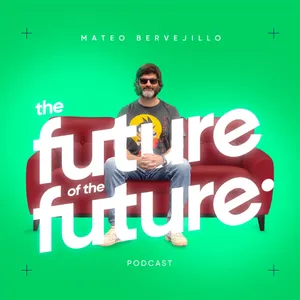
Mateo Bervejillo interviews Technology Leaders to talk about everything and anything related to Technology and the Future. Guests open up about their stories and opinions on cutting edge topics, in an informal conversation tone.
Latest Episodes
The most recent episodes — sign up to get AI-powered summaries of each one.
- 4 days ago19 min
206. Jake Dubin. Human Judgement In An AI Native World.
AI is making it easier than ever to build software; but building software faster doesn't necessarily mean building it better. As code becomes cheaper to generate, engineering judgment becomes more valuable, not less.Today's guest, Jake Dubin, has spent more than 25 years building and scaling technology companies through multiple waves of innovation. From engineering and architecture to CTO, founder, and inventor, he's seen firsthand that while AI is changing how we create software, it hasn't changed the fundamentals: great architecture, security, scalability, testing, and human accountability still matter.In this conversation, we explore where AI genuinely transforms software development, where the hype gets ahead of reality, and why the future belongs not to AI alone, but to teams that know how to combine AI speed with human judgment.
- 6 days ago13 min
205. Saurin Shah. When Execution Is Free, What Should We Build?
Technology has always rewarded people who could build. But as AI makes execution faster, cheaper, and more accessible than ever, a new question is emerging: if almost anyone can build almost anything, how do we decide what's actually worth building?Today's guest is Saurin Shah, a product and technology leader who has spent his career at the intersection of engineering, product strategy, and innovation. We'll explore how the roles of engineers, designers, and product leaders are converging, why creativity may become the most valuable skill in the AI era, what experiences shaped his approach to innovation, and what continues to drive him to build what's next.This is a conversation about the future of product leadership, creativity, and making better decisions in a world where execution is becoming abundant.
- 1 weeks ago39 min
204. Julian Reeve. Unmistakable Identity.
As AI reshapes the way we work, it's easy to get caught up in questions about what jobs will change or which skills will become obsolete. But perhaps the more important question is this: what makes us uniquely human, and why will those qualities matter even more in an AI-powered world?Today's guest believes that while AI is transforming what we do, it doesn't have to change who we are. Julian Reeve is a keynote speaker, burnout specialist, and creator of the Intentional Synthesis™ framework. After surviving a heart attack that forced him to rethink his career and identity, Julian has dedicated his work to helping leaders and organizations build resilience, prevent burnout, and unlock the human capabilities that technology can never replace.In this conversation, we explore the future of leadership in the age of AI, why burnout is a systems problem rather than a personal failure, how leaders can use AI to strengthen, not replace, human judgment, and the habits that help people stay creative, adaptable, and deeply human in a rapidly changing world.
- 1 weeks ago20 min
203. Marcelo SanMartin. A Pragmatic Approach For AI.
Everyone is talking about AI, but buying the latest tools isn't the same as transforming a business. So what does digital transformation actually look like in the age of AI? Where should leaders start, what mistakes should they avoid, and what will separate the companies that thrive from the ones that get left behind?To help us answer those questions, I'm joined by Marcelo SanMartin, a technology and business transformation executive who's spent his career helping organizations navigate major shifts. We dive into what AI means beyond the hype, how it's reshaping strategy, leadership, and the workforce, and what practical steps CEOs can take today to create real business value.
- 2 weeks ago21 min
202. Anuj Gupta. SimForge And Physical AI.
Today's AI can write, code, and reason, but what happens when it leaves the screen and starts interacting with the real world? That's where physical AI comes in, and it could be the next major leap in technology. In this episode, I'm joined by Anuj Gupta, founder and CEO of SimForge, to explore how simulation is becoming the foundation for training intelligent machines. We dive into what physical AI really means, why this moment is different, the challenges of building at the intersection of AI and robotics, and Anuj's own journey from moving to the US to building a deep-tech startup from the ground up. Let's get into it.
- 2 weeks ago37 min
201. Alisha Outridge. The AI Founder Playbook.
Today's AI can write code, build prototypes, and launch products faster than ever before. But if building has become easy, figuring out what's actually worth building has become the real competitive advantage. Today's guest has spent more than 15 years building products at Meta, Reuters, TuneCore, and high-growth startups, and now helps founders avoid the biggest mistake in AI: creating products nobody actually wants to pay for. She's the creator of the AI Founder Playbook, where she teaches entrepreneurs to think like product leaders before they think like AI builders.
- 3 weeks ago28 min
200. Mateo Bervejillo. Lessons From 200 Episodes As A Host.
This is not just another episode; this is our 200th episode. Time flies! When I started this show, back in March of 2023, I never really thought that far into the future, nor did I visualize getting here. Today I want to do more of the talking myself, but I also want to bring our dear Anabella Gonzalez, Ani, to the forefront, so she can interview me. Ani usually stays in the background, but she helps me put everything together, publish the episodes, and even find some of the best guests we've had on the show. In short, she makes my life easier. Enjoy her interview and my answers!
- 3 weeks ago44 min
199. Bogdan Snisar. We Still Want To Trust Humans.
Artificial intelligence isn't just changing how we build software, it's changing how companies operate. From AI employees working alongside humans to the mental models leaders need to unlearn, this episode explores what it really takes to thrive in an AI-first world. My guest is Bogdan Snisar, an engineering leader at Solea AI who has spent more than a decade building software, with previous engineering leadership roles at companies like Revolut and Wix. He's also been on the founder's journey himself, launching multiple startups before joining one of the fastest-growing AI ventures. That combination of operator, engineer, and founder gives him a uniquely practical perspective on product, AI, and what separates great technology from great businesses. Enjoy!
About The Future Of The Future
Mateo Bervejillo interviews Technology Leaders to talk about everything and anything related to Technology and the Future. Guests open up about their stories and opinions on cutting edge topics, in an informal conversation tone.
Customized Recaps
AI-powered recaps with compact key takeaways, quotes, and insights.
Straight to Your Inbox
Get key takeaways from The Future Of The Future in a 5-minute read.
Save Hours Every Week
Stay current on your favorite podcasts without falling behind.
Frequently Asked Questions
What is Podzilla's The Future Of The Future daily summary?
It's a free AI-powered email that summarizes new episodes of The Future Of The Future as soon as they're published. You get the key takeaways, notable quotes, and links & mentions — all in a quick read.
How does the The Future Of The Future podcast summary work?
When a new episode drops, our AI transcribes and analyzes it, then generates a personalized summary tailored to your interests and profession. It's delivered to your inbox every morning.
Is this an official The Future Of The Future product?
No. Podzilla is an independent service that summarizes publicly available podcast content. We're not affiliated with or endorsed by Mateo Bervejillo.
Can I get summaries of other podcasts too?
Absolutely! The free plan covers up to 3 podcasts. Upgrade to Pro for 15, or Premium for 50. Browse our full catalog at /podcasts.
How often does The Future Of The Future release new episodes?
The Future Of The Future publishes weekly. Our AI generates a summary within hours of each new episode.
What topics does The Future Of The Future cover?
The Future Of The Future covers topics including Technology, Education, Business. Our AI identifies the specific themes in each episode and highlights what matters most to you.
Start getting The Future Of The Future summaries tomorrow morning.
Free forever for up to 3 podcasts. No credit card required.
Free forever for up to 3 podcasts. No credit card required.