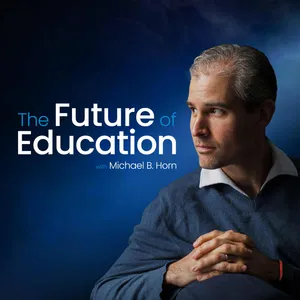
Free Daily Podcast Summary
The Future of Education: Daily Summaries Delivered
by Michael B. Horn
Interviews with the top innovators & changemakers so that you can stay on top of the trends transforming transform learning, education, and the development of talent worldwide so that all individuals can build their passions, fulfill their potential, and live a life of purpose michaelbhorn.substack.com
Latest Episodes
The most recent episodes — sign up to get AI-powered summaries of each one.
- Aug 17, 202622 min
Behind the Explosion in Unconventional Education
Mickey Revenaugh, co-founder of Connections Academy, is out with her debut book titled School’s Out: Why Families Are Choosing Unconventional Education. She joined me—and a surprise cohost, my daughter Kayla!—to talk about what she learned from reporting and writing the book. Together we explored the rise of innovative schooling models and their impact on student learning and traditional education systems, from unschooling models to project-based learning and more. Mickey shared insights on why families are embracing these diverse educational pathways, discussed the challenges and opportunities with assessment and public funding, and expressed optimism that Gen Alpha’s passion for learning and adaptability will mean a brighter world in the years ahead.Michael HornWelcome to The Future of Education. I’m Michael Horn. You’re joining the show where we’re dedicated to building a world in which all individuals can build their passion, fulfill their potential, and live lives of purpose. And to help us think through how to do that today, I’m delighted we have a repeat guest, a friend of mine who, from my very first days in the education world, was there ushering me in, none other than Mickey Revenaugh. We had her on the podcast in 2023 when she was, quote unquote, retiring.Introducing Mickey’s backgroundMichael HornMany folks, Mickey, know you as one of the founders of Connections, of course. But more recently, you were the author of this terrific new book, and congratulations, called School’s Out: Why Families Are Choosing Unconventional Education. I’ve got another copy right behind me. We’re delighted to— Everyone get this book. I will say that upfront. I’m delighted to have you again and talk to you about the book.It’s good to see you.Mickey RevenaughThank you. It’s a pleasure to be here. It’s always fun to talk with you, and I can’t believe it’s been 3 years. And I also appreciate your wise guidance as an author because this first time out for me and whoo, has it been a learning experience.Michael HornI can only imagine, but we’re gonna come back to that in a minute. Before I get started with my questions, I’m gonna out myself. This is the second time this has happened to me in the last couple years where a friend of mine in the education world writes a book, and then before I can even crack it, my daughter literally reads the entire thing spine to spine before I even open the book. And in this case, she actually drafted a bunch of questions for you, and I wondered, could she join us and actually do the interview with me? What do you think?Mickey RevenaughIt would be my pleasure. I’m a little tiny bit intimidated because, you know, kids ask really good questions, but I would love it.Michael HornThey do. They do. And I won’t prep you, but I will bring in Kayla, this is my daughter.Mickey Revenaugh :Hi, Kayla. Nice to meet you.Michael HornAnd Kayla’s gonna be in 6th grade, she’s at a Montessori school, and, like I said, she’s poured through this book. And so I’m going to ask the first question and then I’ll turn it over to you to ask a bunch of yours. But Mickey, maybe let’s start here, which is, as we talked about when I had you on the podcast the first time, before starting Connections with that team, that incredible team, you were a writer. You wrote a lot about — you were a journalist. You wrote a lot about education. You wrote a lot about technology in education. You started observing all these things.You quote unquote retire. I’m going to keep saying quote unquote. And then you start investing in writing again. My recollection is you took some classes, you start writing at 5:00 AM. And I guess my big question is, why this book? Why did you decide to go out, report, as Kayla constantly keeps telling me, interview a lot of people, see a lot of different schooling arrangements, Why did you write this book?Nurturing children’s natural love of learningMickey RevenaughWell, part of it actually was inspired by the Kayla in my life, who’s my great-niece, Gemma, who went to Forest School for her preschool years. And I had not heard of Forest School. I mean, I was really hip to virtual school and charter schools and all kinds of other things, but Forest School in the Pacific Northwest where it’s just like mud, mud, mud all the time. And I thought, all right, well, I’m really curious about this. Why would her mom choose that? Why would she love it? And so that kind of started me down the path of trying to understand from a family’s point of view, what is the draw of these uncon
- Aug 10, 202634 min
Intelligent Training Built for the Frontline
Rachael Nemeth, co-founder and CEO of Opus Training, joined me to share how Opus leverages real operational data to deliver personalized, actionable training in over 130 languages through mobile devices to bridge the learning gap for the 110 million Americans who aren’t desk-based. This was a fascinating conversation, if for no other reason than so few companies focus on these front-line workers and that the training Opus provides isn’t your standard compliance-based stuff, but the education that will most benefit individual employees, teams, and sites based on their actual performance on the job. Rachael shared her own journey from the restaurant industry to building Opus. Our conversation explored the shortcomings of traditional training metrics, the importance of manager enablement, and the need for technology that truly serves and empowers America’s frontline workforce.Michael HornWelcome to The Future of Education. I’m Michael Horn. You’re joining the show where we’re dedicated to creating a world in which all individuals can build their passions, fulfill their potential, and live lives of purpose. And to help us think through that today, I’m really excited because we get to focus on an area we don’t talk nearly enough, in my opinion, about in the conversation around helping individuals skill up and figure out potential and so forth. And none other than Rachael Nemeth. She’s the co-founder and CEO of Opus Training, which we’re going to hear all about today. But I think the motto is turning training into traction. Rachael, thank you so much for joining us.I’m excited to hear about your story and about Opus.Rachael NemethYeah, thanks for welcoming me. I’m excited to be here.Michael HornYeah, you bet. So, why don’t you just start us off, like baseline, you know, tax, like what is Opus Training before we get into the backstory of how you created it?Rachael NemethYeah, so when you think about the 2,100 learning management systems that are in the world today, it’s obviously just from that number, it is a very fragmented market. Opus is a training operating system that’s designed specifically for the 110 million Americans who aren’t sitting at a desk all day. So, it is a big product for a big workforce that is largely underserved. What’s special about Opus, though, is that we aren’t just helping teams create training, which is kind of, you know, a lot of what you see in a traditional learning system. We’re actually helping operators change behavior in their workflow by using live operational data from the business, which we’ll talk a little bit more about. Yeah. But we’re sort of taking knowledge to the next level, knowing that this workforce is changing.Michael HornOkay, I have so many questions that I’m excited to geek out on this, but let’s back up a little bit. Tell us the story. Most people don’t focus on the frontline, as you said, right? And the people who are not in front of computers when they picture their upskilling or reskilling platforms. How did you decide to build Opus Training? What was the background that you brought to it and the problem that you saw that you wanted to solve?Switching careers to teaching EnglishRachael NemethIt was definitely not an overnight, you know, light bulb moment. Maybe just to rewind, so my background is not in tech. It’s actually early. It was not in teaching either. My background’s in restaurants. So, I worked for 13 years in the restaurant industry, most recently for Danny Meyer at Union Square Hospitality Group.Michael HornBest hospitality anywhere.Rachael NemethIf you’re a foodie, you know Danny. And before that, I cut my teeth in baking manufacturing. My mom worked in bakeries for 43 years. My grandfather owned a barbecue chain in Kansas City called Don’s World of Beef. So, I have this sort of rich family history of the food service. And candidly, I thought I was kind of destined for it. And also very candidly, I spent my whole life trying to get out of the industry. It is a terrible industry.You’re overworked, you’re underpaid.Michael HornListeners know my wife’s,, that’s her background and her industry and Some of the work conditions and personalities, shall we say, are not Danny Meyer. So, yes, I get it.Rachael NemethAnd I still eat spaghetti over the sink. Like, I do not go out to fancy dinners. I still eat on the go because that is the life I’ve lived. But maybe just fast forward to about 10 years ago, I was looking to make a transition. And so, I quit the industry to start teaching English as a second language. My second pass
- Jul 27, 202634 min
Why Teens Don't Want to School Alone
Thomas Arnett from the Clayton Christensen Institute joined me to once again explore why families and students seem to be quite willing to try innovative microschools in the K–8 grades, but considerably more resistant when it comes to high school. Traditional high school experiences, particularly social and extracurricular elements like sports and common rites of passage, continue to hold such strong appeal for most families, even as innovative, personalized, and lower-cost education models expand. Drawing from personal anecdotes and research, we talked about the social and developmental needs of adolescents, the trade-offs families make when considering alternative schooling, and what it might take for disruptive education models to achieve mainstream adoption without reproducing the conventional system’s limitations. I continue to think that thinking through these questions is among the most important facing the emerging sector of innovative, low-cost schools with disruptive potential.Michael HornWelcome, everyone, to The Future of Education. I’m Michael Horn. You’re joining the show where we’re dedicated to creating a world in which all individuals can build their passions, fulfill their potential, and live lives of purpose. We have a repeat guest. I don’t know if guest is the right word anymore, but Thomas Arnett from the Christensen Institute, friend, and someone I love to geek out on various topics about the future of education. Tom, welcome. Good to see you.Thomas ArnettGood to see you too, Michael. It’s always fun to be here. Always love these conversations.Debating the Purpose of EducationMichael HornYeah, we’ve got a meaty one today. And I’ll just say, like, we’ve been exploring a couple times on this podcast already and in a lot of our one-on-one conversations as well. Something that I think has stood out to both of us, and I’ll set the table this way and then you can amend it, which is I think we’re both intrigued in a world of education savings accounts that as low-cost private schools, often micro schools but not always, come into the world, that there’s actually a real potential disruptive innovation of schooling as we’ve known it, the creation of new value networks and so forth. And then some of the things we’ve been sort of wrestling over is, okay, they come in at the low end, if you will, people who are overserved by all the offerings of comprehensive district schools. They want a more tailored, customized experience. And now that, you know, they’re sort of government funding, if they don’t choose it, it’s sort of an opportunity cost, if you will, of not taking it. And so these low-cost, at least private schools where you can afford them and then have more money for some other, you know, tutoring, piano lessons, whatever it might be around the sides. Feels like it could be a real disruptive innovation.And certainly the enrollment numbers in a lot of these states that have ESAs have been growing pretty rapidly, Florida, Arizona in particular. And one of the questions we’ve been puzzling over is, okay, so that gets its start there. What’s the upmarket climb such that you can start to serve more complicated problems, more families that require more services without replicating all of the cost and centrality of the school district model where it’s sort of everything for everyone. And in particular, we’ve been looking at this in high school because what I think we’ve seen is kindergarten, first, second grade in particular, there seems to be lots of willingness to make choices that are not in your district school. Middle school, there’s certainly a lot of people willing to do that because middle school in many parts of the country is a pretty bad experience. We don’t have fond memories of it. And then high school, though, a lot of people sort of snap back into a traditional high school. We’ve seen it with our friend and colleague Heather Staker, even like she moved her whole family to Austin, Texas from Hawaii, of all places, to attend Acton Academy for her kids.And then the oldest got to high school and was like, nah, I want football and sort of the traditional high school experience. So, so even there. And I think one of the things we’ve been puzzling over is how do you replicate a few parts of the high school experience, or replicate’s the wrong word, but sort of learn to serve or offer those things that we think people are clamoring for. And I think they fall in a few buckets. One is there’s certainly college fears and pressures, like if I go this alternative route, will I get into a great college? I think the second one is what I would label Friday Night Lights and prom, but it might be better thought of as cultural nostalgia, or we framed it as coming-of-age experiences, rites of passage in a conversation we had about this topic a few months ago with our friend Tyle
- Jun 15, 202648 min
Tomorrow Schools: 7 Microschools Offering a Window Into the Future
Four of my former Harvard master’s degree students—Ruben Villarreal-Halprin, Matthew Millikin, Jaysan Shah, and William Wiltshire—joined me to discuss their independent study project exploring seven diverse microschools across the United States: the Village School, Elizabeth City-Pasquotank Public Schools microschool, NuVu, the Levitt Lab, Khan Lab School, Red Bridge, and Alpha School. Several of these I’ve featured here before; others are new. The conversation dove into the range of models, philosophies, and uses of technology and AI within each school to reflect on the spectrum of innovation in schooling, the challenges and opportunities of choice, and the importance of creating learning environments that both lift the floor and blow through the ceiling for students. I look forward to your thoughts and where you all want to learn more!Show Notes:Tomorrow Schools on LinkedIn: https://www.linkedin.com/in/tomorrow-schools-50881b3b6Michael HornWelcome to the Future of Education. I’m Michael Horn. You’re joining the show where we’re dedicated to creating a world in which all individuals can build their passions, fulfill their potential and live lives of purpose. And to help us think through that, today I’m, I’m really excited. I’ve got four of my former students. I say former because not only did I teach them several months ago at this point, but they’re all graduates now at, at Harvard. So congratulations to them. They all made it through the rapid fire year that is the Harvard Graduate School of Education experience.But welcome guys. We’ve got Jaysan, Matthew, William, Ruben, all just amazing. You’re all amazing. You all come from really cool different backgrounds with education. And, first, welcome. And then second, I, I’ll say the reason I wanted to talk to you guys is because in the second semester you chose to do an independent study with me for some, you know, inane reason of wanting to continue to work with me, but you did it around a series of microschools that are emerging that in your words, like start to allow us to question the principles of what is a school? What’s the purpose of schooling in this era of AI? What are the things that are most important perhaps, or how can we think about things perhaps differently from how we have? And you did these deep dives into these seven microschools around the country and got to visit and spend time in all of them and create some really cool rapport and reflections around them. And I wanted to dig deeper with you on the podcast about it. So welcome.Maybe let’s start, just go around, if you will, the proverbial virtual studio and, and just sort of give the thumbnail sketch of who you are, your background. Why this was an interesting conversation for you to do research in for an entire semester. And we’ll, we’ll start there. So William, why don’t you jump in first?William WiltshireSure, yeah. Thank you so much, Michael, for having us. I was a middle school math and history teacher in New York City before coming to the Harvard Graduate School of Education at a charter school. And charters were thought to be the innovation to traditional education when they kind of started gaining momentum. And in my teaching experience there, I enjoyed my time and loved working with the kids, but there was certainly nothing innovative about the role of a teacher in that school. State test was kind of the North Star and seat time regulations and requirements were super strict. And so as AI was coming on the scene in the world of education. I started kind of expecting change in my role, but not seeing anything meaningful.And so came to Harvard to try to better understand where the profession is moving and kind of where schools in general are shifting and evolving. And met these three great guys in your class in the fall. And we just kind of went 100 miles an hour on this school visits project. And it was incredible. So, really glad to be here. Excited to keep chatting.Michael HornYeah, let’s do it. So, Ruben, let’s go to you next. Tell us your background. We didn’t officially intersect pre Harvard, but we kind of did because you were at a school that an organization I was a founding board member had funded. So tell. Tell us a little bit about your background and how you jumped into this.Ruben Villarreal-HalprinYeah, we were awfully close to running into each other. I spent three years at that school as an assistant principal. It was in Richmond, California. I ran the humanities department there. Prior to that, eight years teaching humanities as well, all around the country. Memphis, Tennessee, San Francisco. Came back to my hometown of Cambridge in the Ed policy program. This project really excited me. My time in schools
- Jun 3, 202623 min
Inside Primer's Growing Network
Ryan Delk, the founder of Primer, an innovative K–8 private school network focused on accessibility, mastery, and student agency, sat down with me at a Primer school in Florida to help me learn about Primer’s schooling model. Ryan explained how Primer partners with passionate educators to launch flexible, community-focused campuses that prioritize affordability and transparency for families. Our discussion showcased how Primer leverages technology to personalize academics through regular assessment, supports teachers by reducing administrative burdens, and cultivates real-world skills and student empowerment through project-based “pursuits.” And we have clips throughout of teachers and students interacting in the school, as Ryan gave me a tour of the school. I can’t wait to hear all of your thoughts in the comments.Michael HornWelcome to the Future of Education. As I’ve discussed, for the last decade-plus, we’ve seen a wave of microschools and, more accurately in my view, low-cost private schools, emerge across the country. Many are local schools with one or two sites. But a few have scaling ambitions through different mechanisms—names like Acton Academy, Prenda, OpenEd, Wildflower, KaiPod arguably, Flourish, and a few others. And then there’s another school network with such ambitions called Primer. I had long heard about the Primer model from many folks and knew several of the team members. But I had never had the opportunity to visit a Primer School. Knowing I would have the opportunity to interview Gov. Jeb Bush and Primer’s founder, Ryan Delk, in Florida at a Primer School, I was also excited to visit and learn more about the model. What follows is some of the conversation Ryan and I had and a look into the school itself. For those listening, you’ll miss a lot of the video of the actual schools but you should be able to get the basic flavor. For those watching, I hope you enjoy and learn from the accompanying video of students and teachers.Creating a high-agency learning environmentMichael HornRyan, I’ve been wanting to see a Primer school for I don’t know how many years now. We’re here, we’re here at Coconut Grove. Tell us about the Primer model. That’s the first thing I always hear when I hear about Primer schools is you have to understand the Primer school model. What is it?Ryan DelkSo it’s, I’ll talk about it from the family, teacher and student perspective. So from an educator perspective, Primer exists to empower these great educators who have dreamed of starting a school or want to start a school and want to serve their communities. But that’s a quite arduous process if you want to get a school ground. And so we partner with these great educators, we help them open these schools across Florida, now Alabama, soon Texas. And these are sometimes former administrators, they’re sometimes longtime teachers, sometimes Teach for America alums. But they’re people that see that the traditional system is not meeting kids needs, not meeting the needs of their community. But they really care about figuring that out. And so they, they, they partner with us to open, to open these schools.From a family perspective. Most of our families are in some sort of school situation that they know is not meeting their needs. And they’re typically not the families that can afford to move to a private school. These are really mostly working class, middle class, sometimes low income families that really care about their kids’ education. They’re deeply passionate about this. They believe in education as a driver of upward mobility and the importance of it. But they know that the current setup is not meeting their kids’ needs. And so they seek out Primer.They’re able to attend Primer often for free or for a very low tuition cost per month. And then from a student perspective we really believe in this idea of taking kids seriously. That’s like our sort of North Star from a student experience. And so we’ll talk more about that and I think we’re going to go, go see some kids in action. But this idea of when you create a high agency environment for a student and specifically around academics, you give them transparency into exactly where they’re at. Are they above grade level, behind grade level? And so parents, teachers, students, everyone can see, okay, I’m a grade level ahead in math, I may be a grade level behind in reading. Here’s the game plan. You give them agency over, you sort of give them the opportunity to get, to either get farther ahead or to get onto grade level.And so all the software that we’ve built that powers the school day, is really sort of built with that in mind. And so you have this high agency environment for kids. You have teachers who are really excite
- May 26, 202621 min
An Explosion in Educational Choice: Reflecting on a Quarter-Century of Change in Florida
I hosted a conversation with former Florida Governor Jeb Bush and Ryan Delk, the founder of the Primer micrschools network, about the evolution of educational choice in Florida and its broader implications for the nation. Our discussion explored the state's journey from the early implementation of school choice policies to the current landscape where over half of Florida's families have the ability to select their children's schools and other educational services. The episode delved into key issues like funding, regulation, accountability, and federalism.Michael HornGovernor, Ryan, welcome to the Future of Education. Thanks for being here.Governor BushGood to be at a Primer school.Michael HornYes, it is indeed. And the history, Governor, of publicly funded widespread universal school choice, educational choice in Florida really gets its start from your time as Governor. You have laws in 1999, 2001, I’d say 2003, with funding following the student to Florida Virtual. You have all these milestones. As you look back now, 2026 at the state of educational choice here, how would you describe where we are in Florida? Where in the movement, if you will, are we right now?Governor BushWe’re not completely there, but we certainly got to scale for sure. When we started, I think we had 80 kids in that, parents went to a private school with public money. And that’s expanded over time. One voucher program, another corporate tax scholar program. Today, over 50% of parents in Florida choose where their kids go to school. It could be we have universal public school choice, we have universal education savings accounts. And so we’re, we’re building what I think is the right way to educate our children by empowering parents. It’s really exciting.Michael HornAnd as you noted, we’re sitting in a Primer school, literally one of hundreds of microschools, low cost private schools throughout the state right now. I’m curious, did you envision this sort of education entrepreneurship that we’ve seen when you were Governor?Governor BushI didn’t envision anything. I hoped that it would happen. My personal belief is that parents deserve to have this power to choose where their kids go to school and if they do that, that there will be schools like Primer, more tools for homeschool kids. Charter schools will emerge. The religious schools that were in decline in terms of providing education to their students would see growth, all of that. I was hopeful it would happen and I’m proud that Florida has been a leader. But it’s also exciting to see it happen across the country.Michael HornRyan, you’ve been a direct beneficiary of really the foresight of these policies that I think it’s fair to say. And you also, as I understand it, have quite an intergenerational connection as well when it comes to microschools, educational choice in Florida. What’s your family connection to the story that’s unfolded here that started under Governor Bush?Ryan DelkYeah, it’s interesting. There’s a very personal connection, but then there’s also this sort of interesting macro connection. And the personal connection is my mom was a public school teacher, so she was very pro public schools. We were zoned for. She took me to kindergarten orientation at the school that we were zoned for. And she quickly realized that it was a failing school. It wasn’t going to meet, you know, her standards for us. We were living with, in my grandparents house at the time in a low income area outside Orlando.We didn’t have, you know, any choice to move. We couldn’t afford private school. And so she just took matters into her own hands. And so she ended up starting one of the first kinds of homeschool microschools in Florida. She got me and my siblings and then about a dozen other kids together and she just willed this thing into existence. And what’s interesting, and this is where it kind of connects to the macro. So I, this incredible education that frankly was like, you know, significantly higher quality than, you know, what I would have, you know, deserved, you know, relative to our socioeconomic status or what you would have expected. And what’s interesting is that she started that right before Governor Bush’s first term.Impact of Governor Bush’s PoliciesRyan DelkAnd so, we sort of experienced, you know, what I think of as the before times and it was very contrarian. We got a lot of questions. I think she was frankly judged by a lot of people, you know, for, for doing what she did. And then when Governor Bush took office, he, you know, sort of decided to, to go to the mat for, you know, a lot of these issues and make it a key priority. And so we, we actually sort of experienced the shi
- May 18, 20261h 14m
Alpha School, AI and the Reinvention of Education: A Conversation with Joe Liemandt & Michael Horn
In a live conversation at WHOOP headquarters in Boston moderated by Rags Gupta, I joined Joe Liemandt, the principal of the much-discussed and debated Alpha School, to talk about the hype and hope behind AI in K-12 education. Our discussion explored how AI, when paired with a redesigned learning model centered on student motivation and mastery, could unlock student growth along a number of dimensions. And we talked about why there’s never been a better time than now to be an education entrepreneur.The Future of Education is a reader-supported publication. To receive new posts and support my work, consider becoming a free or paid subscriber.Michael HornSeveral weeks back, the Massachusetts AI Coalition hosted me along with Joe Liemandt in a conversation about Alpha schools, the reinvention of learning in general, the role that AI could or may not play in reinventing education. All hosted at WHOOP headquarters in a conversation that was moderated by Rags Gupta. Fascinating conversation. We covered a ton and we have a recording of it, so we thought we would repurpose it for you here on the Future of Education. Enjoy the conversation that I had with Rags Gupta and Joe Liemandt of Alpha School at WHOOP headquarters.Rags GuptaWelcome, Michael Horn. And welcome, Joe LiemandtJoe LiemandtThank you.Redesigning the school dayRags GuptaWe’re going to kick it off. And Michael, we’re going to start with you. We’re two or three years into this AI wave. Where are we and how is AI best being deployed in education today? What are you seeing out there?Michael HornYeah, It’s interesting because I think there’s a couple answers to that question. On the one hand, education, when I started, when we wrote that book, it was thought of as the backwater of technology. It’s where you never saw it, if it was there, it was rarely used, and so forth.I think we are at a very different moment where, for better or worse, AI is ubiquitous in K12 schools across the country, meaning that if you think beyond just a chatbot, or if you do think of a chatbot, it’s embedded in almost every product. Chromebook, Magic School, various apps that are being used. The average school district has nearly 3,000 apps that are being used. AI is somewhere in there, to say nothing of the fact of how students and teachers are using it on their own time. So on one level, it’s everywhere, and on the other level, I would argue that what matters far more, and I think Joe’s going to agree on this, is not the technology per se, but the learning model itself or the model of schooling itself. And so on the reinvention question of how is AI being used, there are a handful of models, I think Alpha being one, that are putting AI at the centerpiece and creating truly new school models. And that is a significant minority of the action. I would argue most of the AI is being leveraged onto the traditional status quo to either reinforce existing processes and priorities, or, frankly, in some cases, the better verb would be to exacerbate them.Rags GuptaI’m going to pull on that thread a little bit, but Joe, you’ve been studying this for a while. Where are we in the cycle of deploying AI in education?Joe LiemandtWell, I believe we’re right at the beginning of it. I do believe it’s ubiquitous. But I believe, you know, I believe there is, in all the debates, I believe there is good screen time, there is bad screen time, there is good AI, there is bad AI. And all the concerns right now about it being deployed poorly are very well founded. You know, 90% of chatbot use in schools is for cheat bots, right? And its chatbots are designed for cognitive offload, literally the opposite of learning. And if used incorrectly, we literally are going to have a generation who knows much less than they need to. Now I also obviously believe there’s good use of it and using it correctly.And I believe part of that is, at least in our whole theory, is you have to re envision the whole school day from the ground up. It enables this totally new model. And that part of it is just at the start. I’ve spent a lot of time talking to a lot of schools all over the place and you know, I, the first question I ask of them is, you know, our first commitment to every kid is that you will love school, right? And three weeks ago when we did our last survey, 43% of our students said, I’d rather go to school than go on vacation, right? Like a high bar of loving school. 90 some percent said they love it. And my first question to everybody, and they say, oh, can I use this Alpha time back model? I’m like, are you willing to redesign your school day so that kids love school more than vacation? And my view is if the answer is no, then using AI to reinforce your exi
- May 11, 202635 min
Changing of the Guard at Virtual School Funded Only When Students Demonstrate Mastery
Steve Kossakoski, outgoing co-founder of the Virtual Learning Academy Charter School (VLACS), and Natalie Berger, its new CEO, joined me to talk about lessons learned over VLACS’s history and its evolution as a leader in virtual education, particularly in a world of AI. VLACS has one of the most important funding models in education; instead of receiving money based on enrollment or attendance, it only receives funds when students demonstrate mastery.Natalie also shared her vision for expanding career-connected and project-based learning, as well as deepening partnerships with New Hampshire universities to offer more dual-credit opportunities for students.Michael HornWelcome to the Future of Education. I’m Michael Horn. You’re joining the show where we’re dedicated to creating a world in which all individuals can build their passions, fulfill their potential, and live lives of purpose. And to help us think through that today, I’m really excited because it’s one of the schools that I’ve taken a lot of inspiration from over many, many years, written a lot about it, lauded it many times, but it’s at an interesting inflection point. It’s the Virtual Learning Academy Charter School, VLACs as it’s commonly known out of New Hampshire. And Steve Kosikowski, who of course is the co-founder and has led it for many, many years, stepping down as the leader. And Natalie Berger, you’re stepping into these shoes to lead the organization as the CEO. Natalie, Steve, welcome both.I’m excited to get the update from you both and hear all the things VLACs. So thank you so much for joining me.Natalie BergerThanks for inviting us.Steve KossakoskiThanks, Michael.Starting charter schools in New HampshireMichael HornYeah, you bet. So, Steve, maybe like round us and like where the organization is today, as you like, made this decision to step into your next act that does not involve shepherding children and so forth and tell us like, you know, give us a quick arc of like, for those that haven’t followed the Virtual Learning Academy Charter School over the years founding story, where it has evolved to, who are you serving today? How does the funding model work? Some of those sort of nuts and bolts of the school.Steve KossakoskiSure, yeah. So the founding story is, I think, an interesting one. I was assistant superintendent in the Exeter, New Hampshire area and I work for a very innovative superintendent, Skip Hansen. And when the charter school laws changed in New Hampshire, he was the first superintendent to step forward and say, I think there’s a great opportunity to create charter schools that could benefit our kids. And so he thankfully allowed me to do the design work on the Great Bay Charter School, which is still operating today. And then a few years later, he asked me about the virtual side and he said, do you think we could help another group of kids through a virtual charter? And again allowed me the opportunity to do the design work on that. And so it was just that simple, you know, interaction in his office one day that led to everything.Soon thereafter, he decided to retire. And I said, well, it’d be an opportunity for me to do something different. And I stepped into the role. And the first few years were really quite interesting. There were nights when I would go home and wonder if we were going to make payroll and where the money was coming from. And we were always following the policies available at the state level. But since we were doing things in a different way, there were just questions all the time and just always thankful for the commissioner, Lionel Tracy,and always finding answers for us or knowing the right person to ask and really helping us to get off the ground.And then I think the next piece that led to our success was the people we were able to attract and hire, one of whom is here with us today, Natalie, she was in our second cohort, or first. Natalie second. Came in as a teacher and for many, many years just continued to do exemplary work and kind of rose up through the ranks. And I think one of the cool things about Natalie is if there’s a job at VLAC, she’s probably been involved either directly in it or somehow in it. So she really has just a wonderful understanding and an understanding that I don’t have because I’ve never been a teacher at VLAC. I’ve never taught a kid, and, you know, she has. So I think she brings a lot of wonderful things.Serving diverse student needsSteve KossakoskiOver the years, we have grown to a point where now we serve regularly 10 to 12,000 students on an annual basis, you know, 98% or so who are from New Hampshire, the rest are from out of state. We come close to 1000 full time students each year, K through 12, and the rest are
About The Future of Education
Interviews with the top innovators & changemakers so that you can stay on top of the trends transforming transform learning, education, and the development of talent worldwide so that all individuals can build their passions, fulfill their potential, and live a life of purpose michaelbhorn.substack.com
Customized Recaps
AI-powered recaps with compact key takeaways, quotes, and insights.
Straight to Your Inbox
Get key takeaways from The Future of Education in a 5-minute read.
Save Hours Every Week
Stay current on your favorite podcasts without falling behind.
Frequently Asked Questions
What is Podzilla's The Future of Education daily summary?
It's a free AI-powered email that summarizes new episodes of The Future of Education as soon as they're published. You get the key takeaways, notable quotes, and links & mentions — all in a quick read.
How does the The Future of Education podcast summary work?
When a new episode drops, our AI transcribes and analyzes it, then generates a personalized summary tailored to your interests and profession. It's delivered to your inbox every morning.
Is this an official The Future of Education product?
No. Podzilla is an independent service that summarizes publicly available podcast content. We're not affiliated with or endorsed by Michael B. Horn.
Can I get summaries of other podcasts too?
Absolutely! The free plan covers up to 3 podcasts. Upgrade to Pro for 15, or Premium for 50. Browse our full catalog at /podcasts.
How often does The Future of Education release new episodes?
The Future of Education publishes weekly. Our AI generates a summary within hours of each new episode.
What topics does The Future of Education cover?
The Future of Education covers topics including Education, Business, Entrepreneurship. Our AI identifies the specific themes in each episode and highlights what matters most to you.
Start getting The Future of Education summaries tomorrow morning.
Free forever for up to 3 podcasts. No credit card required.
Free forever for up to 3 podcasts. No credit card required.