Free Daily Podcast Summary
The Freight Buyers' Club: Daily Summaries Delivered
by Mike King
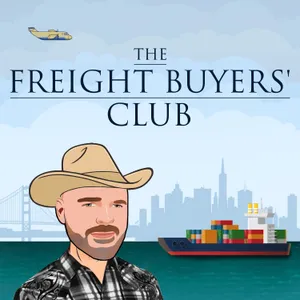
The Freight Buyers’ Club podcast is a new home for anyone with a professional interest in international trade, container shipping, procurement, logistics and air cargo. Each episode your host, award-winning journalist Mike King, will be speaking to leading decision-makers, analysts, journalists, operators and shippers to get their take on current freight and logistics markets and the challenges and opportunities ahead.
Latest Episodes
The most recent episodes — sign up to get AI-powered summaries of each one.
- 2 days ago11 min
Cindy Allen (CEO, Trade Force Multiplier) on Why Customs Now Wants to Know Your Supplier’s Supplier
In this clip from The Freight Buyers’ Club, host Mike King speaks with Cindy Allen, CEO of Trade Force Multiplier and a former Executive Director at US Customs and Border Protection, about the shift in US trade policy from national security to what she says CBP and the administration are now calling economic security. Allen explains why CBP wants importers of record to trace goods back through every supplier and every border they have crossed, not just the last point of origin, and why she describes trade policy right now as “a team sport,” with the US on one side and most of its trading partners on the other. She also walks through the four legal authorities she says the administration is using to assess tariffs after the Supreme Court struck down its use of IEEPA, including forced labour tariffs she says now apply to more than 60 countries, and the use of a rarely invoked authority against Canada. Watch the full episode: https://youtu.be/4s1XNmd5p6A #FreightBuyersClub #Customs #Tariffs #USTradePolicy #SupplyChain #ImporterOfRecord #TradeCompliance #CBP #GlobalTrade #Logistics
- 4 days ago50 min
Shipping to the US? Why inland freight costs are soaring, with Dean Croke, Principal Analyst at DAT iQ, and Bill Cassidy, Senior Editor, Trucking at the Journal of Commerce
What happens to your freight once the container is off the ship in America, and why is it costing so much more to move? In this episode of The Freight Buyers’ Club, host Mike King is joined by Dean Croke, Principal Analyst at DAT iQ, and Bill Cassidy, Senior Editor, Trucking at the Journal of Commerce, to explain what’s going on in the US inland market and what it means for importers and exporters around the world. US truck rates are up by around a third on last year, but as Dean explains, it isn’t because there’s more freight. He says the market has been repriced by a mass exodus of trucking capacity, driven by tougher enforcement on driver licensing, immigration status and English proficiency, and he describes his own encounter with ICE officers checking drivers at a truck stop fuel island. Dean also explains why national averages hide what’s happening on the busiest import lanes out of Los Angeles, and why diesel prices that vary by state are changing where carriers are willing to run. Bill sets out what shippers are actually paying, and why he sees a “K-shaped” economy shaping US freight demand. The pair also look at how the AI data centre boom has been holding up parts of the trucking market, and why Dean thinks that could be a bubble, as well as C.H. Robinson’s $5.8 billion acquisition of RXO, the $604 million verdict against C.H. Robinson and what it means for carrier vetting, the US midterms, the shift from road to rail, the proposed Union Pacific and Norfolk Southern merger, and what to expect in 2027. The video version on YouTube and Spotify includes on-screen charts from DAT iQ, the Journal of Commerce and the Drayrates-JOC port drayage index, which are worth a look alongside the audio. Thanks to Dimerco Express Group (https://dimerco.com/), our sponsor and your best partner on the transpacific. In this episode 00:00 Coming up 01:00 Introductions 03:00 Why Americans call it “the freight market” 05:00 Truck rates up a third, but no more freight 07:00 ICE at the fuel island 10:00 West Coast imports and the lanes out of Los Angeles 13:00 Diesel and where carriers choose to run 15:00 What shippers pay, and the K-shaped economy 21:00 Drayage rates surge at the Gulf Coast ports 22:00 Data centres, flatbed and farm machinery 28:00 C.H. Robinson buys RXO 31:00 The $604 million verdict and carrier vetting 39:00 The midterms, diesel and the trucker vote 43:00 From road to rail 45:00 The Union Pacific and Norfolk Southern merger 46:00 What to expect in 2027 49:00 Thanks and goodbye Related episodes Air Cargo Unpacked: Peak Season, Wartime Costs: What’s Next for Air Cargo in 2027? https://youtu.be/TJwYZQp7K0g Cargo Theft, Double-Brokering and Chameleon Carriers: Nancy O’Liddy on the Fraud Hitting US Freight, with Nancy O’Liddy, Executive Director of the National Industrial Transportation League https://youtu.be/4b4Pz1uN67I
- 1 weeks ago5 min
Suez Traffic Is Back, So Why Are War Risk Premiums Still High? With David McKie, Preston Turnbull
More container ships are heading back through the Red Sea and the Suez Canal, but does that mean the waters are any safer? Not according to the London insurance market. Freight Buyers’ Club host Mike King caught up with David McKie, partner at Preston Turnbull LLP and a specialist in shipping and maritime insurance law, at the Cyprus Shipping News event in London on 13 October 2026. They discussed how war risk insurers actually assess danger, and what that means for the costs that end up being passed down the supply chain to cargo owners. David explains the difference between hull and machinery cover and war risk insurance, and how the Joint War Committee in London decides which waters count as high risk. That covers the Black Sea, the Strait of Hormuz and Bab el-Mandeb, along with what happened to premiums once the Hormuz crisis kicked off in early 2026. He also sets out what would need to change before shipowners, and ultimately their customers, start paying less. For context, at the time of recording the Joint War Committee had not relaxed its view of the Red Sea at all. In July 2026 it pushed its high-risk zone further north along the Saudi coast, and in September 2026 it extended its Black Sea listing to cover almost the entire basin. So more transits through Suez reflected carriers choosing to pay the premium, not insurers deciding the risk had gone away. The Freight Buyers’ Club, hosted by award-winning freight journalist Mike King, brings together the people shaping freight procurement and supply chains. Subscribe for more conversations like this one.
- 1 weeks ago37 min
Air Cargo Unpacked: Peak Season, Wartime Costs
Peak season has arrived with wartime costs attached. In this month’s Air Cargo Unpacked, Mike King and Neel Jones Shah ask whether there is still such a thing as a traditional peak season. They look at how soaring jet fuel prices are hitting airlines and shippers, and what the conflict in the Middle East means for air cargo, from the attacks on Riyadh’s King Khalid International Airport to container ships sunk in the Strait of Hormuz. Neil Wilson, editor of TAC Index, calculating agent for the Baltic Air Freight Indices, takes us through the latest rates. Global rates are up 24.3% year on year, Hong Kong to US is far outpacing Hong Kong to Europe, and jet fuel is up 111% year on year. Plus the outlook for peak season and 2027 from Elaine Low (Maersk), Peter Kerins (Magna Aviation), Henk Venema (DHL Global Forwarding), Simon Milne (Solent Freight Services), Peter Scholten (Air One) and Steven Polmans (Swissport). We also discuss the US midterms, and finish on the first flight of the Airbus A350F and the FAA exemption that lets Boeing keep building the 777F. Also mentioned: Delta Air Lines, United Airlines, Spirit Airlines, airBaltic, Lufthansa, IAG, Air France-KLM, Qatar Airways, Singapore Airlines, Atlas Air, FedEx, Kalitta Air, the FAA, WorldACD, BIMCO, Air Cargo News, CNN and the Baltic Exchange. Next week on the Freight Buyers’ Club: Bill Cassidy (Journal of Commerce) and Dean Croke (DAT Freight & Analytics) on the US domestic trucking market. Next month on Air Cargo Unpacked: David Shepherd, Managing Director, IAG Cargo. Watch: Is Global Trade Fragmenting for Good? Customs, Tariffs and the New Rules of Importing: https://youtu.be/4s1XNmd5p6A Read: Mike King in the latest issue of Cargo Airports & Airline Services (CAAS), on the Asia Pacific market (pages 4-10) and interviewing Robert van de Weg, CEO of Mexican carrier mas (pages 14-16): https://caasint.com/latest-issue/ Rates data courtesy of TAC Index and the Baltic Exchange. Produced by Karen Ball. #AirCargo #PeakSeason #FreightRates #JetFuel #TACIndex #BalticExchange #FreightBuyersClub
- 2 weeks ago58 min
Is Global Trade Fragmenting for Good? Customs, Tariffs and the New Rules of Importing: What Freight Buyers Need To Know
A year ago, we asked whether global trade was entering an era of chaos. A year on, it looks less like chaos and more like a new, fragmented normal: the US has built a new, stacked tariff regime out of four separate legal authorities, the EU has ended its duty-free threshold for cheap parcels, and customs authorities on both sides of the Atlantic are quietly redefining what it means to import something legally. In this episode: The US’s new tariff regime, stacking four separate legal authorities, including fresh forced labour tariffs on sixty trading partners The EU’s flat €3 customs duty on parcels under €150, and its impact on Shein, Temu and AliExpress US Customs and Border Protection’s purge of millions of importer records The EU’s Customs Data Hub and where European customs reform stands WiseTech’s VerifyWise, built in part on its newly acquired FRDM.ai, and how it maps suppliers and minimises risk Is this a genuinely new global trading order, or the same old protectionism with a new label on it? Featuring: Stephen Tracey, General Manager for Customs Product Europe, WiseTech Global Cindy Allen, CEO, Trade Force Multiplier Roel Gevaers, Professor, University of Antwerp / Academic Director, Antwerp Management School Chapters: 00:00 Coming up, cold open and introductions 03:00 Opening salvo: fragmentation, data as the new border, and economic security 07:00 Cindy: trade as a “team sport” 12:00 Cindy: this summer’s tariff changes, explained 17:00 Stephen: where fragmentation bites hardest for European traders 19:00 Stephen: the EU’s three euro parcel duty 21:00 Stephen: the Customs Data Hub and EU reform timeline 23:00 Stephen: where AI actually helps in customs 25:00 Stephen: VerifyWise, FRDM.ai and supplier risk 27:00 Cindy: are the forced labour tariffs genuine, or IEEPA relabelled? 31:00 Roel: Europe’s view on the forced labour tariffs, and risk to Shein and Temu 35:00 Roel: is there a precedent for this pace of change? 36:00 Roel: China’s response, and how the e-tailers adapted 40:00 Roel: the European carmakers analogy, and whether this is good policy 43:00 Roel: where next for the WTO and WCO? 44:00 Cindy: SME importers, refunds and the cost of compliance 48:00 Stephen: how CargoWise responds to a sudden rule change 51:00 Five years out: can trade stay connected as policy diverges? 55:00 Final thoughts: the one thing to get right next year 57:00 Thanks and goodbyes #GlobalTrade #Customs #Tariffs #ForcedLabour #SupplyChain #Logistics #FreightBuyersClub
- 2 weeks ago59 min
Advantage Carrier: John McCown, Nick Bailey and Jimmy Suroto on $6bn Carrier Profits, 49.9% Reliability and a 2027 Overcapacity Warning
Container shipping has become "advantage carrier", according to John McCown of The McCown Report. US demand on the transpacific has been flat for a second year, yet spot rates have soared, and by John's count carriers made around $6bn in net income in the second quarter, seven times the first. So what can shippers actually do about it? In this container shipping special, produced with the support of Dimerco Express Group, Mike King is joined by three people who track this market more closely than most: John McCown, publisher of The McCown Report and author of Giants of the Sea Nick Bailey, co-founder of The Signal House and former lead analyst for logistics and services at A.P. Moller-Maersk Jimmy Suroto, founder of Nava Analytics & Research and a PSA veteran We cover: Why rates have climbed so sharply while US demand stays flat, and what John calls "gotcha surcharges" Schedule reliability falling to 49.9% in August, the lowest since 2022 according to Sea-Intelligence, and why Nick says a global average hides your real exposure Port congestion in Asia, a typhoon season John calls the worst in a decade, the Middle East war, and why he believes carriers have learned to profit from disruption Why Asia-Europe and transpacific spot rates have gone in opposite directions Nick's argument that supply chains are now constrained by architecture, not capacity, and how to separate customer, defensive and distortion demand The long shift from West Coast to East and Gulf Coast ports, Jones Act waivers and US maritime policy COSCO, the FMC and the 9 November deadline for US port fees on China-linked ships Jimmy's 2027 forecast of 2% to 5% trade growth against BIMCO's forecast of 9% fleet growth, and what that wave of new ships could mean for rates Mentioned in this episode: ▶️ EXCLUSIVE: FMC Chair Laura DiBella on Trump's Maritime Dominance & Global Enforcement Powers https://youtu.be/GlZPTBKUzA4 Produced with the support of Dimerco Express Group (https://dimerco.com/), your trading partner connecting Asia with the US and beyond. If you enjoy the show, please like, subscribe and leave a comment telling us what you'd like us to cover next. We're working towards 10,000 YouTube subscribers this year, and every subscribe helps. Chapters: 00:00 Coming up 00:49 Welcome: Jimmy Suroto, Nick Bailey and John McCown 05:03 John McCown: flat US demand, soaring rates and "gotcha surcharges" 08:06 Nick Bailey: connected, cascading and compounding risk 11:04 Jimmy Suroto: what most container forecasters miss 12:10 Reliability falls to 49.9%: who is on time and who isn't 15:34 Port congestion hotspots and how carriers profit from disruption 18:40 Why transpacific and Asia-Europe spot rates split 21:27 Nick Bailey: architecture, not capacity, and why a bigger fleet won't save you 24:13 Customer, defensive and distortion demand on the transpacific 27:11 Efficiency or protection, and the headline rate trap 31:50 John McCown: advantage carrier, and the long shift to East Coast ports 34:27 Peak season, tariffs and chaos from the White House 37:30 Will container lines ever lose money again? 39:13 Jones Act waivers and the gap in US maritime policy 43:58 COSCO, the FMC and shots across the bow 47:30 Jimmy Suroto: back to baseline on the transpacific 49:25 Asia-Europe's new growth path 50:28 The Gulf and a 2% to 5% forecast for 2027 51:18 Why listen to Jimmy? His forecasting track record 51:58 A 9% bigger fleet: when does overcapacity bite? 53:35 John McCown on the 9 November port fee deadline 57:55 Nick Bailey: resilience versus efficiency in 2027 1:00:00 Thanks and goodbye #ContainerShipping #FreightBuyersClub #OceanFreight #Suppl...
- 3 weeks ago5 min
Brandon Fried: 45 Years in Air Cargo, the Pan Am 103 Legacy, and Retiring as 'VP of Lunch'
In this extended interview from Air Cargo Unpacked, retiring Airforwarders Association Executive Director Brandon Fried looks back on a career that started almost by accident: a relative in the forwarding business, warehouse work, fine art logistics, legal document delivery, and eventually his own operation in Washington DC before joining AfA. Brandon reflects on what he's most proud of: helping build the modern cargo security framework in the wake of the Pan Am 103 bombing, working with the TSA and Customs and Border Protection to create the Known Shipper Program and canine screening. Neel Jones Shah, who worked alongside Brandon from both the airline and forwarder side, pays tribute to his impact on the industry. Brandon also shares his biggest concern for the future of air freight forwarding (uncertainty and poorly informed regulation, "you're either at the table or you're on the menu"), and his message to whoever succeeds him: stay engaged with companies of every size, not just the big ones. And yes, he confirms his next title: Vice President of Lunch. From The Freight Buyers' Club Podcast. #AirCargo #FreightForwarding #AviationSecurity #Logistics #SupplyChain
- 3 weeks ago15 min
Intra-Asia Container Trades, Port Congestion and Rising Rates, with Elaine Low, Area Managing Director, Southeast Asia, Maersk
Mike King travels to Maersk's Southeast Asia head office in Singapore to talk with Elaine Low, Area Managing Director for Southeast Asia at A.P. Moller-Maersk, about the intra-Asia container trades. It's the world's biggest container trade, and one that rarely gets the attention it deserves, even with Drewry's Intra-Asia Container Index at three-year highs. Elaine explains how manufacturers expanding across the region and fast-growing Asian consumer markets are driving demand. She highlights automotive and EVs, electronics and the semiconductor ecosystem as key industries. She also argues that the real constraint is landside infrastructure at Southeast Asia's many smaller ports, and says every port in the region is effectively full. The conversation also covers how Maersk's Gemini hub-and-spoke network has helped it deal with typhoons and geopolitical disruption, the balance between contract and spot demand, how surcharges have been passed on, and what Maersk's integrator strategy offers shippers in Asia. #Maersk #IntraAsia #ContainerShipping #PortCongestion #SoutheastAsia #FreightBuyersClub #Logistics
Get The Freight Buyers' Club summaries in your inbox
Free AI-powered daily recaps. Key takeaways, quotes, and mentions — in a 5-minute read.
Get Free Summaries →Free forever for up to 3 podcasts. No credit card required.
You Might Also Like
Listeners also like.

The Trade Guys
Trade experts analyze global trade issues, policies, and their real-world impacts on businesses and consumers.

The Investor's Podcast (We Study Billionaires) - The Investor’s Podcast Network
Analyzes the investment strategies of billionaire investors and explores lessons from legendary financiers on wealth, wisdom, and life.

The VIP Seat: Private Aviation News
A weekly breakdown of private aviation news, from jet charter trends and safety issues to industry analysis and insider interviews.

Car Dealership Guy Podcast
Interviews and live coverage exploring the people, trends, and innovations shaping automotive retail.

The Auto Market Brief
A weekly analysis of automotive market trends and forecasts, featuring data-driven insights from industry experts.

Red Eye's Extra Mile with Eric Harley Podcast
Extended discussions on trucking industry issues, regulations, technology, and driver wellness with expert guests and real-world stories.
King Dems Podcast | Growth Mindset, Leadership, AI and Business Insights
Ademola Isimeme Odewade, MBA, ACA, BSc. (Economics)

PodFather
A guide to launching and growing a podcast, featuring actionable tips from an experienced host and other successful podcasters.

Hangar Flying with Smokehouse Pilots Club
Smokehouse Pilots

The Owner Meeting
Real estate investors share proven strategies and costly mistakes to help others build wealth and achieve financial freedom.

The Bottom Line
Evan Davis interviews business leaders about major industry challenges, leadership decisions, and the realities of running organizations.
Right About Now - Legendary Business Advice
Raw business insights from founders and industry leaders, revealing real wins, failures, and actionable strategies without the fluff.
About The Freight Buyers' Club
The Freight Buyers’ Club podcast is a new home for anyone with a professional interest in international trade, container shipping, procurement, logistics and air cargo. Each episode your host, award-winning journalist Mike King, will be speaking to leading decision-makers, analysts, journalists, operators and shippers to get their take on current freight and logistics markets and the challenges and opportunities ahead.
Customized Recaps
AI-powered recaps with compact key takeaways, quotes, and insights.
Straight to Your Inbox
Get key takeaways from The Freight Buyers' Club in a 5-minute read.
Save Hours Every Week
Stay current on your favorite podcasts without falling behind.
Frequently Asked Questions
What is Podzilla's The Freight Buyers' Club daily summary?
It's a free AI-powered email that summarizes new episodes of The Freight Buyers' Club as soon as they're published. You get the key takeaways, notable quotes, and links & mentions — all in a quick read.
How does the The Freight Buyers' Club podcast summary work?
When a new episode drops, our AI transcribes and analyzes it, then generates a personalized summary tailored to your interests and profession. It's delivered to your inbox every morning.
Is this an official The Freight Buyers' Club product?
No. Podzilla is an independent service that summarizes publicly available podcast content. We're not affiliated with or endorsed by Mike King.
Can I get summaries of other podcasts too?
Absolutely! The free plan covers up to 3 podcasts. Upgrade to Pro for 15, or Premium for 50. Browse our full catalog at /podcasts.
How often does The Freight Buyers' Club release new episodes?
The Freight Buyers' Club publishes 2x weekly. Our AI generates a summary within hours of each new episode.
What topics does The Freight Buyers' Club cover?
The Freight Buyers' Club covers topics including News, Business, Management. Our AI identifies the specific themes in each episode and highlights what matters most to you.
Start getting The Freight Buyers' Club summaries tomorrow morning.
Free forever for up to 3 podcasts. No credit card required.
Free forever for up to 3 podcasts. No credit card required.