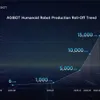
Last month, AgiBot announced the production of its 15,000th robot. I discovered, while interviewing Peng Chen, Business Development Director for Agibot, that “15,000th” is almost impossible to say.Producing that many robots is difficult too. But it may not be the hardest part. The next test is whether those robots can leave the demonstration stage behind and perform useful work reliably in factories, stores, care facilities, and eventually our homes.Peng’s answer was direct: “We’re in the era converting from demo phase to deploy phase,” he said.What does 15,000 actually mean?On June 28, AgiBot’s 15,000th robot rolled off the production line. The company had reached 10,000 only three months earlier, an impressive ramp for a business founded in 2023.The figure represents cumulative production, not 15,000 robots working autonomously in the field. Production, shipments, and active deployments are different measures.Still, AgiBot has achieved meaningful scale. Omdia reported that it shipped 5,168 humanoid robots in 2025, representing 39 percent of the market it tracked.The milestone suggests that robot hardware is reaching a scale that can support broader experimentation and deployment.Not every robot looks like a personWhen people hear “15,000 robots,” they may imagine an army of identical humanoids walking off an assembly line.AgiBot’s portfolio is much broader.The company produces full-size humanoids, half-size humanoids, wheeled industrial robots, quadrupeds, dexterous manipulation systems, and commercial cleaning robots. The X2 featured in my interview is a half-size humanoid designed to appear approachable and interact with people.Peng described possible applications across education, research, manufacturing, logistics, retail, restaurants, healthcare, and outdoor inspections.The robot’s physical form depends on the job.A wheeled platform may make more sense on a factory floor. A quadruped may be better suited to inspection work. A smaller humanoid may be useful for entertainment, education, customer guidance, or social interaction.This diversity is a reminder that the future of embodied AI will not be defined by a single perfect human replica. It will probably include many types of machines designed for different environments.The difficult leap from demonstrations to deploymentRobotics demonstrations have become remarkably good at attracting attention.Robots dance, run, sort objects, fold clothes, perform backflips, and hold conversations. These moments are entertaining and often technically impressive.Check out this rehearsal of Agibots rehearsing for a performance at the AGI and Robotics summit at Stanford. Very entertaining. But a demonstration is not the same as a deployment. A demonstration asks whether a robot can perform a task under favorable conditions. A deployment asks whether it can perform that task repeatedly, safely, affordably, and with minimal human intervention. A robot working in a factory cannot succeed nine times out of ten and simply try again after a failure. It must operate according to production schedules, coordinate with people and other machines, and respond predictably when something unexpected happens. Battery life, maintenance, integration, safety, training, and the cost of human supervision all become part of the calculation.Peng acknowledged that this is not an AgiBot challenge alone.“The whole industry” is searching for places where robots can work autonomously and reliably, he said.This is why constrained environments are likely to come first.Factories, warehouses, and commercial facilities offer repeatable processes and spaces that can be adapted to machines. Homes, hospitals, and nursing facilities are far less predictable. Every room is different. Objects move. People behave unexpectedly. The consequences of an error can be much more serious.AgiBot has reported approximately 100 cumulative hours of factory livestream operations involving G2 robots in a tablet-production quality-inspection process. The robots worked alongside people and followed the rhythm of an active production line.That is a meaningful step beyond a short stage demonstration. It is not yet proof that general-purpose robots can operate autonomously everywhere, but it illustrates the path from controlled experiments to narrowly defined work.People may be more ready than expectedAgiBot expected some people to be uneasy around the X2. Instead, Peng said, public response has been overwhelmingly enthusiastic.I saw that curiosity at NVIDIA GTC, where the robot’s friendly appearance and dance moves drew a crowd.The X2 can converse, perform, guide visitors, and give presentations. While complex physical work remains challenging, social interaction could become one of the first practical uses for sma
Podzilla Summary coming soon
Sign up to get notified when the full AI-powered summary is ready.
Free forever for up to 3 podcasts. No credit card required.
Listen to This Episode
More from the droids newsletter podcast

Machina Labs Wants to Make Factories Programmable
A Robot Built to Give Disabled and Elderly Some Independence

Restaurant Robots Are Growing Up

Cheap drone mass-production startup Neros wins $500M Army contract
Get summaries like this every morning.
Free AI-powered recaps of the droids newsletter podcast and your other favorite podcasts, delivered to your inbox.
Free forever for up to 3 podcasts. No credit card required.