Free Daily Podcast Summary
The Diary of a CFO: Daily Summaries Delivered
by Wassia Kamon, CPA, CMA, MBA
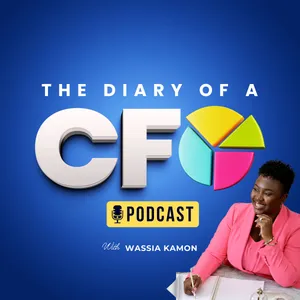
Whether you’re a current CFO, on the path to the role, or part of a finance team, this podcast is for you.The Diary of a CFO podcast takes you behind the scenes of modern finance leadership through honest conversations about how real finance leaders build their careers, make tough decisions, and navigate the weight of the CFO role.Hosted by award‑winning CFO Wassia Kamon, each episode gives you practical insight into how today’s best finance leaders:Build high‑performing finance and FP&A teams.Partner with CEOs, boards, and capital providers (banks, PE/VC, and impact lenders).Navigate growth, regulation, and transformation without burning out. Whether you’re a current CFO, a senior finance leader, or a someone who wants a stronger handle on the numbers, you’ll walk away with tactics you can use and stories that make you feel less alone on your journey.To suggest topics, email <a target="_blank" rel="noopener noreferre
Latest Episodes
The most recent episodes — sign up to get AI-powered summaries of each one.
- 3 days ago11 min
The Difference Between Getting the CFO Job and Keeping It (My 2-Year Check-In)
In this solo episode of The Diary of a CFO, I sit down halfway through the year to reflect on what I’ve learned during my first two years in the CFO seat, as well as the lessons I’ve gathered from speaking with more than 40 CFOs on this podcast.I talk about the difference between strategic thinking and strategic leadership, and why most companies test for the first when the second is what ultimately keeps you in the seat.I also explore why your relationship with your CEO and board can be the single most important factor in whether you succeed or get pushed out, including a real story from a CFO whose CEO asked her to stop attending board meetings after she shared information he didn’t want disclosed.We get into why working with a founder CEO is completely different from working with a hired CEO, what that means for navigating the role, and how mid-market CFOs operate at different altitudes in the same day, from talking to funders to reviewing accounting entries.I also unpack what I mean by “strategic influence” and why it has to permeate everything you do and say as an executive, right down to the words you choose.And finally, I reflect on why alignment with your boss, your company, your family, and your health has become the one word that defines everything I’ve learned so far.This is not just for CFOs. If you’re in any senior leadership seat, this episode is for you.
- 2 weeks ago40 min
5 Reasons ERP Implementations Fail and How To Get Yours Right, with Sharon Barboza
Most ERP implementations do not fail because of the technology. They fail because of what happens before the system is even turned on.In this episode, I sit down with Sharon Barboza, Manager of Digital Services at Citrin Cooperman Advisors. Sharon is a licensed CPA who has worked on every side of finance, from public accounting to controller to senior NetSuite consultant. She has seen hundreds of growing businesses go through system implementations and knows exactly where they break.We break down the five most common reasons ERP implementations fail. Why accounting is always the last department brought into the conversation and what that costs in redesign and delays. The client who mentioned a Bulgarian subsidiary one week before go-live that nobody knew about. Why accountants resist leaving Excel and how to show them the value without making them feel replaceable.The 78-tab forecasting spreadsheet that took days to update and why that was the wake-up call. How to build a roadmap that plans for where the business is going, not just where it is now.What to look for in your chart of accounts before you realize you needed it. How one client went from a failed implementation with another partner to a successful launch by rebuilding trust from scratch. And how embedded banking tools like Fispan eliminated the constant cycle of broken bank feeds and manual file transfers.Whether you are a finance leader about to start an ERP implementation, in the middle of one that feels like it is going sideways, or still trying to decide if it is time to leave Excel, this episode covers the full picture.This episode is brought to you by FISPAN. Learn more at fispan.com.
- Aug 21, 202658 min
From CAO to EVP Supply Chain: How to Make a Big Career Pivot at the Executive Level
She spent 19 years at Southwire. She started in treasury, moved through business unit finance, became Chief Accounting Officer, and then made a move nobody saw coming. She left finance to run supply chain at a $9 billion company that provides cable for and electrical transmission throughout the US.In this episode, I sit down in person with Christy Wright, Executive Vice President of Supply Chain at Southwire. Christy also recently served as Interim CFO while continuing her supply chain role.We talk about what made her leave finance after checking every experience box. Why she says curiosity and a connection to the supply chain team years earlier planted the seed. What surprised her about the operations side, including having to learn the periodic table to understand the materials her team works with every day.How her finance background gives her a different lens in supply chain, from her focus on scrap and recyclability to her appreciation for lean and continuous improvement. What it felt like stepping into the Interim CFO seat while running supply chain and why prioritization and sleep became non-negotiable.Why she says people leadership is the hardest and most continuous work of her career. Her advice for controllers and CAOs who want to become CFOs, including why a lateral move might be the most important one you make. And the 12 for Life program at Southwire that brings at-risk youth into manufacturing to earn a paycheck, learn skills, and finish high school.Whether you are a finance leader thinking about stepping into operations, already in the CFO seat trying to understand the business better, or building your career at one company and wondering if that is enough, this conversation covers it.This episode is brought to you by FISPAN. Learn more at fispan.com.
- Aug 6, 202634 min
How Operations Experience Makes You a Better CFO, with Donna Cohen, CFO of CarMax Auto Finance (Live in Atlanta)
She spent her entire career in accounting and finance. Public accounting, FP&A, financial reporting, corporate accounting. Then she made a move nobody expected. She went into operations. And when she came back to finance as a CFO, everything was different.In this episode, I sit down in person with Donna Cohen, Chief Financial Officer at CarMax Auto Finance. Donna has been at CarMax for almost 14 years and is a board-ready qualified financial expert with deep expertise in M&A, spinoffs, restructurings, and automation initiatives.We talk about what operations taught her that finance never could and why she recommends every finance leader try it. How she uses a different part of her brain now that she has seen both sides. The PE experience in the hotel industry that broke her faith in corporate America, including the downsizing, the restructuring, and the day she negotiated her exit and called it her "liberation day."How she ended up at CarMax after thinking she was done with corporate forever. Her strategy for making change stick inside a large organization, including finding champions, planting seeds, and being comfortable with not getting credit.How she introduces AI to teams that have never even used ChatGPT at home. The mentor who gave her an engagement to run after just one year and wrote her a letter about growth over perfection that changed how she leads to this day.The breaking point where she realized she was giving everything to work, her kids, and her husband with nothing left for herself. And why she says she never even knew she was capable of being a CFO.This episode is brought to you by FISPAN. Learn more at fispan.com.
- Jul 24, 202632 min
How to Evaluate a CFO Role in Private Equity Before You Say Yes - Chris Voudouris, 3x PE CFO
Most finance leaders think about making the jump to a private equity backed company at some point. Very few know what they are actually walking into.In this episode, I sit down with Chris Voudouris, a 3x PE CFO who has been on every side of the table. He started at KPMG in audit, moved into transaction services analyzing deals on both the buy side and sell side, then made the leap into private equity. He has led finance at multiple PE-backed companies across different industries and moved his family to Atlanta for his first CFO role knowing nobody in the city.We talk about what nobody tells you before you take a CFO role at a PE-backed company. The three lenses he uses to evaluate any opportunity before saying yes: the investment, the business, and the people. What documents you should be asking for before you accept the role, from the confidential information memorandum to the quality of earnings report. How he builds trust with his CEO and why he says the foxhole relationship is everything. The budget error that wiped out 15% of projected EBITDA growth he had just presented to the board and what happened when he told his CEO immediately. Why he lives by the rule that relationship always trumps the issue. How to be the chief interpreter of your organization as a CFO. The difference between stress that motivates and distress that destroys. And his honest advice for anyone in public accounting thinking about crossing over into PE.Whether you are considering a move into private equity, already in a PE-backed role trying to navigate the pressure, or a first-time CFO figuring out how to evaluate your next opportunity, this conversation is the playbook.
- Jul 9, 202649 min
From Big 4 Auditor to CFO: How to Make People Want to Work With You in Finance - James White (Live in Atlanta)
He spent over 20 years at Ernst & Young. He did a secondment to Berlin, Germany by himself. He went back to Alabama to take over the CPA firm his father started 50 years ago. And then he made the leap to CFO of a Nasdaq-listed AI company.In this episode, I sit down in person with James White, CFO of ScanTech AI Systems. James is a multi-state CPA, an AICPA board member, and the son of one of the first Black CPAs in the state of Alabama.We talk about what kept him in public accounting for 20 years when most people leave in five. How he made himself easy to get to know in rooms where he was often the only one who looked like him. Why he believes being the smartest person in the room is not what gets you ahead. What he had to learn and unlearn when he moved from auditor to CFO.How he motivates people who are not as driven as the type A teams he came from in public accounting. Why he told a room full of AICPA leaders that he has always felt like an imposter and how that honesty actually helped him. The moment his daughter said she did not want to be an accountant because of how much he worked, and how that changed everything about how he leads. And the generational story that starts with his great-grandfather building a park in Alabama and ends with James sitting on the AICPA board.Whether you are in public accounting thinking about making the jump, already in the CFO seat figuring out how to lead, or trying to understand what it really takes to make people want to work with you, this conversation covers it.
- Jun 25, 202649 min
From 6x National Champion to Fortune 500 Chief Audit Officer - Lori Kaczynski on Leadership and Resilience
She won six Canadian national championships in speed skating and was training for the Olympics. Then, had a car accident at 18. Four knee surgeries. Three years of rehabilitation.Today Lori Kaczynski is the Senior Vice President and Chief Audit, Risk, and Compliance Officer at Graphic Packaging International, a Fortune 500 company headquartered in Atlanta. She leads global internal audit, compliance, and enterprise risk management.In this episode, I sit down in person with Lori. We talk about what competitive athletics taught her about discipline and resilience that she carries into the boardroom today. How she moved from a small Canadian town of 5,000 people to building a career in Atlanta with no coaching and no roadmap. Why she hires internal auditors based on soft skills and culture fit before technical ability. The difference between leading audit with an enforcement mindset versus a business partner mindset and why one gets people to call you with their problems and the other makes them hide. The Von Mises framework she uses when people resist change. How a network of 60 Fortune 500 women chief audit executives became her most valuable career resource. What her husband accidentally taught her about networking. And why she is building what she calls a "portfolio career" for what comes next.Whether you are in audit, risk, compliance, or any finance leadership role, this conversation will challenge how you think about what it really takes to lead at a high level.
- Jun 4, 202653 min
How Finance Teams Should Be Using AI Right Now, with Chad Gold, CFO of Fullstory
He started at Ernst & Young, moved to Home Depot where he had a front row seat to one of the most operational CFOs in the country, then jumped into high-growth startups and never looked back.In this episode, I sit down in person with Chad Gold, 2022 CFO of the Year by the Atlanta Business Chronicle and current CFO of Fullstory. Chad drove 10x growth in enterprise value at SalesLoft to over $2.3 billion and was the first CFO at G2.We talk about why he left the stability of Home Depot for startups and what his wife thinks about that risk. His "lines not dots" principle for building relationships that actually shape your career. His playbook for the first 90 days in a new CFO role and why most leaders make the mistake of trying to tackle everything at once. How to get the business to bring finance in early instead of after the fact. Why the CFO, not the CTO, should be leading AI adoption inside the company. How his team cut the close process by 50% using AI and is going for another 50%. The SEC agent they built that reviews contracts in minutes. How they automated daily cash reporting with Claude in five minutes. Why he thinks the finance org chart is shifting from a triangle to a diamond. And the whiteboard lesson from his Home Depot boss that changed how he thinks about success forever.Whether you are a CFO trying to figure out where AI actually fits, a finance leader navigating high-growth, or someone thinking about making the leap from big company to startup, this conversation covers it.
About The Diary of a CFO
Whether you’re a current CFO, on the path to the role, or part of a finance team, this podcast is for you.The Diary of a CFO podcast takes you behind the scenes of modern finance leadership through honest conversations about how real finance leaders build their careers, make tough decisions, and navigate the weight of the CFO role.Hosted by award‑winning CFO Wassia Kamon, each episode gives you practical insight into how today’s best finance leaders:Build high‑performing finance and FP&A teams.Partner with CEOs, boards, and capital providers (banks, PE/VC, and impact lenders).Navigate growth, regulation, and transformation without burning out. Whether you’re a current CFO, a senior finance leader, or a someone who wants a stronger handle on the numbers, you’ll walk away with tactics you can use and stories that make you feel less alone on your journey.To suggest topics, email <a target="_blank" rel="noopener noreferre
Customized Recaps
AI-powered recaps with compact key takeaways, quotes, and insights.
Straight to Your Inbox
Get key takeaways from The Diary of a CFO in a 5-minute read.
Save Hours Every Week
Stay current on your favorite podcasts without falling behind.
Frequently Asked Questions
What is Podzilla's The Diary of a CFO daily summary?
It's a free AI-powered email that summarizes new episodes of The Diary of a CFO as soon as they're published. You get the key takeaways, notable quotes, and links & mentions — all in a quick read.
How does the The Diary of a CFO podcast summary work?
When a new episode drops, our AI transcribes and analyzes it, then generates a personalized summary tailored to your interests and profession. It's delivered to your inbox every morning.
Is this an official The Diary of a CFO product?
No. Podzilla is an independent service that summarizes publicly available podcast content. We're not affiliated with or endorsed by Wassia Kamon, CPA, CMA, MBA.
Can I get summaries of other podcasts too?
Absolutely! The free plan covers up to 3 podcasts. Upgrade to Pro for 15, or Premium for 50. Browse our full catalog at /podcasts.
How often does The Diary of a CFO release new episodes?
The Diary of a CFO publishes biweekly. Our AI generates a summary within hours of each new episode.
What topics does The Diary of a CFO cover?
The Diary of a CFO covers topics including Business, Management. Our AI identifies the specific themes in each episode and highlights what matters most to you.
Start getting The Diary of a CFO summaries tomorrow morning.
Free forever for up to 3 podcasts. No credit card required.
Free forever for up to 3 podcasts. No credit card required.