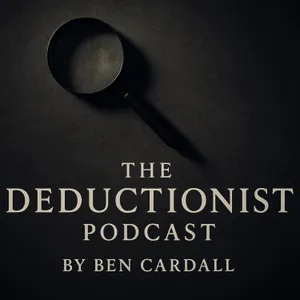
Free Daily Podcast Summary
The Deductionist Podcast: Daily Summaries Delivered
by ben cardall
Look no further, dear listener, for The Deductionist podcast is here to sharpen your deductive skills and blow your mind with its clever insights. Hosted by the charming and enigmatic deductionist himself (HA!) and the Watson of awesomeness! Each episode is a masterclass in observation, deduction, and logic, as they take you on a journey through the mysteries of everyday life. From analyzing crime scenes to decoding the hidden meanings in social interactions, The Deductionist podcast brings a fresh and witty perspective to the art of deduction. With a razor-sharp mind and quick wit...ish, they'll have you hooked from the very first episode. So join us as we explore the secrets of the world around us, and learn how to become a master of deduction like the one and only Deductionist. It's time to uncover the truth and take your deductive skills to the next level.
Latest Episodes
The most recent episodes — sign up to get AI-powered summaries of each one.
- Today27 min
How to Hear the Bark in the Boardroom (Groupthink Examples)
A room where nobody objects looks like agreement. Holmes would call it the dog that did nothing in the night, and former senior detective Bob Pointer has spent a career listening for exactly that kind of silence. Ben Cardall and Bob work through real groupthink examples from boardrooms, police work and jury rooms to show why teams make bad decisions with total confidence, and how a group ends up somewhere none of its members chose. In this episode:- Why silence isn't consent, why a nod tells you nothing, and what to ask when the room goes quiet- How Bob spotted the real power in an office through a glass wall before the manager even walked in- The consensus psychology behind tag questions like "we all agree, don't we?"- Irving Janis, Solomon Asch and pluralistic ignorance, the research behind the best known groupthink examples- What a quick verdict and the choice of foreman tell a detective about a jury room- Who speaks first and who speaks last, and what those bookends of power reveal in any meeting- A protocol for productive dissent built on information rounds, private confidence ratings and red teams that actually get heard If any of these groupthink examples sound like your last meeting, subscribe and tell us in the comments where you stayed quiet. Access the free tier or go deeper with exclusive paid challenges: https://www.omniscient-insights.com/axiomhttps://www.omniscient-insights.com/community-home MERCH -- https://the-deductionist.myspreadshop.co.uk/allE-SCAPE GAME -- https://www.youtube.com/@thedeductionistteamEverything else you need -- https://linktr.ee/bencardall Music provided by https://robertjohncollinsmusic.com/`
- 1 weeks ago32 min
How to Spot the Sunk Cost Fallacy in an Investigation
Peter Sutcliffe was interviewed nine times and the accent on a hoax tape counted in his favour. The tape had been played to the nation, and walking away from it would have meant admitting the enquiry had chased the wrong voice. Former senior detective Bob Pointer and private investigator Ben Cardall take the sunk cost fallacy into the incident room and the interview room, on both sides of the table. In this episode:- What the sunk cost fallacy is, and what theatre tickets and Concorde reveal about it- Barry Staw's escalation research and why the most senior person in the room is most at risk- The Yorkshire Ripper enquiry, the Wearside tape and the Byford Report- How investigators rate the same evidence differently depending on their theory- Spotting the sunk cost fallacy in witnesses and subjects who have committed to a story- Why authentic dissent beats a devil's advocate, and Holmes's Norbury protocol- Sincere listening, ORBIT and the premortem as field tools If you have ever defended a theory because of what it cost you, subscribe and tell us in the comments which case you held onto too long. Tags: sunk cost fallacy, escalation of commitment, tunnel vision investigation, confirmation bias, investigative interviewing, behavioural analysis, Yorkshire Ripper investigation, Byford Report, ORBIT interviewing, premortem, Sherlock Holmes deduction, Deductionist podcast Access the free tier or go deeper with exclusive paid challenges: https://www.omniscient-insights.com/axiomhttps://www.omniscient-insights.com/community-home MERCH -- https://the-deductionist.myspreadshop.co.uk/allE-SCAPE GAME -- https://www.youtube.com/@thedeductionistteamEverything else you need -- https://linktr.ee/bencardall Music provided by https://robertjohncollinsmusic.com/` #podcast #ripper #sunkencost
- 1 weeks ago27 min
How to Predict Human Behaviour (and When You Can’t)
Hannah Fry went through every past season of The Traitors looking for statistical patterns, then got recruited as a traitor herself. Maths can predict human behaviour across a crowd with unnerving precision. Point it at one person and the predictions fall apart, for reasons chaos theory explains. In this episode:• Why crowds behave like equations, from Hannah Fry's London riots model to the near repeat burglary effect• How geographic profiling narrows a search without naming a suspect• What the mathematics of love leaves out, and how overfitting fools analysts• Chaos theory done properly, with Edward Lorenz, the butterfly effect and the MusicLab experiment• Why 160 machine learning teams still could not predict human behaviour in individuals• Bayesian reasoning as the bridge from pattern to person, tested on the taxicab problem• The Sally Clark case and the statistical errors that convict the innocent Subscribe for the method behind every case, and learn to predict human behaviour without ever having to guess. Access the free tier or go deeper with exclusive paid challenges: https://www.omniscient-insights.com/axiomhttps://www.omniscient-insights.com/community-home MERCH -- https://the-deductionist.myspreadshop.co.uk/allE-SCAPE GAME -- https://www.youtube.com/@thedeductionistteamEverything else you need -- https://linktr.ee/bencardall Music provided by https://robertjohncollinsmusic.com/` #maths #traitors #behaviour
- 4 weeks ago50 min
How Romance Scams Really Work | Forensic Linguist Dr Elisabeth Carter
The evidence in a romance scam is all there in writing. Every message, every apology, every “be careful, there are scammers on here” sits in the chat log like a frozen crime scene. Dr Elisabeth Carter, criminologist and forensic linguist, reads those crime scenes line by line, by hand, and she joins Ben Cardall and Bob Pointer to show exactly how the crime is built. Most people picture a romance scam as a lonely pensioner and an oil rig sob story. The language shows something far more deliberate: credibility first, rapport second, then a slow transition where the scammer turns vulnerable and the victim offers the money nobody asked for. Elisabeth explains genre mapping (why the exaggeration we tolerate in normal dating, and the countdown clocks we tolerate on Black Friday, make red flags look green), how organised crime groups pass victims between operators to keep them awake, where sextortion enters, and why AI has made the old spelling mistake test useless. Bob brings the reverse order technique from interview practice, Ben brings a super recogniser’s view of deepfake dating profiles, and the live chat brought receipts. You’ll leave with one rule that would stop most romance scam attempts dead in their tracks. Victims of romance fraud get called gullible. The research describes grooming, coercion and abuse. By the end of this episode, you’ll see why. 🎧 Scam Secrets with Dr Elisabeth Carter, Shari Vahl and Alex Wood (BBC Radio 4): https://podcasts.apple.com/gb/podcast/scam-secrets/id1828899532 or search “Scam Secrets” on BBC Sounds🔗 Dr Elisabeth Carter, Kingston University: https://www.kingston.ac.uk/about/staff/dr-elisabeth-carter📖 Elisabeth’s latest book: The Language of Romance Crimes (Cambridge University Press)🚨 Report fraud (England, Wales, NI): https://www.reportfraud.police.uk or 0300 123 2040🚨 Scotland: call Police Scotland on 101 Subscribe if you want to see whether the Real Life Sherlock reputation survives ninety more pages of this. Access the free tier or go deeper with exclusive paid challenges: https://www.omniscient-insights.com/axiomhttps://www.omniscient-insights.com/community-home MERCH -- https://the-deductionist.myspreadshop.co.uk/allE-SCAPE GAME -- https://www.youtube.com/@thedeductionistteamEverything else you need -- https://linktr.ee/bencardall Music provided by https://robertjohncollinsmusic.com/`
- Oct 2, 202630 min
How to Tell If Someone Is Lying...ish (Microexpressions Won't)
Spotting lying, we are told is just Somebody freeze framed a grieving parent's face, announced "duping delight" to four million followers, and the comment section returned a verdict before the police did. The lie detection science says that person was running on a coin flip with a ring light. Ben Cardall and former senior detective Bob Pointer take the microexpressions truth apart, then rebuild what the research says about how to tell if someone is lying without guessing. In this episode:- Why watching Lie to Me made viewers worse at recognising honest people- The 2 percent problem: how rarely microexpressions appear, and why they show up on truth tellers too- What the research on murderers' televised pleas found, and why it cannot convict anyone from one clip- The 54 percent wall: 24,483 judges, and why cops, judges and psychiatrists score like students- The 900 million dollar airport programme that never caught a threat- What Ekman got right, including the Othello error most of his fans have never heard of- How to tell if someone is lying with methods that move accuracy: Strategic Use of Evidence, verifiable detail and cognitive load If you have ever been certain about a face, watch this before you decide you know how to tell if someone is lying. Tags: how to tell if someone is lying, lie detection science, microexpressions truth, microexpressions, Paul Ekman, deception detection, true crime analysis, body language myths, Aldert Vrij, strategic use of evidence, investigative interviewing, Deductionist Podcast
- Oct 2, 202654 min
The Real Life Sherlock | Solving Cain's Jawbone Ep 5 | Just Like Everyone
Many a true word is spoken in jest and only some of them from Sherlock. Except on page eighteen of Cain's Jawbone, where it isn't. One word has been swapped, and I read straight past it three times. This is episode five of my live attempt to solve Cain's Jawbone, the 1934 literary murder puzzle by Torquemada. A hundred pages printed out of order, six murders, six killers, and a solution only a handful of people have ever cracked. Last episode was three ways to hide a body in a sentence. This one opens the second drawer. His toolkit. The anti-proverb, the namesake and the mock-heroic. Three techniques Torquemada uses on pages 11 to 20, and every one of them works by looking completely ordinary. I am not sure that Sherlock would have taken this long to solve it but I am doing the best I can haha My toolkit. The concordance, the anachronism test and stylometry. Three methods built to catch exactly that, borrowed from 13th century friars, a Renaissance forgery hunter, and the statisticians who unmasked J.K. Rowling's pen name. Along the way you'll get the Moses illusion, a garden cricket in full medieval armour, a nickname for Alexander that made me very excited for all of ten minutes, and the line on page eighteen that tells you what the six killers will look like. Then I'll tell you where the solve actually stands. No spoilers. Not now, not when I finish, not ever. If you're solving it yourself, everything here is technique, not answers. Sources mentionedWolfgang Mieder on the anti-proverb (1982)Thomas Erickson and Mark Mattson, the Moses illusion (1981)Alexander Pope, The Rape of the LockHugh of Saint-Cher's Bible concordance (c. 1230)Lorenzo Valla on the Donation of Constantine (1440)Frederick Mosteller and David Wallace, Inference and Disputed Authorship (1964)Patrick Juola and Peter Millican, the Robert Galbraith analysis (2013) If you've spotted something I've missed, tell me in the comments. Spoiler-free, please. I'll check it against the ledger. #cainsjawbone #reallifesherlock #truecrime #puzzle #torquemada #sherlock
- Sep 11, 202638 min
The Real Life Sherlock | Cain's Jawbone Ep 4 | Trust No One
Cain's Jawbone is a 1934 literary puzzle by Edward Powys Mathers, pen name Torquemada. 100 scrambled pages, six murders, no key, no instructions, and only four verified solutions in ninety years. In a bid to live up to the the Real Life Sherlock title I have been given. Professionally, on stage, on camera, that name is the whole premise, read people, catch what others miss, work it out before anyone else does. This book does not care what I go by. 20 pages in, and it's taken longer than I'd like to admit for the method to start paying off. But it finally is. Every detail I've checked has turned out to be doing real work, real quotations, real history, real legal language buried in places it shouldn't be. And one name keeps turning up in completely different rooms of this book, wearing a completely different mood each time. I'm not telling you the name. I'm not telling you the pages. But I'll tell you the book rewards suspicion, and I've stopped trusting anyone in it, including the narrator. This episode also opens the actual toolkit, the real literary techniques a book like this uses to hide things in plain sight, so you can start spotting them yourself before I say another word. No spoilers. Not when I finish, not ever. Every viewer gets the same blank page I got, including the Real Life Sherlock. Follow along. This is going to take a while. Subscribe if you want to see whether the Real Life Sherlock reputation survives ninety more pages of this. Access the free tier or go deeper with exclusive paid challenges: https://www.omniscient-insights.com/axiomhttps://www.omniscient-insights.com/community-home MERCH -- https://the-deductionist.myspreadshop.co.uk/allE-SCAPE GAME -- https://www.youtube.com/@thedeductionistteamEverything else you need -- https://linktr.ee/bencardall Music provided by https://robertjohncollinsmusic.com/` #sherlockholmes #cainsjawbone #puzzle
- Aug 24, 202642 min
He Ran the UK's Fraud Squad. Now He Fights AI Fraud
Ai is here and David Clarke spent his career catching fraudsters, first as a City of London Police Fraud Squad chief, then building the National Fraud Intelligence Bureau from the ground up. Now he's watching artificial intelligence industrialise the exact crime he built his life around stopping. This conversation is about what happens when the con artist never sleeps, never runs out of voices, and gets smarter every week. In this episode: David explains how AI has moved fraud from mass blast scams to attacks personalised to the individual victim, and why that shift is the one nobody's prepared for. He walks through why he calls the current fraud landscape the worst he's seen in 45 years, official statistics included, and where those statistics are quietly undercounting the real damage. He breaks down AMLiss, the tool he built to catch red flags buried inside multilingual contracts and business communications before they become a problem. He makes the case that expecting ordinary people to spot deepfake fraud on their own is naive, and lays out what should replace that expectation instead. He pitches his "Digital Fortress" concept, a nationwide system linking banks, telecoms, and law enforcement against AI driven crime, and argues for who should be running it. He talks through what actually changes moving from fraud squad detective to corporate chief security officer. And he gives the one tell that gives away an AI run scam before the money ever moves. Subscribe if you want to see whether the Real Life Sherlock reputation survives ninety more pages of this. Access the free tier or go deeper with exclusive paid challenges: https://www.omniscient-insights.com/axiomhttps://www.omniscient-insights.com/community-home MERCH -- https://the-deductionist.myspreadshop.co.uk/allE-SCAPE GAME -- https://www.youtube.com/@thedeductionistteamEverything else you need -- https://linktr.ee/bencardall Music provided by https://robertjohncollinsmusic.com/` #podcast #ai #guildhawk
Get The Deductionist Podcast summaries in your inbox
Free AI-powered daily recaps. Key takeaways, quotes, and mentions — in a 5-minute read.
Get Free Summaries →Free forever for up to 3 podcasts. No credit card required.
You Might Also Like
Listeners also like.

The Deduction
Experts explain tax policy, tariffs, and economic debates in clear, accessible episodes.

The Deduction
Experts explain tax policy, trade, and economic impacts in plain terms.
Detectives Don't Sleep
Real detectives recount their investigations into history's most compelling criminal cases.

Inquiring Minds
Explores the intersection of science and society through critical thinking and in-depth analysis.

CrimeLess
iHeartPodcasts and Smartless Media

The Fact Hunter
Investigates global conspiracies by gathering expert insights and evidence to help listeners form informed conclusions.

Curiosity Weekly
A science podcast breaking down recent discoveries in fields like neuroscience, climate tech, AI, and genetics with expert interviews.

The Jordan Harbinger Show
Conversations with top performers across fields, distilling actionable insights on success, relationships, and personal growth.
Skeptoid
Examines urban legends, paranormal claims, and science myths with critical analysis and evidence-based research.
Data Science Rabbit Podcast
Examines how data science is applied in real-world scenarios through storytelling and practical examples.

Scamfluencers
Examines real stories of online influencers who manipulate trust to run scams in social media, finance, wellness, and fashion.
Decoder Ring
A cultural critic investigates the origins and significance of curious phenomena, from forgotten trends to everyday rituals.
About The Deductionist Podcast
Look no further, dear listener, for The Deductionist podcast is here to sharpen your deductive skills and blow your mind with its clever insights. Hosted by the charming and enigmatic deductionist himself (HA!) and the Watson of awesomeness! Each episode is a masterclass in observation, deduction, and logic, as they take you on a journey through the mysteries of everyday life. From analyzing crime scenes to decoding the hidden meanings in social interactions, The Deductionist podcast brings a fresh and witty perspective to the art of deduction. With a razor-sharp mind and quick wit...ish, they'll have you hooked from the very first episode. So join us as we explore the secrets of the world around us, and learn how to become a master of deduction like the one and only Deductionist. It's time to uncover the truth and take your deductive skills to the next level.
Customized Recaps
AI-powered recaps with compact key takeaways, quotes, and insights.
Straight to Your Inbox
Get key takeaways from The Deductionist Podcast in a 5-minute read.
Save Hours Every Week
Stay current on your favorite podcasts without falling behind.
Frequently Asked Questions
What is Podzilla's The Deductionist Podcast daily summary?
It's a free AI-powered email that summarizes new episodes of The Deductionist Podcast as soon as they're published. You get the key takeaways, notable quotes, and links & mentions — all in a quick read.
How does the The Deductionist Podcast podcast summary work?
When a new episode drops, our AI transcribes and analyzes it, then generates a personalized summary tailored to your interests and profession. It's delivered to your inbox every morning.
Is this an official The Deductionist Podcast product?
No. Podzilla is an independent service that summarizes publicly available podcast content. We're not affiliated with or endorsed by ben cardall.
Can I get summaries of other podcasts too?
Absolutely! The free plan covers up to 3 podcasts, any in the catalog. Basic raises that to 15, Pro to 40 and Max to 100. Browse our full catalog at /podcasts.
How often does The Deductionist Podcast release new episodes?
The Deductionist Podcast publishes weekly. Our AI generates a summary within hours of each new episode.
What topics does The Deductionist Podcast cover?
The Deductionist Podcast covers topics including Science, Education, How To, Life Sciences. Our AI identifies the specific themes in each episode and highlights what matters most to you.
Start getting The Deductionist Podcast summaries tomorrow morning.
Free forever for up to 3 podcasts. No credit card required.
Free forever for up to 3 podcasts. No credit card required.