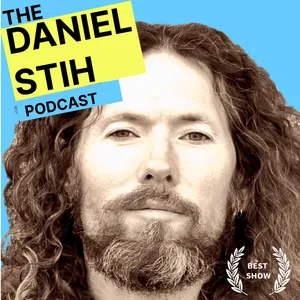
Free Daily Podcast Summary
The Daniel Stih Podcast: Daily Summaries Delivered
by Daniel Stih
Thinking clearly — alone and together.This podcast is a public record of how I reason through complex problems.Solo episodes focus on thinking tools and perspective — designed to help you regain clarity when you're stuck, overwhelmed, or unsure how to proceed.Guest episodes are conversations as research — explorations of how others think. A guest's presence is not an endorsement of any kind; the purpose is to examine reasoning, assumptions, and logic in real time.The goal is not to persuade or debate.It's to show how reasoning works when easy answers fail — and how to think clearly about what's really going on.Website: https://www.danielstih.com
Latest Episodes
The most recent episodes — sign up to get AI-powered summaries of each one.
- Aug 10, 20267 min
Shared Experience ≠ Shared Meaning
Can two people have the same experience while assigning completely different meanings to it? This conversation uses the idea of "friends with benefits" as a case study to explore a broader question: How do expectations, assumptions, and personal meaning shape the way we experience the same situation differently? In this episode we explore: emotional attachment and casual relationships why people interpret intimacy differently hidden expectations and unspoken assumptions emotional asymmetry in relationships biology, psychology, and attachment the difference between physical intimacy and emotional connection why ambiguity creates confusion and hurt communication and mismatched objectives A recurring theme throughout the discussion is that people often assume shared understanding when, internally, they may be operating from completely different emotional frameworks. This episode originally aired on a previous relationship-focused podcast project. What interests me is the broader pattern of human behavior, interpretation, emotional decision-making, and how people navigate ambiguity in relationships.
- Aug 7, 202610 min
Why Political Conversations Become Unproductive - Before They Even Begin
What does democratic socialism mean? I wasn't sure. Rather than deciding whether it was good or bad, I began investigating how the term is defined by different sources. This episode explores why political conversations become unproductive before they even begin—not because people disagree - rather they are using the same words to mean different things. Why definitions matter before debating ideas The differences between Wikipedia, political organizations, and AI-generated summaries How labels shape our thinking before we evaluate evidence Why broad summaries don't answer the question we're asking A better framework for evaluating political ideas, one proposal at a time The episode isn't about democratic socialism. It's about how to think clearly when we encounter political language, unfamiliar terminology, or competing definitions. Before asking whether you agree with an idea, first ask: "What do you mean?"
- Aug 1, 20261h 5m
Are We Asking the Wrong Questions About Data Centers? With Jennifer Pelton
Data centers have become one of the most controversial pieces of modern infrastructure. Most discussions focus on artificial intelligence, electricity demand, water consumption, and carbon emissions. But are those the right questions? In this episode, attorney and civil liberties advocate Jennifer Pelton shares a different perspective. She argues that surveillance—not AI—is a major force behind the rapid expansion of data centers and discusses why she believes important issues are being overlooked. We explore: what data centers are and how they've evolved the different types of data centers and why those distinctions matter surveillance, privacy, and constitutional rights the idea of "controlled opposition" environmental and community impacts, including mining, noise, infrasound, and electrical infrastructure common assumptions about AI, renewable energy, and cloud storage what citizens can do if a data center is proposed in their community Throughout the conversation, one question keeps returning: How do we know that? Whether you agree, disagree, or remain undecided, this episode is an invitation to examine evidence, question assumptions, and think more deeply about one of the fastest-growing technologies shaping modern society. SHOW NOTES Jennifer L. Pelton, Esq. NY & CT Attorney Substack: https://substack.com/@jennesq LinkedIn: https://www.linkedin.com/in/jennifer-l-pelton-esq/ Linktree": https://linktr.ee/jenniferpelton
- Jul 7, 20267 min
When Algorithms Reinforce the First Question
Why do so many people investigating the same topic end up reaching similar conclusions? Is it because the evidence points in one direction? Or is it because recommendation algorithms reinforce the first question they asked? In this episode, I explore how social media algorithms shape the information we encounter—not by deciding what's true or false - by giving you more of what you're interested in. Using examples from AI-generated music, data centers, and water consumption, I examine how the first article, video, or headline we encounter can quietly frame the rest of our investigation. The challenge isn't misinformation. It's that we become experts within the original frame of a problem without stepping outside it to ask a different question that may lead somewhere entirely different. Sometimes the most important discovery isn't finding a better answer - it's realizing you started with asking the wrong question.
- Jul 5, 20262 min
What Does "Taking a Break" Mean?
This conversation started as a discussion about "taking a break" in a relationship. Underneath is a broader question about compatibility, emotional pressure, communication, boundaries, and how people respond when relationships begin to feel psychologically overwhelming. When someone asks for space, what are they actually communicating? Is it a temporary reset, avoidance, incompatibility, emotional overload, or the beginning of the end? In this episode we explore: why some relationships begin to feel smothering how people communicate discomfort indirectly the difference between needing space and wanting out emotional pressure and relationship dynamics compatibility under stress whether distance clarifies or accelerates underlying problems This episode originally aired on a previous relationship-focused podcast project. What interests me now is the broader pattern of human behavior, communication, interpretation, and decision-making under emotional uncertainty.
- Jul 3, 20269 min
AI Music, Stolen Songs, and the Problem Nobody Seems to Be Solving
AI companies have been accused of training music-generation models on copyrighted songs without permission. Lawsuits followed. Licensing deals emerged. The debate became about copyright and compensation. While investigating the issue, I found myself asking a different question: How did the music actually get into the training system? That question led me into datasets, metadata, YouTube links, and an under explored part of the public discussion—the pipeline between publicly available music and AI model training. In this episode, I explore why datasets are not the same as audio collections and why understanding how a system works is as important as deciding what should happen after the fact. This isn't an argument for or against AI companies or artists. It's an exploration of problem definition, assumptions, and why understanding the mechanism leads to better questions—and better solutions.
- Jul 2, 202655 min
What Problem Does Air Testing Actually Solve? (Jason Earle)
Jason Earle left a career on Wall Street after discovering that mold in his childhood home may have contributed to years of allergies and asthma. He went on to perform thousands of building investigations and developed the Got Mold? Test Kit to make air sampling accessible and affordable. In this conversation, we explore: What problem air sampling is intended to solve The role of independent mold inspectors The difference between testing, investigating, and remediation The discussion explores a recurring theme throughout this podcast: Before choosing a solution, it's worth asking what problem we're actually trying to solve.
- Jun 28, 202618 min
Data Centers, AI in Space & How Narratives Shape Our Future
An exploration of how the questions we ask—and the models we build—can influence narratives that shape technology, investment, and public policy. A widely cited paper estimated the water footprint of AI models. The results spread rapidly through news stories, social media, and public debate. But what question was the researchers actually trying to answer? I explore the assumptions behind lifecycle water accounting and how assumptions are shaping conversations about AI, data centers, and proposals for space-based computing.
About The Daniel Stih Podcast
Thinking clearly — alone and together.This podcast is a public record of how I reason through complex problems.Solo episodes focus on thinking tools and perspective — designed to help you regain clarity when you're stuck, overwhelmed, or unsure how to proceed.Guest episodes are conversations as research — explorations of how others think. A guest's presence is not an endorsement of any kind; the purpose is to examine reasoning, assumptions, and logic in real time.The goal is not to persuade or debate.It's to show how reasoning works when easy answers fail — and how to think clearly about what's really going on.Website: https://www.danielstih.com
Customized Recaps
AI-powered recaps with compact key takeaways, quotes, and insights.
Straight to Your Inbox
Get key takeaways from The Daniel Stih Podcast in a 5-minute read.
Save Hours Every Week
Stay current on your favorite podcasts without falling behind.
Frequently Asked Questions
What is Podzilla's The Daniel Stih Podcast daily summary?
It's a free AI-powered email that summarizes new episodes of The Daniel Stih Podcast as soon as they're published. You get the key takeaways, notable quotes, and links & mentions — all in a quick read.
How does the The Daniel Stih Podcast podcast summary work?
When a new episode drops, our AI transcribes and analyzes it, then generates a personalized summary tailored to your interests and profession. It's delivered to your inbox every morning.
Is this an official The Daniel Stih Podcast product?
No. Podzilla is an independent service that summarizes publicly available podcast content. We're not affiliated with or endorsed by Daniel Stih.
Can I get summaries of other podcasts too?
Absolutely! The free plan covers up to 3 podcasts. Upgrade to Pro for 15, or Premium for 50. Browse our full catalog at /podcasts.
What topics does The Daniel Stih Podcast cover?
The Daniel Stih Podcast covers topics including Education, Self-Improvement. Our AI identifies the specific themes in each episode and highlights what matters most to you.
Start getting The Daniel Stih Podcast summaries tomorrow morning.
Free forever for up to 3 podcasts. No credit card required.
Free forever for up to 3 podcasts. No credit card required.