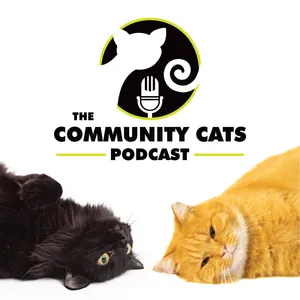
Free Daily Podcast Summary
The Community Cats Podcast: Daily Summaries Delivered
by The Community Cats Podcast
Our mission is to provide education, information and dialogue that will create a supportive environment empowering people to help cats in their community.
Latest Episodes
The most recent episodes — sign up to get AI-powered summaries of each one.
- 5 days ago22 min
Ep 682: Too Small Is Not a Diagnosis, with Jordyn Purpura Feline Director, Yolo County SPCA; Strategic Advisor, Orphan Kitten Club; Clinical Researcher, Vernau Laboratory at UC Davis
"When we say age is not a disease, we also mean it for the youngest." This episode is sponsored-in-part by Maddie's Fund, OcuTrap, and Jessica Dolce, Compassion Fatigue + Grief Educator. Jordyn Purpura started out smuggling orphaned raccoons into his childhood bedroom. Twelve years of neonatal fostering later, he's in his final year of veterinary school, chasing a gap he kept running into from both sides of the exam table: almost nothing in veterinary education begins before eight weeks of age. As a foster parent, that gap sounded like a doctor saying there wasn't much anyone could do. As a shelter worker placing bottle babies, and sometimes being the one present for their euthanasia when no foster could be found, it looked like an entirely preventable loss. For a long time there was a defensible reason not to push harder on kitten medicine: it doesn't matter what a veterinarian is willing to diagnose or prescribe if there's nobody to take that kitten home and feed it every two hours. Jordyn's argument is that this excuse has quietly expired. Foster networks have grown, nurseries have opened, funding has followed. What hasn't caught up is the reflex — too small for blood work, too small for imaging, too small for a medication that was never labeled for a body this size. That reflex has a body count. Kittens remain the animals least likely to leave a shelter alive, not because their medicine is impossible but because almost no one was taught it. Jordyn is teaching it now, to veterinary technicians, to emergency teams, to his own cohort. And he'd like the rest of us to start asking for it out loud.[/one_second] [one_second]Press Play Now For: Why veterinary education effectively starts at eight weeks, and what that costs kittens The emotional weight shelter staff carry when there's no foster available Bringing tube feeding and neonatal husbandry onto hospital nursing teams What the UC Davis famciclovir research showed about recovery times Congenital hypothyroidism as an overlooked cause of "failure to thrive" Getting creative with diagnostics instead of calling a kitten too small for them How fosters and rescues can push their veterinary partners toward more Why generational openness matters more than age when shifting practice Resources & Links Vernau Laboratory at UC Davis UC Davis Feline Pediatrics on Instagram Jordyn Purpura on Instagram — The Vet Med Couple UC Davis Fracture Program for Rescue Animals Orphan Kitten Project at UC Davis Orphan Kitten Club
- 1 weeks ago28 min
Ep 681: Making the Case for TNR Without County Buy-In, with Eve Salimbene, President of Street Cat Project of Polk County
"Today's inside cat is tomorrow's outside cat." This episode is sponsored-in-part by Maddie's Fund, OcuTrap, and The Community Cat Clinic. Eve Salimbene spent her career in the legal field before moving into animal welfare 26 years ago — and by her own admission, she was a dog person until she landed in Polk County, Florida. There she found a county with groups working on dogs and essentially nothing for cats: a high shelter kill rate, no low-cost spay/neuter anywhere in the county, and a year-round breeding season with none of the winter respite she'd known up north. She posted a question online asking what was being done. The response pulled her in, and in 2020 a brand-new group of volunteers TNR'd 133 cats. Six years later the count is roughly 6,700 — and the 133 looks like the tip of the iceberg. The complication is that TNR isn't condoned in Polk County. The Board of County Commissioners and the sheriff who runs animal control don't believe it works, which puts Eve's team in a strange middle space: vocal enough that caregivers know they aren't alone, careful enough not to get shut down. Some of the people they've helped won't give testimonials for fear of retribution. Eve and Stacy dig into where the cats actually come from, why Eve believes proactive municipal investment beats two more decades of trap and kill, and what a real pilot project would need to look like. Three smaller municipalities have now approached her about running one — and she's pushing for a five-year window with honest baseline numbers. Press Play Now For: Why running a law firm turns out to be decent preparation for animal advocacy What it's like to lead a TNR organization in a county that officially opposes TNR The 2020 cohort of colonies now reporting zero kittens, years later Where Polk County's community cats actually originate — and why "transient population" is the honest answer The tagline that reframes owned-cat spay/neuter as a community cat issue Municipal spay/neuter funding on the move: New York City, DeKalb County, and a statewide Texas program Eve's proposed funding mechanisms, including a one-cent sales tax and corporate donors in the Tampa–Orlando corridor Stacy's pilot-project challenge: designate the worst zip code, hit the volume, and watch intake drop Why three small municipalities may end up leading where the county won't Resources & Links Street Cat Project of Polk County Coalition for Animal Rights and Education in Polk County (CARE) on Facebook Contact Eve directly: contact@streetcatproject.org Community Cat Program Management Certificate — University of the Pacific, Benerd College (next session begins September 14) Sustainable Solutions Grant Program — United Spay Alliance Making the Case for TNR Certification Workshop - presented by Neighborhood Cats
- 2 weeks ago35 min
Ep 680: Small and Mighty: Inside Jersey City's Feral Fixers TNR Club, with Robyn Alcock & Jen Scott, Co-Founders of Feral Fixers TNR Club (Jersey City, NJ)
"It's okay to be small and grassroots." This episode is sponsored-in-part by Maddie's Fund, OcuTrap, and The Community Cat Clinic. Robyn Alcock and Jen Scott joined host Stacy LeBaron to talk about Feral Fixers TNR Club, the Jersey City nonprofit they co-founded in 2024 alongside Kathryn Parker after years of trapping independently. In just two years, the all-volunteer group — who all keep full-time jobs — has helped more than 375 cats through TNR, rescue, and medical care. Much of the conversation centered on the realities of running a small "operational board" nonprofit: the governance lessons that shaped their early structure, why they held off on setting formal growth metrics in year one, and how nearly half of the cats they trap turn out to be friendly, adoptable animals rather than TNR candidates — a shift driven largely by the lack of low-cost spay/neuter access in Jersey City. Stacy, Robyn, and Jen also dug into practical solutions: MASH-style pop-up clinic models from groups like Animal Balance and Slomba Shelter Solutions as ways to bring high-volume spay/neuter directly into underserved neighborhoods, and the fundraising path that took Feral Fixers from small individual donors to their first Mission Meow grant and a matching grant from United Spay Alliance's Community Cats Grants program at their two-year mark. It's a useful blueprint for any small, grassroots group trying to prove — as Robyn puts it — that it's okay to be small. Press Play Now For: How a pandemic-era trapping experience and a childhood spent bottle-feeding strays led Robyn and Jen to co-found a Jersey City nonprofit Practical governance lessons for small, "operational board" nonprofits — board size, conflicts of interest, and keeping personal and organizational finances separate Why nearly half of Feral Fixers' TNR trapping efforts turn into friendly-cat rescues, and how that's reshaping their workload The transportation and appointment-access barriers keeping Jersey City residents from affordable spay/neuter MASH-style clinic models, including Animal Balance, as an option for bringing spay/neuter directly into underserved communities How Feral Fixers built its funding base through small donors, a Mission Meow grant, and a United Spay Alliance matching grant Stacy's framework for identifying and cultivating leadership-level donors as an organization grows Why "altered at intake" numbers matter for understanding a community's real spay/neuter gap Resources & Links Feral Fixers TNR Club: https://feralfixersclub.org/ Feral Fixers TNR Club on Instagram: https://www.instagram.com/feralfixersclub/ United Spay Alliance Community Cats Grants: https://www.unitedspayalliance.org/community-cats-grants/ Animal Balance: https://www.animalbalance.org/ Slomba Shelter Solutions: https://slombasheltersolutions.com/
- 3 weeks ago32 min
Ep 679: Running on Empty: Compassion Fatigue and Grief in TNR, with Jen Blough, LPC Licensed Professional Counselor & Author
"It's about knowing your limits, knowing where you are energy-wise, time-wise, resource-wise, and just doing what you can — and knowing that is enough, and that is making a difference." This episode is sponsored-in-part by Maddie's Fund, OcuTrap, and Neighborhood Cats TNR Certification Workshop. Jen Blough returns to the podcast after nearly a decade away — she was featured in the show's first fifty episodes — to talk about the work she's built in the years since: helping animal welfare professionals name and navigate the emotional toll of the field. A licensed professional counselor, former shelter worker and animal control officer, and lifelong animal advocate, Jen didn't set out to specialize in compassion fatigue. She backed into it in grad school, when a professor described the symptoms of secondary traumatic stress and she realized he was describing her own life. Much of the conversation is spent untangling terms that get used interchangeably but aren't the same thing. Jen breaks down compassion fatigue as the combination of burnout (which comes from your environment — under-resourced organizations, systemic failures, day-to-day friction) and secondary traumatic stress (which comes from absorbing someone else's trauma, human or animal). She walks through how moral distress and moral injury fit in — the no-good-options decisions that TNR caregivers and shelter workers face constantly — and why none of these, despite how real they feel, show up in the DSM. The back half of the conversation turns to grief, and this is where the discussion gets specific to community cat work. Jen introduces two concepts: disenfranchised grief (loss that society doesn't validate, which often includes animal loss) and ambiguous loss (grief without closure — not knowing what happened to a cat who stops showing up at a colony). Stacy and Jen talk through the real tension caregivers face around outdoor cats aging out of a colony, and how organizations can handle transparency with volunteers about euthanasia and loss without either traumatizing them or leaving them in the dark. Jen closes with practical advice on knowing your limits and recognizing that showing up in smaller ways — a donation, a shared post, a bag of food — still counts as meaningful advocacy. Press Play Now For: The real difference between burnout, compassion fatigue, secondary traumatic stress, moral distress, and moral injury Why compassion fatigue isn't a diagnosable condition, and how it can fluctuate day to day Disenfranchised grief and why animal loss so often gets dismissed by people outside the field Ambiguous loss — the particular grief of not knowing what happened to a cat who never returns to the feeding station How organizations can navigate telling (or not telling) volunteers about euthanasia and cat loss Jen's advice for recognizing your capacity and letting "not right now" be an acceptable answer A first look at Jen's forthcoming book and new certification program for animal welfare professionals Resources & Links Jen Blough's website Beyond Compassion Fatigue: Trauma, Resilience, and Recovery in Animal Care and Advocacy — pre-order To Save a Starfish: A Compassion Fatigue Workbook for the Animal Welfare Warrior Beyond Compassion Fatigue podcast
- Aug 18, 202619 min
Ep 678: Ctrl+Alt+Meow: How an IT Guy Built a Home for Cat Lovers, with Darein Gray, Founder of Paw-Events.com
"There's not a lot of that — you don't really hear about cat parks or cat meetups. So I wanted to try and change that." This episode is sponsored-in-part by Maddie's Fund, OcuTrap, and The Community Cat Clinic. Darein Gray never set out to build a pet-industry platform — he's an IT guy by trade, working in data and business analytics. But when he noticed there was no real gathering space for cat people the way there is for dog people, he taught himself the tools to build one. What started as a solo passion project has grown into Paw-Events.com, a free directory now covering 60-plus U.S. cities, connecting cat and dog lovers with adoption days, spay/neuter clinics, rescue fundraisers, cat cafés, and community meetups in one searchable place. Host Stacy LeBaron and Darein dig into how the platform actually works for TNR and community cat programs specifically — not just the bake-sale-and-fun-run events people usually picture. Organizations running mobile spay/neuter clinics, trapping events, or vaccination and microchipping days can list by city and neighborhood, filtered so people can find exactly what's happening near them. Darein talks through how smaller grassroots groups, which often don't have the advertising muscle of a PAWS or a Humane Society, can get the same visibility as the big names — and how individuals, not just organizations, are welcome to list events too, after a basic vetting process. The conversation also covers the platform's education side (ESA and service animal resources, vaccination info, cat training events), its city-hub structure and how organic communities form within bigger metro areas, and Darein's openness to expanding into new states and regions when local advocates reach out. For anyone doing outreach for a workshop, clinic, or trapping event, this episode is a look at a free tool built specifically to solve the "how do we get the word out" problem. Press Play Now For: How Paw-Events.com works as a free, searchable directory for cat and dog events across 60+ U.S. cities Why the platform is built for TNR events, spay/neuter clinics, and microchipping days — not just adoption fairs How smaller rescues and individual organizers can list events alongside big-name organizations The vetting process for individuals who want to post their own events How city "hubs" and grassroots communities naturally form on the platform What to do if you want your city or state added to the platform The educational resources available, including ESA/service animal info and cat training events Resources & Links Paw-Events.com Website Paw-Event.com's Facebook Paw-Event.com's Instagram Paw-Event.com's TikTok
- Aug 11, 202627 min
Ep 677: The Environment Makes the Cat: The SAFE Framework for Community Cat Adoption, with Jodi Belongié, RVT, Co-founder of Chico Cat Café, Founder & Executive Director of The CATS Foundation
"The environment we build around a cat shapes her outcome more than any single intervention we can ever make." his episode is sponsored-in-part by Maddie's Fund, OcuTrap, and The Community Cat Clinic. Jodi Belongié has spent more than 25 years in animal welfare and shelter medicine, driven by a question that traces back to age 14, when she talked her way into fostering an abandoned pregnant cat with no rescue to call. That instinct, that the systems cats need don't have to already exist, you can build them, led her to co-found the Chico Cat Café in 2021, which became the proving ground for what she calls the SAFE framework: an original behavioral welfare model, developed through the UC Davis Koret Shelter Medicine Program, that reframes adoption assessment around a single question — not "is this cat adoptable?" but "is this environment giving her a fair chance to show us who she is?" Jodi and Stacy dig into what that looked like in practice: the café's deliberately home-like design, hard caps on capacity (never more than 12–14 cats, nine visitors an hour), and a rescue-based intake process built to get cats settled before they ever meet an adopter. The conversation widens into Jodi's vision for community cat management's next chapter — small, replicable hubs that go beyond adoption into trap depots, spay/neuter access, and food pantries, especially in the rural and under-resourced areas philanthropy tends to overlook. That's the mission behind The CATS Foundation, launching spring 2027.[/one_second] [one_second]Press Play Now For: The origin story behind Jodi's decades in animal welfare — and why she says "the credential has always been secondary to the question" What the SAFE framework is and how it reframes adoption assessment around environment instead of the cat Inside the design choices behind Chico Cat Café's home-like, non-industrial space The capacity-for-care numbers Jodi holds firm on, and why more cats than people is intentional How SAFE's underlying philosophy already shows up in the work of colony managers, TNR practitioners, and foster coordinators Jodi's vision for a "2.0" model of small, replicable community cat hubs — and why she believes it should start small The mission behind The CATS Foundation and its spring 2027 launch Resources & Links Jodi's Substack, Pawsitive Paradigm: https://pawsitiveparadigm.substack.com/ Jodi on LinkedIn: https://www.linkedin.com/in/jodibelongiervt/ Editor's note: This conversation was recorded while Chico Cat Café was in operation. The café permanently closed in April 2026, and Jodi is now focused on The CATS Foundation, launching spring 2027.
- Aug 4, 202630 min
Ep 676: The Cat Who Came Home After Five Years: Inside a Shelter's Return-to-Home Playbook with Corinne Bourgoin, Shelter Operations Supervisor at the MSPCA Boston Adoption Center
This episode is sponsored-in-part by Maddie's Fund, OcuTrap, and The Community Cat Clinic. Corinne Bourgoin returns to the podcast five years after her first appearance, and the numbers show what's changed: the MSPCA Boston Adoption Center's return-to-home rate for cats hit 33% in 2025, more than six times the roughly 5% national average. She draws a careful distinction between "return to owner" and "return to home" — sometimes a cat goes back to one caretaker, sometimes to a neighborhood that's been caring for it collectively — and traces the results back to a mindset shift: assume every stray has someone looking for it, and treat reunification as the shelter's job, not just the owner's. From there, Corinne gets practical. A dedicated, well-followed Facebook page puts stray photos in front of the neighborhoods cats actually came from. For microchipped cats, she doesn't stop at the manufacturer's registry — she cross-checks petmicrochiplookup.com for the most current database, then follows up with whoever implanted the chip. She also shares how anyone can do this detective work before a cat ever reaches a shelter: neighbor conversations, Nextdoor and community Facebook posts, flyers, and "paper collars" — a strip of paper taped around a friendly cat's neck asking, "Is this your cat?" Technology like AirTags helps, but she's clear it's only half the equation; the other half is neighbors staying present in their own communities. The conversation turns to ear tips and how "community cat" has shifted from a behavioral judgment call to a population-risk one — any unaltered outdoor cat, tipped or not. Corinne's years at Maui Humane Society gave that shift real stakes: during the Maui wildfires, more than 600 cats survived the burn zone, many already sterilized and ear-tipped, which meant no kitten boom compounding the recovery. She closes with Tiger, a geriatric cat who arrived at the shelter after five years missing — his microchip led her to an owner who'd long given up hope, and he walked straight to the cabinet where his food bowl used to sit. Press Play Now For: Why "return to home" is a more accurate goal than "return to owner" — and how MSPCA hit a 33% reunification rate for cats A step-by-step walkthrough of tracking down an owner through microchip databases, including why the manufacturer's registry often isn't the most current one Low-tech tools anyone can use to reunite a found cat with its family, from paper collars to Nextdoor posts How the definition of "community cat" has evolved from a behavioral call to a population-management one How more than 600 ear-tipped, sterilized cats survived the Maui wildfires without a kitten population boom The story of Tiger, reunited with his family five years after going missing Resources & Links MSPCA-Angell Pet Microchip Lookup Return-to-Home Certification Workshop (Community Cats Central) Contact Corinne: lostpet@mspca.org
- Jul 28, 202626 min
Ep 675: Cats Pick Their People: Inside Florida's First Cat Cafe Franchise with Sandra Cagan Founder & CEO of the Orlando Cat Cafe
This episode is sponsored-in-part by Maddie's Fund, OcuTrap, and The Community Cat Clinic. Sandra Cagan spent decades in property management before a milestone birthday and a brief human-interest news story about a New York cat cafe sent her in a new direction. She cold-emailed her county commissioner in Lake County, Florida — "You're gonna think I'm crazy, but this is what I want to do" — and had his support within the hour. The Orlando Cat Cafe opened in September 2016 as Florida's first cat cafe, and this year marks its 10th anniversary alongside the Community Cats Podcast's own. Sandra built it as a business first: a full-service cafe rather than packaged snacks, separate AC and filtration systems to keep the cafe and cat areas from cross-contaminating, and a "sweet spot" of about 28 cats at a time in a 1,000-square-foot play area, refreshed weekly by exclusive shelter partner SPCA Florida. All 489 adoptions facilitated last year sent 100% of the fee straight to SPCA Florida — a public-private model she credits partly to a public administration master's she earned during the pandemic. That same pandemic tested her resolve: Florida ordered the cafe closed, and she kept it shut into late July rather than reopen too soon, paying her staff the whole time. Her advice to other cat cafe owners: keep six months of reserves and treat the business like any other, rather than publicly asking for help with basics like a broken AC unit. Ten years in, Sandra has turned that playbook into the country's first cat cafe franchise: 18 months of groundwork, a 500-plus-page operations manual, a $42,750 initial fee, and total investment of roughly $450,000–$650,000 depending on location. She and her team vet franchisees closely and personally scout a shelter partner in every new market, favoring slow, strategic growth — currently focused on the Southeast — over rapid expansion. Press Play Now For: How a milestone birthday, a chance news story, and one bold email led to Florida's first cat cafe Why Sandra runs the cat side and the cafe side as two separate legal entities, with 100% of adoption fees going to her shelter partner The financial cushion and mindset that got the Orlando Cat Cafe through a months-long pandemic shutdown without laying off staff What it actually takes to become an Orlando Cat Cafe franchisee — from a 500-page operations manual to the investment range Why the cats do the matchmaking at the cafe, and how that changes the adoption experience Resources & Links Orlando Cat Cafe: https://www.orlandocatcafe.com Orlando Cat Cafe Franchise: https://www.orlandocatcafefranchise.com SPCA Florida: https://www.spcaflorida.org
Get The Community Cats Podcast summaries in your inbox
Free AI-powered daily recaps. Key takeaways, quotes, and mentions — in a 5-minute read.
Get Free Summaries →Free forever for up to 3 podcasts. No credit card required.
You Might Also Like
Listeners also like.
Cattitude - The #1 Cat Podcast
Explore cat breeds, health tips, and new products weekly on a podcast dedicated to cat care and feline enthusiasts.
The Animal Communication Podcast
Hear animals share insights on behavior, health, and spirituality through conversations with experienced animal communicators.
The Fur Real Podcast with Mark A Kyle
Explores the bond between humans and animals through stories of rescue, veterinary advances, and pet technology.

Vet Candy – Veterinary Lifestyle, News & Learning
Veterinarians and vet students discuss animal health, career advice, and industry trends in casual, informative conversations.

Hunt-Find-Alert: K9 Search and Rescue Community
Examines K-9 search and rescue operations, working dogs, and their roles in emergency response and detection missions.
Culture Apothecary with Alex Clark
Experts share holistic remedies to heal cultural wounds through candid conversations on wellness, identity, and systemic change.

The Cato Weekly Podcast
Leading scholars and policymakers explore liberty, limited government, free markets, and peace through a libertarian lens.
The American Birding Podcast
Discusses birds, birding, conservation, and birding-related travel with experts and enthusiasts across North America and beyond.
Animal
A writer travels the world exploring human connections with animals through intimate encounters and philosophical reflection.
Nonprofit Hub Radio
Interviews with nonprofit leaders and experts offering practical insights to help organizations improve and grow.
Nature Podcast
Covers breakthrough research from Nature journal across all scientific fields, with insights from scientists and science journalists.
The Zooquarium Podcast
A biologist and an artist answer listener questions about animals and ecosystems, blending science and creativity for all ages.
About The Community Cats Podcast
Our mission is to provide education, information and dialogue that will create a supportive environment empowering people to help cats in their community.
Customized Recaps
AI-powered recaps with compact key takeaways, quotes, and insights.
Straight to Your Inbox
Get key takeaways from The Community Cats Podcast in a 5-minute read.
Save Hours Every Week
Stay current on your favorite podcasts without falling behind.
Frequently Asked Questions
What is Podzilla's The Community Cats Podcast daily summary?
It's a free AI-powered email that summarizes new episodes of The Community Cats Podcast as soon as they're published. You get the key takeaways, notable quotes, and links & mentions — all in a quick read.
How does the The Community Cats Podcast podcast summary work?
When a new episode drops, our AI transcribes and analyzes it, then generates a personalized summary tailored to your interests and profession. It's delivered to your inbox every morning.
Is this an official The Community Cats Podcast product?
No. Podzilla is an independent service that summarizes publicly available podcast content. We're not affiliated with or endorsed by The Community Cats Podcast.
Can I get summaries of other podcasts too?
Absolutely! The free plan covers up to 3 podcasts. Upgrade to Pro for 15, or Premium for 50. Browse our full catalog at /podcasts.
How often does The Community Cats Podcast release new episodes?
The Community Cats Podcast publishes weekly. Our AI generates a summary within hours of each new episode.
What topics does The Community Cats Podcast cover?
The Community Cats Podcast covers topics including Business, Kids & Family, Animals, Family, Non-Profit, Pets & Animals. Our AI identifies the specific themes in each episode and highlights what matters most to you.
Start getting The Community Cats Podcast summaries tomorrow morning.
Free forever for up to 3 podcasts. No credit card required.
Free forever for up to 3 podcasts. No credit card required.