Free Daily Podcast Summary
The Climate Guru: Daily Summaries Delivered
by Brent Probinsky
Get key takeaways, quotes, and insights from The Climate Guru in a 5-minute read. Delivered straight to your inbox.
Latest Episodes
The most recent episodes — sign up to get AI-powered summaries of each one.
- Apr 17, 202612 min
The Climate Guru Ep. 41 - Our Oceans and Their Hidden Power & Fragility
The oceans are the most powerful life support system on Earth and they are under threat. In this episode of The Climate Guru, Brent breaks down why the oceans matter more than most people realize. Covering 71% of the planet, the oceans absorb 25% of carbon emissions and more than 90% of excess heat, helping stabilize our climate and prevent extreme global warming. They also produce over half of the oxygen we breathe through phytoplankton and support food systems for more than 3 billion people. But this balance is rapidly shifting. From plastic pollution and agricultural runoff creating massive dead zones, to overfishing, coral reef collapse, and rising ocean temperatures, marine ecosystems are being pushed to their limits. As oceans become more acidic and stratified, the very systems that sustain life are beginning to break down. We also explore rising sea levels, the risk of climate migration, and the growing global effort to protect international waters. The future of the oceans will depend on how quickly we reduce greenhouse gas emissions, transition to clean energy, and rethink our relationship with the natural world. The health of the oceans is not separate from us. It is the foundation of life on Earth. Subscribe for more conversations on climate, environmental justice, and solutions that matter. #TheClimateGuru #Oceans #OceanHealth #ClimateChange #ClimateCrisis #SaveOurOceans #OceanConservation #MarineLife #ProtectTheOcean #ClimateAction #GlobalWarming #BluePlanet #Sustainability #EnvironmentalJustice #Biodiversity
- Apr 3, 20267 min
The Climate Guru Ep. 40 - Indigenous Perspectives on Nature and Responsibility
The Amazon Rainforest is the largest tropical forest on Earth, spanning nearly 7 million square kilometers across nine countries and influencing climate systems far beyond South America. But protecting the Amazon isn’t just about saving trees—it’s about protecting the Indigenous communities who have lived there for thousands of years. In this episode, Brent the Climate Guru explores the vital role Indigenous peoples play in preserving the Amazon. Their territories, which cover about 30% of the forest, consistently show lower deforestation rates and higher biodiversity than surrounding areas. These communities carry generations of ecological knowledge and maintain deep cultural and spiritual relationships with the forest. Brent also explains why the Amazon is critical to the global climate. The forest stores massive amounts of carbon, generates “flying rivers” of atmospheric moisture that regulate rainfall across South America, and acts as a powerful climate stabilizer. But with roughly 17% of the forest already lost—and a tipping point estimated between 20–25%—the Amazon faces increasing threats from ranching, agriculture, mining, fires, and rising temperatures. This episode highlights why protecting Indigenous land rights may be one of the most effective climate and conservation strategies we have—and why the future of the Amazon is inseparable from the future of the people who call it home. #AmazonRainforest #ClimateChange #IndigenousRights #EnvironmentalJustice #ClimatePodcast #ProtectTheAmazon #ClimateAction
- Mar 20, 202612 min
The Climate Guru Ep. 39 - Why Indigenous Land Rights Are Key to Protecting the Amazon Rainforest
The Amazon Rainforest is the largest tropical forest on Earth, spanning nearly 7 million square kilometers across nine countries and influencing climate systems far beyond South America. But protecting the Amazon isn’t just about saving trees—it’s about protecting the Indigenous communities who have lived there for thousands of years. In this episode, Brent the Climate Guru explores the vital role Indigenous peoples play in preserving the Amazon. Their territories, which cover about 30% of the forest, consistently show lower deforestation rates and higher biodiversity than surrounding areas. These communities carry generations of ecological knowledge and maintain deep cultural and spiritual relationships with the forest. Brent also explains why the Amazon is critical to the global climate. The forest stores massive amounts of carbon, generates “flying rivers” of atmospheric moisture that regulate rainfall across South America, and acts as a powerful climate stabilizer. But with roughly 17% of the forest already lost—and a tipping point estimated between 20–25%—the Amazon faces increasing threats from ranching, agriculture, mining, fires, and rising temperatures. This episode highlights why protecting Indigenous land rights may be one of the most effective climate and conservation strategies we have—and why the future of the Amazon is inseparable from the future of the people who call it home. #AmazonRainforest #ClimateChange #IndigenousRights #EnvironmentalJustice #ClimatePodcast #ProtectTheAmazon #ClimateAction
- Mar 6, 202641 min
The Climate Guru Ep. 38 - Interview with Zimyl Adler
Join climate expert Brent Probinsky and activist Zimyl Adler as they discuss the outcomes of COP30, focusing on forest conservation, indigenous rights, and the role of finance in climate action. Discover insights into global efforts, challenges, and opportunities for meaningful change in climate policy. Chapters 00:00 Introduction to Climate Activism and COP30 00:41 Experiences from COP30: People's Summit and Official Negotiations 02:54 Disappointments and Expectations: Fossil Fuels and Deforestation 07:29 The Role of Indigenous Peoples in Climate Action 10:34 Tropical Forest Forever Facility: Opportunities and Concerns 13:50 Financial Mechanisms and Deforestation: A Critical Analysis 18:06 The Sahado: An Overlooked Ecosystem in Crisis 20:04 Pressure Points: Educating Investors and Pension Holders 21:01 The Need for Binding Agreements in Climate Negotiations 24:14 The Future of Climate Action: Transparency and Accountability 26:44 The Climate Crisis and Political Challenges 28:49 Community Solutions and the People's Summit 31:42 Agroecology and Local Food Systems 35:25 Global Movements for Sustainable Agriculture 37:52 Indigenous Rights and Climate Action 40:05 Cultural Connections and Personal Passions
- Feb 27, 202610 min
The Climate Guru Ep. 37 - Greenland, Climate Change, and Shared Responsibility
Greenland is 80% ice and home to 58,000 people, most of them Indigenous Inuit whose communities and culture depend on the stability of Arctic ice. That ice is disappearing at an alarming rate. In this episode, we explore what is happening in Greenland and how global emissions, particularly from the United States, are shaping its future. The U.S. has contributed more cumulative greenhouse gases than any other nation in history, roughly 22% of all emissions still in the atmosphere. Today, it remains the second largest emitter after China, despite representing only a small percentage of the world’s population. Arctic temperatures are rising three to four times faster than the global average due to Arctic amplification. Greenland’s ice sheet is melting seven times faster than it did in the 1990s. Coastal villages are eroding. Infrastructure is collapsing. Fisheries that supply the majority of local income and protein are under threat. Wildlife such as polar bears, walrus, and seals are losing habitat. Oceans are acidifying. Sea levels have already risen about 10 inches globally, and Greenland accounts for a significant share of the ice driven contribution. This episode looks at climate responsibility, Indigenous resilience, Arctic tipping points, and why Greenland’s transformation matters far beyond the Arctic. Climate change is not distant. It is happening now. #ClimateChange #Greenland #Arctic #IndigenousRights #ClimateJustice #GlobalResponsibility
- Feb 13, 202616 min
The Climate Guru Ep. 36 - Venezuelan Oil, and the Collapse of One of the World’s Richest Ecosystems
Hi, this is Brent, the Climate Guru. Venezuela sits on the largest proven oil reserves in the world, even larger than Saudi Arabia, but it’s also home to some of the dirtiest, heaviest crude on the planet. Thick, sulfur-laden oil that must be heated and diluted is only the beginning of the story. Over the last 20 years under the Chavez and Maduro regimes, Venezuela has gone from a major oil producer to an environmental and humanitarian disaster. Oil infrastructure was neglected after international companies were expelled, leading to widespread spills, pollution, and collapsing production. As oil revenues dried up, the government turned to gold mining, allowing thousands of legal and illegal mines to invade the most sensitive ecological regions, including Venezuela’s portion of the Amazon rainforest. Mercury contamination, deforestation, poisoned rivers, and the destruction of national parks are accelerating the loss of biodiversity in one of only 17 mega-diverse countries on Earth. Jaguars, dolphins, rare birds, and endemic species are disappearing as ecosystems unravel. Economic collapse has forced over six million people to flee the country, while wildlife trafficking and bushmeat hunting surge as desperate survival strategies. This podcast breaks down how corruption, resource mismanagement, and environmental neglect are destroying Venezuela’s natural systems, undermining carbon storage in the Amazon, and fueling one of the largest humanitarian crises in the world today. Let’s get into the details.
- Jan 30, 20269 min
The Climate Guru Ep. 35 - Planning Ahead: Where to Move to Avoid Climate Change Fall-Out in the US
In this episode of the Climate Guru, Brent breaks down one of the biggest questions people are asking as climate change accelerates: where is the safest place to live in the United States over the coming decades. Rising temperatures sea level rise stronger storms wildfires drought and water scarcity are already reshaping where communities can safely and sustainably exist. Brent walks through the science behind these risks and explains how different regions of the US are being affected now and what climate scientists project through the end of the century. The conversation explores why some regions are emerging as relative climate havens including the Great Lakes and upper Midwest inland Northern New England and parts of the inland Pacific Northwest. Brent explains what makes these areas more resilient including access to fresh water lower extreme heat risk reduced exposure to hurricanes and sea level rise and fewer wildfire threats. This episode also goes beyond physical climate risks to examine social and economic resilience. Brent discusses why community support infrastructure healthcare housing insurability and economic diversity matter just as much as geography when choosing where to live in a changing climate. You will also hear about regions facing the greatest risk including coastal and Gulf states low lying areas vulnerable to sea level rise regions experiencing extreme heat and humidity and places where insurance markets and local tax bases are already under strain. This is a clear grounded guide for anyone thinking about climate migration long term planning or understanding how climate change will reshape where and how we live. Listen to the full podcast episode or watch the video to learn how climate science geography and social resilience intersect and what to consider when planning for the future.
- Jan 23, 202612 min
The Climate Guru Ep. 34 - East Asian Flyway Under Threat
The East Asian Australasian Flyway is one of the most important bird migration routes on Earth. Every year, more than 50 million migratory birds representing over 200 species travel from the frozen reaches of Alaska and Siberia to Australia and New Zealand. Along the way, they depend on mangroves, mudflats, peatlands, and coastal wetlands across Southeast Asia to rest, feed, and survive the journey. In this episode, Brent the Climate Guru explains why Southeast Asia is a global biodiversity hotspot and a climate stronghold. The region contains roughly one third of the world’s mangroves and nearly forty percent of tropical peatlands, making it one of the most powerful natural carbon storage systems on the planet. The episode explores how shrimp farming, aquaculture, palm oil plantations, coastal development, and land conversion are rapidly destroying these critical ecosystems. These losses are pushing species like the Spoon billed Sandpiper toward extinction and transforming peatlands and mangroves from carbon sinks into major sources of greenhouse gas emissions. Brent also breaks down why Indonesia consistently ranks among the top greenhouse gas emitting countries and how wetland destruction is a major driver. The conversation highlights real world conservation success stories across China, Thailand, and Malaysia that show large scale wetland restoration can work when governments, development banks, and conservation groups act together. This episode is about more than birds. It is about climate stability, biodiversity, and protecting the natural systems that keep carbon out of the atmosphere. Subscribe for more conversations on climate, biodiversity, and environmental justice. Share this episode to help protect the world’s migratory lifelines. #ClimateChange #Biodiversity #Mangroves #Peatlands #Wetlands #MigratoryBirds #EnvironmentalJustice #NatureBasedSolutions
Get The Climate Guru summaries in your inbox
Free AI-powered daily recaps. Key takeaways, quotes, and mentions — in a 5-minute read.
Get Free Summaries →Free forever for up to 3 podcasts. No credit card required.
You Might Also Like
Listeners also like.

Warm Regards
Warm Regards Podcast

The Green Place: a Climate Podcast
James Atfield
Outrage + Optimism: The Climate Podcast
Persephonica and Global Optimism

Climify
Climate Designers
How to Save a Planet
Gimlet
Unf*cking the Future
iHeartPodcasts
Climate Changers
Ryan Flahive
Bridging the Carbon Gap
David Case, Helena Rambler, Cindy Ye, Pierce Siegel, Giulia Di Vincenzo, Adeline Sauberli, Eli Gitter-Dentz, Marie Fadeyeva, Nicholas Wu, Ajani Stella, Daniel Shneider, Gabriel Gitter-Dentz, Kevin Zhou, Adam Rudt
Living on Earth
World Media Foundation
Climate One
Climate One from The Commonwealth Club

Planet Visionaries – SEASON 5
A podcast in partnership with The Rolex Perpetual Planet Initiative
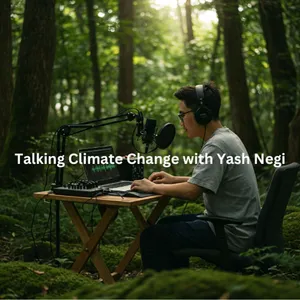
Talking Climate Change with Yash Negi
Yash Negi
About The Climate Guru
Welcome to The Climate Guru podcast. Join Brent as he embarks on a journey to unravel the intricacies of environmentalism, travel, and climate change. In this podcast, he will explore the intersections of sustainability, adventure, and activism through engaging conversations, insightful interviews, and firsthand experiences.Whether you're a seasoned eco-warrior or a curious traveler looking to make a positive impact, Brent's passion and expertise will inspire you to take meaningful action towards a more sustainable future. Tune in as we navigate the global landscape of environmental challenges and discover how each of us can play a role in preserving our planet for generations to come. Join the movement with Brent, The Climate Guru!
Customized Recaps
AI-powered recaps with compact key takeaways, quotes, and insights.
Straight to Your Inbox
Get key takeaways from The Climate Guru in a 5-minute read.
Save Hours Every Week
Stay current on your favorite podcasts without falling behind.
Frequently Asked Questions
What is Podzilla's The Climate Guru daily summary?
It's a free AI-powered email that summarizes new episodes of The Climate Guru as soon as they're published. You get the key takeaways, notable quotes, and links & mentions — all in a quick read.
How does the The Climate Guru podcast summary work?
When a new episode drops, our AI transcribes and analyzes it, then generates a personalized summary tailored to your interests and profession. It's delivered to your inbox every morning.
Is this an official The Climate Guru product?
No. Podzilla is an independent service that summarizes publicly available podcast content. We're not affiliated with or endorsed by Brent Probinsky.
Can I get summaries of other podcasts too?
Absolutely! The free plan covers up to 3 podcasts. Upgrade to Pro for 15, or Premium for 50. Browse our full catalog at /podcasts.
How often does The Climate Guru release new episodes?
The Climate Guru publishes biweekly. Our AI generates a summary within hours of each new episode.
What topics does The Climate Guru cover?
The Climate Guru covers topics including Science, Education, Nature, Culture, Society & Culture, Self-Improvement, Places & Travel. Our AI identifies the specific themes in each episode and highlights what matters most to you.
Start getting The Climate Guru summaries tomorrow morning.
Free forever for up to 3 podcasts. No credit card required.
Free forever for up to 3 podcasts. No credit card required.