Free Daily Podcast Summary
The Astrophysics Podcast: Daily Summaries Delivered
by Paul Duffell
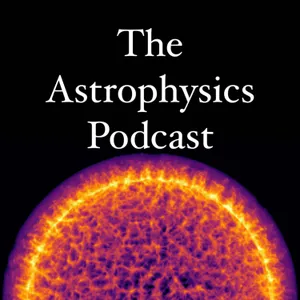
Once a month, Purdue University's Professor Paul Duffell discusses astronomy and astrophysics with experts from around the world. Duffell and guests discuss supernovae, galaxies, planets, black holes, and the nature of space and time.Supported by the National Science Foundation under grant AAG-2206299.Music by Brittain Ashford.Produced in beautiful Lafayette, Indiana by Paul Duffell.Follow us on BlueSky!
Latest Episodes
The most recent episodes — sign up to get AI-powered summaries of each one.
- 5 days ago55 min
Dr. Meridith Joyce -- Stars, in Theory
How do we know how old a star is? Unlike trees, stars don't have rings we can count, and determining their ages requires us to understand the complicated physics happening deep inside them. Stellar models are essential to this process, but even our best models have significant uncertainties in how they treat processes like convection and mixing. Dr. Meridith Joyce is a computational astrophysicist who works on improving these models, in order to better understand stars. In this episode, we talk about how we determine the ages of stars, what their oscillations can tell us about their interiors, and take a closer look at one particularly famous star: Betelgeuse.
- Oct 1, 202655 min
Dr. Chris Irwin -- Prepare to be Shocked!
Shockwaves are a familiar phenomenon here on Earth. In astrophysics, they play a role in some of the most powerful events in the universe, from exploding stars to gamma ray bursts. Shockwaves can transform enormous amounts of energy and carry information about events that are otherwise impossible to observe directly. Dr. Chris Irwin studies how these shocks form and evolve, and how we can use them to learn about cosmic explosions.
- Jul 1, 20261h 6m
Dr. Ranadeep Dastidar -- Astrophysics at the Speed of Light
The Theory of Relativity was discovered by Einstein over a century ago, and it tells us how time and space are distorted when moving close to the speed of light. We mere earthlings don't get the opportunity to move that fast, but there are some phenomena in astrophysics that move very fast; more than 99.9999% of the speed of light. Ranadeep Dastidar is a computational modeler who writes code to predict and interpret these "relativistic" phenomena.
- Jun 1, 20261h 17m
Dr. Abigail Polin -- Astrophysics Q & A #3
Abigail Polin is back, and we are doing another astrophysics Q&A! This time, our questions come from a class of third graders in Indiana. You'll be surprised at how some of the simplest questions can lead us down a very complex path!
- May 1, 20261h 5m
Dr. Jeff Gerber -- Let's Talk Stars
This episode we get back to the objects that inspired the whole field of astrophysics -- stars. Those little points of light that first inspired us as children are incredible physics laboratories that we can still use today to learn about plasma physics, turbulence, and nuclear reactions. Dr. Jeff Gerber tells us why he made his career out of studying how stars work, and how much we still have to learn about these giant balls of plasma.
- Apr 1, 202650 min
Dr. Charles Law -- All the Molecules in Protoplanetary Disks
Just how much do we know about how the planets formed? How much of this can we learn from getting images of young solar systems? Why does it help to look at the disk using radio waves instead of optical wavelengths? Dr. Charles Law discusses these questions and more as we talk about radio astronomy and the birth of the solar system.
- Mar 1, 20261h 14m
Dr. Daniel Polin -- The Biggest Digital Camera in the World
The Vera Rubin Observatory has just started taking its first data this month. We have a special guest (Dr. Daniel Polin) who helped in the construction of the camera for Rubin. This digital camera was a major feat due to the very large amount of data contained in each exposure, requiring clever techniques for reading and transmitting data quickly. Let's find out what it takes to build the biggest digital camera in the world.
- Feb 1, 20261h 1m
Dr. Gurtina Besla -- Dark Matter in the Milky Way
Most of the mass in the universe is invisible. We call it "Dark Matter", and the only reason we know it's there is because we can see how it gravitationally interacts with regular matter. For example, in our own galaxy, Dark Matter comprises most of the mass, in a large spherical "halo" that binds the smaller spiral of gas and stars that we can see. As all our stars orbit the Milky Way, they are passing through a sea of dark matter, and this should create observable consequences that allow us to test theories about the nature of dark matter itself. Dr. Gurtina Besla develops large-scale computer simulations of the Milky Way to compute these observational signatures, allowing us to put our theories of dark matter to the test inside our own galaxy.
Get The Astrophysics Podcast summaries in your inbox
Free AI-powered daily recaps. Key takeaways, quotes, and mentions — in a 5-minute read.
Get Free Summaries →Free forever for up to 3 podcasts. No credit card required.
You Might Also Like
Listeners also like.

PBS Space Time
An astrophysicist explains cosmic phenomena like black holes and galaxy evolution through accessible, science-driven discussions.
The 365 Days of Astronomy
A daily podcast featuring diverse voices exploring astronomy and space science topics.

Ask a Spaceman!
An astrophysicist answers listener questions about space, time, and the universe.

Dear People of Earth Science and Physics- The UFO Podcast - Disclosure - Aliens - UAP
Explores UFO and UAP phenomena through scientific analysis, physics, and expert discussions on credible sightings and cosmic mysteries.
Math & Physics Podcast
Two University of Toronto students discuss topics in math and physics.
SpaceTime with Stuart Gary
Weekly explorations of astronomy, space, and science news with insights from a veteran science journalist and industry experts.

Physics Frontiers
Two physicists explore topics ranging from subatomic particles to the far reaches of the universe.
Bedtime Astronomy
A calming exploration of cosmic wonders, sharing stories about stars, planets, and celestial phenomena to inspire curiosity before sleep.
SpaceTime Conversations
norekiva

Cosmos in a Pod
Explores space, science, philosophy, and technology to reveal the wonders of the universe and humanity's place within it.
Physics for Future
Experts discuss quantum mechanics, atomic clocks, and AI to make physics accessible for students and the public.
Daniel and Kelly’s Extraordinary Universe
Two scientists explore diverse topics across the universe, from particles to ecosystems, with accessible and engaging explanations.
About The Astrophysics Podcast
Once a month, Purdue University's Professor Paul Duffell discusses astronomy and astrophysics with experts from around the world. Duffell and guests discuss supernovae, galaxies, planets, black holes, and the nature of space and time.Supported by the National Science Foundation under grant AAG-2206299.Music by Brittain Ashford.Produced in beautiful Lafayette, Indiana by Paul Duffell.Follow us on BlueSky!
Customized Recaps
AI-powered recaps with compact key takeaways, quotes, and insights.
Straight to Your Inbox
Get key takeaways from The Astrophysics Podcast in a 5-minute read.
Save Hours Every Week
Stay current on your favorite podcasts without falling behind.
Frequently Asked Questions
What is Podzilla's The Astrophysics Podcast daily summary?
It's a free AI-powered email that summarizes new episodes of The Astrophysics Podcast as soon as they're published. You get the key takeaways, notable quotes, and links & mentions — all in a quick read.
How does the The Astrophysics Podcast podcast summary work?
When a new episode drops, our AI transcribes and analyzes it, then generates a personalized summary tailored to your interests and profession. It's delivered to your inbox every morning.
Is this an official The Astrophysics Podcast product?
No. Podzilla is an independent service that summarizes publicly available podcast content. We're not affiliated with or endorsed by Paul Duffell.
Can I get summaries of other podcasts too?
Absolutely! The free plan covers up to 3 podcasts, any in the catalog. Basic raises that to 15, Pro to 40 and Max to 100. Browse our full catalog at /podcasts.
How often does The Astrophysics Podcast release new episodes?
The Astrophysics Podcast publishes monthly. Our AI generates a summary within hours of each new episode.
What topics does The Astrophysics Podcast cover?
The Astrophysics Podcast covers topics including Science. Our AI identifies the specific themes in each episode and highlights what matters most to you.
Start getting The Astrophysics Podcast summaries tomorrow morning.
Free forever for up to 3 podcasts. No credit card required.
Free forever for up to 3 podcasts. No credit card required.