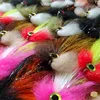
BONUS: Swine Design Secrets: Eli Berant Discusses the Optimus Swine
Episode OverviewThe Butcher Shop goes deep on one of the Great Lakes predator fly world's most distinctive patterns in this conversation with Eli Berant, the Michigan-based fly designer and founder of Great Lakes Fly. Eli is the creator of the Optimus Swine — a reverse foam head-embedded, side-kicking musky streamer that has been turning heads and producing fish since around 2009. In this episode, host Marvin Cash walks Eli through the full arc of the pattern: the lake musky problem it was designed to solve, the unconventional decision to reverse a foam popper head to create a slower fall and a pronounced glide-bait wiggle, the material choices that define the fly's profile and movement and the step-by-step construction logic from spinner bait hook to laser dub head.The conversation covers the full Swine family — the original 8–9 inch version on a 6/0 Mustad, the scaled-down Swine Junior for river smallmouth and stripers, the fettuccine-foam Pot Belly Swine for subsurface river applications, and the articulated Maximus Swine and Maximus Swine Junior, which remain something of a "secret menu" offering. Eli also addresses color selection by region — from olive-and-pink for fired-up Tennessee muskies to the Wisconsin-proven Willen's Villain black-white-yellow combo and his own favorite Mardi Gras pattern — and breaks down his preferred line and leader systems for lake musky versus river smallmouth applications. Throughout, the discussion grounds fly design theory in direct, tactical fishing application.Key TakeawaysHow reversing a foam popper head toward the rear of the hook creates a slower fall rate and induces the Optimus Swine's distinctive side-to-side glide-bait action.Why proportionality in bucktail application — specifically how much material per section and how many sections — is the most common failure point for tiers attempting the Swine for the first time.How to tune the Pot Belly Swine's fettuccine foam piece by removing individual strips to achieve neutral balance and proper swim orientation before fishing.Why a jerk-strip retrieve with a sinking line (350–450 grain tip) is the preferred delivery system for lake musky, allowing the sink tip to hold depth while the fly kicks side to side on each pull.When to dial back retrieve aggression and employ a stutter-strip or extended pause with the Swine Junior, particularly during cold-water conditions when bass are holding and waiting.Why sharing newly discovered synthetic fly tying materials openly — rather than hoarding them — is essential to keeping those materials in production and available to the broader tying community.Techniques & Gear CoveredThe Optimus Swine is designed around a jerk-strip retrieve that drives its foam-induced side-to-side action, and Eli breaks down exactly how to execute it — stripping two feet with the line hand in alternating pulls, roughly like ripping a bag open. For lake musky, he runs a 10-weight with a 350–450 grain sinking tip, paired with a short 3–4 foot leader from loop to fly — a butt section of 40-pound to wire, finished with cross-lock snaps for fast fly changes. River smallmouth and striper applications drop to a 7- or 8-weight with a 200–350 grain tip depending on conditions. Construction-specific details are substantial: Mustad 32608 spinner bait hook (6/0 for the original), Rainy's Mini Me medium foam popper head reversed and goop-set with silicone adhesive, synthetic yak hair blended with flash for the tail, grizzly saddle feathers as flanks, Magnum Flashabou, everyday bucktail applied in top-and-bottom sections, laser dub for the head, and 1/2-inch eyes pressed and held in a two-touch goop cure process. Anadromous Fly Company tungsten carbide scissors get a specific callout as Eli's go-to cutting tool for heavy production tying.Locations & SpeciesThe Optimus Swine was developed specifically for lake musky, with Lake Saint Clair in Michigan serving as the primary proving ground — a relatively snag-free fishery that allows anglers to fish sinking lines freely across the water column. The pattern's documented multi-species versatility extends to Great Lakes migratory species, pike, lake trout, stripers on the East Coast and river smallmouth, including Eli's personal use of the Swine Junior on Lake Saint Clair for targeting large smallmouth by eliminating the smaller fish. Color selection is explicitly regional in the episode: olive-and-pink for fired-up Tennessee fish, pink-and-chartreuse or the Willen's Villain black-white-yellow for Wisconsin tannic water, and Mardi Gras (pink, chartreuse, black head) as a broadly effective patte
Podzilla Summary coming soon
Sign up to get notified when the full AI-powered summary is ready.
Free forever for up to 3 podcasts. No credit card required.
Listen to This Episode
More from The Articulate Fly

S8, Ep 33: Tying Tradition: Jason Taylor's Journey Through the Art of Fly Tying
S8, Ep 32: Spring Fishing Unlocked: Mac Brown's Tips for Targeting Elementary and Graduate School Fish
S8, Ep 31: Chasing Smallmouth: Brian Shumaker's Adaptations for Unpredictable Spring Weather
S8, Ep 30: Central PA Chronicles: George Costa's Guide to Spring Fishing Conditions and Techniques
Get summaries like this every morning.
Free AI-powered recaps of The Articulate Fly and your other favorite podcasts, delivered to your inbox.
Free forever for up to 3 podcasts. No credit card required.