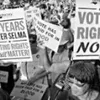
Season 6, Episode 29: Rebecca W. Walston and Danielle S. Castillejo - Updates - Voting Right's Act
Rebecca 1. On grief, shock, and not trusting white institutions “I don't think shocked is the word that I would use. At the risk of making a sweeping generalization, I think we don't trust white people. I don't think we ever have. And I think even when we see something that looks like forward progress, that doesn't necessarily mean that we trust the white privileged supremacist institutions that were the reason why we needed forward progress in the first place. So I don't know that surprised is or shocked is a word. I think I have some grief about the fact that my generation is now facing something that we thought was long over.” 2. On how quickly government moves when Black rights are targeted “If you ask for anything else, the answer is the wheels of government move slowly and the wheels of justice move slowly… But the second you want to strip Black people of something, the second you want to oppress Black people… ‘We can do that over lunch. We can get that done in the next hour. We can undo 50 years worth of voting rights legislation in five minutes.’” 3. On whiteness as an invented category and an exchange “Isn't that the setup of whiteness all along? And when I say whiteness in that, I'm talking about the category white because the truth is nobody who identifies as white is actually like whiteness is a contrived category. What you are is European. What you are is Irish or German or British or Dutch or any other set of categories. And the whole idea in the U.S. sort of experiment is that you would exchange that ethnic specificity, that nationality and the story, the narrative and the identity that is attached to that, that you would exchange it. You would erase yourself. You would shorten your name, change your last name, drop your language, drop the accent, drop all of the cultural markers of your people to join this category called white in the United States.” 4. On the cost of racism, misogyny, and xenophobia “The exchange is always, you get to become us and them is whoever we're othering at the moment. And this belief that in that othering somehow you come out unscathed, uninjured, which is never true, right? Racism, misogyny, xenophobia, it's expensive. It costs money.” 5. On Supreme Court cases and the invention of whiteness “If you follow the court cases at the turn of the century where you have a number of immigrants that are coming to the United States under all these waves and there's a series of court cases, people seeking citizenship… the debate in the courts the entire time is this idea that there's such a thing as a category called white and the people who belong to this category have access to power and wealth and the people who are not in this category will not have access to that power or wealth.” 6. On racism reinventing itself “Racism is smart. Misogyny is smart. Xenophobia is smart. It never stays the same. It morphs and it changes. It reimagines and reinvents itself. It's clever… When you have this period of expansion of rights, it will be followed by a period of extreme backlash.” 7. On the danger of believing civil rights are permanent “I was born into a season where the battles had already been fought and won and the space around human rights was fairly expansive. So my only experience is living in the space of having the rights, the civil rights that we should have as human beings. That's what I know, and it never dawned on me… that in a country that could put the first Black man in office could at the drop of a dime pivot and do the polar opposite.” 8. On power, race, and who gets to belong “In the end it's probably really about power and that racial lines, gender lines, nationality lines are how we have decided to limit the access to that power. And this is the thing: when you get invited into the us category and you think you're secure, you aren't. Because to quote Martin Luther King Jr., injustice anywhere is a threat to justice everywhere. Just because today you fall in the category of us in the us versus them calculation is no guarantee that tomorrow you will stay in that category.” 9. On loyalty to power “If my connection is only to power, I'm loyal to no one and at the same time I'm loyal to anyone who allows me to keep that power.” 10. On the present threat and the limits of talking about trauma as past “Probably the way that we were imagining trauma in that cohort was on this idea that the trauma that we're talking about has long since passed and whatever that threat was doesn't exist today in that way. And for that reason, we sort of have the space to talk about the trauma itself and its impact. And I think where we are in this moment is that's no longer true. The threat is present, it is real, it is tangible, and it's bigger and more concrete in significant ways than it was five, six years ago.” 11. On fear, denial, and
Podzilla Summary coming soon
Sign up to get notified when the full AI-powered summary is ready.
Free forever for up to 3 podcasts. No credit card required.
Listen to This Episode
More from The Arise Podcast

Season 7, Episode 3: Jenny, Rebecca and Danielle - the Power of Mutual Aid and the issue of Fear

Season 7, Episode 2: HBCUs, The Empire and Whatever else

Season 7, Episode 1: The Graveyard of Instagram with Rebecca W. Walston and Danielle S. Rueb Castillejo

Season 6, Episode 33: Adoption and Whiteness with Rebecca, Jenny and Danielle
Get summaries like this every morning.
Free AI-powered recaps of The Arise Podcast and your other favorite podcasts, delivered to your inbox.
Free forever for up to 3 podcasts. No credit card required.