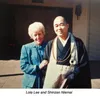
The Basic Teachings of Zen Meditation. Presented on June 29, 1986
(Note: Although there is some remaining quiet delayed echo from the original cassette tape, this talk by Lola about the basics of Zen meditation is still a good primer for a new student of the discipline)---Zen Roshi Lola McDowell Lee, explores the essence of Zen practice, noting that while the era of the 1960s opened Western minds to Eastern traditions, it often lacked the rigorous supervision required for deep spiritual growth.By the mid-80s, she observes a stabilization where Zen schools (Soto and Rinzai) have established roots, offering methods developed by Chinese and Japanese masters to help individuals realize a state of unity with the absolute.Lola explains that Zen meditation is not an abstract concept but a grounded practice. It begins with the physical act of sitting (Asana). By adopting a stable posture, one creates a triangle of solidity that allows the practitioner to relax into themselves. This physical stillness is the prerequisite for the mental work of observing the breath.Lola shares the parable of the minister trapped in a tower. Just as the minister used a series of increasingly stronger threads—from silk to rope—to escape, the practitioner uses the breath (silk thread) to lead to the observation of thoughts (twine) and finally to deep meditation (the rope) that leads to freedom.We must first dis-identify with the "drunken monkey" of the mind—the constant, jumping stream of unnecessary thoughts and emotions that distract us from our original nature.Zen is not about religious rewards or prejudices of good and evil, but about perceiving the universe exactly as it is.Lola explains the similarities of Zen with Western spiritual concepts, suggesting that the "Buddha mind" is identical to the "Christed consciousness" or the "Light" mentioned in the Gospel of John.She argues that every human enters the world with this light, but it is obscured by the cunning deceptions of the mind. The mind loves to play with safe, abstract questions like "What is God?" to avoid the direct, terrifyingly close question of "Who am I?"By treating these inquiries as distractions, the small mind of many sincere spiritual seekers maintains its control and keeps us from our potential. We need to find the Witness that exists behind the changing reflections of the mind.Our ordinary minds are like greased pigs—constantly changing from anger to sadness to joy. By learning to hold a focus and observe these phenomena without judgment, we can perceive a silence that transcends thoughts.Like a mirror that remains unchanged regardless of what it reflects, the Witness remains untouched by the drama of life. Realizing that this ungraspable reality is the path to true freedom leaves us with the central, irreducible question: "Who are you?"June 29, 1986
Podzilla Summary coming soon
Sign up to get notified when the full AI-powered summary is ready.
Free forever for up to 3 podcasts. No credit card required.
Listen to This Episode
More from Talks by Zen Roshi, Lola McDowell Lee
Freedom from preferences. Delivered Aug 31, 1986
Where Taoism, Christianity and Zen meet. Delivered August 17, 1986
Unlearning and existential trust. Delivered Aug 10, 1986
The Trap of Words - Delivered August 3, 1986
Get summaries like this every morning.
Free AI-powered recaps of Talks by Zen Roshi, Lola McDowell Lee and your other favorite podcasts, delivered to your inbox.
Free forever for up to 3 podcasts. No credit card required.