Free Daily Podcast Summary
Talks by Zen Roshi, Lola McDowell Lee: Daily Summaries Delivered
by I & A Publishing
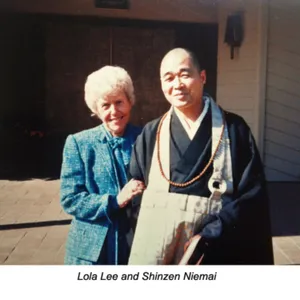
This is a series of newly digitized talks by spiritual teacher, Lola McDowell Lee, spanning two decades—from the early Seventies through the Nineties. Lola was a Zen Roshi whose Rinzai lineage included Doctor Henry Platov and renowned Zen master, Shigetsu Sasaki. Lola was a religious scholar as well as an ordained Christian minister. While the talks are focused mainly on Zen and Buddhism, Lola drew on many spiritual traditions—including those of Jesus, Plato, Lao-Tzu, the Hindu Vedas, Meister Eckhart and Gurdjieff.
Latest Episodes
The most recent episodes — sign up to get AI-powered summaries of each one.
- 1 weeks ago36 min
The importance of mastering attention. Delivered Nov 2, 1986
Zen Roshi, Lola McDowell Lee, discusses the importance of mastering attention—to uncover the silent inner ground of being. Lola recounts a tale about Master Shoju, who calmly sat in a graveyard amidst howling wolves without fear. He had an unshakeable state of mind, invulnerable to the external turmoil of life and death. Most people operate through the thinking mind, engaged in chores, conversations, with their attention scattered across "ten thousand things." People also talk to themselves endlessly about weather, politics, and trivialities—out of touch with their inner core.When individuals first approach meditation in search of self-knowledge, they frequently bring the same habits of "doing" to their practice. They treat meditation as another technique to master, constantly evaluating their performance, worrying whether they are doing it right, or trying out various mental methods and mantras. True meditation has nothing to do with mental gymnastics. Meditation is a state of penetration into the deepest ground of one's being. The mind cannot find stillness through surface thinking and methods. True meditation requires letting go of mental effort, ignoring passing thoughts, allowing attention to rest in the subtle gaps and intervals between thoughts.Lola addresses common misconceptions about meditation. Many mistakenly believe that sitting quietly in a physical posture is sufficient, or that meditation requires a gloomy, pious demeanor. The divine is reflected in the vibrant beauty of nature—sparkling oceans, green grass, and blooming flowers—and that true spiritual practice should awaken greater intelligence, aliveness, and joyful zest for living. The thinking mind is cunning. It rationalizes physical paralysis as spiritual depth, mental dullness as transcendence, and emotional deadness as renunciation. Citing Thomas Merton and D.T. Suzuki, Lola explains that Zen does not seek to explain reality through complex verbal formulas or emotional excitement. It requires pure, unshakeable attention.Lola examines the pitfalls of self-deception and the scattered energy that plagues human life. We easily fool ourselves through egotism, greed, and what Saint Paul termed the "law of my parts"—conflicting internal drives that push us hither and thither without our conscious consent. Without self-observation and disciplined attention, people remain utterly blind to the inner energies driving them. “Not even God himself can help a man who pays no attention." Without inner attention, a person is like someone fighting blindfolded in a dark room against unseen enemies.Lola traces the practice of mindfulness and self-observation to ancient traditions. She discusses practical exercise used with her students—asking them to visualize the color blue and notice how quickly the mind wanders, revealing how undisciplined human attention truly is. When individuals learn to direct their attention inward, moving past surface desires and mental chatter, they tap into the infinite silence and emptiness that they possessed at birth before collecting the noises of the world. Ultimately, Lola frames the journey of meditation as the ultimate monastery of the mind, accessible anywhere and at any time. One can transform ordinary movements such as the Tai Chi or the watchful waiting of the psalmist into acts of deep prayer and self-inquiry, bridging the gap between ego and no-mind. Delivered Nov 2, 1986
- 2 weeks ago36 min
The Wisdom of Ikkyu. Delivered Sep 28, 1986
Zen Roshi, Lola McDowell Lee, reflects on the universal reality of death and the transition of consciousness, illustrated by the historical encounter between the legendary Zen master Ikkyu and his dying disciple Ninagawa.When Ninagawa attempts to take comfort in traditional phrases about coming and going alone, Ikkyu challenges him, pointing to the path of no coming and no going. Lola explains that at death, the physical senses and brain cortex are left behind, halting new sensory input into the psyche. Without fresh input, the mind loops over existing psychological contents.True preparation through meditation allows a seeker to bypass unconsciousness and recognize that life and consciousness are an eternal continuum, whereas the ego remains the true source of bondage and illusion. Lola delves deeply into the life and character of Ikkyu, describing him as a revolutionary, nonconformist Roshi, the illegitimate son of the emperor, disowned due to political friction between northern and southern Japanese factions. Despite early struggles with depression and an attempted suicide, Ikkyu transformed into a wandering monk who carried a seven-note flute, championing humaneness over the deceitful obligations of the feudal elite. The father of wabi aesthetics, Ikkyu taught the beauty of poverty, simplicity, and spiritual independence. Lola contrasts Hinayana strictness, which demands the absolute destruction of desires and avoidance of women, with Mahayana and Zen perspectives. Zen views passions and Bodhi (wisdom) as identical. Ikkyu embodied this through his "Red Thread Zen," famously declaring that human existence is inextricably linked to women through a red thread, viewing them as the flowers of humanity. Lola recounts several colorful anecdotes illustrating Ikkyu's radical iconoclasm—such as burning wooden Buddha statues in a freezing temple to warm the living Buddha within, and later worshipping a common stone with flowers. Outward forms and scriptures are merely symbols, while true spiritual alignment depends entirely on the inner state of consciousness rather than adherence to dogma.Lola examines Ikkyu's profound enlightenment experience at age 26, triggered simply by hearing the piercing cry of a crow in the evening silence. In that instant, the illusion of the separate individual dissolved completely, merging his innermost being with non-being and the heartbeat of nature. For Ikkyu, the void became plenitude, and life and death merged into a single joyous continuum. Delivered Sep 28, 1986
- 4 weeks ago44 min
The positive and the negative paths to enlightenment. Delivered Sep 21, 1986
Zen Roshi, Lola McDowell Lee, contrasts the "positive" and "negative" paths to enlightenment. Drawing upon ancient Chinese Taoist, Li Tzu, she begins by questioning the value of emptiness. Because emptiness cannot be quantified, traded, or manufactured—unlike the walls of a house or the clay of a cup—it possesses an absolute value that transcends human commerce. To abide in this emptiness one must embrace stillness and let go of the transactional nature of human existence.She characterizes the positive path, often associated with asceticism and orthodox religious traditions, as one of accumulation. It involves specific techniques, incremental progress, and explainable methodologies. While this path is valid, its primary danger is the subtle inflation of the ego, wherein a practitioner might proudly claim, "I am That," mistaking hallucination for realization. In contrast, the negative path (via negativa) is the path of the mystic. It is sudden, unexplainable, and requires surrendering the ego-life. It involves taking a leap into the unknown without the comfort of gradual steps. However, this path also has its pitfalls, most notably the temptation of lethargy.Lola distinguishes between "aloneness" and "loneliness." She describes aloneness as a majestic, essential state of being—a direct confrontation with oneself and the ultimate reality. Loneliness, on the other hand, is an accidental, worldly state born of seeking oneself in others. By embracing true aloneness, the practitioner sheds ceaseless stream of thoughts and touches the core of one’s being. Lola describes how different traditions map onto these paths: Islam, Judaism, and Christianity largely follow the affirmative route of prayer and contemplation, while Buddhism and Taoism follow the negative route of silent meditation.Lola discusses the human tendency toward spiritual bargaining. Using a lighthearted allegory of an inventor who creates a "psychoscope" (a mind mirror), she shows how desperately people cling to their idealizations and self-projections. We prefer rose-tinted versions of ourselves to the unvarnished reality. To enter emptiness, one must drop all masks, both the beautiful delusions and the hidden guilts. True discipline, she argues, is not imposed by teachers or rules, but arises from within as a sense of deep responsibility and a joie de vivre. The ultimate realization is not a reward for a bargain struck with the universe, but a free gift accepted in the profound, cloudless silence of meditation. Delivered Sep 21, 1986
- Aug 14, 202647 min
The Silent Night, the Holy Night Within. Delivered December, 1986
Zen Roshi and Christian minister, Lola McDowell Lee, illustrates the many harmonies between Eastern spiritual practices and Western mystical traditions.Lola looks at the traditional nativity story and Christian parables and urges us to look beyond literal interpretations to uncover deeply transformative inner meanings within scripture.She introduces the concept of the "subsistence of existence," the invisible ground or foundation of all being. While humans live outwardly, navigating the world through the cortex of the brain and accumulated societal roles, there remains a deeper, unspoken root consciousness. Maturing spiritually requires shifting our point of view, evolving beyond the literal, childlike understanding of parables to form an internal realization of the divine power that operates through us.We are like a seed that must break open and undergo a death in order to truly grow into what it is destined to be. She draws on the teachings of Meister Eckhart and St. Paul. To be "born of the Father," one must cultivate a spiritual hunger, embarking on a difficult journey of letting go of past conditioning, attachments, and sensory distractions.Lola explores the notion of Bethlehem as not just an historical town but as a symbol of the boundless kingdom of God within each of us. In this metaphor, the manger is the resting place of our animal instincts. It is within this internal, sacred space that a divine procreative force gives birth to the newborn king within us. She likens the three wise men bringing gifts to the unfolding of wisdom, understanding, and bliss that accompanies this internal spiritual awakening.Lola suggests a practice of meditation and via negativa—the negative way or neti neti. Because human consciousness is habitually fragmented across the five senses, we need to purposefully silence the memory, and arrive at a state of pure unknowing, making room for the divine light. St. Augustine warned against the tragic irony of searching endlessly in the external world for a truth that only exists within.Lola distinguishes between seeing, which is an outward action, and true listening, which draws us inward into profound stillness. Like the carol "Silent Night," true spiritual birth happens only in this reverent inner silence, where the unencumbered soul can finally hear the secret, transformative word of the divine. Delivered December 1986
- Aug 7, 202647 min
The Tao of Ordinary Being. Delivered August 24, 1986
The Taoist approach to existence is much different from our usual rigid, goal-oriented conditioning. Lin-Li, a man nearly a hundred years old, lives in profound simplicity. To many, his life seems marked by poverty, loneliness, and the absence of family, a life of failure. Yet to others’ surprise, Lin-Li maintains an inexplicable happiness. He sings while laboring for meager grains in the fields.Lin-Li highlights a critical divide between the Confucian quest for status, behavioral perfection, and learning, and the Taoist path, which champions unlearning. Human misery is largely rooted in our desperate, ego-driven attempt to make sense of the world through our intellects rather than direct experience. We believe that life is a series of problems to be solved or a set of goals to be attained, but in doing so, we bypass the very essence of being.We have a tendency to picture the unknown and then mistake these mental constructs for reality. These inferences are barriers of our own making. By clinging to these concepts, we deceive ourselves into believing we possess knowledge that we do not actually have. Lola emphasizes the necessity of radical honesty in our self-inquiry. The most liberating step one can take is to sincerely admit, "I don't know." When we stop trying to maintain a facade of understanding, we move closer to the immeasurable reality of existence. Only then can we begin to see what is already present, what was there before our birth, and what will remain after our departure.Lola makes a distinction between loneliness and aloneness. Loneliness is framed as a symptom of a mind that is constantly reaching outward to fill a perceived void with external validation, circumstances, or relationships. In contrast, aloneness is a beautiful, luminous state of solitude where one is entirely self-contained. The metaphor of an individual’s internal wedding: the individual (the bride) waiting for the true self (the bridegroom). This is not an external event to be awaited, but a profound internal transformation.By setting aside the ego and embracing the pathless path, one moves into harmony with existence itself. We must step out of the, "as if we know" mentality and into a more direct, unconditioned, and deeply peaceful experience of living. Delivered August 24, 1986
- Jul 25, 202653 min
Freedom from preferences. Delivered Aug 31, 1986
Zen Roshi, Lola McDowell Lee, explores our tendency to confuse changes in external conditions with genuine inner liberation.Lola recounts the classic Taoist parable by Chuang Tzu, "Three in the Morning," about a monkey trainer whose monkeys revolted.The wise individual perceives both sides of dualism without partiality, viewing all phenomena in the unifying light of the Tao.Why are we so easily tricked by these superficial arrangements? Lola examines the "monkeyish" mind. For most of us, the mind leaps wildly from thought to thought. She compares this to a person holding a cracker in a river: thoughts flow through us continuously, and when one is partial to a specific thought, associated ideas and memories rush in like hungry fish, attaching themselves to it until the mental energy dissipates.This mechanical cycle, repeated countless times daily, makes up our subjective worldview—a reality rooted entirely in discrimination (like vs. dislike, pleasure vs. pain). Lola explains that as self-consciousness emerges from the unconscious in early development, a sharp divide is created between the observer and the observed. This separation conceals a third factor—a foundational, unexamined state of ignorance. Far from meaning stupidity, this spiritual ignorance refers to acting without direct knowledge, or noesis. Trapped within this subject-object dichotomy, human beings mistake relative dualities for absolutes.Spiritual understanding recognizes that all dualities are relative and grounded in a singular, non-dual source—whether designated as God in Christian theology, the Tao in Chinese philosophy, or Emptiness in Zen.Lola clarifies the concept of karma. Drawing from its Sanskrit root kri (meaning "to act"), she equates karma with samskara—the condition of living under the domination of bodily sensations and psychological conditioning. Most human beings live under the delusion that they are independent, free-willed agents. In reality, however, they are managed by their sensory reactions and emotional reflexes, swept about like leaves in the wind.When people attempt to "purify their karma"—they remain caught in the same monkeyish trap of manipulating details, neglecting the root cause of their suffering.Lola illustrates the futility of theoretical fixes the story of an abstract-minded doctor who observed a pneumonia-stricken tailor recover after eating 32 potato pancakes. When the doctor prescribed the exact same regimen to a dying shoemaker, the shoemaker died, prompting the doctor to foolishly note that potato pancakes cure tailors but kill shoemakers.This rigid approach to life ignores the nature of things. True transformation requires addressing the interior ground of consciousness.The resolution to this human dilemma lies in the practice of Zazen, silent meditation and cultivation of non-dual awareness. By sitting in total stillness, the gushing fountain of reactive thoughts and feelings settles, giving rise to subjective perception—seeing with the eye of the mind.In this state of quietude, the illusion of dualism vanishes. Transcendence is not an escape. It’s the full integration of the absolute and the relative. When a person acts out of this realization, daily activities like walking or eating lose their ego-centered division (foot vs. floor, subject vs. object) and become total, seamless expressions of life.The Perfect Way requires freedom from preferences. When the mind moves serenely alongside the 10,000 things without taking sides, it abides in an undisturbed peace that transcends joy and sorrow. Delivered Aug 31, 1986
- Jul 12, 202641 min
Where Taoism, Christianity and Zen meet. Delivered August 17, 1986
Zen Roshi, Lola McDowell Lee explores the interplay between ego, consciousness, and the spiritual path, drawing on Taoist, Buddhist, and Christian traditions.She explores the Taoist message of flowing with existence, free from effort or resistance. By aligning oneself with the totality of life, one can move beyond fear and obstruction.Lola recounts the biblical narrative of Adam and Eve and the loss of innocence and the rise of the ego. If the Garden of Eden is a state of unconditioned innocence, then the Fall represents the emergence of self-consciousness, discrimination, and dualistic thinking.Naming things acts as a barrier between humans and direct experience. By labeling the world, we create an illusion of knowledge, often losing sight of the underlying reality that exists beyond these labels.One needs to move past this reliance on names and differentiation, which keeps us trapped in our egos. She explains how the practice of the Zen koan is not to find rational answers but to exhaust the thinking mind. Through persistent meditation, the practitioner eventually reaches a point of mental fatigue, where language and dualistic logic dissolve, allowing for a non-linguistic experience of truth. This collapse of the ego allows one to experience reality as it is, unobstructed by concepts or names.Lola explains that Zen is not about withdrawal from the world, but rather about cultivating an inner emptiness that supports one's engagement with daily life without being identified with the ego.Wu Wei (non-action) is not passive inaction but a state of conscious alertness where one flows with life's natural rhythms. Letting go of the ego allows one to experience the joy and serenity of being truly awake. Delivered August 17, 1986
- Jul 4, 202644 min
Unlearning and existential trust. Delivered Aug 10, 1986
Zen Roshi, Lola McDowell Lee, explores the concepts of unlearning, existential trust, and the structural dynamics of the ego.Lola describes the state of an enlightened individual as one whose nature has completely sunk back into its roots in the One. True spiritual power, she argues, is not achieved through cleverness, daring, or accumulated knowledge, but rather through an intense process of unlearning.Within every person exists this pristine, unconditioned reality—the true man of no rank.An obstacle to realizing this wisdom is the modern obsession with cleverness and interpersonal strategy. Individuals constantly construct internal scripts, planning how they will speak or act based on anticipated reactions (if I do this, they will do that). They even include their spiritual development as part of their ambitions for the future.It is an exercise in delusion for an individual ego to attempt to outsmart the source from which it emerged—and to which it must inevitably return. It’s like a tiny ocean wave attempting to outwit the vast sea, or an individual leaf plotting against its parent tree. True liberation demands that these mental structures be abandoned in favor of self-understanding and self-acceptance, which renders cunning obsolete.To dissolve the artificial armor of the intellect, we must acknowledge: I don't know. Strip away conceptual hand-me-downs, leaving an unclouded personal trueness, enabling an individual to walk through existence with the unvarnished trust of a small child holding a parent’s hand.Lola distinguishes between two dimensions of human capability: phenomenal intelligence, which governs analytical, academic operations—and numinal intelligence, which manifests as an innate, structural wisdom born into all living things.Numinal intelligence is not characterized by cunning or calculation. It manifests as a profound trust in reality. The simple act of lying back and falling asleep is a marvelous expression of our underlying trust in and connection to the totality of life.Lola tells a story of an eighty-year-old sword-master and an ambitious disciple. Despite his high technical proficiency and physical power, the disciple remained trapped within his own ego, constantly demanding a duel to claim the master's lineage. The aging master instructed the disciple to first defeat the master's former disciple who had long since discarded his sword to become a contemplative monk.The aggressive disciple angrily found this monk and demanded a duel with him. The monk calmly declined to pick up a weapon, stating that he would simply allow the disciple to attack him. Upon standing, the monk effectively transformed into a terrifying, slightly swaying pillar of energy. The disciple panicked, discarded his sword and fled. By provoking anger in the disciple, the monk instantly exposed vulnerabilities in the student's being.Lola quotes the biblical passage, “Blessed are the poor in spirit, for theirs is the kingdom.” Spiritual poverty is the absence of a grasping, possessing ego-self. When an individual is dominated by pride, jealousy, or desires, their vital energy is continually fragmented and leaked away. But when an individual achieves true desirelessness, their energy ceases to scatter outward. Instead instead, they move inward, compacting the consciousness into an unassailable, solid field—a pillar of strength, light, and focused meditation.It’s what Plotinus meant when he called it the "flight of the alone to the alone.” The seeker must strip away personal trappings, cultural embellishments, and egoic self-beautifications. Delivered Aug 10, 1986
Get Talks by Zen Roshi, Lola McDowell Lee summaries in your inbox
Free AI-powered daily recaps. Key takeaways, quotes, and mentions — in a 5-minute read.
Get Free Summaries →Free forever for up to 3 podcasts. No credit card required.
You Might Also Like
Listeners also like.
Thich Nhat Hanh Dharma Talks
Teachings and dharma talks by Zen Master Thich Nhat Hanh.

Tara Brach
Teaches mindfulness and self-compassion through meditation, blending psychology and Eastern spirituality to ease emotional suffering.
The 12-Step Buddhist Podcast
Explores Buddhist principles and mindfulness practices integrated with 12-step recovery to heal trauma and addiction.

On Being with Krista Tippett
Conversations exploring spirituality, science, and the human experience through deep interviews with thinkers, poets, and spiritual leaders.
The Collected Teachings of Ajahn Chah - Audiobook
Recordings of English-translated talks by Buddhist teacher Ajahn Chah, read by Ajahn Amaro.

NDE Radio With Lee Witting
Explores near-death experiences and out-of-body encounters through research and personal accounts.

Glorian Podcast
Lectures on spirituality, religion, and esoteric traditions including kabbalah, mythology, astrology, alchemy, and sacred practices.

Ram Dass Here And Now
Ram Dass shares heart-centered spiritual teachings from decades of lectures, introduced by Raghu Markus.

Unlearned Wisdom by Johnny Chang
Biblical insights and life lessons drawn from personal experiences and faith, offering practical spiritual guidance.

Dharma Lab
Neuroscientists explore how meditation and mindfulness shape the brain and well-being.

Life with Sally
Sally Clarkson

The Lila Rose Show
Discussions on relationships, faith, health, identity, and purpose with political and cultural commentary.
About Talks by Zen Roshi, Lola McDowell Lee
This is a series of newly digitized talks by spiritual teacher, Lola McDowell Lee, spanning two decades—from the early Seventies through the Nineties. Lola was a Zen Roshi whose Rinzai lineage included Doctor Henry Platov and renowned Zen master, Shigetsu Sasaki. Lola was a religious scholar as well as an ordained Christian minister. While the talks are focused mainly on Zen and Buddhism, Lola drew on many spiritual traditions—including those of Jesus, Plato, Lao-Tzu, the Hindu Vedas, Meister Eckhart and Gurdjieff.
Customized Recaps
AI-powered recaps with compact key takeaways, quotes, and insights.
Straight to Your Inbox
Get key takeaways from Talks by Zen Roshi, Lola McDowell Lee in a 5-minute read.
Save Hours Every Week
Stay current on your favorite podcasts without falling behind.
Frequently Asked Questions
What is Podzilla's Talks by Zen Roshi, Lola McDowell Lee daily summary?
It's a free AI-powered email that summarizes new episodes of Talks by Zen Roshi, Lola McDowell Lee as soon as they're published. You get the key takeaways, notable quotes, and links & mentions — all in a quick read.
How does the Talks by Zen Roshi, Lola McDowell Lee podcast summary work?
When a new episode drops, our AI transcribes and analyzes it, then generates a personalized summary tailored to your interests and profession. It's delivered to your inbox every morning.
Is this an official Talks by Zen Roshi, Lola McDowell Lee product?
No. Podzilla is an independent service that summarizes publicly available podcast content. We're not affiliated with or endorsed by I & A Publishing.
Can I get summaries of other podcasts too?
Absolutely! The free plan covers up to 3 podcasts. Upgrade to Pro for 15, or Premium for 50. Browse our full catalog at /podcasts.
How often does Talks by Zen Roshi, Lola McDowell Lee release new episodes?
Talks by Zen Roshi, Lola McDowell Lee publishes biweekly. Our AI generates a summary within hours of each new episode.
What topics does Talks by Zen Roshi, Lola McDowell Lee cover?
Talks by Zen Roshi, Lola McDowell Lee covers topics including Education, Religion & Spirituality, Spirituality, Buddhism, Self-Improvement. Our AI identifies the specific themes in each episode and highlights what matters most to you.
Start getting Talks by Zen Roshi, Lola McDowell Lee summaries tomorrow morning.
Free forever for up to 3 podcasts. No credit card required.
Free forever for up to 3 podcasts. No credit card required.