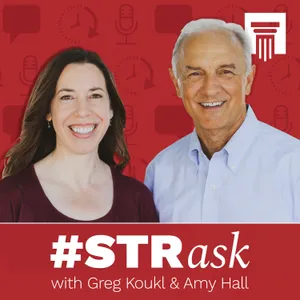
Free Daily Podcast Summary
#STRask: Daily Summaries Delivered
by Stand to Reason
Get key takeaways, quotes, and insights from #STRask in a 5-minute read. Delivered straight to your inbox.
Latest Episodes
The most recent episodes — sign up to get AI-powered summaries of each one.
- Yesterday25 min
If We’re Not Under the Old Testament Laws, Why Are We Using Them to Condemn People?
Questions about why people are using the Old Testament laws to condemn people if we’re not under those laws, thoughts on Christians celebrating the feasts of the Law out of obedience to the Lord, and whether we should keep the feasts so we’ll recognize Christ at his second coming. If the Old Testament laws were not even meant for us, then why are so many using the old laws to condemn people now? What do you think about my friends insisting that Christians celebrate and honor the various feasts of the Mosaic Law—not out of a spirit of legalism, but merely out of obedience to the Lord who saved them? Just as part of the purpose of the Mosaic Law and sacrificial system was to teach God’s people how to recognize Jesus when he came, should Christians be keeping the Feast of Tabernacles and other commands so we can recognize Christ at his second coming?
- 5 days ago27 min
Everyone Deserves Love and Happiness
Questions about how to answer someone who says, “Everyone deserves love and happiness,” in response to objections to same-sex weddings, and how to think about same-sex adoption when looking through the lens of the greater good. How would you answer someone who said, “Everyone deserves love and happiness,” in response to my objections to same-sex weddings? How should I think about same-sex adoption when looking through the lens of the greater good? If same-sex marriage is legal, what is the greater good in terms of children—giving a child a home or fighting against same-sex adoption ever occurring?
- 1 weeks ago24 min
What Is a Biblical Case for Submitting to God’s Good Design for Our Bodies?
Questions about how to make a biblical case for God’s good design in creating two genders and the rightness of submitting to his design for our own bodies, and how “gender-affirming” care can be wrong if it’s not discussed in the Bible. Would you make a biblical case for God’s good design in creating two genders and the rightness of submitting to his design for our own bodies? My trans, Episcopal brother is asking why “gender-affirming care” is wrong and harmful if it’s not discussed in the Bible.
- 1 weeks ago23 min
Is the Despair Portrayed in Psalms and Job Descriptive or Prescriptive?
Questions about whether the despair portrayed in Psalms and Job is descriptive, prescriptive, or something else, whether the Beatitudes are descriptive or prescriptive, how to meditate on God’s Word, and whether reading the Bible gives us information about God or a relationship with him. Should we view the despair of believers portrayed in Psalms and Job descriptively, prescriptively, or some other middle way? Are the Beatitudes found in Matthew 5 descriptive, prescriptive, or both? How do we meditate on God’s Word just by reading it, and how is meditating on God’s Word different from yoga? How should I respond to someone who says, “The Bible gives us information about God. You can’t read it again and again and say you have a relationship with God.”
- 2 weeks ago28 min
What Is the Difference Between Believing and Knowing?
Questions about the difference between believing and knowing from a biblical perspective, why it’s considered bad manners to ask for testable, repeatable evidence for the existence of gods, and why Christians don’t prove God exists by asking him to change carbon dioxide into hydrogen. How would you understand the difference between believing and knowing from a biblically informed Christian perspective, with knowing from a secular perspective being that which one can see, smell, touch, or demonstrate empirically? Why is it considered very bad manners to ask for testable, repeatable, consistent evidence that gods and goddesses do exist? What prayer can anyone say over a small amount of baking soda so that when vinegar is poured onto it, the bubbles test positive for hydrogen instead of carbon dioxide, thereby giving evidence that the supernatural being to whom the prayer is offered does exist?
- 2 weeks ago23 min
What Is Your Best Answer When Asked to Prove God Exists?
Questions about our best answer when an atheist asks us to prove God exists, how God can be merciful and forgiving without the existence of fallen humanity, and why, if God is complete in himself and already receives glory from the angels, he would create us to witness his glory. What is your best answer when an atheist asks you to “prove God exists”? Since God is a Trinity, he can be love without needing creation, but how can he be, by nature, merciful and forgiving without fallen humanity, and wouldn’t that make us necessary? If God is complete in himself, he didn’t need to create us, and if his angels are there, he already receives glory, so why is it to the benefit of an uncreated creation that they should be created and witness the glory of God?
- 3 weeks ago21 min
Why Did the Sadducees and Pharisees Want to Kill Jesus?
Questions about why the Sadducees and Pharisees wanted to kill Jesus and why God doesn’t say anything when we pray to him. Why did the Sadducees and Pharisees want to kill Jesus? Why doesn’t God say anything when we pray to him?
- 3 weeks ago24 min
Can a Person Be Saved but Have Nothing to Show for It?
Questions about whether 1 Corinthians 3:15 indicates that a person can be saved but have nothing to show for it in the way they live, and whether a lack of good works after salvation means the person is not really saved. Does 1 Corinthians 3:15 indicate that a person can be saved but have nothing to show for it in the way they live, and if so, how does this fit with passages like James 2 and John 15? If good works demonstrate/follow salvation, does that mean I’m not saved since I still fail so much when it comes to selfishness, not helping others much, not giving much, etc.?
Get #STRask summaries in your inbox
Free AI-powered daily recaps. Key takeaways, quotes, and mentions — in a 5-minute read.
Get Free Summaries →Free forever for up to 3 podcasts. No credit card required.
You Might Also Like
Listeners also like.
Stand to Reason Weekly Podcast
Greg Koukl
Ask NT Wright Anything
ThriveCast
GotQuestions.org Podcast
GotQuestions.org
Talk Truth
McGregor Podcast
Theology Lab: Courage & Curiosity for Everyday Faith
Scott Rice (Resident Theologian for Theology Lab at Highrock church; ThD, Harvard Divinity School)
The Counsel of Trent
Catholic Answers

Ask Ligonier
Ligonier Ministries
Adherent Apologetics
Zac Sechler
Curiously Kaitlyn
Kaitlyn Schiess
Theology in the Raw
Theology in the Raw

Daily Dose Of Wisdom
Daily Dose Of Wisdom
Thoughtful Faith
Jacob
About #STRask
Stand to Reason’s Greg Koukl and Amy Hall answer questions on ethics, theology, apologetics, and culture from a Christian perspective. Submit your questions on Twitter using the hashtag #STRask.
Customized Recaps
AI-powered recaps with compact key takeaways, quotes, and insights.
Straight to Your Inbox
Get key takeaways from #STRask in a 5-minute read.
Save Hours Every Week
Stay current on your favorite podcasts without falling behind.
Frequently Asked Questions
What is Podzilla's #STRask daily summary?
It's a free AI-powered email that summarizes new episodes of #STRask as soon as they're published. You get the key takeaways, notable quotes, and links & mentions — all in a quick read.
How does the #STRask podcast summary work?
When a new episode drops, our AI transcribes and analyzes it, then generates a personalized summary tailored to your interests and profession. It's delivered to your inbox every morning.
Is this an official #STRask product?
No. Podzilla is an independent service that summarizes publicly available podcast content. We're not affiliated with or endorsed by Stand to Reason.
Can I get summaries of other podcasts too?
Absolutely! The free plan covers up to 3 podcasts. Upgrade to Pro for 15, or Premium for 50. Browse our full catalog at /podcasts.
What topics does #STRask cover?
#STRask covers topics including Religion & Spirituality, Spirituality, Christianity. Our AI identifies the specific themes in each episode and highlights what matters most to you.
Start getting #STRask summaries tomorrow morning.
Free forever for up to 3 podcasts. No credit card required.
Free forever for up to 3 podcasts. No credit card required.