Free Daily Podcast Summary
Strange Bites: Daily Summaries Delivered
by Lance Martin
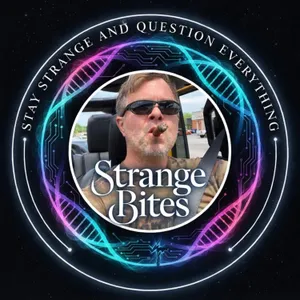
Strange Bites is a short science podcast. Lance Martin takes a real discovery in biology, physics, neuroscience, genetics, anthropology, or paleontology and explains it in about fifteen minutes, with just enough story to make the facts stick.New episodes twice a week. Recent bites include a brain built from two lineages, bacteria that grow their own wires, a gene that can still jump, and fossils that may have been an animal’s compass. Sources are in the show notes. The science is not simplified past recognition. It is told so you can follow it.If you want weird science, new discoveries, and a science podcast you can finish on a walk, start anywhere. Stay strange. Question everything.
Latest Episodes
The most recent episodes — sign up to get AI-powered summaries of each one.
- 2 days ago12 min
Episode 73: The Mushroom That Draws Little People
In southwest China and in the northern Philippines, people who eat a certain wild mushroom without cooking it long enough sometimes report the same thing. They see dozens or hundreds of tiny human figures, three to thirty centimeters tall, walking around real objects, climbing over surfaces, and, in at least one account, jumping off a spoon into a bowl of soup. The figures are often described as elves, clowns, or fairy-like characters in bright clothes. They look solid. They follow the edges of tables. They do not walk through walls.The mushroom is Lanmaoa Asiatica, a bolete sold in markets in Yunnan and known locally as Jian Shou Qing, which means something like “turns blue in the hand.” In the Philippines it is called Sedesdem. Researchers at the University of Utah, Colin Domnauer and Bryn Dentinger, used DNA sequencing to show that the Chinese and Philippine mushrooms are the same species. Chemical and genetic tests found none of the known psychoactive compounds of other mushrooms, including psilocybin. The compound that produces the visions has not been identified.This is Episode 73. Tonight the we learn about a mushroom that makes the same specific hallucination in places thousands of miles apart, and about what that consistency suggests.SOURCEShttps://www.sciencedaily.com/releases/2026/10/261024222021.htmhttps://attheu.utah.edu/facultystaff/scientists-identify-mushroom-behind-tiny-people-hallucinations/https://www.sciencealert.com/mushroom-behind-tiny-human-visions-lacks-genes-for-known-psychedelicshttps://www.futurity.org/mushroom-tiny-people-hallucinations-3342322/Paper: Domnauer and Dentinger. Mycologia, 2026. (University of Utah / Natural History Museum of Utah.)
- 4 days ago12 min
Episode 72: The Fungus Named for a Dinosaur
In the forests of Yunnan, in southwestern China, a fungus the size of a traffic cone has been growing out of the roots of oak trees, and until 2024 no one in science had named it. The fruiting bodies are whitish to pale yellow, club-like or finger-like, up to fifty centimeters tall and as heavy as 2.2 kilograms. That is the largest known fruiting body in the entire phylum Ascomycota, the group of fungi that make spores in tiny sacs rather than on the gills of a classic mushroom.The species is Dianjunus rex, nicknamed D-rex. It is not just a new species. It required a new genus and a new family, Dianjunaceae, inside the order Xylariales. A molecular clock places the origin of that family around sixty-five million years ago, roughly a million years after the Cretaceous-Paleogene extinction that ended the non-avian dinosaurs. The authors are careful. The timing is suggestive. It is not proof that the extinction created the fungus.This is episode 72. Tonight the get into a giant that was hiding in plain sight, and ponder what a dead tree and a molecular clock can still tell us.SOURCEShttps://www.sciencedaily.com/releases/2026/10/261025073034.htmhttps://www.eurekalert.org/news-releases/1147398https://www.sciencealert.com/scientists-uncover-d-rex-gigantic-new-king-fungus-from-china-traces-its-roots-to-65-million-yearshttps://www.discovermagazine.com/meet-d-rex-a-newly-discovered-5-pound-fungus-with-a-65-million-year-old-lineage-49812Paper: Song, Yan, Pérez-Moreno, Zhang, Yang, Xie, Su, Liu, Wang, Liu, Yang, Yang, Liu, Shi, Wan, Cheewangkoon, Dai, Senanayake, and Yu. Unearthing a fungal giant: Dianjunaceae fam. nov., a novel Paleocene lineage of Xylariales harboring Dianjunus rex gen. et sp. nov. Frontiers in Fungal Biology, 2026. DOI: 10.3389/ffunb.2026.1940464
- 1 weeks ago12 min
Episode 71: The Diamond That Answered the Laser
A diamond the size of a small pebble, floating in a laboratory in Okinawa, moved because the electrons inside it changed their spin. Not because someone pushed it. Not because a magnet was switched on in the ordinary way. Because billions of tiny quantum magnets, trapped in defects in the crystal, were told by a green laser to point a certain way, and the force from those spins was enough to shift the whole levitating assembly by about a hundred nanometers against gravity.The work comes from the Quantum Machines Unit at the Okinawa Institute of Science and Technology, OIST. The paper is in Science Advances, published on October 7, 2026: Spin-force from a Nitrogen-Vacancy ensemble drives a 100 mg levitated resonator. The authors are Anshuman Nayak, Daehee Kim, Shilu Tian, and Jason Twamley. It is the first time a purely quantum force has been seen measurably moving a macroscopic object of this size while that object is subject to gravity.This is Strange Bites episode 70, and tonight the story is about a nudge that is still classical in its response, and about how far we still are from a real Schrödinger’s cat.SOURCEShttps://www.oist.jp/news-center/news/2026/10/8/first-observation-quantum-spins-shifting-centimeter-scale-object-labhttps://www.sciencealert.com/for-the-first-time-ever-quantum-spins-shift-a-centimeter-scale-objecthttps://scitechdaily.com/a-quantum-breakthrough-inside-a-diamond-could-help-solve-one-of-einsteins-greatest-mysteries/Paper: Nayak, Kim, Tian, and Twamley. Spin-force from a Nitrogen-Vacancy ensemble drives a 100 mg levitated resonator. Science Advances, 7 October 2026. DOI: 10.1126/sciadv.aeh0566https://doi.org/10.1126/sciadv.aeh0566
- 1 weeks ago12 min
Episode 70: The Ghostly Green Star
Most stars cannot be green. That has been the rule for as long as anyone has thought carefully about the colors of the sky. Temperature sets the color. Cool stars lean orange. Stars like the Sun are white or pale yellow. The hottest are blue-white. Green sits in a gap that ordinary stellar physics does not fill. A star that looked green would have to be doing something temperature alone cannot do.Astronomers at the University of Warwick have now found one. It is not a living star. It is a white dwarf, the dense remnant of a sun-like star that has already died, catalogued as WD J1330+6435. It sits about 280 light-years away in the constellation Draco. Models of human color vision, applied to its spectrum, say that if you could stand close enough to see its disk, it would glow chartreuse green. Sodium in its atmosphere is swallowing the orange and red light. What is left is green.This is Strange Bites episode 70, and tonight the story is about a color that was not supposed to exist on a star, and about the dead planetary system that painted it.SOURCEShttps://www.eurekalert.org/news-releases/1147389https://www.reuters.com/science/newly-identified-green-star-leaves-astronomers-amazed-2026-10-16/https://www.skyatnightmagazine.com/news/green-star-white-dwarf-discoveryhttps://www.sciencedaily.com/releases/2026/10/261015120000.htmPaper: Hollands and colleagues. Any colour you like: The diverse chromaticities of white dwarfs. RAS Techniques and Instruments, 2026.
- 2 weeks ago11 min
Episode 69: The Rule That Does Not Care About Size
A black hole does not care how big it is when it decides to burp. That is the finding, stripped to one sentence. Whether the hole is about ten times the mass of the Sun or millions of times heavier, it appears to launch its powerful jets at the same point in its feeding cycle. The critical mark is about two percent of a limit called the Eddington limit, the point where the outward push of radiation balances the inward pull of gravity.The work was led by Dr. Adelle Goodwin at Curtin University’s International Centre for Radio Astronomy Research, with Dr. Andrew Mummery at the Institute for Advanced Study in Princeton. It is published in Nature Astronomy under the title A universal critical accretion rate for black hole jet formation. They looked at stars being torn apart by supermassive black holes, events called tidal disruption events, and found a pattern that matches what we already knew from much smaller holes in our own galaxy.This is Strange Bites episode69. Tonight the Story is about a rule that seems to ignore size, and about why some black holes go quiet and then light up hundreds or thousands of days later.SOURCEShttps://www.eurekalert.org/news-releases/1144361https://www.eurekalert.org/news-releases/1144447https://scitechdaily.com/astronomers-discover-a-universal-trigger-for-black-hole-jets/Paper: Goodwin, Mummery, and colleagues. A universal critical accretion rate for black hole jet formation. Nature Astronomy.
- 2 weeks ago12 min
Episode 68: The Tail That Chose to Leave
About ninety-nine million years ago, in a forest that is now northern Myanmar, a small lizard made a decision that is still sitting in a piece of amber. Something came for it. The lizard dropped its tail. The tail did not come off by accident. The break is clean, the muscle ring is still there, and the shape matches what a living lizard does on purpose when it leaves a piece of itself behind.The specimen is a detached tail, catalogued as SMNHTAU.R.21353, held at the Steinhardt Museum of Natural History in Tel Aviv. It is the first direct fossil evidence of voluntary tail shedding in a vertebrate. Not a broken bone. Not a bite mark. A completed escape, frozen in resin.Tonight the story is about a defensive trick that was already working in the mid-Cretaceous, and about what amber can keep when stone cannot.SOURCEShttps://www.palaeo-electronica.org/content/2026/5967-first-fossil-evidence-for-a-dropped-lizard-tailhttps://doi.org/10.26879/1706https://www.palaeo-electronica.org/content/2026/5983-first-fossil-evidence-for-a-dropped-lizard-tail-supplemental-materialsPaper: Fabrikant, Christopoulos, Nasser, and Davranoglou. Direct fossil evidence of caudal autotomy in a Cretaceous lizard. Palaeontologia Electronica, 29(3):a38, 2026.
- 3 weeks ago9 min
Episode 67: The Needle in the Stone
Somewhere under the Atlantic, in mud that has not seen daylight since the Cretaceous, there is a needle smaller than a speck of dust. It is made of magnetite, the same iron mineral a compass desires, but it is not a compass you could hold. It’s about the size of a bacterial cell and its magnetism is arranged like a tornado around a hollow center. Whatever grew it was reading the planet.These are magnetofossils. Giant ones, shaped like spearheads, spindles, bullets, and needles, left in seafloor sediment by an animal we still cannot name. A team at the University of Cambridge, working with the Helmholtz Zentrum Berlin, took the first three-dimensional pictures of the magnetism inside one of them and found a structure that looks built to sense both the direction and the strength of Earth’s field. Direction tells you which way is north. Strength, changing from place to place, tells you where you are.This is Strange Bites episode 67. Tonight we learn about a compass with no owner, and about the oldest evidence we have that an animal was navigating by the planet itself.SOURCEShttps://www.sciencedaily.com/releases/2026/09/260930020329.htmhttps://www.eurekalert.org/news-releases/1106425https://www.reuters.com/science/magnetic-fossils-may-reveal-ancient-creatures-internal-gps-system-2025-11-17/Paper: Harrison and colleagues. Communications Earth and Environment, 2025. DOI: 10.1038/s43247-025-02721-3https://www.nature.com/articles/s43247-025-02721-3
- 3 weeks ago10 min
Episode 66: The Gene That Refused to Sit Still
There is a gene in you that was supposed to have retired. It learned a job in the brain, the kind of job a settled gene is allowed to keep, and then it refused to sit down. Most of the old movers in the human genome are fossils. This one kept the knife.The gene is called BC200. It is expressed mainly in neurons. It began, millions of years ago, as a transposon, one of the mobile pieces of DNA we still call jumping genes. Genes that come from that kind of ancestry usually lose the ability to move once evolution puts them to work. BC200 did not. Cornell researchers found copies of it inside a human poxvirus, and the paper that followed says the movement never really stopped.SOURCEShttps://www.sciencedaily.com/releases/2026/10/261002080013.htmhttps://www.sciencealert.com/dna-from-a-human-brain-gene-has-turned-up-in-a-virushttps://www.technologynetworks.com/genomics/news/never-seen-before-type-of-human-jumping-gene-found-in-poxvirus-416882Paper: Gao, Pritham, Feschotte, Sun. Escape of the BC200 gene to a human poxvirus reveals its persistent transposition in primates. Science, 24 September 2026. DOI: 10.1126/science.aeh3441https://doi.org/10.1126/science.aeh3441
Get Strange Bites summaries in your inbox
Free AI-powered daily recaps. Key takeaways, quotes, and mentions — in a 5-minute read.
Get Free Summaries →Free forever for up to 3 podcasts. No credit card required.
You Might Also Like
Listeners also like.

The Weirdest Thing I Learned This Week
Three science journalists share bizarre and little-known facts they’ve recently discovered.
Stuff To Blow Your Mind
Explores the strange edges of science, consciousness, and reality through neuroscience, cosmology, evolution, and emerging technology.

Science Stuff To Blow Your Mind
Podgo

Monstro Bizarro
Explores real-life cases of cryptids, paranormal phenomena, and monster mysteries.

BrainStuff
Explores and explains the science behind everyday phenomena, from popcorn to particle physics.

Science Magazine Podcast
Weekly episodes covering original scientific research, global science news, and expert commentary.

Science Quickly
A bite-sized science podcast exploring discoveries with journalists and experts.
Science for Kids / Science's Not Boring: The Kids Science Podcast
Two fictional siblings host a science podcast for kids, exploring topics like space, nature, and the human body through engaging stories.
Brains On! Science podcast for kids
Kids co-host with Molly Bloom to explore science questions, mystery sounds, and facts in a weekly podcast.

Surprisingly Brilliant
Seeker
Terrestrials
Nature stories that reveal surprising animal and plant behaviors through immersive, family-friendly audio adventures.

Here Be Monsters
Here Be Monsters
About Strange Bites
Strange Bites is a short science podcast. Lance Martin takes a real discovery in biology, physics, neuroscience, genetics, anthropology, or paleontology and explains it in about fifteen minutes, with just enough story to make the facts stick.New episodes twice a week. Recent bites include a brain built from two lineages, bacteria that grow their own wires, a gene that can still jump, and fossils that may have been an animal’s compass. Sources are in the show notes. The science is not simplified past recognition. It is told so you can follow it.If you want weird science, new discoveries, and a science podcast you can finish on a walk, start anywhere. Stay strange. Question everything.
Customized Recaps
AI-powered recaps with compact key takeaways, quotes, and insights.
Straight to Your Inbox
Get key takeaways from Strange Bites in a 5-minute read.
Save Hours Every Week
Stay current on your favorite podcasts without falling behind.
Frequently Asked Questions
What is Podzilla's Strange Bites daily summary?
It's a free AI-powered email that summarizes new episodes of Strange Bites as soon as they're published. You get the key takeaways, notable quotes, and links & mentions — all in a quick read.
How does the Strange Bites podcast summary work?
When a new episode drops, our AI transcribes and analyzes it, then generates a personalized summary tailored to your interests and profession. It's delivered to your inbox every morning.
Is this an official Strange Bites product?
No. Podzilla is an independent service that summarizes publicly available podcast content. We're not affiliated with or endorsed by Lance Martin.
Can I get summaries of other podcasts too?
Absolutely! The free plan covers up to 3 podcasts, any in the catalog. Basic raises that to 15, Pro to 40 and Max to 100. Browse our full catalog at /podcasts.
What topics does Strange Bites cover?
Strange Bites covers topics including Science. Our AI identifies the specific themes in each episode and highlights what matters most to you.
Start getting Strange Bites summaries tomorrow morning.
Free forever for up to 3 podcasts. No credit card required.
Free forever for up to 3 podcasts. No credit card required.