Free Daily Podcast Summary
Star Stories with Ian Lauer: Daily Summaries Delivered
by Ian Lauer
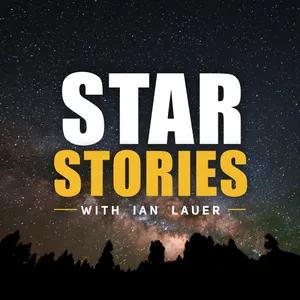
Retelling ancient star myths and uncovering the knowledge within them. Every culture that has ever existed looked up at the same sky. The same Orion. The same Pleiades. The same river of stars cutting across the darkness. And almost every one of them, whether separated by oceans, language, or centuries, looked at them, and told a story about what they saw. Stories about hunters and lovers and gods and monsters. Stories that survived wars, migrations, and the collapse of entire civilizations. Stories that were passed down, generation after generation, for thousands of years. Star Stories brings those stories back to life. Each episode takes a constellation, a star, or a region of the night sky, and retells the ancient myths and legends that human cultures built around it. The storytelling is immersive and narrative, retold in a modern format. At the end, we decode what information these cultures were embedding into the story. From the deserts of Ancient Egypt to the frozen lands of the Nordic people, we tell the stories from cultures around the world, to reconnect you to the night sky. Hosted by Ian Lauer.
Latest Episodes
The most recent episodes — sign up to get AI-powered summaries of each one.
- 4 days ago13 min
1770 Solar Storm | Star Stories Notebook
Did Captain James Cook witness a solar storm bigger than the famous Carrington Event of 1859?In this episode, we explore a new paper that says this may be the case. It explores a Chinese chronicle that documents a massive solar storm from 1770, and argues that it may be the biggest solar storm ever documented.This is a new format for me called "Star Stories Notebook". During my research into star myths, I come across a lot of interesting things that don't fit into a typical star story...but I still find them fascinating. And I figured if I found it cool, you would too!
- 1 weeks ago20 min
Algol | The Demon Star
Tonight, we're looking at the constellation Perseus. In that constellation, he's said to be holding the head of Medusa, and the eye of Medusa is a star that blinks - a star called Algol, also known as the Demon Star.It's changing brightness was first discovered in the 1700s. But a team of researchers believe the ancient Egyptians were aware of, and tracked, the variability of Algol's brightness.In this episode, we retell the story of how Perseus obtained the head of Medusa. And we'll explore why this star has such negativity associated with it...because who knows, maybe there's a reason why the ancient Egyptians were tracking it.
- 2 weeks ago15 min
Coma Berenices | A Celestial Offering
Tonight, we’re looking at a particularly strange constellation. It's about…hair.The constellation I’m talking about is Coma Berenices.A small, faint star pattern just above Virgo. It reaches its highest point at midnight at the beginning of Springtime.Tonight’s story comes to us from ancient Greece, and it’s a unique one…because it’s about someone who was a real person. It was written about 2270 years ago, during the time when this person was alive.There’s some interesting things to uncover there, but the big thing I want to dive into is this idea that the story might be a lot older than when we first see it written down.Because in different parts of the world, there’s some similarities between each tale that, the more you look into, the harder it becomes to ignore.But first, let’s make sure we understand the story about this hair. So let’s dive into the story…about the hair of Berenices.
- 3 weeks ago17 min
Summer Triangle | The Cowherd and the Weaver Girl
Tonight, we’re looking at the Summer Triangle, and we'll be hearing a story that comes to us from ancient China.The earliest known reference to this tale is from 2,600 years ago. And the fascinating part about this story is that, as the ages progressed, we can see the story evolve over time to a full narrative.Parts were being changed and updated as time went on. But tonight’s version is going to be based on a version written about 1500 years ago.And afterwards, we’ll talk about how this story shifted from the original version, to one that turned into the Qixi festival that’s still celebrated today.We’ll also go into how this story might have ancient roots that connect it with a culture across the pacific ocean, which could mean this story is more than 20,000 years old.But first, let’s return to the woman, tirelessly weaving in heaven.
- Oct 5, 202629 min
Auriga | The Fall of Phaethon
Tonight, we're looking at the constellation Aruiga, the Charioteer.And we'll be telling a tale from Greek mythology, about the famous fall of Phaethon.While many know this story as a lesson of the consequences of ego and hubris, the famous ancient philosopher Plato say this tale is actually transmitting ancient knowledge about the precession of the equinoxes.So let's dive into the story, and see why some people think Plato could be right.
- Sep 28, 202616 min
Orion | The Man Who Cut Off His Own Arm
Tonight we're going to the Philippines.More specifically, to the southern island of the Bukidnon people, a story which was written down in the early twentieth century.It's about a hunter named Magbangal.But what makes it fascinating isn't just what happens to Magbangal.It's what happens afterward.Because when the story is finished, almost everything inside it ends up in the sky.And together, those stars form something that was incredibly important to the people watching them.
- Sep 21, 202611 min
Sun & Moon | The Thorny Road
Tonight we're looking at the Sun and the Moon.This story comes from the Hausa people of northern Nigeria.And it's a very simple story.But it answers a very strange question.Why does the Sun chase the Moon?And the incredible part about this story? There's fantastic observational astronomy encoded within such a short tale.So let's go back to a time when they weren't enemies.Because once you hear what happened...you might understand why the Sun has never stopped chasing him.
- Sep 14, 202622 min
Northern Crown | A Ring in the Grass
Tonight we're looking at the constellation Corona Borealis, also known as the Northern Crown.And for more than a century, books, astronomy websites and planetarium stories have connected that circle with a Native American tale called The Celestial Sisters.It's usually described as a Shawnee story about Corona Borealis.Except I went back and found the oldest published version I could verify.And Corona Borealis isn't mentioned at all.And that sent me down one of those rabbit holes where every answer creates another problem.So join me as we retell this tale, and dive into what I found about it.
Get Star Stories with Ian Lauer summaries in your inbox
Free AI-powered daily recaps. Key takeaways, quotes, and mentions — in a 5-minute read.
Get Free Summaries →Free forever for up to 3 podcasts. No credit card required.
You Might Also Like
Listeners also like.
Bedtime Astronomy
A calming exploration of cosmic wonders, sharing stories about stars, planets, and celestial phenomena to inspire curiosity before sleep.
Myths and Legends
Retells global myths and legends, from Arthur to Aladdin, with origins and tales reimagined for modern listeners.
The 365 Days of Astronomy
A daily podcast featuring diverse voices exploring astronomy and space science topics.

Astonishing Legends
Explores unexplained mysteries and paranormal phenomena through investigations and interviews with experts.
The Lost Sci-Fi Podcast - Vintage Sci-Fi Short Stories
Narrates vintage science fiction short stories from the 1700s to the 1960s by authors like Asimov, Bradbury, and H.G. Wells.
Through the Telescope
Two hosts explore key astronomy topics in digestible episodes, making the cosmos accessible and engaging for all knowledge levels.

StarTalk with Neil deGrasse Tyson
Astrophysicist Neil deGrasse Tyson blends science, pop culture, and comedy with guests to explore space, physics, and life in the universe.

The Strange Case of Starship Iris
Crew of a spaceship navigate survival, secrets, and identity in the aftermath of Earth's war with aliens.

Hostile Worlds: Exploring Space
A documentary-style podcast exploring extreme alien environments through immersive audio storytelling aboard a fictional exploration vessel.
Stories Podcast: A Bedtime Show for Kids of All Ages
Retold fairy tales, classic stories, and original adventures performed weekly for children of all ages.

Cosmos in a Pod
Explores space, science, philosophy, and technology to reveal the wonders of the universe and humanity's place within it.
13 Minutes: Trouble with Hubble
The story of the Hubble Space Telescope’s flawed mirror and the mission to save it.
About Star Stories with Ian Lauer
Retelling ancient star myths and uncovering the knowledge within them. Every culture that has ever existed looked up at the same sky. The same Orion. The same Pleiades. The same river of stars cutting across the darkness. And almost every one of them, whether separated by oceans, language, or centuries, looked at them, and told a story about what they saw. Stories about hunters and lovers and gods and monsters. Stories that survived wars, migrations, and the collapse of entire civilizations. Stories that were passed down, generation after generation, for thousands of years. Star Stories brings those stories back to life. Each episode takes a constellation, a star, or a region of the night sky, and retells the ancient myths and legends that human cultures built around it. The storytelling is immersive and narrative, retold in a modern format. At the end, we decode what information these cultures were embedding into the story. From the deserts of Ancient Egypt to the frozen lands of the Nordic people, we tell the stories from cultures around the world, to reconnect you to the night sky. Hosted by Ian Lauer.
Customized Recaps
AI-powered recaps with compact key takeaways, quotes, and insights.
Straight to Your Inbox
Get key takeaways from Star Stories with Ian Lauer in a 5-minute read.
Save Hours Every Week
Stay current on your favorite podcasts without falling behind.
Frequently Asked Questions
What is Podzilla's Star Stories with Ian Lauer daily summary?
It's a free AI-powered email that summarizes new episodes of Star Stories with Ian Lauer as soon as they're published. You get the key takeaways, notable quotes, and links & mentions — all in a quick read.
How does the Star Stories with Ian Lauer podcast summary work?
When a new episode drops, our AI transcribes and analyzes it, then generates a personalized summary tailored to your interests and profession. It's delivered to your inbox every morning.
Is this an official Star Stories with Ian Lauer product?
No. Podzilla is an independent service that summarizes publicly available podcast content. We're not affiliated with or endorsed by Ian Lauer.
Can I get summaries of other podcasts too?
Absolutely! The free plan covers up to 3 podcasts, any in the catalog. Basic raises that to 15, Pro to 40 and Max to 100. Browse our full catalog at /podcasts.
How often does Star Stories with Ian Lauer release new episodes?
Star Stories with Ian Lauer publishes weekly. Our AI generates a summary within hours of each new episode.
What topics does Star Stories with Ian Lauer cover?
Star Stories with Ian Lauer covers topics including Science, History, Astronomy, Culture, Society & Culture. Our AI identifies the specific themes in each episode and highlights what matters most to you.
Start getting Star Stories with Ian Lauer summaries tomorrow morning.
Free forever for up to 3 podcasts. No credit card required.
Free forever for up to 3 podcasts. No credit card required.