Free Daily Podcast Summary
Standard Deviations with Dr. Daniel Crosby: Daily Summaries Delivered
by Dr. Daniel Crosby
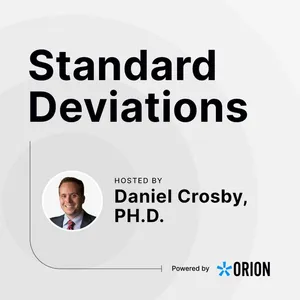
The Standard Deviations podcast looks at money, mind and meaning, all through a psychological lens. Each week, psychologist and New York Times bestselling author Dr. Daniel Crosby interviews a fascinating new guest, experts in everything from finance to literature to wellness. Each guest provides listeners with three concrete ways to apply what was learned that week, ensuring that weekly listening becomes part of a path to a richer life. Episodes are brief, research-based, and designed to fit perfectly within your commute time. So, tune in for practical news that will help you make more, think more and be more.
Latest Episodes
The most recent episodes — sign up to get AI-powered summaries of each one.
- 2 days ago18 min
Dr. Daniel Crosby - The Psychology of Family Money Conversations and Inheritance: Why Families Avoid Talking About Inheritance and How Advisors Can Lead the Conversation
Tune in to hear:Why do so many ultra-high net worth individuals feel that their heirs are ill-prepared and what is to be done about this? Also, why do so many families put off the difficult conversation of succession?Why is The Great Wealth Transfer, at its root, a behavioral problem and not a fiscal one?What are five psychological barriers that keep families from talking about money and succession planning? What are some of the ways advisors can work with their clients to overcome these barriers? Why is status quo bias a potent obstacle in succession planning?Why does perceived inequity in inheritance create such a charged emotional reaction among children? What is the deeper issue it betrays?What are the five conversations that parents should have with their heirs as a part of the psychological and emotional work required for effective succession planning?How can advisors automate the succession planning process as much as possible? What are the 6 steps of this process?Links The Soul of WealthConnect with UsMeet Dr. Daniel CrosbyCheck Out All of Orion’s PodcastsPower Your Growth with OrionDisclosures:These show notes may contain links to third-party websites. Any links to such third-party websites are provided solely as a convenience to you and not as an endorsement by Orion of the content on such third-party websites, or any affiliation or association with its operators. Orion is not responsible for the content of linked third-party websites, including, without limitation, any link contained in a linked website, or any changes or updates to a linked website, and do not make any representations regarding the information, services, products or accuracy of any material contained on such third-party websites.Compliance Code: 2872-U-26278
- 1 weeks ago20 min
Dr. Daniel Crosby - The Psychology of Financial Anxiety: Five Types of Anxious Clients and What Actually Calms Them
Tune in to hear:What critical point do the formal ways of measuring financial anxiety miss out on?What are some of the meaningful qualitative differences between how financial anxiety may present for different clients? What are 5 different archetypes of anxious clients you might encounter? What is one way that advisors can address clients’ anxiety-driven avoidance?How can advisors help their hypervigilant clients? Why does simple reassurance often backfire and actually encourage hypervigilant behavior?How should advisors best counsel clients who are prone to catastrophizing? Why is scenario planning so helpful in this case?What is the “control-seeker” archetype like in practice and how can advisors best help them?What is the “scarcity survivor” investor archetype and what should advisors do to help them?Links The Soul of WealthConnect with UsMeet Dr. Daniel CrosbyCheck Out All of Orion’s PodcastsPower Your Growth with OrionDisclosures:These show notes may contain links to third-party websites. Any links to such third-party websites are provided solely as a convenience to you and not as an endorsement by Orion of the content on such third-party websites, or any affiliation or association with its operators. Orion is not responsible for the content of linked third-party websites, including, without limitation, any link contained in a linked website, or any changes or updates to a linked website, and do not make any representations regarding the information, services, products or accuracy of any material contained on such third-party websites.Compliance Code: 2870-U-26278
- 2 weeks ago30 min
Dr. Tyler Rosier - Wired for Wealth
Tune in to hear: What did Dr. Rosier see in his clinical work that convinced him that the way in which people handle money is, at its core, partially a brain problem? What does clinical neuropsychology add to the behavioral finance picture when we are trying to understand why people do what they do with money and why they can know the right thing but still fail to do the right thing? What is one place where an underlying neurological mechanism gives birth to a behavior that a behavioral finance expert might flag and what should we do about this? Why do money scripts have such staying power for us, even when we may become consciously aware of them? What are some practical ways we can bring our money scripts to our awareness and are there some common money scripts we should be on the look out for? Is this the kind of thing that people need a financial therapist, or a psychotherapist, to root out or can it just be done with selfwork and introspection? Why are high-achievers still vulnerable to scarcity mindsets, even when it is so divergent from their present reality? How can people apply Dr. Rosier’s “wired framework” and what is it exactly? Once someone has woken up to previously unexamined money scripts, how can they sort of jam the signal when our wiring is so limbic and deep? If someone were to design a financial environment that makes good decisions easy and bad decisions hard, what might this look like in particular? What signals should investors look for that it’s time to take a step back or time to take a pause before making a decision? What is it that creates the gap between the financial life we say we want and the financial life we lead? Links Dr. Tyler Rosier on LinkedIn Dr. Rosier’s Website Wired for Wealth Connect with Us Meet Dr. Daniel Crosby Check Out All of Orion’s Podcasts Power Your Growth with Orion Disclosures: These show notes may contain links to third-party websites. Any links to such third-party websites are provided solely as a convenience to you and not as an endorsement by Orion of the content on such third-party websites, or any affiliation or association with its operators. Orion is not responsible for the content of linked third-party websites, including, without limitation, any link contained in a linked website, or any changes or updates to a linked website, and do not make any representations regarding the information, services, products or accuracy of any material contained on such third-party websites. Compliance Code: 2524-U-26243
- 3 weeks ago39 min
Peter Lazaroff - The Perfect Portfolio: How to Build an Investment Strategy That Fits Your Behavior, Goals and Life
Tune in to hear: Why did the writing of Peter’s new book end in his family getting a new puppy? Why does Peter believe that the perfect portfolio is the one that best suits the particular individual who owns it? Why does he think portfolio construction should be centered around human behavior instead of what is mathematically optimal? What are some of the most effective guardrails advisors can implement in portfolios to protect against the detrimental effect loss aversion can have on investor behavior? Why does Peter describe attention itself as an investment risk factor in his new book? Also, what is to be done about this from a practical standpoint? Does Peter have any thoughts, tips or tricks for getting investors to avoid confirmation bias more often? Why is our brain so eager to turn our most recent experiences into a forecast about the future and how does Peter handle this with the clients he serves? If people could make one financial change after reading Peter’s book, what would he hope that change would be? Links Peter Lazaroff on LinkedIn Plancorp Wealth Management The Perfect Portfolio (Book) Making Money Simple (Book) The Long Term Investor (Podcast) Connect with Us Meet Dr. Daniel Crosby Check Out All of Orion’s Podcasts Power Your Growth with Orion Disclosures: These show notes may contain links to third-party websites. Any links to such third-party websites are provided solely as a convenience to you and not as an endorsement by Orion of the content on such third-party websites, or any affiliation or association with its operators. Orion is not responsible for the content of linked third-party websites, including, without limitation, any link contained in a linked website, or any changes or updates to a linked website, and do not make any representations regarding the information, services, products or accuracy of any material contained on such third-party websites. Compliance Code: 252-U-26243
- Oct 8, 202620 min
Dr. Daniel Crosby - The Psychology of Sports Betting and Investing: How Gambling Culture Reshapes Retail Investor Behavior and What Advisors Should Do About It
Tune in to hear: What did Betterment’s 2026 Retail Investor Survey uncover about Gen Z investors and sports betting and why is this finding so significant? Do Gen Z’s financial prospects look more promising than Gen X and the millennials, according to the data? Are they more or less likely to contribute to workplace retirement programs? Why is the dopamine hit of sports betting, and similar “financial entertainment,” so psychologically powerful? Also, why are variable reward schedules such strong reinforcers of behavior? How do the psychological principles of recency bias, near-miss effects, social proof and loss chasing reinforce the addictiveness of gambling? What are the important distinctions between an investor, a trader, a speculator and a gambler? What are the different questions each of these individuals are asking? Why is the gamification of investing so detrimental to investor performance? What are some effective ways advisors can start a healthy discourse around risky investment behaviors, like sports betting or day trading? Links The Soul of Wealth Connect with Us Meet Dr. Daniel Crosby Check Out All of Orion’s Podcasts Power Your Growth with Orion Disclosures: These show notes may contain links to third-party websites. Any links to such third-party websites are provided solely as a convenience to you and not as an endorsement by Orion of the content on such third-party websites, or any affiliation or association with its operators. Orion is not responsible for the content of linked third-party websites, including, without limitation, any link contained in a linked website, or any changes or updates to a linked website, and do not make any representations regarding the information, services, products or accuracy of any material contained on such third-party websites. Compliance Code: 2501-U-26243
- Oct 1, 202626 min
Ryan Eisenman - Making Private Markets More Accessible
Tune in to hear: What did Ryan see about the way people were managing private investments that made him think his company Arch needed to exist? How does Ryan think the constant feedback and news around public markets affects investors and can the relative quiet of private markets give us a different experience from a behavioral perspective? What can the longer time horizon of private markets teach us about patience, conviction, how to invest and delayed gratification? For investors who rely exclusively on public markets, what sorts of exposure might they be missing from their portfolio? What role should private markets play in filling these potential gaps in exposure? What are Ryan’s thoughts around who should have access to private markets? What role can tech play in making private market investing more equitable? Does the Arch diligence tool ever tell investors to run far away from certain investments? Should the technique used to vet private companies differ in a meaningful way from the way investors and advisors vet public companies? Do some of the constraints around investing in private companies (e.g. the project just beginning to break ground) lead to more optimal or suboptimal investor behavior? What is Ryan’s prediction for the future of private markets? What is something that someone has done for Ryan, or something that he has experienced, that has fundamentally changed how he thinks about showing up for the people around him? Links Ryan Eisenman on LinkedIn Ryan Eisenman on Twitter Arch Connect with Us Meet Dr. Daniel Crosby Check Out All of Orion’s Podcasts Power Your Growth with Orion Disclosures: These show notes may contain links to third-party websites. Any links to such third-party websites are provided solely as a convenience to you and not as an endorsement by Orion of the content on such third-party websites, or any affiliation or association with its operators. Orion is not responsible for the content of linked third-party websites, including, without limitation, any link contained in a linked website, or any changes or updates to a linked website, and do not make any representations regarding the information, services, products or accuracy of any material contained on such third-party websites. Compliance Code: 2522-U-26243
- Sep 24, 202627 min
John Crawford IV - The Case for Value and Dividend Investing: Building Wealth, Income and Resilience
Tune in to hear: What is one thing that the investment community has made more complicated than it needs to be, in John’s opinion? How does an oldschool, value and dividend focused shop like John’s get folks interested in this style of investing that is so well supported but seems to almost be forgotten in the present day? Has John found that when clients have an income element to their portfolio, they are more settled and more able to stay the course? How does Crawford Investment Counsel think about risk reduction in a portfolio, both behaviorally and otherwise? Does John look at things like beta, or is he looking exclusively at absolutely fundamental things in terms of the quality of the company? Where in a company’s lifecycles does Crawford Investment Counsel look and why do they believe this is a source of potential alpha? How does Crawford Investment Counsel ensure that they never stray from their first principles in difficult times? What in particular has John done to raise gentle, kind and grateful children in a world where children of means can sometimes act entitled? If John was approached by a 30 year old investor today, and they were asking for one piece of personal financial advice, what would he tell them? Links Crawford Investment Counsel Connect with Us Meet Dr. Daniel Crosby Check Out All of Orion’s Podcasts Power Your Growth with Orion Disclosures: These show notes may contain links to third-party websites. Any links to such third-party websites are provided solely as a convenience to you and not as an endorsement by Orion of the content on such third-party websites, or any affiliation or association with its operators. Orion is not responsible for the content of linked third-party websites, including, without limitation, any link contained in a linked website, or any changes or updates to a linked website, and do not make any representations regarding the information, services, products or accuracy of any material contained on such third-party websites. Compliance Code: 2521-U-26243
- Sep 17, 202634 min
Matt Halloran - Shut Up and Listen
Tune in to hear: If Matt could take one lesson from his former life as a therapist and impart it to all the advisors that he serves, what would that lesson be? What compelled Matt to write his new book, Shut the F Up and Listen, and why did he think this message was particularly important in this moment we are in? The impulse to listen in order to respond, or to listen in order to solve a problem, is a really human impulse. How can we move beyond this and begin listening just for the sake of listening? What does it look like when one enters a conversation with intent and how does that look different from more opportunistic forms of listening? How can advisors best read what’s not being said in the room, through body language or otherwise, while remaining sensitive? How would Matt advise advisors to think about creating the optimal conditions for psychological safety in their offices? Is there ever a time that advisors should be more directive with their clients? Links Matt Halloran on LinkedIn Matt Halloran on Instagram Shut the F Up and Listen Connect with Us Meet Dr. Daniel Crosby Check Out All of Orion’s Podcasts Power Your Growth with Orion Disclosures: These show notes may contain links to third-party websites. Any links to such third-party websites are provided solely as a convenience to you and not as an endorsement by Orion of the content on such third-party websites, or any affiliation or association with its operators. Orion is not responsible for the content of linked third-party websites, including, without limitation, any link contained in a linked website, or any changes or updates to a linked website, and do not make any representations regarding the information, services, products or accuracy of any material contained on such third-party websites. Compliance Code: 2499-U-26243
Get Standard Deviations with Dr. Daniel Crosby summaries in your inbox
Free AI-powered daily recaps. Key takeaways, quotes, and mentions — in a 5-minute read.
Get Free Summaries →Free forever for up to 3 podcasts. No credit card required.
You Might Also Like
Listeners also like.

The Stacking Benjamins Show
Two financial experts discuss personal finance topics with engaging guests and listener questions in a relaxed, conversational style.

Choiceology with Katy Milkman
Explores how behavioral science and real-life decisions reveal ways to improve judgment and make better choices.

The David Guttman Podcast
Conversations with top leaders on building wealth, integrity, and a meaningful life through real-world lessons and authentic mentorship.

Growth Mindset Psychology: The Science of Self-Improvement
Explores the science behind lasting self-improvement through psychology, neuroscience, and timeless wisdom traditions.

NerdWallet's Smart Money Podcast
Finance experts answer real-world money questions on budgeting, investing, credit cards, and financial planning with clear, research-backed advice.

THE PRIVATE BOARDROOM
Explores the psychological challenges and inner growth of high-achieving leaders navigating success, pressure, and fulfillment.

The Long View
A weekly discussion on long-term investing, retirement planning, and portfolio strategy with finance experts.

Seven Figures: Smart Money Strategies for Women with Sandy Waters
Audacy

BigDeal
Conversations with driven entrepreneurs and investors reveal raw, practical lessons on building wealth and living intentionally.
A Bit of Optimism
Conversations with thinkers and doers exploring what drives purpose, growth, and meaning in life.

Your Money Guide on the Side
A practical guide to personal finance and investing, breaking down complex topics with expert insights and actionable advice.

The Happiness Formula
iHeartPodcasts
About Standard Deviations with Dr. Daniel Crosby
The Standard Deviations podcast looks at money, mind and meaning, all through a psychological lens. Each week, psychologist and New York Times bestselling author Dr. Daniel Crosby interviews a fascinating new guest, experts in everything from finance to literature to wellness. Each guest provides listeners with three concrete ways to apply what was learned that week, ensuring that weekly listening becomes part of a path to a richer life. Episodes are brief, research-based, and designed to fit perfectly within your commute time. So, tune in for practical news that will help you make more, think more and be more.
Customized Recaps
AI-powered recaps with compact key takeaways, quotes, and insights.
Straight to Your Inbox
Get key takeaways from Standard Deviations with Dr. Daniel Crosby in a 5-minute read.
Save Hours Every Week
Stay current on your favorite podcasts without falling behind.
Frequently Asked Questions
What is Podzilla's Standard Deviations with Dr. Daniel Crosby daily summary?
It's a free AI-powered email that summarizes new episodes of Standard Deviations with Dr. Daniel Crosby as soon as they're published. You get the key takeaways, notable quotes, and links & mentions — all in a quick read.
How does the Standard Deviations with Dr. Daniel Crosby podcast summary work?
When a new episode drops, our AI transcribes and analyzes it, then generates a personalized summary tailored to your interests and profession. It's delivered to your inbox every morning.
Is this an official Standard Deviations with Dr. Daniel Crosby product?
No. Podzilla is an independent service that summarizes publicly available podcast content. We're not affiliated with or endorsed by Dr. Daniel Crosby.
Can I get summaries of other podcasts too?
Absolutely! The free plan covers up to 3 podcasts, any in the catalog. Basic raises that to 15, Pro to 40 and Max to 100. Browse our full catalog at /podcasts.
What topics does Standard Deviations with Dr. Daniel Crosby cover?
Standard Deviations with Dr. Daniel Crosby covers topics including Education, Business, Entrepreneurship, Investing, Self-Improvement. Our AI identifies the specific themes in each episode and highlights what matters most to you.
Start getting Standard Deviations with Dr. Daniel Crosby summaries tomorrow morning.
Free forever for up to 3 podcasts. No credit card required.
Free forever for up to 3 podcasts. No credit card required.