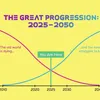
The Great Progression: Peter Leyden on AI, Trump and the Next 25 Years
Some people see a world coming apart. Peter Leyden sees an old world dying so a better one can be born. That, in essence, is The Great Progression, the thesis of Peter Leyden’s forthcoming HarperCollins book and the spine of our conversation. Peter is the OG Silicon Valley futurist who came to San Francisco at the dawn of WIRED, co-authored the iconic 1997 Long Boom cover story with Peter Schwartz, and has spent three decades trying to draw a coherent map of where humanity is actually headed. His claim is audacious: we are living through a fourth reinvention of America, an event that occurs roughly every 80 years (the founding, 1865, 1945, and now 2025), driven this time by three converging general-purpose technologies: AI, clean energy, and bioengineering. Stack them together, he argues, and we are looking at a civilization-scale change on the order of the Enlightenment. The Positive Reframe: If there is a phrase to walk away with, it is this: positive reframe. Peter is not a naïve optimist. He is something more interesting: a man who has built a methodology for looking at the same chaos everyone else is looking at and pulling out the constructive story buried inside it. Trump, in his telling, is not the future but the wrecking ball that takes the political hit so the next coalition can build the next thing. AI is not the great extractor but the first technology that takes intelligence, the rarest resource we have ever known, and makes it cheap and abundant. You don’t have to agree. I pushed back hard, and he pushed back harder. Where I Pushed Back: I challenged him on three fronts: the human cost of the in-between (every 80-year reinvention he cites was paid for in blood), the myth of golden ages (drawing on Ada Palmer’s Inventing the Renaissance to argue that real breakthroughs continue past institutions rather than replace them), and the empirical record of AI in education (Denmark and Norway, both early digital classroom pioneers, are now removing devices and walking it back). Peter has answers for all three. Whether they hold is for you to judge. What We Covered: The two-line email Kevin Kelly sent that pulled Peter from Minneapolis to early WIRED The Long Boom: what it nailed and what it missed China, 35 years after Tiananmen, and why Peter would not move there today The 80-year cycle and the fourth reinvention of America The Enlightenment parallel and the six foundational inventions of the modern world Why Peter calls Trump a wrecking ball, not the future The emerging abundance politics of the next 60-40 majority coalition The strange Anglosphere pessimism about AI How Peter wrote this book using AI and was two to three times more productive: My Take: I am, as I told Peter, a pessimist of the intellect and an optimist of the spirit, in the Gramscian sense. I genuinely hope he is right. I am genuinely afraid he is not. The technology is not the hard part. The hard part is the gap between our scientific power and the wisdom to apply it without destroying ourselves. Peter has not converted me. But he has reminded me there is another way to look at it, and that the difference between hope and despair sometimes comes down to whether you can hold a positive reframe long enough to actually build something with it. You can see the full video interview here: https://www.singularityweblog.com/the-great-progression-peter-leyden/
Podzilla Summary coming soon
Sign up to get notified when the full AI-powered summary is ready.
Free forever for up to 3 podcasts. No credit card required.
More from Singularity.FM

Steven Kotler on We Are As Gods

We Don’t Need More. We Need Better: Intelligence Scales. Wisdom Does Not.

Why I Cancelled ChatGPT and Switched to Claude, And Why You Should Too
Ada Palmer on Inventing the Renaissance: How Golden & Dark Ages Are Constructed and Why They Matter
Get summaries like this every morning.
Free AI-powered recaps of Singularity.FM and your other favorite podcasts, delivered to your inbox.
Free forever for up to 3 podcasts. No credit card required.