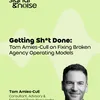
Getting Sh*t Done: Tom Amies-Cull on Fixing Broken Agency Operating Models
Most companies don’t fail at strategy. They fail at execution=.In this episode of Signal & Noise, Brett House and Rio Longacre sit down with Tom Amies-Cull—a seasoned operator who has spent two decades inside the most complex, high-pressure agency environments, including senior leadership roles across IPG, Dentsu, and Kinesso.This isn’t a conversation about AdTech plumbing.It’s about something far more fundamental—and far more broken:How organizations actually work.Or more accurately… why they often don’t.Drawing from years inside the machine, Tom unpacks the uncomfortable truth behind transformation in large, matrixed organizations:It’s not a strategy problem. It’s a coordination problem. It’s a leadership problem. It’s an operating model problem.As he puts it: “Transformation usually fails not because companies lack strategy, but because they can’t convert intent into coordinated behavior.”This is a candid, sometimes blunt breakdown of what actually gets in the way of change:Why most “transformations” are just reorgs in disguiseHow internal politics quietly kill executionThe real reason employees aren’t change-resistant—they’re resistant to bad changeWhy strategy decks and org charts are not operating modelsHow unclear decision rights create organizational paralysisThe hidden role of middle management as the “connective tissue” of executionWhy leadership teams say they want accountability—but often avoid it in practiceThere’s a lot of industry noise right now about agencies evolving into platforms, operating systems, and AI-powered machines.Tom brings this conversation back to reality:Most organizations are further away than they think.Not because the vision is wrong—but because the underlying systems (people, incentives, culture, decision-making) aren’t built to support it.The result?Pockets of excellence… held together by heroic effort, not scalable design.Everyone is talking about AI.But Tom reframes it:AI isn’t a technology problem.It’s an operating model and leadership problem.AI can accelerate planning, production, and activation—but it cannot fix:Fragmented P&LsMisaligned incentivesPoor leadership behaviorsBroken decision-making structuresIf those don’t change, AI just makes dysfunction happen faster.We also explore why indie agencies and PE-backed firms may have an edge right now:Less structural debtFaster decision-makingClearer accountabilityStronger focus on value creationWhile legacy holdcos wrestle with complexity, challengers are moving faster—and with purpose.This episode is about closing the gap between:What companies say they are…and what they are actually capable of doing.Because in today’s environment, speed matters.Clarity matters.Execution matters most.Agency transformationOperating models and org designLeadership in complex organizationsAI’s real impact on the industryThe future of holding companies…this is a must-listen.📩 Connect with Tom:Find him on LinkedIn or through his advisory work (linked in show notes)🎧 Follow Signal & Noise:Subscribe for more unfiltered conversations with operators shaping the future of media, advertising, and AI.
Podzilla Summary coming soon
Sign up to get notified when the full AI-powered summary is ready.
Free forever for up to 3 podcasts. No credit card required.
Listen to This Episode
More from Signal & Noise

The Negotiated Future: Ethan Settel on Newton Research, Agentic Media Buying, and the Reinvention of Media Operations

The Godfather of MarTech on the Great Convergence: Scott Brinker on Al, First-Party Data, and the Future of MadTech
The Accuracy Crisis in Advertising: Scott McKinley on Bad Data and the Hidden Tax on CTV

Signal Break: The Real Take on the LiveRamp Acquisition by Publicis Groupe
Get summaries like this every morning.
Free AI-powered recaps of Signal & Noise and your other favorite podcasts, delivered to your inbox.
Free forever for up to 3 podcasts. No credit card required.