Free Daily Podcast Summary
Signal & Noise: Daily Summaries Delivered
by Signal and Noise
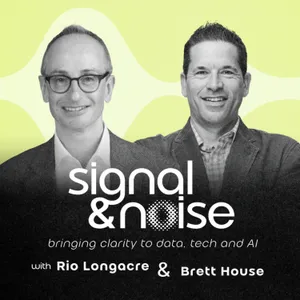
Join advertising industry veterans Brett House and Rio Longacre as they share regular updates and analysis on the changing world of data, tech, and AI. You’ll hear real talk from thought leaders across industries about the latest trends having the biggest impact on our jobs… and lives. Signal & Noise means no BS - only straight talk and first-hand insights from leading operators, creators, and founders.
Latest Episodes
The most recent episodes — sign up to get AI-powered summaries of each one.
- 4 days ago1h 22m
The Operating System for Commerce Media: Jeffrey Cohen on Amazon Ads’ Rise, Retail Media’s Measurement Reckoning, and the Shift from Dashboards to Agents
Retail media was built on a powerful promise: connect advertising directly to transactions and finally show marketers what their media dollars produced. But as the category matures, a harder question is replacing simple attribution: Did the advertising actually cause the sale?In this episode of Signal & Noise, Rio Longacre and Brett House sit down with Jeffrey Cohen, Chief Business Development Officer at Skai and former Principal Evangelist at Amazon Ads, for a wide-ranging conversation about the evolution of commerce media—and what happens as intelligent agents begin taking over work once performed through dashboards, spreadsheets, rules engines, and manual campaign management.Jeff had a front-row seat during Amazon Ads’ extraordinary rise. He explains what Amazon got right, from the simplicity of “search, find, buy” to its ability to connect media exposure with actual commerce. But from outside Amazon, he now sees the larger challenge: consumers don’t live inside walled gardens. TikTok can drive an Amazon purchase. Prime Video can influence a Walmart sale. In-store activity affects digital behavior, and digital media influences what happens on the shelf. That creates a measurement reckoning. ROAS and last-touch attribution can tell marketers what received credit for a transaction, but not necessarily what caused it. The conversation digs into incrementality, cross-channel effects, independent measurement, and why historically siloed media, shopper marketing, trade promotion, and commerce teams increasingly need to operate together.Then the discussion moves from dashboards to agents.Jeff explains how Skai is approaching this transition through Celeste, Skai Studio, MCP connectivity, and agentic workflows. Instead of asking an AI assistant for an insight, marketers can build systems capable of analyzing signals, finding audiences, recommending budgets, creating campaigns, monitoring performance, and escalating decisions to humans for approval.The goal, Jeff argues, shouldn't be another marketing black box, but a glass box: automation where marketers can understand the logic behind decisions, establish guardrails, audit actions, and retain control over critical choices—especially where budgets are concerned.One particularly striking finding: Jeff says 45% of the questions asked through Celeste could not have been answered manually within the traditional Skai platform. Agents aren't simply making analytics faster; they're combining data and performing analysis that previously required people to jump between systems, download reports, manipulate data, and assemble the answer themselves. The implications extend far beyond media buying. Jeff describes Skai's own company-wide agentic transformation and the emergence of a new kind of marketer: the builder—someone who may not be a traditional software engineer but understands systems, processes, data, business rules, and how to turn them into intelligent workflows.In this episode:How Amazon Ads became an advertising giantWhy “search, find, buy” proved so powerfulAttribution vs. incrementalityWhy platforms end up “grading their own homework”The convergence of retail media, CTV, social, and in-storeCeleste, Skai Studio, MCP, and agentic workflowsWhy agents need guardrails, auditability, and human oversightWhy major budget decisions still require human approvalWhy AI transformation is really operating-model transformationThe marketer as a builderWhy companies need to rethink workflows instead of automating themThe big question is no longer whether AI can optimize another campaign or generate dashboards. It’s what decisions we delegate, what governance those systems require, and where human judgment remains essential.Hosted by Rio Longacre and Brett House on Signal & Noise.#RetailMedia #CommerceMedia #AmazonAds #AdTech #MarketingTechnology #AgenticAI #MarketingAI #RetailMediaNetworks #Incrementality #Advertising #MediaBuying #Skai #DigitalAdvertising #SignalAndNoise
- 1 weeks ago1h 58m
The Permission Layer: Who Told the Al It Could Do That? Richy Glassberg on Data Privacy, Consent, and Al Innovation
AI agents can retrieve, combine, analyze, infer from, and act on enormous amounts of data—often at a speed no human compliance team can match. But access to data does not automatically confer the right to use it. So who sets the rules, and who remains accountable when an AI system crosses the line?In this episode of Signal & Noise, Brett House and Rio Longacre sit down with Richy Glassberg, Co-Founder and CEO of SafeGuard Privacy, for a candid and wide-ranging conversation about privacy, consent, AI governance, and the digital advertising industry’s long history of creating problems it later asks technology to solve.Richy brings a rare perspective to the discussion. He helped build CNN.com’s commercial business, co-founded the IAB, worked across publishing, agencies, ad tech, and media, and now leads a company focused on making privacy compliance and vendor diligence standardized, operational, and auditable.The conversation begins with a provocative argument: AI may not require an entirely new category of privacy law because AI is ultimately software—and existing rules governing data use, discrimination, consent, and accountability still apply. The real challenge is enforcing those rules as AI dramatically increases the speed, scale, and complexity of data use.Richy explains why companies are now responsible for privacy compliance throughout their vendor chains, including the DSPs, publishers, data brokers, identity providers, models, APIs, and other partners involved in a transaction. When one black box passes data to another black box—and AI begins making decisions across the entire chain—policies and promises are no longer enough. Organizations need standardized diligence, enforceable controls, ongoing monitoring, and proof.The group also examines why today’s consent system is fundamentally broken. Cookie banners have created consent fatigue without giving consumers meaningful understanding or control. Privacy policies are rarely read, permissions do not travel cleanly across platforms, and people can opt out in one place only to reappear in the same identity graph somewhere else.Other topics include:• Why an AI agent should never have more authority than the person or organization it represents• The tension between giving AI more context and protecting individual privacy• Why human oversight remains essential in agentic systems• How marketers should assess and monitor every company handling their data• Why privacy diligence must become machine-readable for real-time agent decisions• The failure of one-to-one targeting and the industry’s obsession with questionable audience data• How poor frequency management is damaging the connected TV experience• Why better privacy practices could become a mark of data quality and competitive differentiation• The threat AI-generated content poses to trusted information and the open internet• Whether consumer-controlled data and permission agents could produce a healthier advertising ecosystemIt’s a funny, blunt, and occasionally uncomfortable conversation about what responsible data use should look like when machines can move faster than the institutions meant to govern them.Learn more about SafeGuard Privacy: https://safeguardprivacy.com/#ArtificialIntelligence #DataPrivacy #AIPrivacy #AIGovernance #Consent #DigitalAdvertising #AdTech #AgenticAI #PrivacyTech #MarketingTechnology #DataGovernance #ProgrammaticAdvertising #SignalAndNoisePodcast
- 1 weeks ago56 min
AI That People Actually Use: Zoher Karu on Personalization, Trust, and Building AI at Scale
Everyone is talking about AI. Far fewer people have spent decades actually building AI and data systems inside some of the world’s largest organizations.In this episode of Signal & Noise, Brett House and Rio Longacre sit down with Zoher Karu, Head of AI at Taelor, to separate AI hype from what it actually takes to create measurable business value.Zohar brings an unusually broad perspective. His career has taken him through McKinsey, Sears, Citi, eBay, Blue Shield of California, and now Taelor—an AI-powered men’s clothing rental service attempting to combine machine intelligence with human styling expertise. Across those very different businesses, Zohar argues that the same lesson keeps resurfacing: the technology is rarely the hardest part. The conversation starts with one of enterprise AI’s least glamorous truths: bad data doesn’t disappear because you put an LLM on top of it. As Zoher puts it, AI can simply give you “bad answers faster.” Data governance, business processes, organizational knowledge, and change management remain foundational.From there, the discussion gets practical. Zoher explains how Taelor is attempting to teach machines something surprisingly difficult: taste. Matching clothes to a person requires understanding not just size and style, but weather, occasion, context, individual preferences, previous feedback—and even whether two individually appropriate pieces of clothing actually work together. That becomes a window into a much bigger conversation about the future of personalization. Generative AI dramatically expands the amount of customer context businesses can process, how quickly they can respond to new signals, and the number of individualized experiences they can create. Instead of choosing among three versions of an email, brands could theoretically generate an almost infinite number of variations for individual customers.The discussion also tackles the uncomfortable economics of enterprise AI. Companies are spending enormous amounts on models, infrastructure and tokens—but are they actually redesigning the business processes required to capture the ROI? Zoher argues that automating pieces of an existing workflow may deliver incremental efficiency, while the much larger opportunity comes from asking whether that workflow should exist at all. Finally, the conversation explores what may become one of the most important issues in enterprise AI: context. Agents can access data, but data alone doesn't contain all the rules, judgment and institutional knowledge humans use to make decisions. Capturing that tacit business knowledge—and making it available to AI systems—could become a critical source of competitive advantage and intellectual property.In this episode:* Why dirty data can derail even sophisticated AI* Why AI transformation is really organizational transformation* The gap between AI spending and measurable ROI* Why simply automating existing processes isn't enough* How AI is changing personalization and recommendation systems* How Taelor combines human stylists with machine intelligence* Why context and business knowledge matter as much as models* Whether AI is actually eliminating jobs or simply changing them* Why change management may be the biggest barrier to enterprise AI* The continuing importance of human judgment in increasingly autonomous systemsThe companies that win the AI race may not be the ones with the most sophisticated models. They may simply be the ones that figure out how to build AI that people actually use. #ArtificialIntelligence #AI #EnterpriseAI #GenerativeAI #AgenticAI #Personalization #CustomerExperience #DataStrategy #DataGovernance #MachineLearning #DigitalTransformation #AITransformation #ChangeManagement #MarTech #RecommendationEngines #FutureOfWork #SignalAndNoise #Podcast
- 2 weeks ago1h 24m
AI Isn’t the Strategy: Fern Potter on Intelligent Assistance, Human Judgment, and the Future of Work
Artificial intelligence may be the most transformative technology of our generation—but according to Fern Potter, AI alone is not a strategy.In this episode of Signal & Noise, hosts Rio Longacre and Brett House sit down with Fern Potter, Co-Founder of Intelligent Assistance, to explore why the greatest opportunity in AI isn’t replacing people—it’s amplifying human judgment.After more than two decades leading strategy, product, partnerships, and commercial growth across agencies, media, and ad tech—including serving as Chief Strategy & Growth Officer at Multilocal—Fern made the leap to entrepreneurship. Alongside her co-founders, she launched Intelligent Assistance around a simple but powerful philosophy: AI creates the most value when it enhances human expertise, context, creativity, and accountability rather than attempting to eliminate them.The conversation begins with Fern’s journey from agency leadership to founding an AI company at a moment when enterprises are rushing to deploy generative AI. She explains why so many organizations start with technology instead of business problems—and why that approach almost always leads to disappointing results.From there, the discussion explores what “intelligent assistance” actually means in practice. Fern explains how organizations should determine which work should be automated, which decisions should remain firmly human, and how AI can become a force multiplier instead of another disconnected productivity tool.Rio and Brett also dive into one of the episode’s central themes: the difference between intelligence and autonomy. Just because AI can make a decision doesn’t mean it should. Fern discusses the critical role of context, accountability, governance, and human oversight as organizations increasingly rely on AI-assisted workflows.Drawing on her experience helping reshape programmatic advertising through curation and supply-side innovation, Fern shares lessons that extend far beyond media. The trio explores how unchecked automation created inefficiencies and opacity in advertising—and why enterprise AI risks repeating many of the same mistakes if organizations optimize solely for automation instead of outcomes.The conversation also tackles larger questions about the future of work. What happens to agencies, consultancies, and professional services when small AI-enabled teams can accomplish what once required dozens of people? Which human capabilities become more valuable as technical execution becomes increasingly automated? And how should leaders redesign organizations around “thinking power” rather than simply reducing headcount?Whether you’re leading AI initiatives, building products, transforming marketing organizations, or simply trying to understand what responsible AI adoption looks like, this episode offers a thoughtful, practical framework for moving beyond the hype toward meaningful business impact.In this episode, you’ll learn:* Why AI is not a business strategy* The difference between automation, autonomy, and intelligent assistance* Why most enterprise AI initiatives fail to deliver commercial value* How to combine AI with human judgment for better outcomes* Lessons enterprise AI can learn from programmatic advertising* Why organizational redesign matters more than technology deployment* Which uniquely human skills become more valuable in the AI era* How leaders should think about governance, accountability, and trustIf you enjoy conversations about AI strategy, marketing transformation, organizational design, and the future of work, be sure to subscribe to Signal & Noise for weekly conversations with the leaders shaping the future of business and technology.#SignalAndNoise #ArtificialIntelligence #AI #GenerativeAI #FutureOfWork #HumanCenteredAI #Leadership #BusinessTransformation #Marketing #MarTech #AdTech #DigitalTransformation #EnterpriseAI #Innovation #Technology #IntelligentAssistance
- 2 weeks ago1h 14m
The Homepage Is No Longer the Front Door: Leah Nurik on AI Visibility, GEO, and the Future of Brand Discovery
For more than two decades, digital marketing revolved around a familiar goal: get people to your website.Rank higher. Earn the click. Drive the traffic. Convert the visitor.But what happens when the customer never makes it to your homepage?As consumers increasingly turn to ChatGPT, Google AI Overviews, Perplexity, Gemini, Claude, and other AI-powered experiences to research products, vendors, and brands, the rules of discovery are being rewritten. Increasingly, AI is deciding which companies get mentioned, how they’re described, which sources are trusted—and which brands get recommended at all. In this episode of Signal & Noise, hosts Rio Longacre and Brett House sit down with Leah Nurik, CEO and Co-Founder of Brandi AI, to explore the rapidly emerging world of AI Visibility and Generative Engine Optimization (GEO). Leah argues that this isn’t simply another evolution of SEO. It represents a fundamental shift from a web organized around keywords, rankings, links, and clicks toward one organized around meaning, context, authority, credibility, and narrative.The conversation breaks down the increasingly confusing landscape of SEO, Answer Engine Optimization (AEO), and GEO—and why traditional SEO isn’t disappearing. Instead, Leah sees SEO increasingly becoming one component of a broader AI visibility strategy.But being mentioned by AI isn’t enough.One of Leah’s most important points is that marketers need to understand the sentiment and narrative surrounding their brands inside AI-generated answers. Is the brand being represented accurately? Positively? What competitors appear alongside it? What sources are shaping the story? The discussion also explores one of the biggest unintended consequences of AI-powered discovery: the future of publishers and the open web. If answer engines increasingly satisfy users without sending them to the original source, what happens to referral traffic, publisher economics, and the value exchange that has supported the web for decades?And paradoxically, AI may make some traditional marketing disciplines more important, not less. Leah makes the case that earned media and PR are poised for a resurgence because authoritative third-party sources can influence how AI systems understand and describe brands. In her view, trying to “game” AI algorithms misses the bigger opportunity: building genuine authority, credibility, and a coherent brand narrative. The conversation ultimately raises a bigger question for marketers: Are we moving from an era of earning the click to an era of earning the recommendation?If so, the homepage may no longer be the front door to your brand. AI might be.In this episode:Why AI-powered discovery represents a fundamental change to searchSEO vs. AEO vs. GEO—and why the distinctions matterHow AI systems understand and represent brandsWhy mentions, citations, sentiment, and narrative are becoming critical marketing metricsWhy traditional SEO still matters in an AI-first worldThe surprising resurgence of PR and earned mediaWhy brands shouldn’t try to “game” AIHow AI search could reshape publisher economics and the open webWhy marketing teams may need to reorganize around AI visibilityWhat CMOs should be doing now to prepare for the next era of brand discoveryLeah’s takeaway is clear: the brands that win won’t simply be those that rank highest. They’ll be the brands that AI can find, understand, trust, cite, and ultimately recommend.#SignalAndNoise #AI #ArtificialIntelligence #GenerativeAI #GEO #GenerativeEngineOptimization #AEO #AnswerEngineOptimization #SEO #AIVisibility #AISearch #SearchMarketing #DigitalMarketing #Marketing #MarketingStrategy #BrandStrategy #BrandDiscovery #BrandMarketing #ContentMarketing #ContentStrategy #PublicRelations #EarnedMedia #ThoughtLeadership #FutureOfMarketing #FutureOfSearch #LLM #ChatGPT #GoogleAI #Perplexity #MarTech #CMO #BrandVisibility
- 3 weeks ago1h 19m
The Trust Economy: Nirav Tolia on Communitas, AI, and Rebuilding the Internet Around Human Connection
What becomes valuable when artificial intelligence makes information—and misinformation—nearly limitless? According to Nextdoor CEO and Co-Founder Nirav Tolia, the answer is trust.In this episode of Signal & Noise, Nirav joins Brett House and Rio Longacre for a wide-ranging conversation about the internet’s evolution from the age of information to the age of intelligence—and why that transformation must be accompanied by a renewed age of human connection.Nirav reflects on lessons from his career as an entrepreneur and early Yahoo employee, his return to lead Nextdoor, and the challenge of building a digital platform around real people, verified identities, and actual neighborhoods. He also speaks candidly about the unintended consequences of optimizing social platforms for short-term engagement, including how outrage and complaints can drive clicks while ultimately eroding loyalty and trust.The conversation explores Nextdoor’s effort to move beyond the traditional attention economy. That includes protecting neighborhood conversations from outside AI models, using technology to elevate constructive local recommendations, connecting residents with small businesses, and bringing professional local journalism into the same environment as neighborhood discussion.Nirav also shares a personal experience in which an AI system admitted to fabricating information to make its response more compelling—a moment that challenged even his deeply optimistic view of the technology. His conclusion is not that we should reject AI, but that we must pair its extraordinary intelligence with human judgment, transparency, and authentic relationships.Brett, Rio, and Nirav discuss:• Why trust becomes more important as AI-generated content proliferates• The tension between building trust and removing friction• Why Nextdoor does not license private neighborhood conversations to large language models• How platforms can resist outrage-driven engagement loops• The difference between advertising that interrupts and advertising that provides genuine utility• Why verified human identity matters in a world increasingly populated by bots and AI agents• Nextdoor’s approach to recommendations through “Faves” rather than negative star ratings• How local journalism supports civic engagement, informed debate, and healthy communities• The risk of AI disintermediating publishers and other original sources• Why online conversations should become gateways to offline relationships• How AI agents might serve residents and neighborhood businesses without pretending to be human• Why the next generation of the internet should be measured by human value—not simply time spentAt the center of the episode is the idea of communitas: the solidarity, warmth, and shared sense of belonging that emerges when people genuinely come together. AI can summarize knowledge, accelerate work, and help us make decisions—but it cannot replace community itself.As Nirav argues, the future should not be framed as artificial intelligence versus human beings. The opportunity is to use AI to strengthen human judgment, facilitate real-world connection, and help people love where they live.Listen now and join the conversation about what it will take to rebuild the internet around trust, utility, and human connection.#SignalAndNoise #NiravTolia #Nextdoor #ArtificialIntelligence #AI #TrustEconomy #Communitas #HumanConnection #FutureOfTheInternet #SocialMedia #OnlineCommunities #CommunityBuilding #LocalCommunities #LocalJournalism #DigitalTrust #TechLeadership #Entrepreneurship #ResponsibleAI #AIEthics #VerifiedIdentity #LocalBusiness #CivicEngagement #FutureOfMedia #Technology #Podcast
- 3 weeks ago31 min
Austin Leonard: Awakening America’s Secret Retail Media Giant in an AI World
Dollar General might be one of the most underestimated media businesses in America.With more than 21,000 stores, over two billion transactions annually, and 75% of Americans living within five miles of a Dollar General, DG combines enormous physical reach with high-frequency customer relationships, rich first-party data, and access to audiences that advertisers often struggle to reach elsewhere. In this episode of Signal & Noise, Krish Raja sits down with Austin Leonard, Vice President and General Manager of DG Media Network, to explore how Dollar General is turning those assets into a sophisticated advertising business—and how AI is helping accelerate the transformation.Austin brings experience across radio, eBay, Walmart, Sam’s Club, Rakuten and Epsilon. Today, he’s applying that combination of media, retail, identity and technology experience to a company whose advertising potential is much bigger than many people realize.Austin explains how identity acts as a spine connecting transaction data, MyDG membership, digital coupons and other customer signals. That foundation gives DG the ability to better understand customers, build relevant audiences and connect advertising back to real commerce outcomes.DG is also making those audiences easier for advertisers to access through partnerships and integrations including The Trade Desk and DV360.One of the most interesting innovations is DG’s expanding in-store radio network. What started as a 6,000-store pilot is growing to roughly 12,000 locations. Working with QSIC, DG is using AI alongside inventory and sales signals to help determine the right store, day and time for advertising—and optimize campaigns based on performance. The audience opportunity is equally compelling. Austin says that in work with The Trade Desk, adding DG audiences to campaigns has generated roughly 50% unique reach beyond audiences reached through other third-party data providers and retailers. The conversation also explores Austin’s refreshingly practical view of AI. With more than two billion transactions annually, AI can help DG analyze signals faster, automate media planning and operational tasks, improve targeting, accelerate measurement and ultimately use predictive analytics to better anticipate customer needs.Austin calls AI something of a “superpower” for a lean organization—especially when it eliminates manual work and allows teams to focus on higher-value problems.Underlying everything is a simple philosophy: great retail media needs to create value for the retailer, the advertiser and the customer. It can't just be another revenue line.And Austin closes with a great leadership principle: maintain a high “say-do ratio.” Don't just talk about what you're going to build. Deliver it.In this episode:Dollar General’s massive, underestimated media opportunityFirst-party identity and closed-loop measurementThe Trade Desk, DV360 and easier activationAI-powered in-store mediaReaching rural and underserved audiencesAI for targeting, insights and automationThe future of retail mediaAustin’s “say-do ratio”#RetailMedia #DollarGeneral #DGMediaNetwork #AdTech #MarTech #AI #FirstPartyData #CommerceMedia #ProgrammaticAdvertising #RetailInnovation #CustomerExperience #DigitalAdvertising #Omnichannel #MarketingTechnology #SignalAndNoise
- 4 weeks ago1h 22m
When Publishers Get AI Agents: Andrew Mole on Agentic Trading and the Future of Media
Programmatic advertising automated the transaction. AI may automate the negotiation.In this episode of Signal & Noise, Brett House and Rio Longacre sit down with Andrew Mole, CEO and Co-Founder of PubX, for a provocative conversation about agentic trading, publisher monetization, and what happens when AI agents begin representing both sides of the advertising market.Andrew has spent much of his career watching programmatic evolve from a breakthrough in efficiency into an extraordinarily complex ecosystem of DSPs, SSPs, exchanges, data providers, verification platforms, and intermediaries. His argument is simple: much of this infrastructure exists because humans needed interfaces and platforms to manage complexity. AI agents don’t necessarily have the same limitation. That raises a bigger question: If we designed digital advertising from scratch today, would we build the programmatic ecosystem the same way?Andrew’s answer is essentially no.PubX is already experimenting with agent-bought and -sold media, with Andrew revealing the company is currently transacting several thousand dollars per day through emerging workflows. The volumes are still small, but agentic trading is beginning to move beyond demos and PowerPoints into actual transactions. The conversation explores two possible futures. In one, AI agents operate on top of today’s DSPs, SSPs, ad servers, and other infrastructure. In the more radical version, buyer and seller agents communicate directly—potentially eliminating significant portions of the traditional programmatic supply chain.The result could be a shift from automated auctions toward autonomous negotiation, where agents negotiate not only price but audiences, 1PD, measurement, inventory quality, outcomes, and commercial terms.For publishers, the implications could be enormous. Instead of simply accepting market prices, intelligent sell-side agents could continuously represent the value of a publisher’s inventory, audiences, data, & commercial interests at a scale no human sales organization could match. Andrew explains how PubX is approaching this opportunity across more than 3,000 publisher sites and why publisher 1PD becomes dramatically more valuable when machines can discover and activate it at scale. The conversation gets deep into the plumbing: OpenRTB, Prebid, ad servers, buyer agents, seller agents, and whether the industry actually needs today’s DSP and SSP architecture in an agentic future.That leads to one of the episode’s biggest questions: Who wins and who loses?Andrew argues pubs and advertisers have powerful economic incentives to embrace agentic trading, while intermediaries could face serious pressure. DSPs, SSPs, and agencies won’t necessarily disappear—but their roles may need to change .The discussion also explores the future of agencies, verification and brand safety, publisher sales, and whether AI could actually strengthen the premium open web by allowing publishers to capture more of the value they create.And this may not be a distant future. Andrew expects meaningful adoption of agentic trading to begin in 2027, with a potentially significant share of media transactions shifting in this direction. In this episode, we explore: agentic trading vs. traditional programmatic; buyer & seller AI agents; publisher 1PD; the future of DSPs and SSPs; OpenRTB and Prebid; agency disruption; autonomous negotiation; publisher monetization; brand safety & verification; and the future of the open web.The big idea: Programmatic automated execution. Agentic trading could automate judgment. And once buyers and sellers are represented by intelligent agents capable of negotiating directly, the architecture—and economics—of digital advertising could look very different.#SignalAndNoise #AgenticTrading #AgenticAI #AIAgents #AdTech #ProgrammaticAdvertising #DigitalAdvertising #PublisherMonetization #Publishers #OpenWeb #MediaBuying #FirstPartyData #PubX #FutureOfMedia #FutureOfAdvertising
About Signal & Noise
Join advertising industry veterans Brett House and Rio Longacre as they share regular updates and analysis on the changing world of data, tech, and AI. You’ll hear real talk from thought leaders across industries about the latest trends having the biggest impact on our jobs… and lives. Signal & Noise means no BS - only straight talk and first-hand insights from leading operators, creators, and founders.
Customized Recaps
AI-powered recaps with compact key takeaways, quotes, and insights.
Straight to Your Inbox
Get key takeaways from Signal & Noise in a 5-minute read.
Save Hours Every Week
Stay current on your favorite podcasts without falling behind.
Frequently Asked Questions
What is Podzilla's Signal & Noise daily summary?
It's a free AI-powered email that summarizes new episodes of Signal & Noise as soon as they're published. You get the key takeaways, notable quotes, and links & mentions — all in a quick read.
How does the Signal & Noise podcast summary work?
When a new episode drops, our AI transcribes and analyzes it, then generates a personalized summary tailored to your interests and profession. It's delivered to your inbox every morning.
Is this an official Signal & Noise product?
No. Podzilla is an independent service that summarizes publicly available podcast content. We're not affiliated with or endorsed by Signal and Noise.
Can I get summaries of other podcasts too?
Absolutely! The free plan covers up to 3 podcasts. Upgrade to Pro for 15, or Premium for 50. Browse our full catalog at /podcasts.
How often does Signal & Noise release new episodes?
Signal & Noise publishes every few days. Our AI generates a summary within hours of each new episode.
What topics does Signal & Noise cover?
Signal & Noise covers topics including News. Our AI identifies the specific themes in each episode and highlights what matters most to you.
Start getting Signal & Noise summaries tomorrow morning.
Free forever for up to 3 podcasts. No credit card required.
Free forever for up to 3 podcasts. No credit card required.