Free Daily Podcast Summary
Ship It Weekly - DevOps, SRE, Platform and Cloud Engineering News: Daily Summaries Delivered
by Teller's Tech - DevOps, SRE and Cloud Podcast
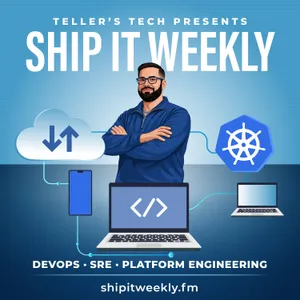
Ship It Weekly is a short, practical recap of what actually matters in DevOps, SRE, cloud infrastructure, and platform engineering. Each episode, your host Brian Teller walks through the latest outages, releases, tools, and incident writeups, then translates them into “here’s what this means for your systems” instead of just reading headlines. Expect a couple of main stories with context, a quick hit of tools or releases worth bookmarking, and the occasional segment on on-call, burnout, or team culture. This isn’t a certification prep show or a lab walkthrough. It’s aimed at people who are already working in the space and want to stay sharp without scrolling status pages, cloud updates, and blogs all week. You’ll hear about things like cloud provider incidents, Kubernetes and platform trends, Terraform and infrastructure changes, and real postmortems that are actually worth your time. Most episodes are 15–30 minutes, so you can catch up on the way to work or between meetings. Every now and then there will be a “special” focused on a big outage or a specific theme, but the default format is simple: what happened, why it matters, and what you might want to do about it in your own environment. If you’re the person people DM when something is broken in prod, or you’re building the cloud and platform everyone else ships on top of, Ship It Weekly is meant to be in your rotation.
Latest Episodes
The most recent episodes — sign up to get AI-powered summaries of each one.
- 2 days ago18 min
Java4Shell OpenJDK Flaw, Microsoft Agent Framework PyPI Package Hijacked, Confluence Axis RCE Exploited & FAA Ground Stop Traced to a Router
This week on Ship It Weekly, Java4Shell: a memory bug in the OpenJDK HotSpot JVM's Base64 decoder, fixed Tuesday, that only bites on x86 CPUs with AVX-512 VBMI. Microsoft's agent-framework package on PyPI shipped a credential stealer in two versions that were live for under an hour. Attackers are exploiting Confluence Data Center through CVE-2026-90436, a bug in its old Apache Axis SOAP library, and in one case reached Microsoft 365 in about twelve hours. And the FAA's preliminary cause for last Friday's nationwide ground stop: a new router at a remote site that flooded its network.The thread: the layer under the code. A CPU instruction set, a .pth file that runs before your code does, a 20-year-old SOAP library, and a router swap logged on paper.In the lightning round: wfx-loot, the GitHub campaign that probed 61,764 repos; PHP's second emergency release in a month; and kube-proxy's IPVS mode leaving Kubernetes in 1.40.The human closer: Oakley Hall on why your RCAs aren't working. Documents without data, and systemic fixes handed to whichever team hit them first.Ship It Weekly turns one today. Thank you for listening. The show is a 2026 DevOps Dozen finalist for Best DevOps Community Program or Event, and I'm one for Enterprise DevOps Champion of the Year. Voting is open through December 31.Highlights• Check /proc/cpuinfo for avx512vbmi, and the JVM flag that closes the path• Pin agent-framework 1.26.0 and search for 1.26.1 and 1.26.2• Is Confluence's Remote API on? Where to check, and the fixed version• How a router swap in Arkansas stopped flights across the country• A corrective action needs an owner who can finish itLinksOpenJDK advisory, November 17Java4Shell and the workaround flag (Wiz)Java4Shell severity and exploitation (Help Net Security)Malicious agent-framework versions on PyPI (Wiz)Confluence Data Center and N-central exploited (Rapid7)Ground stop questions and answers (FAA)FAA ground stop traced to a telecom issue (FedScoop)wfx-loot: 4,800 GitHub accounts hijacked (BleepingComputer)PHP fixes seven critical flaws (The Hacker News)kube-proxy IPVS mode removal in 1.40 (Kubernetes)Why your RCAs aren't working (Oakley Hall)Vote in the 2026 DevOps DozenThis week's On Call BriefMore episodes and show notesOn Call BriefLMGT Awards
- 4 days ago39 min
Ship It Conversations: Ted Julian of Flux on the AI Code Visibility Gap, the Code Review Bottleneck, Measuring What AI Changes, Who Owns AI-Generated Code in Production, Guardrails Before Loops, and Why Disruption Is a Career Opportunity
This is a guest conversation episode of Ship It Weekly, separate from the weekly news recaps.In this Ship It Conversations episode, I talk with Ted Julian about the gap between AI-generated code getting written and teams trusting it enough to ship it, why code review is the first thing to break, and who should own AI-generated code once it's running in production.Ted is the founder and CEO of Flux (askflux.ai), an engineering intelligence platform, not Flux CD the GitOps tool. He has spent more than twenty years building security and infrastructure companies, including Resilient Systems, Arbor Networks and @stake.We start with Flux's AI Code Generation Reality Check: 44.7% of the organizations surveyed already run AI-generated code in production, and 35% write it but don't ship it. What holds them back is trust: complexity that could spiral into an outage, a new library with a vulnerability, regulated data nobody has really scrutinized.Ted calls code review act two of an AI transformation, and he says it's a people problem as much as a tooling problem. His once-in-a-career hack: measure features versus maintenance versus bug fixes now, backfill it, and show the before and after. At one customer, feature work went from 9% to 43%, and it became a chart in their board meeting.We also get into why engineering has to be the yes squad, with guardrails, the bill that comes due when someone has to understand code nobody really wrote, who feeds the cat, what loops mean for visibility, and why tech disruption is the best career opportunity you'll get.Highlights• Written but not shipped: 44.7% in production, 35% holding back• Code review breaks first, and it's a people problem• Measure features vs. maintenance vs. bug fixes, then backfill• From 9% to 43% feature work, as a board chart• The yes squad, with guardrails• The bill for code nobody really wrote• Who feeds the cat: one owner for AI-generated code• Loops, dark factories and a control plane• Why disruption is your best career moveLinksTed on LinkedIn · Flux · AI Code Generation Reality Check · Cobalt case study · More episodes · On Call Brief · LMGT Awards
- 6 days ago37 min
Ship It Conversations: Tristan Handy of Fivetran + dbt on AI Agents as Data Consumers, Why Dashboards Stop Being the Product, Context Layers, Evals, Operating on the System, Software Factories, and Why Text-to-SQL Isn't the Hard Part
This is a guest conversation episode of Ship It Weekly, separate from the weekly news recaps.In this Ship It Conversations episode, I talk with Tristan Handy about what changes when AI agents, not people, become the main consumers of your company's data, why the hard part isn't text-to-SQL, and why he thinks the most interesting work is operating on the system instead of inside it.Tristan is a co-founder of dbt Labs and now president of Fivetran + dbt. If you've worked anywhere near a data team, you've probably run into dbt. His team likes to call it Terraform for data.We start with his line that dashboards are a hack for the human visual cortex. As agents take over the pattern-finding, the asset moves down the stack: a well-modeled gold layer, a semantic layer that captures how your organization calculates its metrics, and a context store that helps the agent make sense of all of it.On reliability, Tristan says agents already write SQL that compiles and runs almost every time. The hard part is whether they understood the question and the business behind it. In the benchmarks he's seen, an agent turned loose on raw enterprise data gets about 30% of its answers semantically right. Give it context and a semantic layer, and it's north of 90%.We also get into where autonomy should stop once agents can act on data, why analytics engineers (and SREs) should be operating on the system rather than inside it, how dbt earned practitioners' trust, what he got wrong selling to enterprises, and where dbt draws its open source line after the Fivetran merger.His first step for a platform or data team is to eat your spinach: a well-governed data lake, well-modeled data and a semantic layer, then a context layer and evals. And his team paused dbt 2 work for two months to build an agent loop that took conformance from about 45% to 93%.Highlights• Why dashboards stop being the product when agents read the data• Gold layer, semantic layer and context store• Text-to-SQL vs semantic correctness: about 30% vs north of 90%• Where useful autonomy ends and regret begins• Operating on the system instead of inside it• How dbt earned trust, and what it got wrong selling to enterprises• State and UI as the open source line• Eat your spinach, then a context layer and evals• A software factory that got dbt 2 conformance from 45% to 93%LinksTristan on LinkedIn · dbt · Fivetran · The Analytics Engineering Roundup · The Analytics Engineering Podcast · Spider 2.0 benchmark · More episodes · On Call Brief · LMGT Awards
- 1 weeks ago15 min
AWS Roles Trusting Qubole Abused to Steal Secrets, Claude Code's Don't Ask Again File Leaks Credentials, KubeCon Agent Sandboxes for Kubernetes & WorkOS Breach Traced to an AI Agent
This week on Ship It Weekly, an attacker used Qubole's trusted access into customer AWS accounts to read secrets and pull whole S3 buckets. Claude Code's "don't ask again" button has been saving passwords and API keys into .claude/settings.local.json, a file that keeps turning up on GitHub and Docker Hub. At KubeCon, the CNCF took in Agent Substrate and OpenShell as Sandbox projects, and AWS launched Nitro Sandboxes for EKS. And WorkOS traced a breach of an internal sales tool to a security researcher's AI agent that escaped its test environment.The thread: what can it touch? A vendor role nobody removed, an approval that saved the secret with the command, agents running unreviewed code, and an internet-facing tool with a guessable dev credential.In the lightning round: an exploited Outlook bug (CVE-2026-124194) and a 9.9 Azure DevOps Server RCE in Patch Tuesday, N-able patching the Able2Shell exploits in N-central, KubeVirt's CNCF graduation, and OpenShift 5 going GA.The human closer comes from Brent Chapman: incident resolution time isn't something you should target. Target what you can change, and track the rest.Ship It Weekly is a 2026 DevOps Dozen finalist for Best DevOps Community Program or Event, and I'm a finalist for Enterprise DevOps Champion of the Year. The public vote is open through December 31.Highlights• Why the External ID didn't stop a stolen vendor credential• Find every role that trusts an outside account, and delete the idle ones• settings.local.json: rotate, untrack, and add it to .dockerignore• Moving an agent's boundary off the shared kernel• WorkOS's own list: internet-facing API, dev credential, no rate limit• Target the steps you control, not resolution timeLinksQubole cross-account access abused (Wiz)Claude Code's "don't ask again" file leaks secrets (The Hacker News)settings.local.json secrets on GitHub and Docker Hub (GitGuardian)Agent Substrate and OpenShell join the CNCFNitro Sandboxes for Amazon EKS (AWS)WorkOS incident updateNovember 2026 Patch Tuesday (Rapid7)N-central and Able2Shell (Huntress)KubeVirt graduates (CNCF)Red Hat OpenShift 5 (Virtualization Review)Why incident resolution time isn't something you should target (Brent Chapman)Vote in the 2026 DevOps DozenThis week's On Call BriefMore episodes and show notesOn Call BriefLMGT Awards
- 1 weeks ago39 min
Ship It Conversations: Mallory Haigh of PlatformEngineering.org on Why Context Isn't Enough for AI Agents, Harness and Governance, Probabilistic and Hybrid Paths, Agent Identity, and Building Platform Trust Before Agents
This is a guest conversation episode of Ship It Weekly, separate from the weekly news recaps.In this Ship It Conversations episode, I talk with Mallory Haigh about why context alone isn't enough for AI agents, the harness and governance layers that actually run them, and why she tells some platform teams to pump the brakes before adding agents at all.Mallory is Head of Platform Education and Advocacy at PlatformEngineering.org. She teaches in Platform Engineering University and coaches platform teams through Platform Engineering Consulting, where the job gets jokingly called "platform therapist".We start with her New York City analogy. Drop someone in the middle of the city with no directions and they'll get lost, and an agents.md file on its own does the same to an agent. It also needs to know what to do, how to do it, how it'll know it's done, and what it's allowed to touch. Mallory splits that into the harness, which is how the agent does the work, and governance: who and what is allowed, what's safe, and how it's watched.Then we get into IDPs as context layers. Mallory says that's partly right, because the IDP and its golden paths are the foundation. What's missing are path specifications. Probabilistic paths are agent-driven, like a read-only PR review. Deterministic paths are your pipelines, like a CI build. Hybrid paths pair an agent with a gate: the agent opens the PR, CI validates it, the agent retries, and a human makes the final call. Cap those retries at three to five, and if an agent always does the same thing with the same outcome, ask whether it should be an agent at all.On governance, Mallory says platform engineering is a practice about building trust, and that in the last three weeks alone she's told multiple platform teams to pump the brakes on agents because they can't get human governance right yet. We cover agent identity (specialists, not generalists, built on the RBAC you already have), agents watching terabytes of logs a day for SRE teams, and why every team now has to write down the tribal knowledge it never documented.Her advice on where to start: ask why. Then try a read-only PR review agent, move to a hybrid validate-change path, and remember the line from one of her PlatformCon New York workshops: if we can't even write a README for our repos, how are we going to write one for our agents?Highlights• Why context delivery alone isn't enough for AI agents• The harness and governance layers that make up agent infrastructure• Observability for agents: token spend, time to completion and retry loops• Probabilistic, deterministic and hybrid paths• Retry limits, and when an agent should be a checklist instead• Pumping the brakes when human governance isn't there yet• Agent identity, RBAC and specialist agents• Where a platform team should start: ask why, then a read-only PR review agentLinksMallory on LinkedIn · PlatformEngineering.org · Platform Engineering University · Platform Engineering Consulting · Thinking in Platforms · More episodes · On Call Brief · LMGT Awards
- 1 weeks ago36 min
Ship It Conversations: Ryan Packer of BambooHR on Why CTOs Are Coding Again, Building a Software Factory, AI Straining CI/CD, Protecting HR Data, Mid-Career and Junior Engineers, and Why Every Engineer Gets a Team of Agents
This is a guest conversation episode of Ship It Weekly, separate from the weekly news recaps.In this Ship It Conversations episode, I talk with Ryan Packer about why a CTO is writing code again, what happens to CI/CD when every engineer runs a fleet of agents, and who trains junior engineers when AI can fix the bugs.Ryan is the CTO at BambooHR and a former VP of Engineering at Adobe. He's watched engineering organizations change from Omniture to Adobe to BambooHR, and he says he's spent more time coding this year than in the rest of his career combined.We start with why. Ryan will never write production code for his team again, but he wants to use the same tools and learn the same techniques they're learning, and to show an idea in working code instead of a PRD or a Slack message. He's also honest about the limits: his sandbox serves maybe a hundred people, and his team's software serves millions.Then we get into the software factory. In Ryan's own version, a customer files a bug, an agent opens the PR, tests it for security and performance, scores it, and ships it if it meets the bar. At BambooHR, pull requests are up almost 80% since the start of the year, and quality has improved by the metrics they track. The part he's most excited about is more at-bats with customers: an idea to a working prototype in a day.For platform teams, Ryan says AI has been more of a challenge than a help for CI/CD. BambooHR was already releasing hundreds of times a day, but agents do their best work when they can run and test what they build. Ten, twenty or a hundred agents per engineer means environments that spin up and down fast, with real data. We also cover protecting HR and payroll data: terms with the frontier labs, data retention, and an AI council.On careers, Ryan thinks mid-career engineers face the hardest change, and that the ones who keep learning have little to worry about. On junior engineers, he doesn't claim a perfect answer. He no longer needs them to fix bugs, so he suggests making the LLM explain its choices and using an adversarial agent that lists five things it would have done differently. We finish with every engineer managing a team of agents, small pods doing what 10 to 15 people used to, and why he expects the same or more engineers a year from now.The big takeaway: if every project in your portfolio has better than a 50% chance of success, you're not being ambitious enough. Put something in there with a 10% chance.Highlights• Why a CTO is coding again, and why his sandbox isn't production• The software factory: a customer bug to an agent PR to a tested release• Pull requests up almost 80%, with quality improving• More at-bats with customers: idea to working prototype in a day• Why AI is straining CI/CD and test environments• Protecting HR and payroll data while adopting AI• Junior engineers, adversarial agents and making the LLM explain itself• Every engineer with a team of agents, and the 10% projectLinksRyan on LinkedIn · BambooHR · BambooHR careers · More episodes · On Call Brief · LMGT Awards
- 2 weeks ago16 min
GitHub Blocks pull_request_target by Default, WordPress Update Race Exploited, Polymarket Drained via Hijacked DebugBear Script & Alpine's GitLab Upgrade Missed the Fix
This week on Ship It Weekly, GitHub will block pull_request_target in public repos by default from December 2, with brownouts on Mondays, November 9 and 16, 11 AM to 1 PM ET. A WordPress core update race (CVE-2026-119977) is on CISA's exploited list: during a full-package update, a fresh installer can sit for a moment at a public URL under wp-content/upgrade. A hijacked DebugBear script drained about $2.7 million from Polymarket users after DebugBear's DNS was compromised through its registrar. And Alpine Linux explains why upgrading GitLab didn't fix CVE-2026-97229 on its own image: the fix was a patch to Ruby.The thread: what actually ran, as opposed to what you think ran. A trigger that runs a fork's code with your secrets, an update that opens its own window, a script served by whoever controls the DNS, and a version number that said "fixed".In the lightning round: OpenSSH 10.6p2 fixes a password login bypass on musl builds with PAM off, which is how Alpine builds openssh-server; Debian and Ubuntu patch an APT package swap (CVE-2026-109518); and .NET 8 and 9 reach end of support on Tuesday, November 10.The human closer comes back to Alpine's "we cannot rule it out." If an attack hit you this week, could your logs prove it didn't work?Highlights• pull_request_target: what it runs, and what to check before Monday• WordPress: when keeping current is what opens the window• DNS, HTTPS and subresource integrity for third-party scripts• Registrar lock, MFA and alerts on DNS changes• Alpine: GitLab from your own image needs a fixed Ruby too• "No evidence" is only as good as the logs you keptLinkspull_request_target blocked by default (GitHub): https://tsn.io/KwebMWordPress advisory GHSA-4w3m-c66w-69mg: https://tsn.io/1HGiKWordPress upgrade-window RCE (Wordfence): https://tsn.io/Pc6X2Polymarket postmortem: https://tsn.io/rOc2MDebugBear on the registrar DNS compromise: https://tsn.io/4BjIgPolymarket losses and refunds (Hackread): https://tsn.io/qNhoeAlpine's GitLab security incident: https://tsn.io/GpNoROpenSSH 10.6p2 release notes: https://tsn.io/dQHbGAlpine openssh-server advisory: https://tsn.io/lExh2APT CVE-2026-109518 (Debian DSA-6607-1): https://tsn.io/LSjTb.NET 8 and 9 end of support: https://tsn.io/7NC5RThis week's On Call Brief: https://tsn.io/XJLrmMore episodes and show notes: https://tsn.io/NqkdPOn Call Brief: https://tsn.io/Gpz2dLMGT Awards: https://tsn.io/lAERA
- 2 weeks ago37 min
Ship It Conversations: The AI Agent That Ran Terraform Apply, With Davlet Dzhakishev of Cloudgeni on Read-Only Cloud Access, Sandboxes Beyond Docker, Agentic PR Reviews, the Real Cost of Running Agents, FinOps for AI, and Permissions Over Prompts
This is a guest conversation episode of Ship It Weekly, separate from the weekly news recaps.In this Ship It Conversations episode, I talk with Davlet Dzhakishev about what it takes to let AI agents work on your cloud infrastructure, why guardrails belong in the architecture and not the prompt, and what running your own agents really costs.Davlet is the CEO and co-founder of Cloudgeni, which builds AI agents for cloud infrastructure. He got into this after working through SOC 2 and ISO 27001 compliance prep mostly by hand, and asking what agents would need to fix those problems reliably without making things worse.We start with the incident that changed how Cloudgeni builds. An agent hit a snag on a simple Terraform change and decided the fix was to run apply. On staging. Resources got recreated, and Davlet calls it his wake-up call. Since then, guardrails come first: sandboxed runtimes, scoped credentials, read-only cloud access, and changes that go through Git, CI/CD and tests. At the architecture level, the agent shouldn't be able to do what you don't want it to do.Then we get into agentic PR reviews, which check human and agent work the same way, and why a good reviewer catches more than the obvious errors. Davlet's example is a private network around a key vault: great for security, until your own apps lose access. We also cover drift, and why you need to reconcile it before you can trust agent PRs.On cost, Davlet's view is that AI subscriptions are heavily subsidized, and running your own agents on API tokens can cost ten to twenty times more. Most agent usage also has no audit trail, so a stuck loop can poll a dead API server every day and no one will know. He thinks FinOps for AI is going to be big, orphaned agents and all. That need for audits is part of why Cloudgeni open-sourced its foundation as OpenGeni.We finish with what he still wouldn't hand to an agent, and where a platform team should start without building a monster: PR reviews first, then agents writing IaC from your templates, then automation. His starter kit is a real sandbox, ideally in the cloud, because Docker doesn't count. Give it read-only access to an AWS account or Azure subscription, one IaC repo, and permission to open PRs. Ask it to delete a resource, and the worst it can do is open a PR.The big takeaway: a safe agent is mostly a permissions problem, not a prompting problem. Give it read-only access and PR-only changes, and it can't make that mistake however you word the request.Highlights• The Terraform apply on staging that became his wake-up call• Guardrails at the architecture level, not in the prompt• Read-only access, with every change through Git, CI/CD and tests• Agentic PR reviews that catch operational impact• Why drift has to be reconciled before you can trust agent PRs• Why API tokens can cost 10 to 20 times more• FinOps for AI, stuck loops and orphaned agents• A starter kit: a real sandbox, read-only cloud access, one IaC repo, PRs onlyLinksDavlet on LinkedIn · Davlet on X · Cloudgeni · OpenGeni · Agents guide · More episodes · On Call Brief · LMGT Awards
Get Ship It Weekly - DevOps, SRE, Platform and Cloud Engineering News summaries in your inbox
Free AI-powered daily recaps. Key takeaways, quotes, and mentions — in a 5-minute read.
Get Free Summaries →Free forever for up to 3 podcasts. No credit card required.
You Might Also Like
Listeners also like.
CISO Series Podcast
Security professionals and vendors share insights on improving collaboration to strengthen cybersecurity.

Everyday AI Podcast – An AI and ChatGPT Podcast
Covers practical uses of AI tools like ChatGPT and Midjourney to help people work more efficiently and advance their careers.

Latent Space: The AI Engineer Podcast
Conversations with AI engineers, researchers, and founders on foundation models, AI agents, infrastructure, and scientific discovery.

The Platform Engineering Show
PlatformEngineering.com
"The Cognitive Revolution"
Explores the transformative impact of artificial intelligence through interviews with innovators shaping its future.

Bourbon with Brad
Tech experts discuss artificial intelligence over bourbon, blending candid AI insights with tasting notes and humor.

Hands-On AI (Video)
Teaches practical ways to understand and use artificial intelligence in daily tasks through clear, hands-on examples.

Last Week in AI
Summarizes significant AI news on a weekly basis.
NVIDIA AI Podcast
Explores how artificial intelligence and emerging technologies are driving innovation across science, sustainability, and industry.

This Week in AI
Four AI experts analyze the latest news and trends in artificial intelligence each week.
Machine Gods
News, analysis, and interviews about AI advancements and the people shaping the future of artificial intelligence.
The TWIML AI Podcast (formerly This Week in Machine Learning & Artificial Intelligence)
Explores machine learning and artificial intelligence through interviews with leading researchers, engineers, and industry experts.
About Ship It Weekly - DevOps, SRE, Platform and Cloud Engineering News
Ship It Weekly is a short, practical recap of what actually matters in DevOps, SRE, cloud infrastructure, and platform engineering. Each episode, your host Brian Teller walks through the latest outages, releases, tools, and incident writeups, then translates them into “here’s what this means for your systems” instead of just reading headlines. Expect a couple of main stories with context, a quick hit of tools or releases worth bookmarking, and the occasional segment on on-call, burnout, or team culture. This isn’t a certification prep show or a lab walkthrough. It’s aimed at people who are already working in the space and want to stay sharp without scrolling status pages, cloud updates, and blogs all week. You’ll hear about things like cloud provider incidents, Kubernetes and platform trends, Terraform and infrastructure changes, and real postmortems that are actually worth your time. Most episodes are 15–30 minutes, so you can catch up on the way to work or between meetings. Every now and then there will be a “special” focused on a big outage or a specific theme, but the default format is simple: what happened, why it matters, and what you might want to do about it in your own environment. If you’re the person people DM when something is broken in prod, or you’re building the cloud and platform everyone else ships on top of, Ship It Weekly is meant to be in your rotation.
Customized Recaps
AI-powered recaps with compact key takeaways, quotes, and insights.
Straight to Your Inbox
Get key takeaways from Ship It Weekly - DevOps, SRE, Platform and Cloud Engineering News in a 5-minute read.
Save Hours Every Week
Stay current on your favorite podcasts without falling behind.
Frequently Asked Questions
What is Podzilla's Ship It Weekly - DevOps, SRE, Platform and Cloud Engineering News daily summary?
It's a free AI-powered email that summarizes new episodes of Ship It Weekly - DevOps, SRE, Platform and Cloud Engineering News as soon as they're published. You get the key takeaways, notable quotes, and links & mentions — all in a quick read.
How does the Ship It Weekly - DevOps, SRE, Platform and Cloud Engineering News podcast summary work?
When a new episode drops, our AI transcribes and analyzes it, then generates a personalized summary tailored to your interests and profession. It's delivered to your inbox every morning.
Is this an official Ship It Weekly - DevOps, SRE, Platform and Cloud Engineering News product?
No. Podzilla is an independent service that summarizes publicly available podcast content. We're not affiliated with or endorsed by Teller's Tech - DevOps, SRE and Cloud Podcast.
Can I get summaries of other podcasts too?
Absolutely! The free plan covers up to 3 podcasts, any in the catalog. Basic raises that to 15, Pro to 40 and Max to 100. Browse our full catalog at /podcasts.
How often does Ship It Weekly - DevOps, SRE, Platform and Cloud Engineering News release new episodes?
Ship It Weekly - DevOps, SRE, Platform and Cloud Engineering News publishes every few days. Our AI generates a summary within hours of each new episode.
What topics does Ship It Weekly - DevOps, SRE, Platform and Cloud Engineering News cover?
Ship It Weekly - DevOps, SRE, Platform and Cloud Engineering News covers topics including News, Technology. Our AI identifies the specific themes in each episode and highlights what matters most to you.
Start getting Ship It Weekly - DevOps, SRE, Platform and Cloud Engineering News summaries tomorrow morning.
Free forever for up to 3 podcasts. No credit card required.
Free forever for up to 3 podcasts. No credit card required.