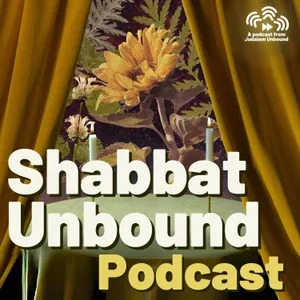
Free Daily Podcast Summary
Shabbat Unbound Podcast: Daily Summaries Delivered
by Lex Rofeberg, Miriam Terlinchamp, Judaism Unbound
Each prayer its own world. With its own Torah to teach us. Most Friday night services move through fifteen prayers in one sitting. Shabbat Unbound asks a different question: what if we took just one prayer and really stayed with it? Over eight episodes, we give one prayer our full, undivided attention. Its history. Its language. Its music. The arguments it has sparked, the comfort it has given, and the questions it refuses to resolve.
Latest Episodes
The most recent episodes — sign up to get AI-powered summaries of each one.
- 2 weeks ago30 min
Episode 5: Shema/V'ahavta
Welcome to Shabbat Unbound, the world's longest Friday night Sabbath service, stretching over eight episodes. Instead of rushing through all the Friday night Shabbat prayers in one sitting, like we might in a classical synagogue environment, we're taking our time diving deep into one prayer each episode through song study and sacred conversation. It's the most original and traditional way to engage in the transition into Shabbat, taking each prayer as its own world with its own Torah to teach us. Miriam Terlinchamp, Lex Rofeberg and an incredible group of musicians invite you to discover what happens when Shabbat slows down. The fifth focuses on Shema/V'ahavta.[1] You can watch this entire episode in video format here.[2] Want to watch the music video of our version of "And You Shall Love"? Great you can find it here.[3] Love the song "And You Shall Love" by featured composers Jessalyn Levine and Annie Villareal-Belford? Great! Check out the original here.
- Sep 25, 202631 min
Episode 4: Lecha Dodi
Welcome to Shabbat Unbound, the world's longest Friday night Sabbath service, stretching over eight episodes. Instead of rushing through all the Friday night Shabbat prayers in one sitting, like we might in a classical synagogue environment, we're taking our time diving deep into one prayer each episode through song study and sacred conversation. It's the most original and traditional way to engage in the transition into Shabbat, taking each prayer as its own world with its own Torah to teach us. Miriam Terlinchamp, Lex Rofeberg and an incredible group of musicians invite you to discover what happens when Shabbat slows down. The fourth episode focuses on Lecha Dodi.[1] Source for writing Lecha Dodi. Rabbi Chaim Vital (1543-1620), student of Arizal (Rabbi Isaac Luria, 1534-1572), writes in his Pri Etz Chaim (Sha’ar Shabbat) the Arizal’s precise procedure for Kabbalat Shabbat:He would go out into the fields and first recite Psalm 29 (‘Mizmor l’David’). Then he would say bo’i kallah three times, followed by Psalm 92 (‘Mizmor Shir l’Yom haShabbat’). That was it! The Arizal would then return home, and had another set of rituals around the meal table. One of these was to recite the words Zachor v’shamor b’dibbur echad ne’emru, to recall the mitzvah of Shabbat in the Ten Commandments. Recall that in the first passage of the Ten Commandments in the Book of Exodus, God says zachor et yom haShabbat, to “commemorate” the Sabbath day, while in the second passage of the Ten Commandments in the Book of Deuteronomy, Moses recorded it as shamor et yom haShabbat, to “safeguard” the Sabbath day. Our Sages explained that God had said both words simultaneously—the people heard zachor v’shamor b’dibbur echad, to “commemorate” and “safeguard” in a single utterance.[2] Miriam mentions bridal imagery in Lecha Dodi and Sabbath practices in general. Here is a sweet article about mystic love by Sara Crispe in her www.myjewishlearning.com essay, “Love Lessons from Lecha Dodi.” [3] Love this rendition of Lecha Dodi? Great! Check out Batya Levine’s other recordings and compositions on her website www.batyalevine.com. Batya’s newest album “Yivarechecha” focuses on blessings and is a downright magical compilation of gorgeous and resonant music. [4] If you want to listen to some of the other nearly 1,000 tunes for Lecha Dodi, we have a few special one’s highlighted on our website at: www.judaismunbound.com/shabbat5785. There’s one set to “All of me” by John Legend, another by “The Jews of Uganda”, a Bretzlover chasidic tune, and more! [5] Want to watch the music video of our version of Lecha Dodi? Great you can find it here.
- Jul 24, 202623 min
Episode 3: Ana B'Koach
Welcome to Shabbat Unbound, the world's longest Friday night Sabbath service, stretching over eight episodes. Instead of rushing through all the Friday night Shabbat prayers in one sitting, like we might in a classical synagogue environment, we're taking our time diving deep into one prayer each episode through song study and sacred conversation. It's the most original and traditional way to engage in the transition into Shabbat, taking each prayer as its own world with its own Torah to teach us. Miriam Terlinchamp, Lex Rofeberg and an incredible group of musicians invite you to discover what happens when Shabbat slows down. The third episode focuses on Ana B'Koach. [1] Interested in learning more about Ana B’Koach? Lex compiled this incredible list of resources including multiple translations, tunes and essays. [2] Jacob’s Ladder has an incredible repertoire of Jewish music. Check out their newest album, HaMakom/The Place here. [3] Here’s a picture of Lex’s ring. Want your own? Us too. Here are a few options by artisans. [4] Lex mentions the role of the 42 names of of God, you can read the original text in the Talmud (Kiddushin 71a:13) that introduces this concept. [5] Richard Levy z”l, Rabbi, poet, teacher, and modern liturgist, published an exceptional translation of psalms, Songs Ascending, an incredible compilation for any poetic, creative, or lover of ancient poetry. [6] Want to watch the music video of our version of Ana Bakoach? Great you can find it here.
- Jun 26, 202623 min
Episode 2: Shiru L'Adonai
Welcome to Shabbat Unbound, the world's longest Friday night Sabbath service, stretching over eight episodes. Instead of rushing through all the Friday night Shabbat prayers in one sitting, like we might in a classical synagogue environment, we're taking our time diving deep into one prayer each episode through song study and sacred conversation. It's the most original and traditional way to engage in the transition into Shabbat, taking each prayer as its own world with its own Torah to teach us. Miriam Terlinchamp, Lex Rofeberg and an incredible group of musicians invite you to discover what happens when Shabbat slows down. The first episode focuses on Shiru L'Adonai. [1] Check out the music video for Shiru L'Adonai here. [2] All the music for the Shabbat Unbound podcast was recorded live at The Monastery Studios in Cincinnati, Ohio under the direction of Ric Hordinski. [3] Check out this page for further learning about Shiru L’Adonai (and all our Shabbat Unbound episodes). [4] Interested in learning more about composer Jake Erhlich and his community? You can find out more about Jake and Congregation T’chiyah on their website. [5] “Every psalm, every prayer is an act of relationship, a way of moving into holy Presence, a way of opening ourselves to hear the voice of the Divine, which the cares of ordinary life may, all too frequently, muffle”. – Psalms of Jewish liturgy, page 121 Miriyam Glazer [6 ] Miriam mentions the Zohar, the mystical text of Kabbalah, when referring to the Sabbath. You can read more about the spiritual nature of the Sabbath in the Zohar, Volume II (Shemot), Terumah 14:164–165
- May 22, 202628 min
Episode 1: Yedid Nefesh
Welcome to Shabbat Unbound, the world's longest Friday night Sabbath service, stretching over eight episodes. Instead of rushing through all the Friday night Shabbat prayers in one sitting, like we might in a classical synagogue environment, we're taking our time diving deep into one prayer each episode through song study and sacred conversation. It's the most original and traditional way to engage in the transition into Shabbat, taking each prayer as its own world with its own Torah to teach us. Miriam Terlinchamp, Lex Rofeberg and an incredible group of musicians invite you to discover what happens when Shabbat slows down. The first episode focuses on Yedid Nefesh. [1] Check out the music video for Yedid Nefesh here. [2] All the music for the Shabbat Unbound podcast was recorded live at The Monastery Studios in Cincinnati, Ohio under the direction of Ric Hordinski. [3] Lex made AMAZING resources to accompany each episode of Shabbat Unbound, check out this page for further learning. [4] Molly Baigot, composer of this version of Yedid Nefesh, is a queer Jewish musician, educator, and activist living on Nipmuc & Pocumtuc land in Easthampton, MA. You can find out more about her on her website: mollybajgot.com [5] Reb’ Zalman’s translation of Yedid Nefesh can be found here [6] Check out this gorgeous article on the power of vulnerability through the lens of love, by Karen Erlichman [7] The melody Healer of the Broken-Hearted for the prayer for healing comes from Shir Meira Feit. Learn more about their work at ShirMeira.com.
- May 7, 20260 min
Trailer
Each prayer its own world. With its own Torah to teach us. Most Friday night services move through fifteen prayers in one sitting. Shabbat Unbound asks a different question: what if we took just one prayer and really stayed with it? Over eight episodes, we give one prayer our full, undivided attention. Its history. Its language. Its music. The arguments it has sparked, the comfort it has given, and the questions it refuses to resolve. One prayer. All the way in. No rushing. No catalogue. A singular prayer, explored from every direction. Song: We listen to how the prayer sounds — its melodies, its variations, the way different communities have sung it across centuries and continents. Study: We open the words themselves — unpacking the Hebrew, the layers of meaning, the rabbinic debates and the poets who shaped every syllable. Story: We bring each prayer to life through the people who wrote it, prayed it, and found themselves changed by it. Eight Prayers. Eight Worlds. One episode drops the fourth Friday of every month. Start anywhere or start from the beginning.
Get Shabbat Unbound Podcast summaries in your inbox
Free AI-powered daily recaps. Key takeaways, quotes, and mentions — in a 5-minute read.
Get Free Summaries →Free forever for up to 3 podcasts. No credit card required.
You Might Also Like
Listeners also like.

On the Other Hand: Ten Minutes of Torah
ReformJudaism.org

Into the Verse - A Parsha Podcast
Aleph Beta

Tablet Studios
Explores Jewish identity, tradition, and culture through diverse podcasts offering insight for contemporary Jewish life.

Da Mah Shetashiv
Rabbi Aaron Lopiansky

Among Chassidim
Explores Chassidic life and thought through candid, in-depth conversations with members of the community.

5-Minute Daf Yomi with Rabbi Shmuel Herzfeld
Daily insights into the Talmud’s page of the day with Rabbi Shmuel Herzfeld.

The Frieda Vizel Podcast
Conversations exploring Hasidism, Judaism, New York City, and cultural topics through interviews and personal insights.

Poetry Unbound
A deep, reflective exploration of a single poem in each episode, guided by Pádraig Ó Tuama.

Stories We Tell
Union for Reform Judaism
Beyond Belief: Tales of Religious Exodus
Freidom Fighter

The Jewish History Podcast - With Rabbi Yaakov Wolbe
A podcast featuring Rabbi Yaakov Wolbe's lectures on Jewish history.

Chosen People Problems
Two women—one secular, one Haredi—explore faith, tradition, and modern life through candid conversations.
About Shabbat Unbound Podcast
Each prayer its own world. With its own Torah to teach us. Most Friday night services move through fifteen prayers in one sitting. Shabbat Unbound asks a different question: what if we took just one prayer and really stayed with it? Over eight episodes, we give one prayer our full, undivided attention. Its history. Its language. Its music. The arguments it has sparked, the comfort it has given, and the questions it refuses to resolve.
Customized Recaps
AI-powered recaps with compact key takeaways, quotes, and insights.
Straight to Your Inbox
Get key takeaways from Shabbat Unbound Podcast in a 5-minute read.
Save Hours Every Week
Stay current on your favorite podcasts without falling behind.
Frequently Asked Questions
What is Podzilla's Shabbat Unbound Podcast daily summary?
It's a free AI-powered email that summarizes new episodes of Shabbat Unbound Podcast as soon as they're published. You get the key takeaways, notable quotes, and links & mentions — all in a quick read.
How does the Shabbat Unbound Podcast podcast summary work?
When a new episode drops, our AI transcribes and analyzes it, then generates a personalized summary tailored to your interests and profession. It's delivered to your inbox every morning.
Is this an official Shabbat Unbound Podcast product?
No. Podzilla is an independent service that summarizes publicly available podcast content. We're not affiliated with or endorsed by Lex Rofeberg, Miriam Terlinchamp, Judaism Unbound.
Can I get summaries of other podcasts too?
Absolutely! The free plan covers up to 3 podcasts, any in the catalog. Basic raises that to 15, Pro to 40 and Max to 100. Browse our full catalog at /podcasts.
How often does Shabbat Unbound Podcast release new episodes?
Shabbat Unbound Podcast publishes monthly. Our AI generates a summary within hours of each new episode.
What topics does Shabbat Unbound Podcast cover?
Shabbat Unbound Podcast covers topics including Religion & Spirituality, Spirituality, Judaism. Our AI identifies the specific themes in each episode and highlights what matters most to you.
Start getting Shabbat Unbound Podcast summaries tomorrow morning.
Free forever for up to 3 podcasts. No credit card required.
Free forever for up to 3 podcasts. No credit card required.