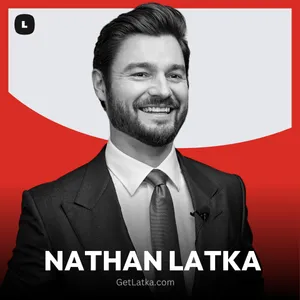
Free Daily Podcast Summary
SaaS Interviews with CEOs, Startups, Founders: Daily Summaries Delivered
by Nathan Latka
Get key takeaways, quotes, and insights from SaaS Interviews with CEOs, Startups, Founders in a 5-minute read. Delivered straight to your inbox.
Latest Episodes
The most recent episodes — sign up to get AI-powered summaries of each one.
- 5 days ago25 min
How 1Mind Hit $1M in 3 Months Selling $100k AI Sales Agents
How do you hit $1 million in contracted revenue in three months and achieve 211% net dollar retention in your first year? Amanda Kahlow is the founder and CEO of 1Mind, an AI platform building go-to-market superhumans that replace SDRs, AEs, and sales engineers. You'll learn: - How to sell AI software for $100,000 to $400,000 using flat subscription pricing instead of metered models. - The unit economics of replacing 89 SDRs and 19 sales engineers with a single custom agent. - How they maintain 80 to 90 percent SaaS margins while running heavy LLM operations. - The strategy behind 1Mind's 600 percent year-over-year growth rate. - Why most enterprise customers purchase a second AI agent within 90 days of going live. - How 1Mind uses their own AI agent to source 78 percent of their eight-figure pipeline. - The reality of managing founder dilution and secondary sales after building a $380 million business. - Why AI agents are expanding past chat interfaces and joining live Zoom calls to run product demos. Amanda is a three-time entrepreneur who previously founded and served as CEO of 6sense, scaling the company through multiple funding rounds and a $380 million valuation before stepping down. Watch this episode on YouTube: https://youtu.be/lFX0n3uYTkw Connect with Amanda: https://www.1mind.com/ Connect with Nathan: https://founderpath.com/
- 1 weeks ago24 min
Selling Check for $400M, Now Building a $1.5M ARR AI Startup
How do you build a $1.5 million ARR enterprise AI platform after previously selling a fintech startup for nearly $400 million? Ahikam Kaufman is the CEO of SafeBooks AI, an agentic data automation platform for the office of the CFO. You'll learn: - How to charge $125,000 ACVs by pricing against the cost of an accounting headcount. - Why the company raised a $15 million seed round just to build their initial data architecture. - How they landed a $300,000 engagement in their first year of going to market. - The exact strategy Ahikam used to distribute $25 million in retention bonuses during a past acquisition. - Why building a proprietary graph database is the only way to prevent AI hallucinations in finance. - How SafeBooks scaled to 15 paying enterprise customers. - The economics of automating the quote-to-cash process across disparate CRMs and ERPs. - How to manage founder dilution while building a venture-backed tech company. Ahikam is a veteran fintech executive who previously co-founded Check, which he scaled and sold to Intuit in 2014 for nearly $400 million, creating over 10 millionaires in the process. Watch this episode on YouTube: https://youtu.be/JQA3RX9PsHw Connect with Ahikam: https://safebooks.ai/ Connect with Nathan: https://founderpath.com/
- 2 weeks ago17 min
How Flossy Reached $4M ARR With AI Dental Receptionists
How do you survive shutting down during the pandemic, pivot a heavily funded business model, and rebuild a team of 8 into a $4M ARR AI powerhouse? Miles Beckett is the CEO of Flossy, a verticalized AI receptionist that automates patient booking and engagement for dental practices. After successfully building and exiting two previous startups for tens of millions, Miles raised a $15M Series A for a dental discount plan. When the market shifted, he pivoted the company entirely to voice AI, made hard cuts to the team, and found explosive product-market fit. Today, Flossy is growing 60 to 70 percent month over month. You'll learn: Why vertical AI agents beat general tools like Intercom How to sell $500/month software to PE-backed roll-ups The reality of firing 30 people to save a company's burn rate How a $1 million breakup fee saved a past acquisition deal Why they rejected a theoretical $40 million buyout The math behind adding $100,000 in new ARR each month How they used a $3M seed round to survive 2020 lockdowns The mechanics of multi-location enterprise SaaS deals Miles is a seasoned operator who previously built and sold Equal to Everyday Health for $30M, and Silver Sheet to AMN Healthcare, before diving into the dental tech space. Watch this episode on YouTube: https://www.youtube.com/watch?v=U2RAjHVdHZM Connect with Miles: https://www.flossy.com/ Connect with Nathan: https://founderpath.com/
- 3 weeks ago24 min
Flip Reaches $12M ARR with AI Voice Support for 250 Brands
How do you pivot a banned college ridesharing app into a voice AI company handling 300 million customer service calls? Brian Schiff is the co-founder and CEO of Flip, a verticalized AI voice assistant that automates customer service calls for transportation, retail, and healthcare brands. After realizing their Cornell ridesharing app was a dead end, Brian and his co-founder Sam pivoted into voice AI. Today, Flip automates up to 90 percent of routine support calls for over 250 enterprise companies and recently raised a $20M Series A at a $100M valuation. You'll learn: How to successfully pivot a failing startup model Why verticalized AI beats horizontal platforms How to implement usage-based pricing at $1.50 per call Why "listen mode" is their best sales tactic How to maintain 75 percent gross margins with AI Why they rejected a theoretical $150 million acquisition offer How to select the right industries for expansion Why competitive B2C markets are best for AI tools Brian started his entrepreneurial journey at Cornell's eLab accelerator. He navigated the near-total collapse of transportation revenue during the pandemic to build a highly efficient business growing 3X year over year. Watch this episode on YouTube: https://youtu.be/gtFt5exyCaI Connect with Brian: https://flipcx.com/ Connect with Nathan: https://founderpath.com/
- Apr 15, 202620 min
Kadence Reaches $15M ARR Managing Hybrid Work for Revolut & Boeing
How do you completely reboot a dying hardware startup, restructure a heavy cap table, and pivot into a SaaS product doing $15M ARR? Dan Bladen is the co-founder and CEO of Kadence, a workplace operations system coordinating people and spaces for hybrid work. After realizing his wireless charging startup was a "vitamin, not a painkiller," Dan pivoted during the pandemic to help companies like Nasdaq, Revolut, and Boeing manage their office space. Today, Kadence serves over 600 enterprise customers. You'll learn: How to manage board expectations during a hard pivot The exact mechanics of resetting a cap table for new investors Why shifting from SMB to enterprise accelerated revenue How they achieved over 130 percent net dollar retention Why seat-based pricing still works in the enterprise The math behind saving half a billion dollars in leasing costs How launching SpaceOps AI drives multi-product expansion Why high-ticket dinners replaced SEO for customer acquisition Dan started his career managing technology for a church before founding his first IoT business. He moved his family to the Bay Area just before the pandemic forced him to rethink his entire company operations. Watch this episode on YouTube: https://youtu.be/2ySF3YMDcnY Connect with Dan: https://kadence.co/ Connect with Nathan: https://founderpath.com/
- Apr 8, 202618 min
How Buildern Reached $2M Revenue With 300 Customers | Hmayak Tigranyan
How do you build a construction SaaS to $2M in revenue with just $500K raised and get 95% of growth from SEO? Hmayak Tigranyan is the founder and CEO of Buildern, a construction management software platform serving around 300 customers and generating roughly $2M in revenue today. The company helps residential and commercial builders manage finances and workflows, and it is doing about $160K in monthly revenue with roughly $40K in monthly profit. What makes this business interesting is that it scaled in a legacy industry without paid acquisition or outbound. Buildern built an inbound engine around high-intent SEO, stayed profitable, and is only now adding a sales team as ACV moves closer to the range that can support quota-carrying reps. You'll learn: How Buildern found an underserved construction software niche. Why Hmayak shut down a $3M dev shop to go all in on SaaS. How the company raised just $500K and sold only 10%. What $160K in monthly revenue looks like at a $40K profit level. Why 95% of revenue came from SEO-driven inbound. How Buildern chooses long-tail keywords in construction. Why transparent competitor comparison pages rank well. How internal SEO execution beat the need for an agency. What changed once the company started hiring sales reps. How pricing moved from roughly $6K ACV toward $7.5K to $8K. What AE quotas and compensation look like at this stage. How a profitable vertical SaaS company scales with a global team. Hmayak came into Buildern after years in SaaS development, travel software, and running a dev shop that peaked at about $3M in annual revenue. He launched Buildern in 2021, spent the first two years without paying customers, then used industry-informed angels and product iteration to find the right shape of the product. This episode is for founders building in old industries, operators trying to scale efficiently, and investors who care about profitable SaaS growth. It is a useful masterclass in vertical SaaS positioning, SEO-led demand generation, and disciplined capital use. Watch this episode on YouTube: https://youtu.be/An0n18v4j8E Connect with Hmayak: https://buildern.com/ Connect with Nathan: https://founderpath.com/
- Apr 1, 202622 min
How Allo Reached $10M Revenue With 5,000 Customers
How do you grow an AI phone system to 5,000 customers and roughly $3M ARR in under two years while still aiming for $10M in revenue this year? Jeremy Goillot is the founder and CEO of The Mobile First Company, which launched Allo as its first product. Allo is an AI phone system and dialer for small businesses, now serving around 5,000 customers with average revenue above $160 per month and a goal of reaching $10M in revenue in 2026. This business is interesting because Jeremy did not stop at a self-serve PLG motion. He started there, saw the churn and activation issues, then layered in demos, lead routing, CRM-based qualification, and expansion to raise ACV and improve retention. The result is a high-volume SMB SaaS business built on strong distribution, fast onboarding, and clear activation metrics. You'll learn: Why Jeremy moved from pure PLG to a sales-assisted motion. How Allo increased average revenue from $18 to over $160 per month. The exact activation metric that predicts churn. How the team uses demo routing based on CRM and team size. Why retargeting was one of the cheapest acquisition channels. How Allo won SEO with long-form content and original screenshots. The keyword prioritization system behind their content strategy. Why 50% of new revenue now comes from expansion. How the team thinks about CAC quality instead of lowest CAC. Why Jeremy raised early without waiting for a co-founder. How he kept about 50% ownership after raising around $20M. What it takes to sell into SMBs at high volume with only 17 people. Jeremy previously led growth at Spendesk before starting The Mobile First Company. He launched the company as a solo founder, raised a $5M pre-seed on his own, then built the team around him while keeping significant ownership. His long-term goal is not just one product, but a broader suite of vertical SaaS tools built under separate brands. If you care about SMB SaaS, PLG versus sales-assisted growth, SEO-led distribution, or building a multi-product software company, this episode is a masterclass for SaaS builders. Watch this episode on YouTube: https://youtu.be/PUZMvjyS3xw Connect with Jeremy: https://www.withallo.com/ Connect with Nathan: https://founderpath.com/
- Mar 25, 202615 min
How TitanX Hit $9.7M ARR After Buying IP for $200K
How do you turn $200K into a $9.7M ARR SaaS company with a $100M valuation by buying IP instead of building from scratch? Joey Gilkey is the founder of TitanX, a sales intelligence platform generating $9.7M ARR after launching in 2024. The company serves enterprise sales teams with contracts ranging from $24K to $250K annually, with its largest deals exceeding seven figures. What makes TitanX interesting is its approach to building a moat. Instead of competing as another data provider, the company sits between data sources and execution layers, using proprietary signals and AI to improve outbound performance. The business scales through high ACV sales, expansion revenue, and strategic acquisitions. You'll learn: How Joey turned a $200K IP purchase into a $100M company Why buying IP can be faster than building SaaS products How TitanX structures pricing from $24K to $250K ACV The role of proprietary data in building defensibility How inbound, outbound, and referrals drive pipeline Why expansion revenue is core to growth strategy How acquisitions accelerate ARR growth The credit-based pricing model and consumption dynamics How TitanX uses AI to improve outbound performance The logic behind raising $27M and taking secondary cash Joey started in enterprise sales before launching multiple businesses and eventually betting his entire net worth on TitanX. After acquiring the IP in 2023, he shut down a profitable services business to focus fully on SaaS, scaling from zero to $9.7M ARR in under two years. This episode is for SaaS founders thinking about capital allocation, high-ACV sales, and building defensible data products. It's a practical breakdown of how to scale quickly using acquisition, pricing, and distribution strategy. Watch this episode on YouTube: https://youtu.be/mxiCodnXo6U?si=zebVllHlOY7UlVqO Connect with Joey: https://titanx.io/ Connect with Nathan: https://founderpath.com/
Get SaaS Interviews with CEOs, Startups, Founders summaries in your inbox
Free AI-powered daily recaps. Key takeaways, quotes, and mentions — in a 5-minute read.
Get Free Summaries →Free forever for up to 3 podcasts. No credit card required.
You Might Also Like
Listeners also like.

The SaaS Revolution Show
The SaaS Revolution Show, Alex Theuma
A Product Market Fit Show | Startup Podcast for Founders
Mistral.vc
The Official SaaStr Podcast: SaaS | Founders | Investors
Jason M. Lemkin 🦄
Hot SaaS 🌶 🚀
Max Nyman

SaaS IT UP 🎙️
Republic of SaaS
No Code MBA
Seth Kramer
Bootstrapped : The Lighter Side - The Podcast For B2B SaaS Founders
Lighter Capital - We Help Startups Grow
The Logan Bartlett Show
by Redpoint Ventures
Funds and Founders: Untold Journeys Behind Their Breakthroughs
Abhinav Sinha

The Twenty Minute VC (20VC): Venture Capital | Startup Funding | The Pitch
Harry Stebbings

The SaaS Podcast - Building SaaS in the AI Era
Omer Khan
B2B SaaS Marketing Snacks
Kalungi
About SaaS Interviews with CEOs, Startups, Founders
What if you knew data behind the fastest growing SaaS companies today? Each morning join Nathan Latka as he spends 15 minutes interviewing SaaS founders. You'll learn how SaaS CEO's launched their startup and grew it into a real SaaS business. SaaS Founders range from bootstrapped to funded, MVP to 10,000 customers, pre revenue to pre IPO.
Customized Recaps
AI-powered recaps with compact key takeaways, quotes, and insights.
Straight to Your Inbox
Get key takeaways from SaaS Interviews with CEOs, Startups, Founders in a 5-minute read.
Save Hours Every Week
Stay current on your favorite podcasts without falling behind.
Frequently Asked Questions
What is Podzilla's SaaS Interviews with CEOs, Startups, Founders daily summary?
It's a free AI-powered email that summarizes new episodes of SaaS Interviews with CEOs, Startups, Founders as soon as they're published. You get the key takeaways, notable quotes, and links & mentions — all in a quick read.
How does the SaaS Interviews with CEOs, Startups, Founders podcast summary work?
When a new episode drops, our AI transcribes and analyzes it, then generates a personalized summary tailored to your interests and profession. It's delivered to your inbox every morning.
Is this an official SaaS Interviews with CEOs, Startups, Founders product?
No. Podzilla is an independent service that summarizes publicly available podcast content. We're not affiliated with or endorsed by Nathan Latka.
Can I get summaries of other podcasts too?
Absolutely! The free plan covers up to 3 podcasts. Upgrade to Pro for 15, or Premium for 50. Browse our full catalog at /podcasts.
What topics does SaaS Interviews with CEOs, Startups, Founders cover?
SaaS Interviews with CEOs, Startups, Founders covers topics including Business, Entrepreneurship. Our AI identifies the specific themes in each episode and highlights what matters most to you.
Start getting SaaS Interviews with CEOs, Startups, Founders summaries tomorrow morning.
Free forever for up to 3 podcasts. No credit card required.
Free forever for up to 3 podcasts. No credit card required.