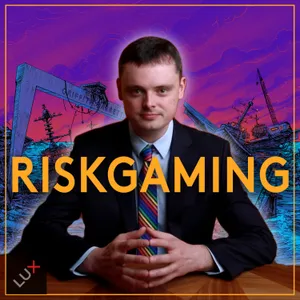
Free Daily Podcast Summary
Riskgaming: Daily Summaries Delivered
by Lux Capital
Get key takeaways, quotes, and insights from Riskgaming in a 5-minute read. Delivered straight to your inbox.
Latest Episodes
The most recent episodes — sign up to get AI-powered summaries of each one.
- Feb 25, 202659 min
Trouncing career regret with famed VC Bill Gurley
An astonishing majority of Americans claim that they hate their job and wish they could do something else. Often though, what might drive our passions is an unknown. How do we find the right path in life and how do we know we are on our way?Joining the Riskgaming podcast this week is Bill Gurley, a legendary venture capitalist who for more than two decades invested at Benchmark in such defining startups as Uber and Zillow. He’s just published a new book titled, “Runnin' Down a Dream: How to Thrive in a Career You Actually Love.” It’s based on his own personal story of how to avoid career regret, of sticking with a job way past the point of boredom.He’s joined in conversation by Lux’s own Josh Wolfe. The two talk about the book as well as the intersecting points of their long friendship and careers.
- Jan 28, 202637 min
Can sports betting overthrow Iran?
I’m going to admit, sports betting isn’t really my thing. I don’t know my parlay from my parler (that’s a French joke), and I can barely keep three balls in the air at work, let alone track the balls across dozens of matches every weekend. But I’m an odd duck, since that is what Americans — and increasingly the world — do for entertainment. Nearly a majority of men in the United States have a sports betting account, and now the betting markets have opened to politics, culture and much more through prediction markets like Polymarket and Kalshi.Will predictions become reality — or can reality be made to conform to predictions? That’s just part of the conversation I have with Dustin Gouker. Dustin is the writer of The Closing Line and The Event Horizon newsletters covering prediction markets and the sports betting landscape.He and I (Riskgaming host Danny Crichton) talk about why prediction markets remain a small sliver of betting, how new underwriting models are taking market share from incumbents, the interface between betting and parametric insurance (because why not?), why sports will always dominate the industry, how performativity is increasingly interacting with international relations, and whether betting markets can be optimized for propaganda value.
- Jan 21, 202637 min
The risks no one talks about
The world is overwhelmingly chaotic as the international system buckles. The practically placid era of cooperation that marked the 1990s and early 2000s is increasingly looking like a winner-takes-all competition among a handful of great powers, even as the world is succumbing to the opportunities of new technologies and the challenges of climate security. It all boggles, and that’s not even including all of the risks that don’t make it to the top of the charts.Lily Boland wants to help policymakers get a greater handle on these future risks, both to understand them individually and how they intersect with each other. She is the Strategic Foresight Fellow at the Converging Risks Lab of the Council on Strategic Risks. In that role, she designs unique foresight games that bring people together to explore alternative realities and their implication for our own.Alongside host Danny Crichton, the two talk about the techniques of foresight and how it differs from forecasting, what can be learned through games, how and why people change their mind, and what are the most under-reported risks that we should all pay more attention to.
- Jan 14, 202634 min
What are the origins of efficiency?
If you live in a city in North America or Europe, you almost certainly have had the experience of watching a construction site slowly morph into a building over the course of many years. You might ask, “why’s it taking so long” as you traipse through a dirty sidewalk shed, frustrations mounting. You are not wrong, since construction has flatlined on efficiency even as other industries find ever novel ways to maximize productivity.The search for efficiency and its disappearance is at the heart of Brian Potter’s new book, The Origins of Efficiency. Through the book by Stripe Press and his popular Substack newsletter Construction Physics, Brian has tried to explain to an angry if curious public how construction actually works in the real world and why it’s an industry both ripe for innovation yet also mired in antiquated techniques.With host Danny Crichton, the two talk about the challenges of construction, why the variability of site selection is a huge problem, the lack of economies of scale in construction, and the regulatory burdens plus NIMBYs that make building so difficult. Then the two talk about why Brian doesn’t think aesthetic uniformity has improved efficiency over time before talking about his writing process and how he does such in-depth research.
- Jan 7, 202640 min
The long game of American reindustrialization
Reindustrialization is the word du jour in American policymaking circles. The hope is that a reinvigorated manufacturing base will bring back middle-class jobs and ensure our strategic autonomy in what looks like a tough century ahead. It’s a towering task, and it will take many strategic decisions to undo the last several decades of deindustrialization.One person who has made it his mission to fix America is Charles Yang. He most recently served in the Biden administration at the Department of Energy, and spun off with the change of admins to start a new think tank called the Center for Industrial Strategy. He’s not just focused on research and publishing, but also building a network of likeminded souls who have the skills needed to bring industrial tech discussions into Washington. Through the Knudsen Fellowship, he is constructing cohorts of sophisticated and fervent believers that America can manufacture the future once again.With host Danny Crichton, the two discuss Charles’s transition from government service into Silicon Valley, the persistent cultural divide between engineering and politics, how to balance being a generalist versus a specialist, what think tanks really do, and how experiential tools like Riskgaming can change the policy discourse.
- Dec 22, 202556 min
11 Clips That Defined 2025
Well, 2025 is already running by with a massive whoosh sound. It goes without saying that every year feels like it is getting more chaotic, intense and yet exciting. There’s never been a better moment to go deep on risk, decision-making, complex scenario analysis and more, and that’s precisely what we did across 45 episodes of Riskgaming this year. We covered the gamut from espionage and defense to artificial intelligence to space technology, and a bunch of subjects in between.To highlight some of the most profound moments of the year, host Danny Crichton teamed up with Riskgaming’s producer Chris Gates to track down the very best clips from the podcast this year. From dozens of hours of episodes, here are our favorite minutes sprawled across 11 clips in one tidy package for your holiday listening.We don’t do a predictions episode — we’re too smart for that in this frenetic and ever-shifting world. If past is prologue, then these 2025 clips offer the best of what’s in store. Scary — and hopeful — times are ahead.
- Dec 17, 202538 min
Can software platforms reverse enshittification?
Software kind of sucks these days, doesn’t it? Cory Doctorow invented the word “enshittification” to describe a pattern he repeatedly observed across software platforms. They start generous and flexible, but over time, they increase their value capture to maximize profits at the expense of their users. Software ends up feeling over-optimized and hostile, constantly fighting our desires. But software ultimately is for us, and there must be a better way.Well, there is, at least in theory. A coalition of software and tech luminaries, joined by hundreds of supporters, recently launched the Resonant Computing Manifesto. They want software that is private, dedicated, plural, adaptable and prosocial — the antipode of the offerings available to us today. It’s a fresh vision, one desperately needed as LLMs rapidly democratize software engineering to everyone.Riskgaming host Danny Crichton and The Orthogonal Bet host Sam Arbesman jointly host this special episode with Alex Komoroske, founder of Common Tools, which dubs itself a new fabric for computing.The three talk about the manifesto, how LLMs are changing software design, the same origin paradigm, fully homomorphic encryption, remote attestation, and whether it is possible for software to be good and also be profitable.
- Dec 10, 202543 min
The inside story of the billionaires fighting for space
The space race was once between the United States and the Soviet Union; now it’s between two tech billionaires trying to seize the mantle of most powerful space lord. For Elon Musk and Jeff Bezos, the development of SpaceX and Blue Origin respectively is the culmination of a lifetime commitment to technology growth and science fiction. It’s also increasingly a ferocious campaign, one that has turned them from experimental pioneers to aggressive businessmen hoping to seize the future of space’s GDP for themselves.All of this is ably documented in Christian Davenport’s new book, “Rocket Dreams: Musk, Bezos, and the Inside Story of the New, Trillion-Dollar Space Race.” A follow up from his massively popular book “The Space Barons,” the book chronicles the last seven years of the new space race with alacrity and intimate details.Christian and Riskgaming host Danny Crichton talk about how he transitioned from covering Afghanistan and America’s home front in the War on Terror to covering the crazy billionaires at the heart of the space race. Then they talk about Musk’s fight over the United Launch Alliance, why Blue Origin has been taking on more risks in recent years, NASA and the government’s growing dependency on private companies for manned spaceflight, what the next decade of the space economy will look like, and finally, how China is entering the picture in a frenetic way.
Get Riskgaming summaries in your inbox
Free AI-powered daily recaps. Key takeaways, quotes, and mentions — in a 5-minute read.
Get Free Summaries →Free forever for up to 3 podcasts. No credit card required.
You Might Also Like
Listeners also like.
RiskReversal Pod
RiskReversal Media

Capital Ideas Podcast
Capital Group
TechSurge: Deep Tech Podcast
Celesta Capital | Deep Tech Venture Capital Firm

Money Maze Podcast
Money Maze Podcast

Equity
TechCrunch, Rebecca Bellan, Kirsten Korosec, Anthony Ha, Sean O'Kane, Theresa Loconsolo

All-In with Chamath, Jason, Sacks & Friedberg
All-In Podcast, LLC

"Can't Be Done"
Adam Draper
Riding Unicorns: Venture Capital | Entrepreneurship | Technology
Riding Unicorns Productions

The Risk Takers Podcast
GoldenPants13

Lightcone Podcast
Y Combinator

Inspired with Alexa von Tobel
Inspired Capital

Not Investment Advice
Bilal Zaidi, Jack Butcher, Trung Phan
About Riskgaming
A podcast by venture capital firm Lux Capital on the opportunities and risks of science, technology, finance and the human condition. Hosted by Danny Crichton from our New York City studios.
Customized Recaps
AI-powered recaps with compact key takeaways, quotes, and insights.
Straight to Your Inbox
Get key takeaways from Riskgaming in a 5-minute read.
Save Hours Every Week
Stay current on your favorite podcasts without falling behind.
Frequently Asked Questions
What is Podzilla's Riskgaming daily summary?
It's a free AI-powered email that summarizes new episodes of Riskgaming as soon as they're published. You get the key takeaways, notable quotes, and links & mentions — all in a quick read.
How does the Riskgaming podcast summary work?
When a new episode drops, our AI transcribes and analyzes it, then generates a personalized summary tailored to your interests and profession. It's delivered to your inbox every morning.
Is this an official Riskgaming product?
No. Podzilla is an independent service that summarizes publicly available podcast content. We're not affiliated with or endorsed by Lux Capital.
Can I get summaries of other podcasts too?
Absolutely! The free plan covers up to 3 podcasts. Upgrade to Pro for 15, or Premium for 50. Browse our full catalog at /podcasts.
How often does Riskgaming release new episodes?
Riskgaming publishes weekly. Our AI generates a summary within hours of each new episode.
What topics does Riskgaming cover?
Riskgaming covers topics including Technology. Our AI identifies the specific themes in each episode and highlights what matters most to you.
Start getting Riskgaming summaries tomorrow morning.
Free forever for up to 3 podcasts. No credit card required.
Free forever for up to 3 podcasts. No credit card required.