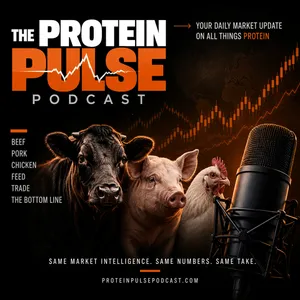
Free Daily Podcast Summary
Protein Pulse Podcast: Daily Summaries Delivered
by Shawn Sparks
The Protein Pulse Podcast delivers concise, commercially focused protein market intelligence for buyers, sellers, traders, procurement leaders, processors, and executives across the beef, pork, chicken, feed, and global protein markets. Each episode translates USDA data, market pricing, slaughter trends, trade flows, imports, feed costs, policy developments, and supply-chain signals into clear, practical market context. The focus is simple: cut through the noise, explain what the numbers mean, and give protein professionals the market context they need before making their next decision. Your Daily Market Update on All Things Protein.
Latest Episodes
The most recent episodes — sign up to get AI-powered summaries of each one.
- Yesterday9 min
THE PROTEIN PULSE - Closing Bell Friday | November 6th, 2026
THE PROTEIN PULSEClosing Bell Friday | November 6th, 2026Full Executive Briefing — Spoken ScriptHOST: Welcome to The Protein Pulse Podcast, your daily market update on all things protein. This is Closing Bell Friday for November 6th, 2026, from The Sparks Group.SHAWN: With Wendy's Independent Committee officially rejecting the Trian Partners-led group's seven thirty-five per share buyout proposal as an undervaluation and adopting a limited duration shareholder rights plan, the corporate battle lines are drawn. I'm sitting in the Protein Pulse offices with my crown sitting high on my throne. I found myself mindlessly twirling my pigtails as the morning protein chaos unfolded during MICA. Rumors were swirling that my special sauce getting sued might cost the kingdom everything, throwing my entire empire into corporate turmoil. Now, I am left not sure if I can have it your way, my way or even if I deserve a break today, because everyone's asking where's the beef? The beef market is in a tizzy, and we all need to put our screwworm tin foil hats down and realize Dave wouldn't want us to fight. Especially when the Board is fully banking on Bob Wright and the execution of Dave's Way to drive future growth instead as the Protein World turns.HOST: Washington confirmed its first 2026 commercial-poultry HPAI detection, putting supplier-specific movement requirements under scrutiny. European advocacy groups filed fourteen complaints over alleged JBS-linked Brazilian cattle sourcing. JBS disputes the allegations. The filings establish no violation, and the poultry report establishes no broader supply loss. September U.S. beef export value grew eight percent while pork export value fell thirteen point five percent. June through September pork availability also increased. Sterling estimates losses for beef processors and hog farms, alongside positive pork-processing returns. Smithfield shifted hog sourcing. McDonald's outlined U.S. chicken tests, and Wendy's rejected a buyout.SHAWN: Choice grade slipped ninety-four cents to three sixty-one fifty-six. Select grade fell four thirty-three to three fifty-two thirty-two, widening the grade premium to nine twenty-four from Wednesday's five eighty-five. Five-area live F-O-B steers averaged two sixteen ninety-five on Wednesday. December live cattle settled Thursday at two fourteen forty a pound, down three sixty. January feeders lost five forty. The widened grade premium alters substitution economics for grade-flexible buyers. Lower cattle prices have not restored packer margins. Sterling puts the beef packer margin at negative three sixty-five a head last week, their first loss in eleven weeks. Unhedged feeder margins at negative three hundred twenty-eight forty-five a head. Plant utilization was eighty-three percent. Steer carcasses averaged nine hundred ninety-one pounds through the week ended October 24th, fifteen pounds above last year. Heavier weights partly offset lower slaughter without restoring packer returns. Fresh eighty-fives fell to two ninety-six. Fifties rose to ninety-four. National reports captured seven eighty-five and eight fifty transactions. Fresh nineties last printed at three sixty-eight Wednesday, with no Thursday trade. Thursday's national USDA averages cannot establish a same-day ninety blend comparison. Executable supplier offers are a separate question.HOST: September shipments totaled two hundred sixteen thousand three hundred fifty-three metric tons, down seven point five percent. Value fell thirteen point five percent to five hundred ninety-one point three zero million dollars. Mexico volume dropped fourteen percent, while Central America rose twenty-five percent. Separately, June through September domestic availability reached seven point one oh eight billion pounds, about two hundred fifteen million pounds above last year, as heavier carcasses, lower exports and higher imports added supply. The narrower fresh, frozen and cooked export series covers different products. The cutout slipped thirty cents to sixty-eight ninety-nine. Bellies fell three fifty-nine to sixty-three seventy-six and hams one sixty-six to sixty ninety-eight. Ribs rose four seventy-five to one twenty-nine oh two and picnics three oh one. That gives bacon and ham buyers negotiating evidence, while rib buyers face a firmer benchmark. Combo forty-two CL and seventy-two CL trim were both below fifty cents a pound, but represent different specifications. Sterling puts pork packer returns at sixteen eighty-two a head last week, versus eleven thirty-nine previously, while farrow-to-finish producers lost fourteen fifty-six a head. Slaughter approached two point six million head and utilization ninety-eight percent. The available national negotiated carcass average was forty-two forty-nine November 4th. No November 5th quote is implied. Internal
- Yesterday1 min
THE PROTEIN PULSE — DRIVE TIME Closing Bell Friday | November 6th, 2026
THE PROTEIN PULSE — DRIVE TIMEClosing Bell Friday | November 6th, 2026HOST: Protein Pulse Drive Time. Closing Bell Friday, November 6th. From The Sparks Group.SHAWN: With Wendy's Independent Committee officially rejecting the Trian Partners-led group's seven thirty-five per share buyout proposal as an undervaluation and adopting a limited duration shareholder rights plan, the corporate battle lines are drawn. I'm sitting in the Protein Pulse offices with my crown sitting high on my throne. I found myself mindlessly twirling my pigtails as the morning protein chaos unfolded during MICA. Rumors were swirling that my special sauce getting sued might cost the kingdom everything, throwing my entire empire into corporate turmoil. Now, I am left not sure if I can have it your way, my way or even if I deserve a break today, because everyone's asking where's the beef? The beef market is in a tizzy, and we all need to put our screwworm tin foil hats down and realize Dave wouldn't want us to fight. Especially when the Board is fully banking on Bob Wright and the execution of Dave's Way to drive future growth instead as the Protein World turns.HOST: Choice grade cutout at three sixty-one fifty-six, down ninety-four cents. Pork cutout at sixty-eight ninety-nine. Fresh eighty-fives at two ninety-six. Fresh fifties at ninety-four. West Texas Crude at ninety fifty-two. Ultra-Low Sulfur Diesel at four thirty-five.SHAWN: Livestock futures fell. The profit picture split. Beef packers and hog producers posted losses while pork packers earned positive returns. When we hit today's close, the question won't just be where livestock prices finish. It'll be which businesses can still earn a margin. Stay disciplined.HOST: Protein Pulse Drive Time. Shawn Sparks, The Sparks Group.SHAWN: Stay disciplined.
- 2 days ago1 min
THE PROTEIN PULSE — DRIVE TIME Thursday Margin Monitor | November 5th, 2026
THE PROTEIN PULSE — DRIVE TIMEThursday Margin Monitor | November 5th, 2026HOST: Protein Pulse Drive Time. Thursday Margin Monitor, November 5th. From The Sparks Group.SHAWN: Stop managing your business by someone else's headline. Seaboard loses eighty million dollars in a quarter while a weekly model shows pork packers making nearly seventeen dollars a head. Sounds like somebody's numbers are wrong, doesn't it? They're not. They're measuring two different things. One is a company's actual quarterly performance. The other is an estimate of current packing economics. Confuse the two, and you'll make bad decisions. Beef is telling us the same story. Choice grade cutouts are sliding, yet ribs are near six seventy-seven while rounds are below two ninety. Same animal. Two very different markets. I don't care how attractive an industry average looks if the specific product I'm buying or selling tells a different story. Headlines tell you where to look. They don't tell you what your business is worth. The profit isn't in chasing the average. It's in knowing the cut, the cost, and what you can actually buy, sell, and deliver. The fun at MICA is over. Time to get back to work. Call me if you need help.HOST: Choice grade cutout at three sixty-two fifty, down two seventy-three. Pork cutout at sixty-nine twenty-nine, down three fourteen. Fresh nineties at three sixty-eight. Imported nineties at three nineteen C-I-F. Domestic nineties F-O-B at three dollars. West Texas Crude at eighty-eight twelve. Ultra-Low Sulfur Diesel at four twenty-one.SHAWN: Headlines tell you where to look. They don't tell you what your business is worth. The profit isn't in chasing the average. It's in knowing the cut, the cost, and what you can actually buy, sell, and deliver. Stay disciplined.HOST: Protein Pulse Drive Time. Shawn Sparks, The Sparks Group.SHAWN: Stay disciplined.
- 2 days ago10 min
THE PROTEIN PULSE - Thursday Margin Monitor | November 5th, 2026
THE PROTEIN PULSEThursday Margin Monitor | November 5th, 2026Full Executive Briefing — Spoken ScriptHOST: Welcome to The Protein Pulse Podcast, your daily market update on all things protein. This is Thursday Margin Monitor for November 5th, 2026, from The Sparks Group.SHAWN: Stop managing your business by someone else's headline. Seaboard loses eighty million dollars in a quarter while a weekly model shows pork packers making nearly seventeen dollars a head. Sounds like somebody's numbers are wrong, doesn't it? They're not. They're measuring two different things. One is a company's actual quarterly performance. The other is an estimate of current packing economics. Confuse the two, and you'll make bad decisions. Beef is telling us the same story. Choice grade cutouts are sliding, yet ribs are near six seventy-seven while rounds are below two ninety. Same animal. Two very different markets. I don't care how attractive an industry average looks if the specific product I'm buying or selling tells a different story. Headlines tell you where to look. They don't tell you what your business is worth. The profit isn't in chasing the average. It's in knowing the cut, the cost, and what you can actually buy, sell, and deliver. The fun at MICA is over. Time to get back to work. Call me if you need help.HOST: Seaboard's pork business has swung from a third-quarter operating profit to an eighty million dollar loss, while the national pork cutout fell below seventy. Brazil's Newcastle disease restrictions have disrupted poultry cargo already at sea, exposing the gap between certification at departure and import eligibility at arrival. Beef cutouts weakened even as pricing varied sharply by primal and trim specification. China's beef quota is redirecting shipments, while market reports linked part of crude's fall below ninety a barrel to expectations of Iran-war de-escalation after the U.S. election. New World screwworm infestations reached one hundred thirteen confirmed animals in the Southwest. USDA export data show softer pork bookings but rising beef shipments.SHAWN: Choice grade boxed beef declined two seventy-three to three sixty-two fifty Wednesday. Select grade fell one seventy-two to three fifty-six sixty-five, narrowing the spread to five eighty-five. Choice grade ribs stood at six seventy-six sixty-seven versus two eighty-nine thirty for rounds. Forward-order interest favored ribs and chucks over rounds, loins and briskets, leaving buyers with markedly different negotiating leverage by primal. Fresh domestic nineties averaged three sixty-eight. Eighty-fives three oh seven. And fifties eighty-eight. Platts assessed imported nineties C-I-F U.S. East Coast at three nineteen on November 3rd. A November 4th Brazil-origin nineties trade was reported at three dollars F-O-B U.S. East Coast port of entry, in November truckload quantities. Neither import benchmark includes the buyer's onward plant-delivery cost. Wednesday's estimated cattle slaughter was one hundred nine thousand head, with year-to-date slaughter seven point one percent below last year. Negotiated live F-O-B steers grading over eighty percent Choice averaged two seventeen fifteen. For the week ended October 31st, Sterling modeled feedlot losses of three hundred twenty-eight forty-five a head and beef-packer losses of three sixty-five a head. U.S. beef net export sales were eleven thousand metric tons for October 23rd to 29th, unchanged on the week but twenty-nine percent below the four-week average. Shipments rose four percent to thirteen thousand four hundred metric tons, led by South Korea and Japan. Stronger current movement than future booking momentum.HOST: Seaboard's pork segment swung from a fifty-eight million dollar profit a year ago to an eighty million dollar third-quarter operating loss, a one hundred thirty-eight million dollar deterioration. Quarterly sales fell to four hundred sixty-one million dollars. Wednesday's pork cutout lost three fourteen to sixty-nine twenty-nine. Bellies fell eight sixty-one to sixty-seven thirty-five and picnics seven ninety-four to forty-nine ninety-eight. Loins declined just one fourteen to seventy-three fifty. Bacon and further-processing exposure differs substantially from loin purchasing. Sterling's weekly model estimates farrow-to-finish losses of fourteen fifty-six a head but pork-packer profits of sixteen eighty-two a head, different from Seaboard's actual quarterly results. National negotiated carcass-base hogs averaged forty-two forty-nine, down two ninety. Estimated hog slaughter was four hundred ninety-five thousand head. U.S. pork net export sales totaled thirty-seven thousand three hundred metric tons for October 23rd to 29th, down twelve percent on the week, including sixteen thousand six hundred metric tons to Mexico. Shipments declined six percent to thi
- 3 days ago10 min
THE PROTEIN PULSE - Wednesday Watchlist | November 4th, 2026
Wednesday Watchlist | November 4th, 2026Full Executive Briefing — Spoken ScriptHOST: Welcome to The Protein Pulse Podcast, your daily market update on all things protein. This is Wednesday Watchlist for November 4th, 2026, from The Sparks Group.SHAWN: Washington doesn't move cattle, but the decisions made there can certainly move markets. These midterm elections have real implications for our industry, from Farm Bill funding and packer oversight to trade policy, tariffs, and beef imports. With cattle supplies tight and beef prices already testing consumers, the next Congress will face some tough decisions. Protecting American producers while keeping beef affordable isn't an easy balancing act. And every policy decision has consequences somewhere along the supply chain. My take? I'm less concerned about which party controls Congress than what their policies mean for cattle availability, processor margins, and protein costs. Political headlines come and go. Supply, demand, and sound procurement decisions are what ultimately drive this business. That's where my focus stays.HOST: Arizona's latest screwworm detections were in a dog and a horse, not cattle. The twenty-kilometer infested zone imposes movement controls, making veterinary clearance and confirmed crossing schedules important for buyers relying on Mexican cattle. Fresh eighty-fives beef surged twenty-seven eighty-one cents a pound Tuesday while fifties fell two sixty-three cents a pound. That split can change ground-beef ingredient economics overnight. Pork delivered another surprise. Ribs lost nine thirty-five as picnics gained six sixteen, even though the overall cutout barely moved. Southern California exporters face a November 4th port-labor deadline, though terminals were operating normally in the latest November 3rd advisory. KFC's expansion contrasted with Popeyes' weaker U.S. sales, while corn and meal futures declined as Ultra-Low Sulfur Diesel rose.SHAWN: Arizona reported New World Screwworm infestations in a dog October 28th and a horse detected October 31st in Cochise County. A twenty-kilometer infested zone restricts movements and increases surveillance. New Mexico recorded twenty-one infestations in October. Texas reported fourteen infestations and four trapped flies during its cited October period. These detections do not establish infected Arizona cattle. Selected Mexican cattle crossings have resumed operations, while Nogales was scheduled for November 30th. No new crossing closure was reported. Feeders and importers need confirmed veterinary clearance and shipment availability before committing to imported cattle. Choice grade boxed beef increased nineteen cents to three sixty-five twenty-three Tuesday. Select grade gained three forty-three to three fifty-eight thirty-seven, narrowing the spread to six eighty-six. Some Nebraska dressed cattle traded around three forty. Lower cattle costs may support packer gross margins. Plant profitability still depends on yields, sales and operating costs. An industry report put average carcass weights at nine hundred sixty-two pounds, fourteen pounds above the comparable week in 2025. Heavier carcasses support tonnage, but cannot indefinitely replace missing cattle. Fresh eighty-fives rebounded twenty-seven eighty-one cents a pound to three oh nine Tuesday, while fresh fifties declined two sixty-three cents a pound to eighty-one. That divergence changes the relative cost of ground-beef inputs. Buyers should compare specifications and firm supplier quotes instead of inferring a uniform trim-market move. No fresh ninety trade was reportable Tuesday. Its last average was three seventy-one on November 2nd. Imported frozen lean still requires a matched-specification landed-cost comparison. Beef cow culling is projected at seven point three five percent for 2026, down from thirteen point one nine percent in 2022. Reduced culling slows herd contraction without adding breeding capacity. An estimated two hundred thousand additional replacement females may be needed simply to maintain the herd. Drought makes retaining them more expensive. By late October, ninety-six percent of Arkansas beef cows were in drought, including seventy-three percent in extreme drought or worse. Mississippi's share in severe drought or worse increased from eighteen percent in late September to seventy-seven percent by October 27th. Earlier hay feeding and limited forage make the retention decision harder despite strong cow-calf returns. A prior industry outlook forecasts U.S. production in 2027 of twenty-three point nine seven three billion pounds of beef, twenty-seven point five seven eight billion pounds of pork and forty-nine point one oh nine billion pounds of broilers. Presented in 2025, these forecasts are planning benchmarks rather than new November 2026 estimates. Cattle rebuilding, pork slaughter cycles and broile
- 3 days ago1 min
THE PROTEIN PULSE — DRIVE TIME Wednesday Watchlist | November 4th, 2026
Wednesday Watchlist | November 4th, 2026HOST: Protein Pulse Drive Time. Wednesday Watchlist, November 4th. From The Sparks Group.SHAWN: Washington doesn't move cattle, but the decisions made there can certainly move markets. These midterm elections have real implications for our industry, from Farm Bill funding and packer oversight to trade policy, tariffs, and beef imports. With cattle supplies tight and beef prices already testing consumers, the next Congress will face some tough decisions. Protecting American producers while keeping beef affordable isn't an easy balancing act. And every policy decision has consequences somewhere along the supply chain. My take? I'm less concerned about which party controls Congress than what their policies mean for cattle availability, processor margins, and protein costs. Political headlines come and go. Supply, demand, and sound procurement decisions are what ultimately drive this business. That's where my focus stays.HOST: Choice grade cutout at three sixty-five twenty-three, up nineteen cents. Pork cutout at seventy-two forty-three. Fresh eighty-fives at three oh nine, up twenty-seven eighty-one. Fresh fifties at eighty-one, down two sixty-three. West Texas Crude at ninety-six oh nine. Ultra-Low Sulfur Diesel at four fifty-three.SHAWN: Arizona's latest screwworm detections were in a dog and a horse, not cattle. Procurement plans need cattle that can clear inspection, cuts customers will buy and product that can reach the dock. Stay disciplined.HOST: Protein Pulse Drive Time. Shawn Sparks, The Sparks Group.SHAWN: Stay disciplined.
- 4 days ago2 min
THE PROTEIN PULSE — DRIVE TIME Taco Meat Tuesday | November 3rd, 2026
THE PROTEIN PULSE — DRIVE TIMETaco Meat Tuesday | November 3rd, 2026HOST: Protein Pulse Drive Time. Taco Meat Tuesday, November 3rd. From The Sparks Group.SHAWN: Day 1 at MICA is in the books after a great Sonoran sunset. But while we caught up over drinks in Scottsdale, the macro environment isn't pausing for golf. Today's Protein Pulse zeroes in on what's spinning outside the resort gates this morning. Logistics and policy. West Coast port labor talks extend through November 4th, threatening cold chain exports, while EU supermarket cyberattacks reveal cold-storage risks. Meanwhile, EPA closed its twenty-year emissions dispute. Beef and pork. Boxed beef climbed alongside tighter imported trim volumes. Mexican feeder cattle resumed crossing at Columbus, and pork cutouts rose to seventy-two twenty-eight while negotiated hogs dropped over ten dollars. Global trade. EU broiler rules, Brazilian cattle pricing, and South American crop progress keep moving fundamentals. I'm on the floor all day. Let's grab coffee, compare notes, and talk real market reality. I still have Protein Pulse swag. You just have to ask for it.HOST: Choice grade cutout at three sixty-five oh four, up thirty-eight cents. Pork cutout at seventy-two twenty-eight, up two eighteen. Fresh eighty-fives at two eighty-two, down six ninety-one. Imported nineties at three nineteen C-I-F. Domestic nineties at three seventy-one F-O-B. West Texas Crude at ninety-six forty-six. Ultra-Low Sulfur Diesel at four forty-two.SHAWN: Confirm chilled-export vessel access before committing freight. Beef buyers should compare approved blend specifications, yields and delivered costs rather than treating theoretical ingredient comparisons as executable savings. Stay disciplined.HOST: Protein Pulse Drive Time. Shawn Sparks, The Sparks Group.SHAWN: Stay disciplined.
- 4 days ago10 min
THE PROTEIN PULSE - Taco Meat Tuesday | November 3rd, 2026
THE PROTEIN PULSETaco Meat Tuesday | November 3rd, 2026Full Executive Briefing — Spoken ScriptHOST: Welcome to The Protein Pulse Podcast, your daily market update on all things protein. This is Taco Meat Tuesday for November 3rd, 2026, from The Sparks Group.SHAWN: Day 1 at MICA is in the books after a great Sonoran sunset. But while we caught up over drinks in Scottsdale, the macro environment isn't pausing for golf. Today's Protein Pulse zeroes in on what's spinning outside the resort gates this morning. Logistics and policy. West Coast port labor talks extend through November 4th, threatening cold chain exports, while EU supermarket cyberattacks reveal cold-storage risks. Meanwhile, EPA closed its twenty-year emissions dispute. Beef and pork. Boxed beef climbed alongside tighter imported trim volumes. Mexican feeder cattle resumed crossing at Columbus, and pork cutouts rose to seventy-two twenty-eight while negotiated hogs dropped over ten dollars. Global trade. EU broiler rules, Brazilian cattle pricing, and South American crop progress keep moving fundamentals. I'm on the floor all day. Let's grab coffee, compare notes, and talk real market reality. I still have Protein Pulse swag. You just have to ask for it.HOST: West Coast exporters face a possible labor interruption. Negotiations involving approximately two hundred fifty security workers at Los Angeles and Long Beach have been extended through five p.m. Pacific on Wednesday, November 4th, according to the port employers' announcement. Vessel calls serving Oakland could also be affected. No shutdown has been confirmed. Two policy developments affect livestock and processing. EPA ended its two-decade livestock air-emissions estimating process. Separately, eight more processors voluntarily adopted USDA's Product of USA label, taking participation above thirty companies. Chinese buying and U.S. meat-export access remain under pressure. China's purchases of U.S. agricultural goods excluding soybeans totaled seven point two zero billion dollars through September, while beef-plant restrictions and weak meat demand continued to limit opportunities for exporters. Domestic prices diverged. Fresh eighty-fives fell six ninety-one cents a pound Friday to Monday, while pork cutouts rose despite lower hog futures. September soybean-meal inventories fell thirty-five point two percent from August as December meal futures declined.SHAWN: National fresh eighty-fives boneless beef averaged two eighty-two Monday, down six ninety-one cents a pound from October 30th. Fresh nineties were three seventy-one, down only twenty-four cents a hundred from Friday, while fresh fifties trim gained one oh three cents a pound to eighty-four. Separately, industry reporting showed ninety percent lean cow beef falling from three ninety on October 29th to three seventy-one on October 30th. The observations are from different reported series. Choice grade boxed beef rose thirty-eight cents Monday to three sixty-five oh four and Select grade gained two ninety-six to three fifty-four ninety-four, producing a ten ten spread. Weekly boxed-beef export sales reached seven hundred eighty-one loads, up eighty-six from the preceding week and thirteen percent year over year. U.S. beef-trimmings imports totaled seventeen thousand eight hundred twenty-seven metric tons for the week ended October 24th, down eight point three percent. Brazil shipped five thousand seven hundred eighty-six metric tons, down nineteen point two percent. Australia increased fourteen point three percent to six thousand four hundred twenty-three metric tons. Platts assessed imported frozen nineties at three nineteen C-I-F U.S. East Coast October 30th. Condition and delivery terms differ from domestic fresh prices. No reportable negotiated fed-cattle cash trade developed Monday. The latest five-area weekly live F-O-B steer average was two twenty-three seventy-three, versus two twenty-seven oh eight the preceding week. Monday cattle slaughter reached one hundred four thousand head, down two thousand. Mexican feeder-cattle entries totaled fourteen thousand three hundred fifty head for the week ended October 30th, including two thousand one hundred fifty via reopened Columbus, New Mexico. Much of the traffic was precontracted. USDA announced a twenty-four point six zero million dollar loan guarantee for a proposed Dimmitt beef-processing plant projected at four hundred head per day. Opening remains prospective.HOST: Monday's pork carcass cutout gained two eighteen to seventy-two twenty-eight after Friday's seventy ten reading. All six primals increased, including hams up three seventy-three to sixty-four forty-three, loins up three oh six to seventy-five sixty-five and bellies up one twenty-seven to seventy-four twelve. December lean hogs settled at fifty-eight eighteen a pound, down sevent
Get Protein Pulse Podcast summaries in your inbox
Free AI-powered daily recaps. Key takeaways, quotes, and mentions — in a 5-minute read.
Get Free Summaries →Free forever for up to 3 podcasts. No credit card required.
You Might Also Like
Listeners also like.

The Pulse
Explores surprising stories in health and science, from operating rooms and labs to breakthrough innovations.

TBPN
Daily tech talk show featuring interviews with prominent tech leaders and condensed highlights of key discussions.

Prof G Markets
Daily market news and analysis on earnings, geopolitics, Big Tech, and AI with clear, no-jargon insights.

The Best One Yet
A daily 20-minute podcast breaking down the three key business stories with sharp, accessible takes.

The Hunter Williams Podcast
Explores cutting-edge science in peptides, hormone optimization, and biohacking with experts pushing the limits of human performance.

PLANTSTRONG Podcast
A former firefighter discusses plant-based nutrition for health and performance with doctors, athletes, and researchers.
Grain Markets and Other Stuff
Two agricultural experts analyze grain markets, farm economics, and agribusiness news with insights on broader rural topics.

Marketplace Morning Report
A daily briefing on the economic news that matters, delivered in a concise, accessible format to start your day informed.

Walk-In Talk Podcast
Raw conversations with food industry professionals about restaurant operations, culinary leadership, and the business of hospitality.

Locked On Packers - Daily Podcast On The Green Bay Packers
A daily breakdown of Green Bay Packers news, strategy, and locker room developments with local analysis and expert insights.

Running on Grass
Two ranchers discuss practical challenges of grass management, drought, cattle markets, and daily life on a working ranch.

Squawk Pod
A daily digest of key moments, interviews, and debates from CNBC’s “Squawk Box,” with added context from a senior producer.
About Protein Pulse Podcast
The Protein Pulse Podcast delivers concise, commercially focused protein market intelligence for buyers, sellers, traders, procurement leaders, processors, and executives across the beef, pork, chicken, feed, and global protein markets. Each episode translates USDA data, market pricing, slaughter trends, trade flows, imports, feed costs, policy developments, and supply-chain signals into clear, practical market context. The focus is simple: cut through the noise, explain what the numbers mean, and give protein professionals the market context they need before making their next decision. Your Daily Market Update on All Things Protein.
Customized Recaps
AI-powered recaps with compact key takeaways, quotes, and insights.
Straight to Your Inbox
Get key takeaways from Protein Pulse Podcast in a 5-minute read.
Save Hours Every Week
Stay current on your favorite podcasts without falling behind.
Frequently Asked Questions
What is Podzilla's Protein Pulse Podcast daily summary?
It's a free AI-powered email that summarizes new episodes of Protein Pulse Podcast as soon as they're published. You get the key takeaways, notable quotes, and links & mentions — all in a quick read.
How does the Protein Pulse Podcast podcast summary work?
When a new episode drops, our AI transcribes and analyzes it, then generates a personalized summary tailored to your interests and profession. It's delivered to your inbox every morning.
Is this an official Protein Pulse Podcast product?
No. Podzilla is an independent service that summarizes publicly available podcast content. We're not affiliated with or endorsed by Shawn Sparks.
Can I get summaries of other podcasts too?
Absolutely! The free plan covers up to 3 podcasts, any in the catalog. Basic raises that to 15, Pro to 40 and Max to 100. Browse our full catalog at /podcasts.
What topics does Protein Pulse Podcast cover?
Protein Pulse Podcast covers topics including News, Business, Arts, Food. Our AI identifies the specific themes in each episode and highlights what matters most to you.
Start getting Protein Pulse Podcast summaries tomorrow morning.
Free forever for up to 3 podcasts. No credit card required.
Free forever for up to 3 podcasts. No credit card required.