Free Daily Podcast Summary
Protection Leadership: Daily Summaries Delivered
by Global Executive Leadership Initiative
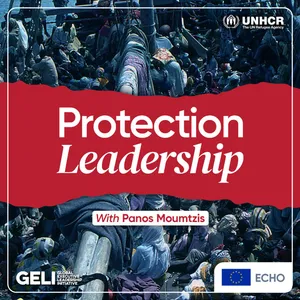
Protection Leadership is a podcast hosted by Panos Moumtzis, Executive Director of the Global Executive Leadership Initiative (GELI). Through conversations with leaders from the UN, NGOs, donors, and local partners, the series explores how to lead on protection in practice, advocating in sensitive contexts, influencing decision-makers, empowering teams, and staying principled under pressure. Practical insights and real-world stories put protection at the center of humanitarian action.Contact Us: https://geli.org/contact-us Funded by the European Union Humanitarian AidProduced by Saspod
Latest Episodes
The most recent episodes — sign up to get AI-powered summaries of each one.
- May 11, 202639 min
Navigating Crisis, Complexity, and Courage in Myanmar - with Gwyn Lewis
“When you arrive in Myanmar, what strikes you most is how beautiful the place is, the country and the people. And you soon realize how separated communities are.” — Gwyn Lewis What does it really take to uphold dignity, safety, and human rights when every decision in a crisis could mean the difference between access and compromise? In this episode of the Protection Leadership Podcast, Panos Moumtzis speaks with Gwyn Lewis about leading humanitarian efforts in one of the world’s most complex crises. Drawing on her experience in Myanmar and earlier work in Palestine and Bangladesh, Gwyn emphasizes that protection is not just about delivering aid, but about safeguarding dignity, rights, and access. Gwyn reflects on the realities of Myanmar, where widespread conflict, displacement, and fragmented control create immense operational and ethical challenges. The conversation explores how humanitarian leaders balance access with principles, navigate political sensitivities, and make difficult decisions amid severe funding cuts. The conversation highlights the importance of collective leadership, localization, and trust-building with all stakeholders, including affected communities and conflict actors. Gwyn also underscores the emotional toll on teams and the need for empathy and shared responsibility. Ultimately, this episode reinforces that protection must remain the guiding framework for prioritization, even in resource-constrained environments, and that hope is sustained through the resilience and agency of affected communities.Key takeawaysProtection as the Core of Humanitarian Action Protection is about ensuring rights, dignity, and safety, not just delivering aid. Centering protection leads to more sustainable and meaningful outcomes. Negotiating Access in Complex Conflict Settings Humanitarian leaders must engage with all parties to a conflict, balancing neutrality with advocacy to reach vulnerable populations.Collective Leadership and Localization Matter Effective responses depend on collaboration across UN agencies, NGOs, and especially local actors who bring critical contextual knowledge and leadership. Difficult Trade-offs in Resource-Constrained Environments Funding cuts force painful prioritization decisions, often requiring leaders to choose between essential services while managing increased protection risks.Hope Driven by Community Resilience <span id="docs-
- Apr 27, 202637 min
Advocating For Afghan Women in Humanitarian Crisis - with Indrika Ratwatte
“Afghanistan remains the second largest humanitarian crisis after Yemen and Sudan. When you look at just the needs alone of the people, 22 million people or 50% of the population are in need of humanitarian assistance.” — Indrika Ratwatte What makes Afghanistan's crisis uniquely complex? In this episode of Protection Leadership , Panos Moumtzis speaks with Indrika Ratwatte, the Resident and Humanitarian Coordinator for Afghanistan, to discuss one of the world’s most complex protection environments. Afghanistan faces overlapping crises: millions in need of humanitarian aid, large-scale returns of Afghans, natural disasters, climate shocks, and sweeping restrictions disproportionately impacting women and girls. Indrika Ratwatte provides an insider’s perspective on balancing principled advocacy with programmatic delivery, navigating dialogue with de facto authorities, and championing the rights and dignity of all Afghans amid acute challenges. The discussion highlights innovative approaches to bridging humanitarian and development work, the importance of empowering Afghan civil society (especially women-led organizations), and the need to keep compassion, engagement, and evidence-based action at the heart of protection leadership. Afghanistan is at a crossroads. Will the world step up, or turn away?Key Takeaways Bridging Humanitarian & Development Efforts Indrika Ratwatte stresses the importance of connecting life-saving humanitarian action with long-term development to help communities transition from fragility to stability, despite funding shortfalls and operational constraints. Advocacy Backed by Evidence Real change requires ongoing, fact-based dialogue, not one-way communication. Advocacy with the de facto authorities is creating space for critical sectors such as women’s health, education, and economic empowerment.<span id="doc
- Apr 13, 202631 min
Centering Refugee Voices: The Fragility and Power of Protection
"Do not speak on my behalf. Let me be there and tell you how protection looks like..." - Ana Maria Diez What would protection in humanitarian work truly look like if leaders prioritized the voices and lived experiences of displaced people? In today's conversation, Ana María Diez—lawyer, refugee, and president of Coalición por Venezuela—joins host Panos Moumtzis to discuss the meaning and challenges of protection for displaced people. Drawing from her own harrowing experiences in Venezuela and her journey into advocacy, Ana María Diez reflects on what true protection, courage, and participation mean for refugees and humanitarian work today. The dialogue delves into humanitarian failures, the fragility of protection, the need for innovation, and why genuine participation and inclusion of refugees in decision-making are non-negotiable. Key Takeaways Protection is Foundational All discussions around solutions for displaced people must begin with protection—it is the cornerstone of dignity and rights. Lived Experience Shapes Leadership Firsthand experience of displacement brings an irreplaceable perspective to advocacy and solution-building. Courage is present in every person with lived experience. Drawing on these personal reserves can lead to greater strength and more effective advocacy. Fragility of Systems Humanitarian systems and protections are much more vulnerable than they appear; a crisis or funding cut can instantly erase hard-won gains. Meaningful Participation Including refugees and displaced persons in decision-making is not optional; it is a right and vital to finding sustainable solutions. Addressing risks and building solutions demands collaboration, openness, innovation, and a recommitment to bringing human faces back to policymaking and grantmaking. Timestamps Ana María Diez shares her personal experience as a protection officer and survivor of kidnapping in Venezuela. Protection as the foundation for all humanitarian efforts, especially integration. Fleeing Venezuela: Ana María’s personal journey to Spain for safety. Ana María Diez on the so-called "humanitarian reset" as a failure of protection. The right to participation for refugees and forcibly displaced persons. Reflections on courage and advice for advocates facing protection challenges. Ana María’s vision for a free Venezuela. Shifting from exclusion to meaningful participation within the Quito Process. The risks of humanitarian withdrawal and the ongoing needs of grassroots organizations. Innovations in humanitarian work: localization, leveraging preexisting capacities, and inclusion. <span id="docs-internal-guid-446769af-7fff-a688-3705-fadee2
- Mar 30, 202634 min
Change Her Story, Change the World: Turning Pain Into Purpose – with Taban Shoresh
“If you don’t speak up, nothing will change. If I say something, and it rings to one person in the room…then that might be the person who needs to hear it that day.” –Taban Shoresh Can lived experience truly shape a person’s path and inspire them to advocate for the protection of the most vulnerable? In this episode of the Protection Leadership podcast, Taban Shoresh—former Iraqi refugee, women’s rights activist, founder of The Lotus Flower, and recipient of the Nansen Refugee Award—joins Panos Moumtzis for a deeply personal conversation. She shares the harrowing experiences of her early childhood—being imprisoned, nearly buried alive, fleeing conflict, and rebuilding her life as a refugee in the United Kingdom. Through honesty and vulnerability, Taban reflects on gender, identity, and the powerful role that lived experience can play in shaping humanitarian leadership. She also speaks about how her past drives her advocacy for women and girls, the creation of The Lotus Flower, and her belief that protection must remain a core pillar of humanitarian action.Key Takeaways Lived Experience is Leadership Taban Shoresh emphasizes the unique value of leadership rooted in experience rather than titles, underscoring the power of compassion and tangible action. Protection is Fundamental Protection—encompassing safety, dignity, and rights—should be the heart of all humanitarian programs, not an afterthought. Small acts of protection can transform lives in unexpected and far-reaching ways—sometimes decades later. Authenticity and Adaptability in Advocacy Speaking truth to power requires tailoring messages for context while staying true to core values. Even in times of shrinking humanitarian funding, persistent advocacy and directness can keep protection at the center of the agenda.Timestamps Taban recounts being taken to prison, the trauma of displacement, and the beginnings of a refugee journey What it means to carry the refugee identity for life The lasting impact of early trauma and the adjustments to life as a UK refugee child How gender shaped Taban Shoresh's experience and her understanding of protection The foundation of The Lotus Flower—purpose born from pain, and a commitment to long-term services for displaced women and girls Why lived experience leadership matters more than titles “Protection should be at the heart
- Mar 16, 202638 min
Reviving Accountability in International Humanitarian Law: A Conversation with Jeremy Konyndyk
“If the humanitarians are not speaking up, it’s easier for everyone else to ignore our protection problem.” — Jeremy Konyndyk Has the world stopped enforcing the rules meant to protect civilians in conflict? In this episode of Protection Leadership, Panos Moumtzis speaks with Jeremy Konyndyk, President of Refugees International, about the erosion of International Humanitarian Law (IHL), the collapse of political consensus around civilian protection, and the difficult balance between operational access and principled advocacy. Drawing on decades of frontline experience (from the Balkans to Yemen, from leading USAID’s disaster response operations to coordinating global COVID-19 and MPox responses), Jeremy reflects on the growing strain on humanitarian norms. He examines how geopolitical fragmentation, shrinking resources, and inconsistent enforcement of international law have weakened protections for civilians. Together, they explore a central tension in humanitarian leadership: When should humanitarians prioritize access, and when must they risk it to speak out?Key TakeawaysThe Erosion of International Humanitarian Law Jeremy discusses the alarming decline in global commitment to International Humanitarian Law and civilian protection norms. When enforcement becomes politicized or selective, the credibility of IHL is weakened, and civilians pay the price.Balancing Advocacy and Humanitarian Access Humanitarian organizations often face a difficult trade-off: speak out and risk access, or stay quiet to preserve operations. Jeremy argues that differentiation within the system is essential. Advocacy organizations may need to be louder, while operational agencies must carefully navigate risk without abandoning principle.Protection Is Not Optional, It’s FoundationalAid delivery alone cannot prevent famine, displacement, or violence. Protection considerations must be embedded in the design and execution of humanitarian programs, from refugee camp policies to the rights to work and to freedom of movement.Reviving Accountability and “Shame” Jeremy makes the case that international protection norms once carried political cost for violators. Rebuilding accountability requires restoring consequences, including reputational consequences, for violations of civilian protection.
- Mar 2, 202636 min
Putting Statelessness on the Map with Aleksejs Ivashuk
“Values and principles should be at the backbone of any governance structure.” — Aleksejs Ivashuk What does it mean to live without a nationality? In this episode of Protection Leadership, Panos Moumtzis speaks with Aleksejs Ivashuk, founder of the Apatride Network and a leading advocate for stateless people across Europe. Drawing from his own lived experience growing up without nationality, Aleksejs offers a powerful, firsthand account of the everyday realities of statelessness; from barriers to education and housing to unpredictable discrimination and the psychological toll of existing outside legal recognition. Together, they explore how statelessness remains largely invisible within the global system, why current governance frameworks often fail those without citizenship, and how meaningful reform requires centering the voices of those directly affected. This is a moving and thought-provoking conversation about identity, dignity, belonging, and the urgent need to put statelessness and protection firmly on the global agenda. Key Takeaways Statelessness Is Often Invisible, By Design Many states do not properly identify or record stateless populations. As a result, millions remain excluded from public awareness, policy discussions, and reliable data collection. Statelessness Means Constant Uncertainty Without legal nationality, everyday activities (attending school, renting a home, opening a bank account) can become major obstacles. The lack of formal recognition creates systemic vulnerability and unpredictable discrimination. Solutions Must Center Stateless Voices Lasting reform requires meaningful participation of stateless individuals in decision-making spaces. As Aleksejs explains, inclusion must go beyond tokenism; those affected must have a seat at the table in shaping legal and policy solutions.<span id="docs-internal-guid-886d43d4-7
- Feb 16, 202634 min
Speaking Truth to Power: Jan Egeland on Courage and Protection Leadership
“Too many people being too scared means that the few who speak up are more exposed. We have to speak up.” — Jan Egeland What does real courage look like in humanitarian leadership? In this episode of Protection Leadership, Panos Moumtzis sits down with Jan Egeland, Secretary General of the Norwegian Refugee Council (NRC) and one of the most prominent voices in global humanitarian advocacy. With over three decades at the forefront of humanitarian crises, human rights advocacy, and peace negotiations, Jan reflects on the risks and responsibilities of speaking truth to power. Together, they explore why excessive caution in humanitarian diplomacy can come at a devastating cost, and why protection leadership demands clarity, solidarity, and moral courage. From confronting atrocities and challenging armed actors, to strengthening collective leadership within the UN and NGO system, this conversation examines how to turn the centrality of protection from rhetoric into real operational change for civilians under threat. Key Takeaways Courage in Humanitarian Advocacy Humanitarian leaders often default to caution, but silence can enable impunity. Jan argues that speaking up, even when politically risky, is essential to protect civilians and uphold humanitarian principles. Collective and Principled Leadership Protection cannot rely on isolated individuals. Effective leadership requires solidarity across agencies, humanitarian coordinators, NGOs, and local actors, ensuring that those who speak out are supported, not sidelined. From Policy to Field Impact The humanitarian system risks becoming over-bureaucratised. Jan calls for simplified coordination, stronger field presence, and action-driven leadership that prioritises operational protection over endless policy discussions.<s
- Feb 2, 202646 min
Leading With a People-First Mindset - with Louise Aubin
In the world of humanitarian aid, who are we really accountable to? In this episode of Protection Leadership, host Panos Moumtzis is joined by Louise Aubin, UNHCR Representative in Malaysia, for a powerful conversation on moral clarity, accountability, and protection-centred leadership in today’s humanitarian crises. Together, they explore why protection is everyone’s business, not a specialist function, but a shared responsibility that should guide every humanitarian decision, across sectors and contexts. Louise reflects on the now-influential moment when she sketched the idea of the “centrality of protection” on a napkin. A simple concept that went on to shape global humanitarian policy and practice. “I’ve had protection as my compass — because it reminds me who I’m accountable to.” — Louise Aubin Drawing on experience from Cox’s Bazar, Niger, and her current role in Malaysia, Louise illustrates how principle, pragmatism, humility, and collaboration are essential to effective leadership, particularly when resources are limited and the stakes are high. Key TakeawaysProtection Is Everyone’s Responsibility Real impact happens when protection moves beyond mandates. Whether working on food, shelter, health, or education, every humanitarian actor shares responsibility for the safety, dignity, and rights of displaced people.Leadership Requires Moral Clarity, Humility, and Purpose Effective leaders are guided by the needs of affected communities, not by ego or certainty. Louise highlights the importance of balancing humility with decisive action, while remaining passionately focus
About Protection Leadership
Protection Leadership is a podcast hosted by Panos Moumtzis, Executive Director of the Global Executive Leadership Initiative (GELI). Through conversations with leaders from the UN, NGOs, donors, and local partners, the series explores how to lead on protection in practice, advocating in sensitive contexts, influencing decision-makers, empowering teams, and staying principled under pressure. Practical insights and real-world stories put protection at the center of humanitarian action.Contact Us: https://geli.org/contact-us Funded by the European Union Humanitarian AidProduced by Saspod
Customized Recaps
AI-powered recaps with compact key takeaways, quotes, and insights.
Straight to Your Inbox
Get key takeaways from Protection Leadership in a 5-minute read.
Save Hours Every Week
Stay current on your favorite podcasts without falling behind.
Frequently Asked Questions
What is Podzilla's Protection Leadership daily summary?
It's a free AI-powered email that summarizes new episodes of Protection Leadership as soon as they're published. You get the key takeaways, notable quotes, and links & mentions — all in a quick read.
How does the Protection Leadership podcast summary work?
When a new episode drops, our AI transcribes and analyzes it, then generates a personalized summary tailored to your interests and profession. It's delivered to your inbox every morning.
Is this an official Protection Leadership product?
No. Podzilla is an independent service that summarizes publicly available podcast content. We're not affiliated with or endorsed by Global Executive Leadership Initiative.
Can I get summaries of other podcasts too?
Absolutely! The free plan covers up to 3 podcasts. Upgrade to Pro for 15, or Premium for 50. Browse our full catalog at /podcasts.
How often does Protection Leadership release new episodes?
Protection Leadership publishes biweekly. Our AI generates a summary within hours of each new episode.
What topics does Protection Leadership cover?
Protection Leadership covers topics including Business, Government, Culture, Society & Culture, Non-Profit. Our AI identifies the specific themes in each episode and highlights what matters most to you.
Start getting Protection Leadership summaries tomorrow morning.
Free forever for up to 3 podcasts. No credit card required.
Free forever for up to 3 podcasts. No credit card required.