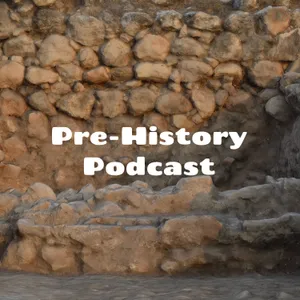
Free Daily Podcast Summary
Pre History - the archaeology of the ancient Near East: Daily Summaries Delivered
by PreHistoryPodcast
Get key takeaways, quotes, and insights from Pre History - the archaeology of the ancient Near East in a 5-minute read. Delivered straight to your inbox.
Latest Episodes
The most recent episodes — sign up to get AI-powered summaries of each one.
- Dec 1, 202231 min
Episode 26: Samarra
As we finish off the Neolithic we must first go backwards to one of the less well known but vastly important cultures of the Neolithic Near East - the Samarra. As the first known Neolithic culture of Southern Mesopotamia the Samarra gave rise to many developments which underpinned the later civilisations of this part of the ancient Near East. It is also an ancient culture for which we have perhaps as many questions as answers. Hopefully more answers will come in time as more sites are excavated and studied. Even today, though, there is still a fair bit which we do know about the Samarra. If you have any questions or comments you can email me at prehistorypodcast@gmail.com or reach me on the website at prehistorypodcast.com.
- Aug 1, 202243 min
Episode 25: The Neolithic Comes to Transcaucasia
In the east of Anatolia and off to the north of Mesopotamia is the southern Caucasus, which is also known as Transcaucasia. This region combines being one of the last parts of the Near East to have mobile hunter-gatherers, and one of the first regions of the Near East to practice copper metallurgy. In between we have the sixth millennium cal BCE, when Transcaucasia has its own unique Neolithic. If you have any questions or comments you can email me at prehistorypodcast@gmail.com or reach me on the website at prehistorypodcast.com.
- Jun 6, 202244 min
Episode 24: Early Chalcolithic Anatolia
After all of the arguments that we saw for the Wadi Rabah as to whether it was part of the Late Neolithic or part of the Early Chalcolithic, this time we shall have a look at Anatolia in the first half of the sixth millennium cal BCE - which is widely agreed here to the Early Chalcolithic. Unlike the more widespread cultures of the Halaf or the Wadi Rabah, each of which spanned multiple modern-day countries, Anatolia in the Early Chalcolithic is home to multiple smaller cultures across its different regions. If you have any questions or comments you can email me at prehistorypodcast@gmail.com or reach me on the website at prehistorypodcast.com.
- May 15, 202239 min
Episode 23: Wadi Rabah
In this episode we head south to look at one of the major cultures of the Southern Levant during the sixth millennium BCE - the Wadi Rabah. While there is a lot that we know about the Wadi Rabah culture, there is also a lot that we argue about. Really, a lot. If you have any questions or comments you can email me at prehistorypodcast@gmail.com or reach me on the website at prehistorypodcast.com.
- Mar 3, 20221h 3m
Episode 22: Halaf
The Halaf culture was first discovered on the eve of the first world war at Tell Halaf in eastern Syria. The beautifully made and elaborately decorated pottery of this culture made it a sensation in the archaeology of the ancient Near East in the early twentieth century, as no one had previously imagined that small and simple farming villages could have produced such beautiful vessels, nor in such large numbers. What is equally impressive today at the beginning of the twenty-first century is that the Halaf not only produced pretty things, but that this culture reversed the trend of small, regional cultural groups that we saw in the seventh millennium and grew to cover all of northern Mesopotamia, most of central Mesopotamia, and heavily influenced or even incorporated groups of people in south-eastern Anatolia and the northern Levant. If you have any questions or comments you can email me at prehistorypodcast@gmail.com or reach me on the website at prehistorypodcast.com.
- Nov 17, 202139 min
Episode 21: Cyprus Goes the Way of the Khirokitia Culture
After having a look at the seventh millennium BCE across Anatolia, the Levant and Mesopotamia, it is time to come back to Cyprus and see how life changed here after 7000 cal BCE. After the end of the Pre-Pottery Neolithic on Cyprus we see the development of the Khirokitia culture. Unlike with the regions which we have talked about on the mainland, the Khirokitia culture lasts not only until 6000 cal BCE but until at least 5300 or 5200 cal BCE, giving us a two thousand year view of life on Cyprus after the end of the Pre-Pottery Neolithic. Or rather, after 7000 cal BCE - because Cyprus goes its own way over the course of the Pre-Pottery Neolithic, and never more so than during the Khirokitia culture. If you have any questions or comments you can email me at prehistorypodcast@gmail.com or reach me on the website at prehistorypodcast.com.
- Sep 16, 202135 min
Episode 20: Mine! Advances in the Seventh Millennium BCE
Now that we have seen how societies changed over the seventh millennium BCE in Anatolia, the Levant and Mesopotamia it is time to have a look at a couple of important and common developments that we see in these regions during this later part of the Neolithic. While groups of people across these regions seem to drift apart during the seventh millennium, there are a couple of things that archaeological cultures across these parts of the Near East - and others - seem to have in common, developing across all of them during this critical but often neglected thousand years just after the end of the Pre-Pottery Neolithic. If you have any questions or comments you can email me at prehistorypodcast@gmail.com or reach me on the website at prehistorypodcast.com.
- Aug 25, 20211h 11m
Episode 19: The many faces of Late Neolithic Mesopotamia
Now that we have had a look at the seventh millennium BCE in Anatolia and the Levant, this time I want to have a look at the change from the Pre-Pottery Neolithic to the Pottery (or Late) Neolithic across the large area of Mesopotamia - the land between the rivers. If you have any questions or comments you can email me at prehistorypodcast@gmail.com or reach me on the website at prehistorypodcast.com.
Get Pre History - the archaeology of the ancient Near East summaries in your inbox
Free AI-powered daily recaps. Key takeaways, quotes, and mentions — in a 5-minute read.
Get Free Summaries →Free forever for up to 3 podcasts. No credit card required.
You Might Also Like
Listeners also like.
This Week in the Ancient Near East
thisweekintheancientneareast
Our Prehistory
Benjy Longworth
The Ancients
History Hit

Ancient History Podcast
Owain Williams

The History of Egypt Podcast
Dominic Perry

Oldest Stories
James Bleckley
The History of Ancient Greece
Ryan Stitt
History of Persia
Trevor Culley and HoPful Media

PreOccupation: A Not-So-Brief History of Palestine
Bassam

New Books in Archaeology
Marshall Poe
Ancient Civilisations
NOISER

World History For Dummies
General Iq
About Pre History - the archaeology of the ancient Near East
The Near East - the region known politically as the Middle East - is the home of both a long and eventful history as well as a much longer and fascinating prehistory. Here on Pre History I will cover the story of the Near East as we know it from the archaeological study of what people left behind as hunter-gatherers turned into farmers, as villages turned into cities, and as empires rose and fell.
Customized Recaps
AI-powered recaps with compact key takeaways, quotes, and insights.
Straight to Your Inbox
Get key takeaways from Pre History - the archaeology of the ancient Near East in a 5-minute read.
Save Hours Every Week
Stay current on your favorite podcasts without falling behind.
Frequently Asked Questions
What is Podzilla's Pre History - the archaeology of the ancient Near East daily summary?
It's a free AI-powered email that summarizes new episodes of Pre History - the archaeology of the ancient Near East as soon as they're published. You get the key takeaways, notable quotes, and links & mentions — all in a quick read.
How does the Pre History - the archaeology of the ancient Near East podcast summary work?
When a new episode drops, our AI transcribes and analyzes it, then generates a personalized summary tailored to your interests and profession. It's delivered to your inbox every morning.
Is this an official Pre History - the archaeology of the ancient Near East product?
No. Podzilla is an independent service that summarizes publicly available podcast content. We're not affiliated with or endorsed by PreHistoryPodcast.
Can I get summaries of other podcasts too?
Absolutely! The free plan covers up to 3 podcasts. Upgrade to Pro for 15, or Premium for 50. Browse our full catalog at /podcasts.
How often does Pre History - the archaeology of the ancient Near East release new episodes?
Pre History - the archaeology of the ancient Near East publishes monthly. Our AI generates a summary within hours of each new episode.
What topics does Pre History - the archaeology of the ancient Near East cover?
Pre History - the archaeology of the ancient Near East covers topics including History. Our AI identifies the specific themes in each episode and highlights what matters most to you.
Start getting Pre History - the archaeology of the ancient Near East summaries tomorrow morning.
Free forever for up to 3 podcasts. No credit card required.
Free forever for up to 3 podcasts. No credit card required.