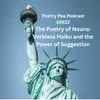
S9E22 The Poetry of Nouns: Verbless Haiku and the Power of Suggestion
In this episode of the Poetry Pea Podcast, we explore why haiku has often been described as "the poetry of the noun" and ask whether removing verbs and limiting adjectives can make a poem even more powerful.Through close readings of haiku by John Wills, Elizabeth Searle Lamb, Charles Rossiter, Noel King, Choshi, Anne Curran, and Bisshie, we discover how concrete nouns create atmosphere, emotion and meaning without explanation. We look at Edward Hirsch's idea of the "arrested moment" and Michael Dylan Welch's advice to write not about your feelings, but about what caused them.Can a poem made almost entirely of nouns hold a reader's attention? Can omission create deeper emotional resonance than description? And how we should trust readers to make their own connections?If you write or love haiku, senryū, Japanese poetry, imagist poetry, or minimalist writing, this episode offers practical insights and examples to inspire your own work.Plus, there's a new writing challenge: can you create a noun-heavy, no-verb haiku that invites the reader to join the dots? If you can get it to me by the 16th June, 2026 it might make it into another podcast and the next journal.Join us for an episode about the remarkable power of concrete imagery.Links in the show notes
Podzilla Summary coming soon
Sign up to get notified when the full AI-powered summary is ready.
Free forever for up to 3 podcasts. No credit card required.
Listen to This Episode
More from Poetry Pea - haiku and other English Language Japanese short forms
S9E29 One Line Haiku & Senryu The Judges' Choices and the best of the submissions
S9E28 The Best of June Poetry Pea Video Prompt Haiku & Senryu

S9E27 Kigo, Kireji and what else makes a haiku a haiku?
S9E26 Discovering Anne McKay: A Hidden Haiku Voice
Get summaries like this every morning.
Free AI-powered recaps of Poetry Pea - haiku and other English Language Japanese short forms and your other favorite podcasts, delivered to your inbox.
Free forever for up to 3 podcasts. No credit card required.