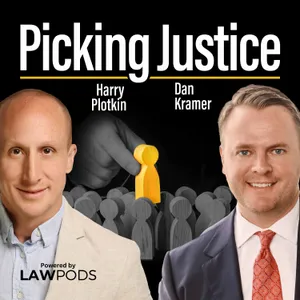
Free Daily Podcast Summary
Picking Justice: Daily Summaries Delivered
by Harry Plotkin & Dan Kramer
Attention Trial Lawyers: You’ve meticulously crafted your opening statement, mastered your directs and crosses, and fine-tuned your closing argument. But have you developed a strategy for jury selection? What will you do when a potential juror gives an unexpected answer? Do you even want that person on your jury? The clock is ticking — you need to think fast.Introducing Picking Justice, the essential podcast for trial lawyers. Join nationally renowned jury consultant Harry Plotkin and leading trial lawyer Dan Kramer as they guide you through the complex art of jury selection.Harry and Dan share invaluable insights and real-world strategies, breaking down the myths and misconceptions that often hold lawyers back in the courtroom.Whether you’re a seasoned litigator or preparing for your first big case, Picking Justice offers expert guidance to help you make smarter choices during jury selection.Subscribe today and elevate your trial skills with Picking Justice.
Latest Episodes
The most recent episodes — sign up to get AI-powered summaries of each one.
- 1 weeks ago45 min
Arash Homampour – For-Cause Challenges and Money Talk in Voir Dire (Rewind)
A juror who promises to be fair may still not belong on your jury. Arash Homampour of The Homampour Law Firm, a trial lawyer known for winning eight-figure verdicts in cases others wouldn’t take, joins hosts Harry Plotkin and Dan Kramer to discuss making for-cause challenges stick. Arash explains why a juror who can’t be entirely impartial on even one issue, such as pain and suffering, may still be disqualified, and how he builds a record to prevent that bias from being rehabilitated. He also shares what to ask when a judge bars dollar figures in voir dire and why leading with a big number can work against you.Learn More and Connect☑️ Arash Homampour | LinkedIn☑️ The Homampour Law Firm | LinkedIn | Facebook | Instagram☑️ Harry Plotkin | LinkedIn | Facebook | Instagram☑️ Dan Kramer | LinkedIn☑️ Kramer Trial Lawyers on LinkedIn | Facebook | YouTube | Instagram☑️ Subscribe: Apple Podcasts | Spotify | YouTubeProduced and Powered by LawPods, a podcast marketing agency for law firms
- 3 weeks ago50 min
Jon Marko – Why Bad-on-Paper Jurors Can Deliver Big Verdicts
The juror who looks worst on paper can end up delivering your biggest verdict. Jon Marko, a Detroit trial lawyer fresh off an $896 million verdict, has seen it happen more than once. While the defense in one of his trials ran AI searches on every juror, Jon stuck to quick social media checks, and he tells hosts Harry Plotkin and Dan Kramer why he wouldn't trust AI to pick his strikes. He also makes the case that repetition, not study, is what builds great voir dire. Tune in to hear how he handled a lawsuit-skeptical juror after using his last strike, and why she ended up leading the jury to a $36 million verdict.Learn More and Connect☑️ Jonathan R. Marko | LinkedIn | Instagram☑️ Marko Law | LinkedIn | Facebook | Instagram | TikTok | YouTube☑️ Harry Plotkin | LinkedIn | Facebook | Instagram☑️ Dan Kramer | LinkedIn☑️ Kramer Trial Lawyers on LinkedIn | Facebook | YouTube | Instagram☑️ Subscribe: Apple Podcasts | Spotify | YouTubeProduced and Powered by LawPods
- Oct 5, 20261h 34m
Steve Vartazarian – How to Keep Biased Jurors From Being Rehabilitated (Rewind)
A juror who says they won't award money for pain and suffering only becomes a cause challenge if that answer holds up when the judge or defense tries to rehabilitate them. Steve Vartazarian, founder of The Vartazarian Law Firm, shares with hosts Harry Plotkin and Dan Kramer the simple questions he uses to lock those jurors in, and why he stops short of pushing them too far. He also explains why he welcomes jurors' worst answers, why he calls it "human harm" instead of pain and suffering, and the one line about damages that jurors love to hear. Tune in for jury selection techniques to use in your next voir dire.Learn More and Connect☑️ Steve Vartazarian | LinkedIn☑️ The Vartazarian Law Firm | LinkedIn | Facebook☑️ Harry Plotkin | LinkedIn | Facebook | Instagram☑️ Dan Kramer | LinkedIn☑️ Kramer Trial Lawyers on LinkedIn | Facebook | YouTube | Instagram☑️ Subscribe: Apple Podcasts | Spotify | YouTubeProduced and Powered by LawPods
- Sep 21, 202657 min
Joe Fried – How to Win Over Hostile Jurors (Rewind)
Some of the toughest jurors aren't the ones to strike; they're the ones to win over. Joe Fried, an Atlanta trial lawyer with Fried Goldberg who has tried cases in 43 states, builds his approach around what jurors share rather than what divides them. He joins hosts Harry Plotkin and Dan Kramer to unpack what turns skepticism into trust: modeling "shockingly vulnerable" honesty, framing a case around a juror's oath, and running a voir dire that surfaces the universal values a case is really about. Joe also explains why he now drops his exact damages number in his opening, and why less is more when arguing them. Tune in for practical takeaway on inclusive jury selection.Learn More and Connect☑️ Joe Fried | LinkedIn☑️ Fried Goldberg | LinkedIn | Facebook | YouTube | Instagram | X☑️ Harry Plotkin | LinkedIn | Facebook | Instagram☑️ Dan Kramer | LinkedIn☑️ Kramer Trial Lawyers on LinkedIn | Facebook | YouTube | Instagram☑️ Subscribe: Apple Podcasts | Spotify | YouTubeProduced and Powered by LawPods
- Sep 8, 202647 min
Non-Economic Damages: Spot the Jurors Who Won’t Award
Most jurors haven't decided how they feel about giving millions for pain and suffering until the trial's nearly over — so how do you spot the ones who never will? In this deep dive, hosts Harry Plotkin and Dan Kramer unpack the "Health Is Wealth" question sequence Harry uses to surface which jurors value non-economic damages. They dig into the counterintuitive power of telling jurors the money isn't meant to help, how to read jurors who dodge or push back on open-ended questions, and the tricky calculus of brain-injury cases and waiving future care. Tune in for a practical playbook on making quality of life feel like real wealth to a jury.Learn More and Connect☑️ Harry Plotkin | LinkedIn | Facebook | Instagram☑️ Dan Kramer | LinkedIn☑️ Kramer Trial Lawyers on LinkedIn | Facebook | YouTube | Instagram☑️ Subscribe: Apple Podcasts | Spotify | YouTubeProduced and Powered by LawPods
- Aug 24, 202654 min
Brett Schreiber – Two Cups and a Pitcher of Blame
Federal court voir dire is often "judicial speed dating" — sometimes just 25 minutes to question 55 strangers. Brett Schreiber of Singleton Schreiber pulled it off before landing a landmark verdict against Tesla, and he joins hosts Harry Plotkin and Dan Kramer to unpack how he picks juries under brutal time pressure. Brett shares his "two cups and a pitcher of blame" framing for shared-responsibility cases, why he primes reluctant jurors to say "yes" before diving in, and why emotional intelligence and reading the room beat any rigid script. He also explains why a story of betrayal is the most powerful motivator for jurors. Tune in for a masterclass in high-stakes jury selection.Learn More and Connect☑️ Brett Schreiber | LinkedIn☑️ Singleton Schreiber | LinkedIn | Facebook | Instagram | X☑️ Harry Plotkin | LinkedIn | Facebook | Instagram☑️ Dan Kramer | LinkedIn☑️ Kramer Trial Lawyers on LinkedIn | Facebook | YouTube | Instagram☑️ Subscribe: Apple Podcasts | Spotify | YouTubeProduced and Powered by LawPods
- Aug 10, 202643 min
Mel Orchard — Get the Wrong Jurors to Out Themselves
Most trial lawyers walk into voir dire with a script and a checklist. Throw both out, says Mel Orchard of the Spence Law Firm in Wyoming, a member of the Inner Circle of Advocates. He opens instead by asking jurors whether anything affected them on the way in that morning — then stays silent for a long time. Talking with hosts Harry Plotkin and Dan Kramer, Mel explains why preconditioning doesn't work, why he no longer lets the panel debate the case in real time, how a personal share draws the poison out of a tough case, and how he preconditions jurors to tens of millions of dollars in voir dire using David Ball's framework.Learn More and Connect☑️ Mel C. Orchard | LinkedIn☑️ Spence Law Firm | LinkedIn | Facebook | X☑️ Harry Plotkin | LinkedIn | Facebook | Instagram☑️ Dan Kramer | LinkedIn☑️ Kramer Trial Lawyers on LinkedIn | Facebook | YouTube | Instagram☑️ Subscribe: Apple Podcasts | Spotify | YouTubeProduced and Powered by LawPods, a podcast marketing agency for law firms
- Jun 15, 202651 min
Kimball Jones – Voir Dire Lessons from a 9-Figure Verdict Run
Imagine trying a case with clear liability and catastrophic damages, with each day of evidence going your way — and still walking away with a defense verdict. That 2018 loss shaped Nevada trial lawyer Kimball Jones' voir dire philosophy and the verdict run that's followed: at least 12 seven-figure verdicts plus multiple eight- and nine-figure results since 2019. Kimball joins hosts Harry Plotkin and Dan Kramer to unpack his approach — starting with the passions question to build rapport, signaling damages early in his mini opening, and addressing juror skepticism about trial lawyers head-on. Tune in for what jurors are really telling you when they claim no passions, and the surprising habit Kimball considers more important than any technique.Learn More and Connect☑️ Kimball Jones | LinkedIn☑️ Bighorn Law | LinkedIn | Instagram | Facebook☑️ Harry Plotkin | LinkedIn | Facebook | Instagram☑️ Dan Kramer | LinkedIn☑️ Kramer Trial Lawyers on LinkedIn | Facebook | YouTube | Instagram☑️ Subscribe: Apple Podcasts | Spotify | YouTubeProduced and Powered by LawPodsEpisode sponsored by Focus Graphics.
Get Picking Justice summaries in your inbox
Free AI-powered daily recaps. Key takeaways, quotes, and mentions — in a 5-minute read.
Get Free Summaries →Free forever for up to 3 podcasts. No credit card required.
You Might Also Like
Listeners also like.

The Trial: USA
Analyzes major criminal trials through court transcripts, interviews with investigators and experts, and detailed courtroom evidence breakdowns.
Doing Justice
A former U.S. attorney examines high-stakes legal cases and the moral dilemmas behind prosecuting powerful figures.
Above the Law - Thinking Like a Lawyer
Three legal experts analyze everyday topics through a legal lens, exploring how law shapes common experiences and cultural phenomena.

American Law Cafe
Breaks down core legal concepts, landmark cases, and doctrines in clear, accessible discussions for law students and legal enthusiasts.
History on Trial
Examines famous American trials to reveal how legal battles reflected and shaped cultural forces of their time.
The People’s Court Podcast
A retired judge mediates real civil disputes between individuals and businesses, offering binding rulings and legal insight.

Judge John Hodgman
A humorist and a writer resolve absurd everyday disputes in a mock courtroom setting.

Vegas Law
A Las Vegas attorney and co-host explore criminal defense, personal injury, business law, and estate planning through real cases and legal analysis.
In Session: Leading the Judiciary
Conversations with experts on leadership and management issues relevant to federal judiciary executives.
The Trial: Australia
A deep dive into major Australian court cases, revealing evidence, key moments, and insights through interviews with insiders.
Law and Chaos
Legal journalists analyze pivotal courtroom cases and their impact on American democracy.

Stay Tuned with Preet
A former U.S. attorney analyzes legal issues in the news and interviews experts on power, policy, and justice.
About Picking Justice
Attention Trial Lawyers: You’ve meticulously crafted your opening statement, mastered your directs and crosses, and fine-tuned your closing argument. But have you developed a strategy for jury selection? What will you do when a potential juror gives an unexpected answer? Do you even want that person on your jury? The clock is ticking — you need to think fast.Introducing Picking Justice, the essential podcast for trial lawyers. Join nationally renowned jury consultant Harry Plotkin and leading trial lawyer Dan Kramer as they guide you through the complex art of jury selection.Harry and Dan share invaluable insights and real-world strategies, breaking down the myths and misconceptions that often hold lawyers back in the courtroom.Whether you’re a seasoned litigator or preparing for your first big case, Picking Justice offers expert guidance to help you make smarter choices during jury selection.Subscribe today and elevate your trial skills with Picking Justice.
Customized Recaps
AI-powered recaps with compact key takeaways, quotes, and insights.
Straight to Your Inbox
Get key takeaways from Picking Justice in a 5-minute read.
Save Hours Every Week
Stay current on your favorite podcasts without falling behind.
Frequently Asked Questions
What is Podzilla's Picking Justice daily summary?
It's a free AI-powered email that summarizes new episodes of Picking Justice as soon as they're published. You get the key takeaways, notable quotes, and links & mentions — all in a quick read.
How does the Picking Justice podcast summary work?
When a new episode drops, our AI transcribes and analyzes it, then generates a personalized summary tailored to your interests and profession. It's delivered to your inbox every morning.
Is this an official Picking Justice product?
No. Podzilla is an independent service that summarizes publicly available podcast content. We're not affiliated with or endorsed by Harry Plotkin & Dan Kramer.
Can I get summaries of other podcasts too?
Absolutely! The free plan covers up to 3 podcasts, any in the catalog. Basic raises that to 15, Pro to 40 and Max to 100. Browse our full catalog at /podcasts.
How often does Picking Justice release new episodes?
Picking Justice publishes biweekly. Our AI generates a summary within hours of each new episode.
What topics does Picking Justice cover?
Picking Justice covers topics including Education, Business, Careers. Our AI identifies the specific themes in each episode and highlights what matters most to you.
Start getting Picking Justice summaries tomorrow morning.
Free forever for up to 3 podcasts. No credit card required.
Free forever for up to 3 podcasts. No credit card required.