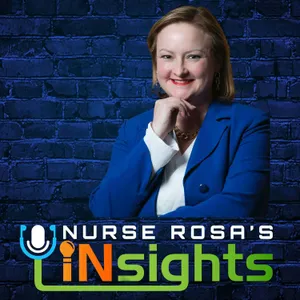
Free Daily Podcast Summary
Nurse Rosa's INsights: Daily Summaries Delivered
by Rosa Hart
Rosa Hart interviews healthcare stakeholders to find out what needs they see in their specialty and learn about their proposed methods to meet them. Anyone can complain, but this podcast is for possibility thinkers who are ready to create solutions.
Latest Episodes
The most recent episodes — sign up to get AI-powered summaries of each one.
- 4 days ago19 min
From the Winner’s Circle: How Amnion Is Changing Wound Care LIVE at Magnet & Pathway 2026
Recorded live at the 2026 ANCC Magnet & Pathway Conference in Chicago. Some of the most powerful innovations in healthcare start with one nurse noticing what’s possible. In this episode we hear from Nely Amaral, RN, BScN, and Anna Kha, CNS, of Mount Sinai Hospital in Toronto, the team behind this year’s Magnet Prize-winning program, Mothers Healing Others. Nely walks us through how the program works, using amniotic membrane donated by mothers having planned C-sections and processed through Mount Sinai’s own tissue and bone bank. We talk about why amnion is such a powerful tissue, with anti-inflammatory and anti-scarring properties and possible pain relief, and how it’s helping patients with some of the hardest head-and-neck surgical wounds. What started as a five-patient trial became a permanent treatment option once the team brought outcomes and before-and-after photos to hospital leadership. We also cover safety, from processing that removes DNA and blood (so no cross-matching is needed) to how the team educates patients and pauses treatment if infection is suspected. Then Nely and Anna share how they plan to use the $125,000 Magnet Prize, including a retrospective review of 140 patients, program expansion, education, and keeping the donated-tissue supply going. We close with Anna’s wound care philosophy: look at the whole person, not just the wound, and lean on every discipline to get patients back to the life they want. If you’re a nurse, a nurse leader, or anyone who believes bedside ideas can change care, this one’s for you. Timestamps 00:00 Meet the Toronto Magnet Prize-winning team 01:07 How a wound-care mentor sparked the amnion idea 03:14 Early healing results in difficult head-and-neck wounds 06:22 Building a nurse-led program across specialties 08:26 From five-patient trial to permanent therapy 11:14 Processing, cross-matching, and infection precautions 13:53 How the $125,000 prize could grow the program 15:45 Why planned C-section donations are used 17:28 Assessing the whole patient, not just the wound 19:57 Recognition for interdisciplinary nursing innovation Key takeaways Great nursing ideas often start with a mentor who shows you what’s possible. Amniotic membrane is a powerful tissue that may reduce inflammation, scarring, and pain. A small pilot with strong outcomes and clear before-and-after images can turn into a permanent program. Donated tissue only works if the supply is sustained, so education and donor engagement matter. Wound care is an art and a science. Assess the person, their history, and why the wound developed. Interdisciplinary collaboration is what makes nurse-led innovation stick. About Nely Amaral and Anna Kha Nely Amaral, RN, BScN, is the Magnet Program Director at Sinai Health, and Anna Kha, CNS, is a clinical nurse specialist in wound care at Mount Sinai Hospital in Toronto. Together they lead Mothers Healing Others, the 2026 Magnet Prize-winning program using donated amniotic membrane as a wound care therapy. Connect with Nely and Anna Nely Amaral, RN, BScN, on LinkedIn: [link] Sinai Health: sinaihealth.ca Resources mentioned Mothers Healing Others, Mount Sinai Hospital Toronto Mount Sinai Hospital Tissue and Bone Bank ANCC Magnet Prize ANCC Magnet & Pathway Conference: magnetpathwaycon.nursingworld.org About your host Rosa Hart, BSN, RN, SCRN, FLAA, is a nurse, speaker, podcaster, and author of Speak Up, Start Now, available on Audible and Kindle. Follow along @NurseRosaSpeaks. Did you know a mother’s gift at birth could help heal someone else’s wound? Tell us in the comments, and share this episode with a wound care nurse who’d love this story.
- 6 days ago35 min
Faster Data, Faster Cures with Joe Lengfellner at IgniteData
Research nurses and coordinators didn’t go into healthcare to copy data from one screen into another, yet that’s exactly where a huge share of their time goes. In this episode of Nurse Rosa’s INsights, hear from Joe Lengfellner, Chief Product and Technology Officer at IgniteData and former Senior Director of Clinical Research Informatics and Technology at Memorial Sloan Kettering Cancer Center. Joe shares what he saw at MSK, where roughly 1,800 research studies meant coordinators and nurses were manually moving data from health records and paper questionnaires into sponsor systems. We dig into how IgniteData’s Archer platform connects directly to the EHR, lets coordinators review the data, and sends it to the sponsor with one click, cutting manual error rates that can reach 8 to 10 percent and boosting efficiency by 60 to 70 percent. We also talk about why training takes less than 20 minutes, how Archer is now live at 9 of the top 10 U.S. cancer centers, why it never stores patient data, and where AI actually helps (hint: it’s the unstructured stuff like pathology and radiology reports). Plus, we get real about platform fatigue, the FDA’s push toward real time clinical trials, and how Joe would spend a billion dollars to fix healthcare’s interoperability problem. If you work in clinical research, lead a research site, build health tech, or invest in it, this one’s for you. Timestamps 0:00 Welcome Joe Lengfellner of IgniteData 1:18 The biggest technology headaches at clinical trial sites 2:02 The manual data problem at MSK 3:43 How IgniteData removes the human middleman 4:34 How the Archer platform works 5:47 Human error, data accuracy, and freeing up research teams 8:01 Training in under 20 minutes and unlearning old habits 10:45 Where Archer is live today, from top cancer centers to global sites 12:02 How faster data gets new treatments to patients sooner 14:28 Privacy first: why Archer stores no patient data 17:17 Where AI fits and where it doesn’t 20:51 What to ask before choosing a data platform 22:46 Platform fatigue and the doorway effect 26:31 The FDA and real time clinical trials 29:19 The billion dollar question 32:55 How to connect with Joe About Joe Lengfellner Joe Lengfellner is Chief Product and Technology Officer at IgniteData, where he leads product innovation focused on making hospital to sponsor clinical data flow fast, reliable, and research ready. Before IgniteData, he spent more than 15 years at Memorial Sloan Kettering Cancer Center, most recently as Senior Director of Clinical Research Informatics and Technology, leading a team supporting MSK’s global clinical research portfolio. He holds a BS in Psychology from Stony Brook University. Connect with Joe and IgniteData Joe on LinkedIn Resources mentioned American Heart Association Get With The Guidelines program FDA real time clinical trials initiative About your host Rosa Hart, BSN, RN, SCRN, FLAA, is a nurse, speaker, podcaster, and author of Speak Up, Start Now, available on Audible & Kindle., Follow along @NurseRosaSpeaks. What would YOU do with a billion dollars to fix healthcare? Share your idea with us in the comments, and don’t forget to like, subscribe, and share this episode with a colleague in clinical research.
- 6 days ago17 min
Advocacy with ANA’s President Jennifer Mensik Kennedy: LIVE at ANCC Magnet & Pathway 2026
Recorded live at Magnet 2026 in Chicago. Nurses are being asked to adopt AI, carry heavier workloads, and stay safe at work, often without a say in any of it. In this episode of Nurse Rosa’s INsights, I sit down with Dr. Jennifer Mensik Kennedy, president of the American Nurses Association, to talk about what it really takes for nurses to shape the decisions that shape our practice. Jennifer opens up about her TIME100 recognition and why advocating for advanced practice nurses mattered so much to her. We get into why voting is one of the most practical forms of nursing advocacy, ANA’s push on workplace violence prevention (including better incident tracking and OSHA involvement), and the fight for more than $300 million a year in Title VIII nursing workforce funding, compared with the $20 billion plus that goes to graduate medical education. Then we turn to AI. Jennifer explains why AI can support nursing work but should never replace clinical judgment, and shares the Oregon legislation she helped shape with nurse Representative Travis Nelson to keep non-human AI agents from using the RN or LPN title. We close on nurse-led innovation and why protecting your ideas and intellectual property needs to happen early, not after someone else profits from them. If you’re a nurse, a nurse leader, or you build or invest in healthcare technology, this one’s for you. Timestamps 00:00 Rosa Hart welcomes ANA president Jennifer Mensik Kennedy02:36 Nursing advocacy, elections, and federal priorities 04:40 The fight for Title VIII nursing education funding 05:49 Why nurses belong in local and state advocacy 09:09 AI needs nurses’ voices, not just their labor 10:46 Oregon moves to protect RN and LPN titles from AI 11:37 Keeping clinical judgment central to healthcare AI 12:18 Nurse-led innovation and protecting intellectual property 14:34 Seeking federal and state protections early 14:54 Closing from MagnetKey takeawaysVoting is advocacy, and nurses can move policy at the local, state, and federal level.Workplace violence can’t be fixed if it isn’t tracked accurately. Nursing education funding is a fraction of what medical education receives. AI can support nursing work, but it can’t hold a nursing license or replace clinical judgment. Nurses should be in the room for technology selection, governance, training review, and escalation pathways.Your ideas have value. Protect them early. About Dr. Jennifer Mensik Kennedy, PhD, MBA, RN, NEA-BC, FAAN, is the 38th president of the American Nurses Association, representing the nation’s nurses on policy, practice, and workforce issues. She was recognized by TIME in 2026 for her advocacy, particularly on behalf of advanced practice nurses. Connect with Jennifer Mensik Kennedy on LinkedIn American Nurses Association: nursingworld.org Resources mentioned:ANA innovation resources: nursingworld.orgTitle VIII Nursing Workforce Development Programs ANCC Magnet & Pathway Conference: magnetpathwaycon.nursingworld.orgAbout your hostRosa Hart, BSN, RN, SCRN, FLAA, is a nurse, speaker, podcaster, and author of Speak Up, Start Now, available on Audible and Kindle. Follow along @NurseRosaSpeaks Should AI ever be allowed to call itself a nurse? Tell us in the comments, and share this episode with a nurse who needs a reminder that their voice matters.
- 1 weeks ago6 min
LPN's Step Up - LIVE at ANCC Magnet & Pathway 2026 with Angela Beddoe & Corenza Townsend
Recorded live at the ANCC Magnet & Pathway Conference 2026 in Chicago, hear from Angela Beddoe, CEO of the American Nurses Enterprise, and Corenza Townsend, LPN and Chief Administrative Officer of Norton West Louisville Hospital. Angela shares conference highlights, and describes the vote to bring LPNs and LVNs into the American Nurses Association, an equity issue members have discussed for nearly a decade. Corenza has a clear message for LPNs: a nurse is a nurse is a nurse, and the door’s wide open. She also shares how speaking up helped lead to a hospital being built in West Louisville. A reminder that leadership is about action; it isn’t about titles or the letters after your name. Every nurse’s voice matters. Timestamps 0:00 Welcome, live from Magnet & Pathway 0:43 Day-one highlights 1:41 What LPNs should look for next year 2:05 “A nurse is a nurse is a nurse” 2:50 The vote to bring LPNs and LVNs into the ANA 3:19 What’s next in 2027 3:52 Speaking up and building a hospital 4:33 Why your voice matters About the host Rosa Hart, BSN, RN, SCRN, FLAA, is a nurse, speaker, podcaster, and author of Speak Up, Start Now, available on Audible & Kindle. Follow @NurseRosaSpeaks
- 1 weeks ago15 min
What's New in Nursing's Scope and Standards of Practice: Innovation and AI - LIVE at ANCC Magnet & Pathway 2026
Recorded LIVE in Chicago, hear from Bradley Goettl, CNO of the American Nurses Enterprise, and Sarah Gray, Senior Vice President of Nursing Impact at the ANA. They discuss the newly released fifth edition of the Nursing: Scope and Standards of Practice. Learn what changed, why it matters for the profession, and how the new AI guidance keeps clinical judgment with nurses. Timestamps: 0:10: Welcome and introductions. Bradley Goettl (CNO, ANA) and Sarah Gray (SVP of Nursing Impact, ANA) join Rosa after speaking on stage about the new scope and standards. 0:39: What's new? The document was not rewritten from the ground up. It is reviewed every five years through a rigorous process of about 48 months. Two additions: innovation and AI. 1:50: Is nursing a profession? This is the fifth edition. It is the foundational description of the profession, grounded in science and evidence, and it came out alongside the push to recognize advanced practice nursing as an advanced practice degree. 2:51: Who does it cover? It is the foundational RN document and applies to every RN, including advanced practice nurses. LPNs/LVNs are not part of it yet. The membership assembly decided in 2026 to include them in ANA membership, so they are being considered for the future. 4:07: "Written by nurses, made for nurses." Nurses define nursing practice, and the profession is self-governing. 4:27: Innovation. Nurses are natural innovators. The new section covers the process of innovation and critical problem-solving, not just workarounds. 5:11: AI in the document. The section is brief by design. Nurses remain in charge of clinical judgment and safe care. 6:12: Keeping pace with AI. Public comment recently opened on ethical principles for AI. 6:40: Accountability. If AI makes the decision, should the nurse's license be on the line? The guests discuss accountability when a nurse confirms or agrees, and "see something, say something." 7:30: AI can reduce cognitive burden and spot trends, but personal judgment is the human part of nursing. 8:04: A quote from page 81. AI-enabled information is "one input" into professional decision-making and should be treated as supportive information, not final authority. 8:55: Governance and licensure support. ANA will keep developing guidance beyond a document with a five-year shelf life. 9:15: Where the guidance helps most. It helps nurses take part in hospital AI policy conversations, with a focus on prevention rather than legal protection. 9:49: ANA's AI think tank brought together industry leaders, nursing and technology experts, across generations and geographies. It is producing tools for nurses, leaders and policymakers. 10:33: Policy advocacy and lobbying on AI. 11:00: State-level conversations. State nursing associations can use the guidelines with legislatures. ANA's government affairs team works with the constituent and state nursing associations. 12:00: How to get it. It is available as a paper book (smaller than past editions) and as an e-copy. 12:44: Not meant to be memorized. Treat it like a drug reference book. Most content is familiar from nursing education, and leaders should know it to support their staff. 13:29: Thanks and sign-off. The fifth edition adds innovation and AI. It is the foundational RN document, and it applies to all RNs regardless of specialty or role. AI is supportive information, not final authority. Clinical judgment stays with the nurse. It is available in print and as an e-copy. About your host Rosa Hart, BSN, RN, SCRN, FLAA, is a nurse, speaker, podcaster, and author of "Speak Up, Start Now", available on Audible & Kindle. Follow along @NurseRosaSpeaks
- 1 weeks ago14 min
Live at Magnet 2026: Making Every Nurse AI Ready with Rich Kenny
Healthcare is changing fast, and nurses need a seat at the table where AI decisions get made. In this episode, hear from Rich Kenny, Vice President of AI and Digital Health Programs at the American Nurses Association, to talk about what it really means for nurses to be “AI ready.” Rich started his career as a flight nurse and now leads ANA’s work on artificial intelligence. With a $5 million grant from the Johnson & Johnson Foundation and Google.org, his team is setting out to train 250,000 nurses in AI literacy, with a focus on nurses in underserved and rural communities. As Rich puts it, there’s no other profession whose voice is needed more right now in shaping these technologies. We talk about why AI readiness is less about knowing everything and more about curiosity and the confidence to ask questions, why designing for nurses in rural and under-resourced settings lifts the whole profession, and how nurses can keep compassion, advocacy, and connection at the center of care as technology evolves. Whether you’re a bedside nurse, a nurse leader, or a healthtech founder building tools for clinicians, this conversation is for you. And stay tuned for more coverage from the Magnet Conference in Chicago. Timestamps 0:00 Rich Kenny’s new AI and digital health leadership role 1:32 The $5 million, three-year AI literacy grant 3:17 From flight nursing to informatics and AI 5:47 A goal to train 250,000 nurses 7:12 AI fluency means confidence to ask questions 8:23 Why AI readiness may mean staying curious 10:32 Nursing experience with ambiguity can inform AI 11:46 Why nursing voices must protect the human element Connect with Rich Kenny on LinkedIn American Nurses Association: nursingworld.org About Your Host Rosa Hart, BSN, RN, SCRN, FLAA, is a former Neuro ICU nurse and stroke nurse navigator, podcast host, speaker, and author of Speak Up, Start Now. Nurse Rosa’s INsights brings you conversations with the nurses, leaders, and innovators changing how healthcare works. 📖 Get Speak Up, Start Now on Audible or Kindle 📲 Follow @NurseRosaSpeaks on social media 👍 Like, subscribe, and share this episode with a nurse who needs to hear it
- 1 weeks ago26 min
LIVE from ANCC Magnet & Pathway 2026 with Katie Boston-Leary
Recorded live at the ANCC Magnet & Pathway Conference 2026 in Chicago. Most people still picture nurses as the ones carrying out the doctor’s orders. Dr. Katie Boston-Leary has spent about 33 years proving that picture wrong. In this episode of Nurse Rosa’s INsights, I sit down with Katie, a former chief nursing officer and now Senior Vice President of Equity and Engagement at the American Nurses Enterprise, right in the middle of the Magnet buzz. We get into what the public misses about nursing, why you’re still a nurse after you leave the bedside, and why technology keeps missing the mark when nurses aren’t in the room where it’s designed. Katie calls the EHR nursing’s biggest broken promise, and we talk honestly about systems that end up taking nurses away from patients and the moral stress that comes with it. We also cover AI, and why nurses should help shape it rather than push it away. Then it gets personal. Katie shares what happened when she pushed back as a nurse leader, including with a physician CEO, and why she’d do it again even when she didn’t win. Her take: not every story has to be a success story to be worth telling, and not everything is a microwave situation. Whether you’re a bedside nurse, a nurse leader, a health tech founder, or someone who builds the tools nurses use every day, this conversation is for you. Timestamps 0:16 Welcome, live from the Magnet conference 1:04 Katie’s journey, from CNO to senior VP 3:24 Closing resource gaps so nurses can be their best 4:26 Next-gen nurses and Katie’s advocacy 5:14 What the public gets wrong about nurses 6:48 “Not a nurse anymore?” Rosa’s leap from her W-2 job 7:35 Leaving the bedside and being a nurse wherever you work 9:30 Why tech and innovation miss the mark without nurses 10:45 The EHR, nursing’s biggest broken promise 12:44 Less time with patients and the moral stress that follows 13:11 AI and nursing: design it, don’t reject it 14:07 Stepping into rooms where nurses weren’t invited 14:33 Speaking up as a nurse leader 15:21 Root cause analyses and follow-up work that lands on nurses 16:38 Lab results, “nagging and flagging,” and med reconciliation 18:12 Pushing back when the CEO is a physician 19:40 Speaking up when you don’t get the outcome you want 20:18 Agency, integrity, and stories that aren’t success stories 21:01 “Even if I lose this battle, I will be back” 23:09 Persistence in innovation: not everything is a microwave situation 23:18 What teams want from leaders: remove the boulders 24:03 Closing and an invitation to next year’s conference Key takeaways Nurses are far more than task doers; healthcare roles depend on each other. Technology fails when nurses aren’t part of designing it. Speaking up and staying persistent are part of leadership, even when you don’t win. A nurse is a nurse wherever they practice. About Dr. Katie Boston-Leary Katie Boston-Leary has been a nurse for about 33 years and is a former chief nursing officer. She joined the American Nurses Enterprise in 2020 and rose from director to Senior Vice President of Equity and Engagement, where her focus is closing resource gaps so nurses can do their best work and building the strongest nursing workforce possible. Connect with Katie Katie Boston-Leary on LinkedIn American Nurses Association: nursingworld.org Resources mentioned ANCC Magnet & Pathway Conference: magnetpathwaycon.nursingworld.org About your host Rosa Hart, BSN, RN, SCRN, FLAA, is a nurse, speaker, podcaster, and author of Speak Up, Start Now, available at nurserosaspeaks.shop and on Amazon. Follow along @NurseRosaSpeaks When did YOU speak up, even if it didn’t go your way? Tell us in the comments, and share this episode with a nurse who needs to hear it.
- 1 weeks ago31 min
Solving Transitions of Care with Dr. Steve Boslovich - CMO, PointClickCare
What if the number that matters most for an older patient isn't their age? Geriatrician Dr. Steven Buslovich, Chief Medical Officer for Senior Care at PointClickCare, joins host Rosa Hart, RN to talk about frailty, the messy handoff from hospital to post-acute care, and why ambient AI should be built for nurses and CNAs, not just physicians. This episode is sponsored by PointClickCare. Dr. Buslovich has spent his career on the receiving end of the hospital transfer packet. He shares how losing his mother and uncle within days of each other brought his grandparents into his daily life and led him to geriatrics. He explains how measuring frailty cut hospitalizations and lawsuits in the facilities he led, and how that work grew into Patient Pattern. He and Rosa also get into the quality-of-life conversations that often never happen before a procedure, and whether AI efficiency will protect clinician time or just add more patients to the load. In this episode: Meet Dr. Steven Buslovich, geriatrician and CMO for Senior Care at PointClickCare "Lazy people do everything twice" Growing up with grandparents and becoming a geriatrician What is frailty? Physiological age vs. chronological age Data-driven conversations with families The missing piece in U.S. healthcare From problem to tech company: the start of Patient Pattern Streamlining the "manila envelope" with digital referrals A dedicated practitioner EHR for post-acute care Ambient AI scribing for nurses and CNAs The power of narrating care at the bedside Protecting clinician time The $1 billion question: a single source of truth for clinical data Polypharmacy and medication reconciliation Closing and how to connect Connect: Dr. Steven Buslovich: PointClickCare: https://pointclickcare.com Learn more: PointClickCare www.pointclickcare.com Facebook: https://www.facebook.com/PointClickCare Instagram: https://www.instagram.com/lifeatpointclickcare/ X: https://x.com/PointClickCare LinkedIn: https://ca.linkedin.com/company/pointclickcare Like, subscribe, and comment with who should answer the next Billion-Dollar Question! Connect with Rosa Hart Get or Gift a copy of her book: “Speak Up, Start Now” on Audible or Kindle Follow @NurseRosaSpeaks on your favorite social media platform Subscribe for weekly conversations on AI in healthcare, hospital innovation, nursing leadership, and the future of health technology. Available on Spotify, Apple Podcasts, YouTube, and all major podcast platforms.
Get Nurse Rosa's INsights summaries in your inbox
Free AI-powered daily recaps. Key takeaways, quotes, and mentions — in a 5-minute read.
Get Free Summaries →Free forever for up to 3 podcasts. No credit card required.
You Might Also Like
Listeners also like.

NOW - No Opportunity Wasted with Angelica Ross
Angelica Ross discusses personal and cultural topics with guests from diverse backgrounds, focusing on making the most of life’s moments.
Red Pill Your Healthcast
Two healthcare providers discuss overlooked health issues and empower listeners to make informed decisions for their families.
Care More Be Better: A Podcast For Sustainable Social Impact and Regeneration
Features interviews with environmentalists, activists, and scientists focused on sustainable social impact and regenerative solutions.
Nursing School Week by Week
A nursing student shares weekly tips on studying, passing exams, mastering clinicals, and landing a first nursing job.
INTERLUDE: Cancer Stories with Dr. Teplinsky
Eleonora Teplinsky
Unlocking Us with Brené Brown
Explores human connection through conversations on vulnerability, courage, and emotion with researchers, thinkers, and audiences.

The Cellular Upgrade
Explores the connection between cellular health, consciousness, and personal transformation through science and spirituality.

Made for Health | Peptides | Lyme | Chronic Infections | Long Covid | Insulin Resistance | Hypermobility
A physician explores science-based approaches to treating chronic conditions and restoring health.
The Restless Ones
Executives at the intersection of technology and business discuss innovation, leadership, and driving change in fast-evolving industries.
Out of the Gray (Gy) - Standard Imaging
Conversations with experts in radiation oncology exploring advancements in technology, research, and clinical practice.

Rise & Roar with the Badass Lioness
A podcast for women leaders and entrepreneurs learning to harness their story, build confidence, and create a powerful personal brand.

Heal Squad x Maria Menounos
A daily podcast hosted by Maria Menounos exploring physical, emotional, and spiritual health through expert interviews and personal healing journeys.
About Nurse Rosa's INsights
Rosa Hart interviews healthcare stakeholders to find out what needs they see in their specialty and learn about their proposed methods to meet them. Anyone can complain, but this podcast is for possibility thinkers who are ready to create solutions.
Customized Recaps
AI-powered recaps with compact key takeaways, quotes, and insights.
Straight to Your Inbox
Get key takeaways from Nurse Rosa's INsights in a 5-minute read.
Save Hours Every Week
Stay current on your favorite podcasts without falling behind.
Frequently Asked Questions
What is Podzilla's Nurse Rosa's INsights daily summary?
It's a free AI-powered email that summarizes new episodes of Nurse Rosa's INsights as soon as they're published. You get the key takeaways, notable quotes, and links & mentions — all in a quick read.
How does the Nurse Rosa's INsights podcast summary work?
When a new episode drops, our AI transcribes and analyzes it, then generates a personalized summary tailored to your interests and profession. It's delivered to your inbox every morning.
Is this an official Nurse Rosa's INsights product?
No. Podzilla is an independent service that summarizes publicly available podcast content. We're not affiliated with or endorsed by Rosa Hart.
Can I get summaries of other podcasts too?
Absolutely! The free plan covers up to 3 podcasts, any in the catalog. Basic raises that to 15, Pro to 40 and Max to 100. Browse our full catalog at /podcasts.
How often does Nurse Rosa's INsights release new episodes?
Nurse Rosa's INsights publishes 2x weekly. Our AI generates a summary within hours of each new episode.
What topics does Nurse Rosa's INsights cover?
Nurse Rosa's INsights covers topics including Business, Medicine, Fitness, Health & Fitness. Our AI identifies the specific themes in each episode and highlights what matters most to you.
Start getting Nurse Rosa's INsights summaries tomorrow morning.
Free forever for up to 3 podcasts. No credit card required.
Free forever for up to 3 podcasts. No credit card required.