Free Daily Podcast Summary
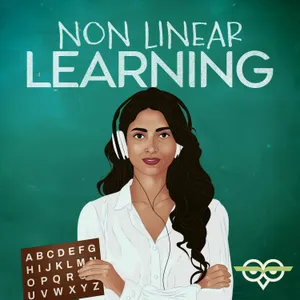
Non Linear Learning - Rethinking Education for Neurodivergent Learners: Daily Summaries Delivered
by Dr. Vaish Sarathy
Where we raise the bar on Education for children with a disability.Educating a child with a disability isn't for the faint of heart, and if you're a parent or educator who refuses to give up on your child's potential, you're in the right place.Hosted by TEDx speaker and Ph.D. Chemist Dr. Vaish Sarathy [mom to a non-speaking Autistic teen with Down syndrome], this podcast offers a bold new way to support your child's learning, regulation, and independence without burnout or arbitrary busy work.Together we explore how to:- Break learning barriers so your child with Autism / Down Syndrome / ADHD can learn complex Math and Science- Make teaching and learning at home a flow state- Support brain + body health with practical, science-backed tools- Use Non Linear Education strategies to unlock growth in ways traditional systems never couldHear from top educators, researchers, and self-advocates. And most importantly, believe again: in your child, and in yourself.
Latest Episodes
The most recent episodes — sign up to get AI-powered summaries of each one.
- 2 weeks ago34 min
210. 5 Myths We Still Believe About Non-Speakers (with David Kaufer)
Why spelled communication is not a guessing game: Dr. Vaish Sarathy speaks with David Kaufer, founder of Communicators for Communication Rights and host of The Lighter Side of the Spectrum, about motor-based typing, the realities of apraxia, and why presumed incompetence blocks education. Access to communication is the foundation for age-appropriate, intellectually rich education. David shares the journey with his son Stone, including school resistance, the harmful use of the message passing test, and how access to supported spelling changed Stone's educational path. They also discuss trauma, regulation, the role of communication partners, and why family persistence matters. 4:05 — Why Message passing tests don't work 25:28 — Non-speaking doesn't mean non-thinking 25:55 — Behavior and Non Speakers 26:45 — The Myths! 29:44 — Why AAC on Ipads don't always work for everyone <div class= "TypographyPresentation_31345133_root TypographyPresentation_31345133_root--medium Ric
- Jul 21, 202636 min
209. The Data Trap: Why "Proving Readiness" Is Costing Non-Speakers Years of Education
We don't make a neurotypical kid prove they can read before we hand them a book. We just teach them to read. But for non-speaking and minimally speaking learners, the rules flip. Sit in the chair first. Imitate first. Get it right four days in a row before we'll believe you got it right the first time. Lisa Mihalich Quinn and Erin Buchanan of Reach Every Voice call this the data trap and they're here to tell you why the data your child's team is collecting might not mean what you think it means. Tune in to this episode to learn: Why "proficiency is not a prerequisite" - and what your child's team should be giving them access to right now, not after they demonstrate readiness The real difference between adapting and modifying curriculum, and why modification can quietly cap your child's academic ceiling for years Why "the data shows" is often a trap that hides more than it reveals - and what questions to ask instead About the guests: Lisa Mihalich Quinn and Erin Buchanan lead Reach Every Voice, a multidisciplinary practice supporting non-speaking learners and learners with communication access needs through in-person and virtual instruction, group programming, and grant-funded initiatives. To kickstart Academic Learning for your non speaking or minimally speaking child (and to learn from Dr. Vaish Sarathy), check out www.studio.com/vaish - an Academic Training App for parents.
- Jul 1, 202646 min
208. The Eighth Sense: Understanding Behaviour, Communication, and Meltdowns with Dr. Dana Johnson
You've talked to 10 therapists. Tried 20 strategies. And your child still goes from calm to crisis in 30 seconds - for reasons no-one understands. Understanding a body requires that we understand the sensory information coming in. And Dr. Dana Johnson - OT, PhD, and founder of the Spellers Center - tells us that there are not 5 but 8 senses. Dana joins Non Linear Learning for the 3rd time to talk about interoception: the eighth sense, the one almost nobody gets taught, and the one that might explain what's been happening in front of you all along. Listen along to learn: Why your child's meltdown appears so sudden Why self-injury can be the body trying to feel itself, not defiance Why "tell me how you feel" is an impossible question for someone who's never reliably felt anything to name Why professionals push back on all of this — and what actually shifts a paradigm 🔗 Dana's YouTube: The Autism Plus Apraxia Doctor 🔗 Dana's Substack Did you know - you can now have Dr. Vaish Sarathy's teaching and personalized training in your pocket - Sign up for the Non Linear Learning Personalized Coach at www.studio.com/vaish
- Jun 15, 202629 min
207. Where there is deficit, there is also great strength - with Mark Talaga
We talk a lot about what our students can't do. But something that educators have found over the years is that there is a scatter to the skills we see in our students. The wildly uneven profile that we see could actually be a blessing. Mark Talaga, counselor, speaker, and founder of the Center for Identity Potential, joins the podcast to talk about asynchronous development in gifted and twice-exceptional learners. And here's what hit me: we're working the same problem from opposite ends. Where there is a sharp strength, there is often a significant deficit, but the opposite is true as well! This conversation got under my skin in the best way. Tune in to this episode to learn: What "asynchrony" actually means in gifted and disabled learners Why IQ tests fail kids on both ends of the bell curve Why labels are meaningless in education Why nurturing a spike / sharp interest (even if it seems "irrelevant") is critical. You can find Mark Talaga's podcast, Hopelessly Gifted, on Apple Podcasts and Spotify, or visit centerforidentitypotential.com.
- May 19, 202641 min
206. What the IEP Is Not Telling You - A Special Ed Insider Breaks It Down (with Dr. Diana Fannon)
The IEP meeting is supposed to be about your child. Have you noticed that it often feels like it's about everyone else's comfort? Dr. Diana Fannon spent 24 years inside public school systems as a bilingual school psychologist and director of special education. She now works with families. And in this podcast, she shares with us a few red and green flags of special education. 🎙️ Tune in to this episode to learn: 👇 Why "inclusive" school districts still often segregate kids with disabilities - and the one red flag that tells you immediately The difference between a goal written for your child vs. a goal written for the teacher's comfort Where in the IEP you can actually write instructions for the teacher not just the student Why Universal Design for Learning saves teacher time instead of adding to it etc. The "system" unfortunately was not built to find your child's intelligence. That's our job. Follow for more! Find Dr. Fannon at disabilityedpros.com and on Instagram @disabilityedpros.
- Apr 30, 202657 min
205. Why the Smartest Brains Are Also the Most Dysregulated | Dr. Andrew Hill
What if your autistic / non-speaking learner's most overwhelming traits e.g., sensory sensitivity, pattern obsession, emotional upheavals are the exact same features that make their brain extraordinary? Dr. Andrew Hill is a cognitive neuroscientist, founder of Peak Brain Institute, and author of Gifted and Tortured. He has spent decades mapping real human brains and has worked with CEOs, athletes and people with disabilities. In this episode, we talk about what the neuroscience of dysregulation actually looks like, why standard IQ tests are built to miss your child, and what parents of non-speaking and autistic learners can do right now to support regulation and reveal the intelligence that's already there. What we cover: Why gifted brains and dysregulated brains are often the same brain — and what that means for your child Brain mapping (quantitative EEG): what it measures, what it reveals, and how to access it affordably Why IQ tests fail non-speaking autistic learners and kids with Down syndrome — and the three physiological factors that actually predict intelligence Neurofeedback for autistic and non-speaking kids: how it works and why it requires almost no active participation The single most important thing you can do for your child's regulation (hint: it starts the night before) and more… Resources mentioned: Get Dr. Hill's Book here: giftedandtortured.com Peak Brain Institute (brain mapping + neurofeedback): peakbraininstitute.com Work with Vaish: Non Linear Education — teaching, courses, and support for parents of autistic and non-speaking learners:Non Linear Education RPM lessons and consultation: drvaishsarathy.com/rpm
- Apr 2, 202643 min
204. Do Support Groups Actually Work? The Hard Truth About Finding Your People - with Sara Intonato
Do support groups actually help, or do they reinforce the very mindset that keeps parents stuck? In this episode, I sit down with Sara Intonato to unpack this difficult question. Both of us (and probably you) have lived the same reality: Hypervigilance, burnout, the constant demand of raising a non-speaking child. When we went looking for help, what we found in traditional support spaces was not growth or even help. Unfortunately we found: cycles of venting without direction low expectations presented as acceptance and a normalization of hopelessness This is a hard but beautiful conversation, that digs deep and lets us find out what really helps. We talk about: A simple 1-minute regulation tool you can use in crisis The HALT framework (Hungry, Angry/Anxious, Lonely, Tired) How to think about self-care when even 5 minutes feels impossible Sara introduces a different model: community with leadership, structure, and high expectations. Effort is great, but our kids need our regulated presence more! If you've ever felt unsupported in "support" spaces, listen to this episode now. Links: Find more about Sara here. Sara's free podcast mini-series Autism Changemakers Dr. Vaish Sarathy: Get on the waitlist for Non Linear Education here.
- Mar 11, 202645 min
203. Your student with Down Syndrome belongs in a mainstream Physics Class
Most special education systems operate on this premise: Students with disabilities must master small foundational skills before they are allowed access to academic content. In practice, this often means students spend years repeating the same goals - decoding, counting, basic worksheets - while their peers move forward into real subjects like science, history, and mathematics. But what happens when a student with significant disabilities is simply included in a high school physics class? In this episode of Non Linear Learning, I speak with Sruthi Muralidharan, a high school physics teacher who is testing that question in a public school classroom. Sruthi teaches general education physics where students with significant cognitive disabilities - including students with Down syndrome - participate alongside their peers in labs, engineering activities, and scientific investigations. Her work challenges several assumptions that dominate special education today. Sruthi did not begin her career in education. She holds an MS in Physics and a PhD in Electrical Engineering and spent more than ten years working in the semiconductor industry. In This Episode We discuss: • Why mastery-based IEP goals often keep students repeating the same material year after year • The limitations of self-contained special education classrooms • What happens when students with significant disab
About Non Linear Learning - Rethinking Education for Neurodivergent Learners
Where we raise the bar on Education for children with a disability.Educating a child with a disability isn't for the faint of heart, and if you're a parent or educator who refuses to give up on your child's potential, you're in the right place.Hosted by TEDx speaker and Ph.D. Chemist Dr. Vaish Sarathy [mom to a non-speaking Autistic teen with Down syndrome], this podcast offers a bold new way to support your child's learning, regulation, and independence without burnout or arbitrary busy work.Together we explore how to:- Break learning barriers so your child with Autism / Down Syndrome / ADHD can learn complex Math and Science- Make teaching and learning at home a flow state- Support brain + body health with practical, science-backed tools- Use Non Linear Education strategies to unlock growth in ways traditional systems never couldHear from top educators, researchers, and self-advocates. And most importantly, believe again: in your child, and in yourself.
Customized Recaps
AI-powered recaps with compact key takeaways, quotes, and insights.
Straight to Your Inbox
Get key takeaways from Non Linear Learning - Rethinking Education for Neurodivergent Learners in a 5-minute read.
Save Hours Every Week
Stay current on your favorite podcasts without falling behind.
Frequently Asked Questions
What is Podzilla's Non Linear Learning - Rethinking Education for Neurodivergent Learners daily summary?
It's a free AI-powered email that summarizes new episodes of Non Linear Learning - Rethinking Education for Neurodivergent Learners as soon as they're published. You get the key takeaways, notable quotes, and links & mentions — all in a quick read.
How does the Non Linear Learning - Rethinking Education for Neurodivergent Learners podcast summary work?
When a new episode drops, our AI transcribes and analyzes it, then generates a personalized summary tailored to your interests and profession. It's delivered to your inbox every morning.
Is this an official Non Linear Learning - Rethinking Education for Neurodivergent Learners product?
No. Podzilla is an independent service that summarizes publicly available podcast content. We're not affiliated with or endorsed by Dr. Vaish Sarathy.
Can I get summaries of other podcasts too?
Absolutely! The free plan covers up to 3 podcasts. Upgrade to Pro for 15, or Premium for 50. Browse our full catalog at /podcasts.
How often does Non Linear Learning - Rethinking Education for Neurodivergent Learners release new episodes?
Non Linear Learning - Rethinking Education for Neurodivergent Learners publishes biweekly. Our AI generates a summary within hours of each new episode.
What topics does Non Linear Learning - Rethinking Education for Neurodivergent Learners cover?
Non Linear Learning - Rethinking Education for Neurodivergent Learners covers topics including Education, Parenting, Kids & Family, Family. Our AI identifies the specific themes in each episode and highlights what matters most to you.
Start getting Non Linear Learning - Rethinking Education for Neurodivergent Learners summaries tomorrow morning.
Free forever for up to 3 podcasts. No credit card required.
Free forever for up to 3 podcasts. No credit card required.