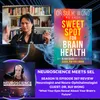
What Your Eyes Reveal About Your Brain's Future (Revisiting Dr. Sui Wong)
This episode revisits Dr. Sui Wong’s insights on how the eyes are neural tissue that can reveal early signs of brain, vascular, and metabolic issues, and reframes migraine as a common, often invisible neurological condition that causes brain fog and cognitive symptoms. Actionable takeaways include scheduling regular dilated eye exams, stabilizing blood sugar, prioritizing sleep and retinal blood flow, reducing digital strain, and tracking migraine triggers to prevent worsening symptoms. In today's review of EP 342 with Dr. Sui Wong from August 2024, we cover: • Why the eyes are considered an extension of the brain — and how the retina is neural tissue • How eye exams may provide early insight into overall neurological and vascular health • What drusen are, why small amounts can be age-related, and why monitoring retinal changes matters • The powerful idea that prevention begins before symptoms become severe • Why migraine is not “just a headache,” but a neurological condition affecting 1 in 7 people globally • The hidden symptoms of migraine — including brain fog, mood changes, word-finding difficulty, and cognitive slowing • Why migraine is a leading cause of disability in young women and often goes unrecognized • The connection between blood sugar regulation, sleep, stress, and neurological function • Practical ways to support long-term brain health through awareness, monitoring, and daily lifestyle habits • How small, consistent actions build cognitive resilience over time Welcome back to Season 15 of the Neuroscience Meets Social and Emotional Learning Podcast. I’m Andrea Samadi, and here we bridge the science behind social and emotional learning, emotional intelligence, and practical neuroscience—so we can create measurable improvements in well-being, achievement, productivity, and results. When we launched this podcast seven years ago, it was driven by a question I had never been taught to ask— not in school, not in business, and not in life: If results matter—and they matter now more than ever—how exactly are we using our brain to make these results happen? Most of us were taught what to do. Very few of us were taught how to think under pressure, how to regulate emotion, how to sustain motivation, or even how to produce consistent results without burning out. That question led me into a deep exploration of the mind–brain–results connection—and how neuroscience applies to everyday decisions, conversations, and performance. That’s why this podcast exists. Each week, we bring you leading experts to break down complex science and translate it into practical strategies you can apply immediately. When the brain, body, and emotions are aligned, performance stops feeling forced—and starts to feel sustainable. Season 14 showed us what alignment looks like in real life. We looked at goals and mental direction, rewiring the brain, future-ready learning and leadership, self-leadership, which ALL led us to inner alignment. And now, Season 15 is about understanding how that alignment is built—so we can build it ourselves, using predictable, science-backed principles. Because alignment doesn’t happen all at once. It happens by using a sequence. And when we understand the order of that sequence — we can replicate it. By repeating this sequence over and over again, until magically (or predictably) we notice our results have changed. Season 15 we’ve organized as a review roadmap, where each episode explores one foundational brain system—and each phase builds on the one before it. Season 15 Roadmap: Phase 1 — Regulation & Safety Phase 2 — Neurochemistry & Motivation Phase 3 — Movement, Learning & Cognition Phase 4 — Perception, Emotion & Social Intelligence Phase 5 — Integration, Insight & Meaning PHASE 1: REGULATION & SAFETY Staples: Sleep + Stress Regulation Core Question: Is the nervous system safe enough to learn? Anchor Episodes Episode 384[i] — Baland Jalal How learning begins: curiosity, sleep, imagination, creativity Episode 385[ii] — Bruce Perry “What happened to you?” — trauma, rhythm, relational safety Episode 387 Sui Wong Autonomic balance, lifestyle medicine, brain resilience Episode 388 Rohan Dixit HRV, real-time self-regulation, nervous system literacy Phase 1 — Regulation & Safety We have reviewed Dr. Baland Jalal where we were reminded that before learning can happen, before curiosity can emerge, before motivation or growth is possible—the brain must feel safe. Then we looked at trauma and relational safety with Dr. Bruce Perry’s Book, What Happened to You, and we move onto Dr. Sui Wong, wit
Podzilla Summary coming soon
Sign up to get notified when the full AI-powered summary is ready.
Free forever for up to 3 podcasts. No credit card required.
Listen to This Episode
More from Neuroscience Meets Social and Emotional Learning
Thought Patterns & Neurochemistry — The Hidden Drivers of Your Life (Revisiting Dr. Caroline Leaf)
The Neuroscience of Belief: How Meaning, Identity and Frequency, Drive Motivation (Featuring Bob Proctor)
The Motivation Loop: How Your Brain Decides What’s Worth Doing

When Brains Dream: How Sleep Integrates Emotion, Insight, and Creativity (Revisiting Antonio Zadra)
Get summaries like this every morning.
Free AI-powered recaps of Neuroscience Meets Social and Emotional Learning and your other favorite podcasts, delivered to your inbox.
Free forever for up to 3 podcasts. No credit card required.