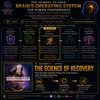
The Science of Recovery—How Dr. Kristen Holmes Helps Us Turn Stress Into Greater Capacity
In this episode Andrea Samadi explores Phase 3 of the Brain's Operating System—movement, learning, and cognition—focusing on the recovery and adaptation side of the "movement loop." She revisits Dr. Kristen Holmes’ insights on measuring strain, sleep, and recovery to show how movement provides the stimulus while recovery enables lasting adaptation and greater capacity. The episode offers practical steps: identify your stimulus, track recovery, find your weakest link, and use feedback to train smarter—not just harder—so measurement becomes a tool for meaningful change. IN EPISODE 405, WE WILL COVER: ✔ Why recovery is not the absence of work—it is where adaptation occurs → How recovery allows the brain and body to absorb stress and build greater capacity. ✔ Where Dr. Kristen Holmes fits into the Movement Loop → Movement creates the stimulus; recovery determines how effectively we adapt. ✔ Why measuring your data matters → What gets measured can be adjusted, repeated, and improved. ✔ How to identify your personal recovery patterns → Using sleep, HRV, resting heart rate, strain, stress, and daily behaviors to uncover what helps—or limits—your performance. ✔ Why your recovery formula is uniquely yours → The habits that improve one person’s readiness may not produce the same results for someone else. ✔ How recovery helps create more predictable performance → When you understand your patterns, you can make better daily decisions instead of leaving your results to chance. ✔ How repeated behaviors become adaptation → Measure → Adjust → Repeat → Recover → Adapt → Build Capacity. ✔ Where the larger journey is taking us → A preview of The Journey of the Mind Workbook and its five-step process: Understand → Reflect → Apply → Measure → Become ✔ What comes next in the Movement Loop → A Bonus Episode applying recovery science to real-world data, followed by Dr. John Medina on how an activated brain turns experience into attention, learning, and lasting change. EP 405 — From Recovery to Adaptation: Revisiting Dr. Kristen Holmes in Phase 3 WELCOME BACK Welcome back to the Neuroscience Meets Social and Emotional Learning Podcast, where we bridge neuroscience, social and emotional learning, and human performance so we can create measurable improvements in our well-being, achievement, leadership, productivity, and results. I’m Andrea Samadi, and if you’ve been following along through Season 16, you’ll know that we’ve been building what I call The Brain’s Operating System for Human Performance—a neuroscience-based framework designed to help us understand how the different systems of the brain and body work together to influence how we learn, adapt, connect, lead, and perform. Our roadmap has five phases: Phase 1 — Regulation & Safety Where we built the foundation by asking: Is the nervous system regulated enough to learn and grow? Phase 2 — Neurochemistry & Motivation Where we explored the systems that drive us to act, persist, and pursue meaningful goals. And now, we are here—Phase 3: Movement, Learning & Cognition. This is where movement becomes the catalyst for learning, adaptation, and performance. The central idea of Phase 3 is that the brain does not change through information alone. It changes through experience. Through movement. Through challenge. Through recovery. And through the repeated process of adapting to what we ask our brain and body to do. I called the framework we are building in this phase: The Movement Loop: Movement (the stimulus) → Brain Activation (the brain responds) → Attention (the brain becomes engaged and ready to learn) → Learning (new information and experience begin changing neural pathways) → Recovery (the brain consolidates and restores) → Adaptation (the brain and body adjust to the repeated challenge) → Performance (the adaptation shows up in what we can do) → Greater Capacity (we become capable of more) Movement is the stimulus. Brain activation is the response. Attention opens the door to learning. Learning creates change. Recovery helps that change stick. Adaptation builds the system. Performance reveals the result. Greater capacity is what we gain. And then we repeat the cycle. In our last episode, EP 404, we revisited the groundbreaking work of Dr. John Ratey, who helped us understand the front end of this loop. Dr. Ratey showed us that: Movement changes the brain. Exercise activates the brain. It supports attention. It prepares us for learning. And it creates the biological conditions that allow the brain to change. <p
Podzilla Summary coming soon
Sign up to get notified when the full AI-powered summary is ready.
Free forever for up to 3 podcasts. No credit card required.
Listen to This Episode
More from Neuroscience Meets Social and Emotional Learning
When Sleep Isn't Rest: What 'Sleep Stress' Reveals About Recovery (Bonus Episode)
Attention Is the Gate—How Movement Becomes Lasting Learning with Dr. John Medina
The 4:00 AM Tradeoff: Movement, REM and Recovery (Bonus Episode)
The Hidden Story Behind Your Resting Heart Rate: What Your RHR Can Reveal About Stress, Recovery & Adaptation
Get summaries like this every morning.
Free AI-powered recaps of Neuroscience Meets Social and Emotional Learning and your other favorite podcasts, delivered to your inbox.
Free forever for up to 3 podcasts. No credit card required.