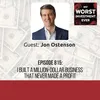
Jon Ostenson – I Built a Million-Dollar Business That Never Made a Profit
BIO: Jon is the Founder and CEO of FranBridge Consulting, a 2-time Inc. 5000 company, and he is a top 1% franchise consultant.STORY: Jon co-founded a marketing and call-center business that appeared successful on the surface, growing to millions in revenue and dozens of employees. However, excessive customization and an inability to charge prices that matched rising costs meant the business never became sustainably profitable.LEARNING: Profitability is oxygen. Knowing when to admit you’re wrong matters just as much as knowing how to start. “Humble yourself and admit when you’re wrong, course correct, and pivot.”Jon Ostenson Guest profileJon Ostenson is the Founder and CEO of FranBridge Consulting, a 2-time Inc. 5000 company, and he is a top 1% franchise consultant. Jon is also the author of the bestselling book, Non-Food Franchising. Jon draws on his experience as a former Inc. 500 Franchise President and Multi-Brand Franchisee in helping his clients select their franchise investments.Worst investment everLeaving the corporate world felt like freedom. After years of structure, predictability, and steady paychecks, you finally get to build something of your own. That was precisely where Jon found himself: grateful for his corporate experience, energized by the idea of business ownership, and eager to prove he could create something meaningful on his own terms.A promising partnership and a compelling business visionShortly after leaving corporate life, Jon partnered with a colleague to launch a marketing and sales company. He owned 60 percent of the business and ran day-to-day operations, while his partner held the remaining 40 percent.The vision was compelling. The company would help franchise businesses grow by handling their marketing, answering inbound calls through an in-house call center, and booking appointments directly for clients. The promise was simple: make the phones ring and convert those calls into revenue.Early momentum and the illusion of successAt first, it worked. The business grew quickly, attracting a strong leadership team and building a culture Jon was proud of. With around 35 employees and annual revenues of $3 million to $4 million, the company appeared successful from the outside. The team was energized, clients were signing on, and the pace was exciting.When growth didn’t translate into profitBut beneath the surface, there was a quiet, persistent problem.The business wasn’t profitable.Despite all the effort, the long hours, and the constant tweaking, the company hovered around breakeven. Some months it lost money. Others it barely scraped by. Payroll was always looming, and profitability felt just out of reach. Jon tried adjusting pricing, shifting emphasis between marketing and call center services, and introducing new technology to increase value.But every fix only delayed the inevitable question he didn’t want to answer: What if the model itself was broken?The hidden cost of customization and complexityThe core issue turned out to be customization. The business was designed to scale by serving franchise systems with repeatable processes. Instead, each franchisee insisted their market was different, their staff was unique, and their customers required special handling. Wanting to please early clients and drive revenue, Jon said yes. Again and again.Over time, the company became highly customized, operationally complex, and increasingly expensive to run. Pricing no longer matched costs. The more the business grew, the harder it became to make money. What looked like top-line success was masking a model that couldn’t sustain itself.The hard decision to walk away with integrityEventually, Jon made the difficult decision to wind down the business. There was no dramatic exit or acquisition, but there was integrity. The team helped place employees in new roles and transitioned clients responsibly. Still, it was a painful experience.The failure wasn’t just financial; it was an ego hit. This was Jon’s first true experience of business ownership, and letting it go meant admitting that the original idea wasn’t as strong as he believed.Lessons learnedThe biggest lesson came from contrast. After running his own startup without a proven product-m
Podzilla Summary coming soon
Sign up to get notified when the full AI-powered summary is ready.
Free forever for up to 3 podcasts. No credit card required.
Listen to This Episode
More from My Worst Investment Ever Podcast

Laurie Barkman - Don't Wait Until You're Exiting to Plan Your Exit

Ep820: Tony Martignetti – A Flattering Binder and $13,500 Down the Drain
David Siegel – The Agentic Economy: Why AI Agents Will Redefine Work and Wealth
Athena Brownson – What Happens When Trust Replaces Due Diligence
Get summaries like this every morning.
Free AI-powered recaps of My Worst Investment Ever Podcast and your other favorite podcasts, delivered to your inbox.
Free forever for up to 3 podcasts. No credit card required.