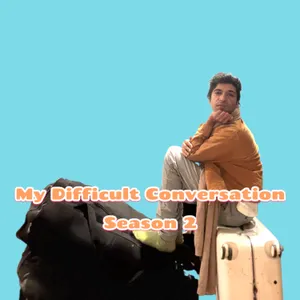
Free Daily Podcast Summary
My Difficult Conversation: Daily Summaries Delivered
by Nick Lovely
Get key takeaways, quotes, and insights from My Difficult Conversation in a 5-minute read. Delivered straight to your inbox.
Latest Episodes
The most recent episodes — sign up to get AI-powered summaries of each one.
- Nov 4, 20251h 5m
What to do? (part 2)
In this episode I talk about what do in regards to how what to do is a euphemism for hopelessness and choosing to do even small things are steps in finding hope. Every aspect of my life has involved a what to do situation. I also talk about how at my age I've missed almost every millennial milestone because of the human rights violations, abuse and exploitation and isolation - how even with dating how inexperienced I am - something like a date would be considered a milestone for me, whereas for another person at 39 it would be so casual - often I wonder if because of this situation and not being sure when I'll get my human rights - if I'm too late for certain aspects of life - such as ever having an actual family as because of this situation I've never had one.
- Nov 4, 202541 min
What to do?
In this episode I talk about what to do? How to fill time when bored - and for me what can I do when there are so many restrictions to participating in life? How the things I do - keep myself from decaying so that the systems and players of torture, and abuse in the past don't succeed in the complete destruction of me.
- Nov 3, 20251h 2m
AI and the major danger (part 2)
Talking more specifically about Radio Frequency and AI - how it undermines human rights, can be used as propaganda that invades personal space, can hijack religion - and in regards of data being inputted into AI -how Radio Berlin ( a tv show) gets turned into a medium it's not intended for. The effects of radio frequency and AI and how it can influence people good and bad, it is a method of communication and how it can separate humanity simply because we are human, which is dangerous to human rights.
- Nov 3, 20251h 11m
AI and the major danger
Talking about AI and how it can help or hurt humanity - but at its current stage how it was built on a flawed system of human rights restrictions - therefore flawed by further enforcing a negative system and turning aspects of human rights into a game which is fundamentally against human rights - and how it works by inputting data which sets up a series of rules that are major danger to human rights - and could literally turn AI into the most efficient killing machine in the world - no matter where a person is - based on the data inputted and who controls what data gets put in. AI can help ways of life - but it is at such a novice stage and has been spread so quickly because of profit efficiency. It appeals to people good and bad - because it can further both agendas - and the right to use such tech is thought of as a factor of human rights - when actually under the surface its undermining the very essence of universal human rights and constitutional rights.
- Nov 3, 20251h 22m
Rest and Relaxation
In this episode I talk about the basic human need for rest and relaxation. One of the most basic human functions is sleep, accessible to everyone - and how because of many aspects of human rights violations - I have never been able to experience that complete state of rest because of the constant living nightmare of the violations of my human rights that has kept me immensely tired.
- Oct 23, 20251h 22m
Let's go
Talking about when people say 'Let's go!' often, and I'm always left wondering - Let's go where? I do get the Disney reference, though in this episode I talk about the use of this phrase, and how when motivating people, it's important to know why and where - as for how we go, everyone gets to different parts of their life in different ways - we all have different forms of transport- physical, social, emotional, and economical - and it's important to consider the ways a person has to get to where they need in life as opposed to carefree encouragement because some people, like myself, my life journey has involved excessive abuse - and so my destination of having my human rights and freedom is essential to my literal survival - so let's go or allez vous... I've been going through this throughout my whole adulthood just waiting to arrive - for the moment where I don't need to go, and I'm allowed to be.
- Oct 20, 20251h 12m
Personal Profanity (Part 2)
Talking about personal profanity on how intentional profanity has been put upon me my whole life by not even being allowed proper economic and social security because of human rights exploitation, in all sorts of ways which has been extremely abusive at times, but also how I have been personally profane to myself, from a certain risky situation to overly farting in my favorite outfit, as a method to also display the effects of others profane attitude (which has been the main language spoken to me most of my life), and as a way to stand up, even just for myself for a moment.
- Oct 20, 20251h 25m
Personal Profanity
F*** - Talking about personal profanity and the sometimes creative and shocking insults I've come up with as tools in my fight for rights, rather than a loss of control, as methods of rebellion to injustice and standing up for civil rights by showcasing uncivil statements a lack of rights causes - as a way to bring an abusive 'audience' member into my world to let them experience the effect of the long term pain and suffering from an abusive cycle, and violations of human rights on me - and then to explain why I said such an awful thing - as a way to showcase the effect of their abusive actions in affecting my more sophisticated behavior, and why I need my human rights to survive. Much of the time when I am in a position of no power or rights in many ways, and mistreated and often when kind, normal dialogue doesn't work, personal profanity turns into a sharp hook (it's happened after a long buildup of gaslighting), to latch on such an abusive person, and reel them into a realization that things need to change, that the violations of my human rights are in turn weakening societal standards, turning unjust abusive situations towards me, into building blocks of societal cesspool trash.
Get My Difficult Conversation summaries in your inbox
Free AI-powered daily recaps. Key takeaways, quotes, and mentions — in a 5-minute read.
Get Free Summaries →Free forever for up to 3 podcasts. No credit card required.
You Might Also Like
Listeners also like.
The Conversation
The Conversation

The Conversation
Milo’s Mommy
Conversations with Toi
LaToi Storr
No Offence, But…
No Offence, But…
Unspoken Conversations
James Crow
Conversations With Love
loveconvo15
Nick's Nuances
Nick - Nuancer
Through Conversations
Alex Levy

The conversation
Grizzlyjones2uproduction
Let's Talk About It
Eugene and Heather
The Problem With...
James Smith
Living in the Matrix
Jonathan Brink & Rich Goulette
About My Difficult Conversation
In this podcast I discuss all the difficult conversations I want to have with people from social justice, to relationships, to art to healthcare and anything and everything that's difficult. I grew up with much of my work and life exploited for films and art dating back to over a decade ago - that has reached the heights of Cannes and the Oscars, including network TV. In this time there has been a lot difficult situations, involving human rights, trauma, gaslighting, relationships, opportunity, art, doublespeak and human value. It's time to start having these difficult conversations.
Customized Recaps
AI-powered recaps with compact key takeaways, quotes, and insights.
Straight to Your Inbox
Get key takeaways from My Difficult Conversation in a 5-minute read.
Save Hours Every Week
Stay current on your favorite podcasts without falling behind.
Frequently Asked Questions
What is Podzilla's My Difficult Conversation daily summary?
It's a free AI-powered email that summarizes new episodes of My Difficult Conversation as soon as they're published. You get the key takeaways, notable quotes, and links & mentions — all in a quick read.
How does the My Difficult Conversation podcast summary work?
When a new episode drops, our AI transcribes and analyzes it, then generates a personalized summary tailored to your interests and profession. It's delivered to your inbox every morning.
Is this an official My Difficult Conversation product?
No. Podzilla is an independent service that summarizes publicly available podcast content. We're not affiliated with or endorsed by Nick Lovely.
Can I get summaries of other podcasts too?
Absolutely! The free plan covers up to 3 podcasts. Upgrade to Pro for 15, or Premium for 50. Browse our full catalog at /podcasts.
How often does My Difficult Conversation release new episodes?
My Difficult Conversation publishes daily. Our AI generates a summary within hours of each new episode.
What topics does My Difficult Conversation cover?
My Difficult Conversation covers topics including Culture, Society & Culture. Our AI identifies the specific themes in each episode and highlights what matters most to you.
Start getting My Difficult Conversation summaries tomorrow morning.
Free forever for up to 3 podcasts. No credit card required.
Free forever for up to 3 podcasts. No credit card required.