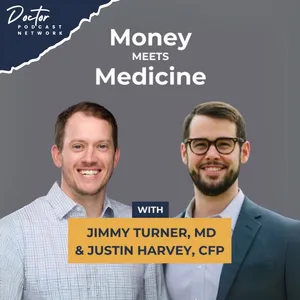
Free Daily Podcast Summary
Money Meets Medicine: Daily Summaries Delivered
by Doctor Podcast Network, Jimmy Turner MD
On Money Meets Medicine, Dr. Jimmy Turner discusses all things career and finance for physicians. With expert guest discussions, Jimmy tackles the personal finance topics you wish you had learned in medical school.The MMM podcast will help you tackle your student loans, achieve financial independence, invest for retirement, and decrease your financial stress and burnout.To get help with free educational content or obtaining own-occupation disability insurance from a source you know you can trust, visit https://moneymeetsmedicine.com/disabilityBackground: Dr. Turner is a practicing anesthesiologist at Wake Forest, author of The Physician Philosopher's Guide to Personal Finance, and Co-Founder of Money Meets Medicine Disability Insurance.For more information, visit moneymeetsmedicine.com
Latest Episodes
The most recent episodes — sign up to get AI-powered summaries of each one.
- 5 days ago38 min
How FOMO Real Estate Deals Cost Doctors
On this episode of the Money Meets Medicine podcast, hosts Dr. Jimmy Turner and Justin Harvey CFP discuss: Why passive activity loss rules trap syndication losses for W-2 earners — and the "active participant" workaround that fails the New York Times testFive ways to unwind a concentrated stock position in a brokerage accountA step-by-step playbook for what to do with an annual bonusResources:Every doctor needs own-occupation disability insurance. Get a quote from us here at Money Meets Medicine Insurance. An insurance agency created for doctors, by doctors. Get a 10% discount off first year's services with the tax strategy team that Jimmy personally uses (Gelt). Not sure where to get started on your financial literacy journey? Snag a free copy of The Physician Philosopher's Guide to Personal Finance. Hosted by Simplecast, an AdsWizz company. See pcm.adswizz.com for information about our collection and use of personal data for advertising.
- 1 weeks ago26 min
HSAs, Donor Advised Funds, and When to Drop Insurance
In this episode of Money Meets Medicine, hosts Dr. Jimmy Turner and Justin Harvey tackle three listener questions on personal finance for physicians. They discuss whether HSA-eligible plans make sense during high healthcare-usage periods like pregnancy, charitable giving strategies including donor advised funds and tax-efficient gifting of appreciated securities, and when physicians with significant net worth should consider stopping life and disability insurance premiums. The hosts emphasize personalized decision-making based on individual circumstances, consistently recommending listeners consult qualified financial professionals before making major financial decisions.Resources:Are you a 1099, locums doc, or private practice partner or business owner? You need a tax strategy team. Get 10% off working with the team I use here (Gelt): https://moneymeetsmedicine.com/CPA Every doctor needs own-occupation disability insurance. Get it from a source you can trust: https://moneymeetsmedicine.com/disability Want to get started on your financial literacy journey? Download a free copy of The Physician Philosopher's Guide to Personal Finance. Hosted by Simplecast, an AdsWizz company. See pcm.adswizz.com for information about our collection and use of personal data for advertising.
- 2 weeks ago31 min
457 Plans, Bonus Investing, and Emergency Funds
On the Money Meets Medicine podcast, Dr. Jimmy Turner and Justin Harvey answer three listener questions. First, they discuss 457 plans and how to determine if you should be participating in yours, including the three questions to answer to figure it out in your situation. They alos discuss if doctors should have emergency funds and, if so, how large they should be. Finally, they chat about investing bonus money: invest it all in at once? Or let it trickle in through dollar-cost averaging (DCA)?Resources for this episode: Every doctor needs own-occupation disability insurance. Get a quote from Money Meets Medicine Disability Insurance, co-founded by host Dr. Jimmy Turner. Are you looking for a new accountant? Check out Gelt, the tax strategy team that Jimmy Turner personally uses. Use this link to get 10% off Gelt's services the first year you work with them. Looking to increase your financial literacy, but not sure where to start? Get a free copy of Dr. Jimmy Turner's best-selling book, The Physician Philosopher’s Guide to Personal Finance. IRS guide on differences between governmental and non-governmental 457 can be found here. Hosted by Simplecast, an AdsWizz company. See pcm.adswizz.com for information about our collection and use of personal data for advertising.
- 3 weeks ago41 min
Part-time work, Paying Off Loans, & Funding Kids College
In this episode of Money Meets Medicine, hosts Dr. Jimmy Turner and Certified Financial Planner (CFP) Justin Harvey tackle three listener questions from the Money Meets Medicine community. 1. Should residents pay extra on their student loans if they are in the new Repayment Assistance Plan (RAP)? 2. What are the financial considerations to make working part-time make sense? 3. If you are a parent (or plan to be), should you pay for your kid's college education? If you do, how can you make that work given the new federal student loan borrowing limits?Resources: Every doctor needs disability insurance. Get it from a source you can trust: https://moneymeetsmedicine.com/disability Are you a 1099, locums doc, K-1 partner, or business owner? You need a tax strategy team. Get 10% off working with Gelt, the team that Jimmy Turner personally uses here (Gelt): https://moneymeetsmedicine.com/CPA Looking to get a lower interest rate on your student loans? Check out Juno’s unique student loan Group Negotiation process at https://moneymeetsmedicine.com/Juno Not sure what to do with your student loans? Get $100 off a student loan consult: https://moneymeetsmedicine.com/loans Have questions of your own? Send them to Jimmy at Jimmy@moneymeetsmedicine.com Hosted by Simplecast, an AdsWizz company. See pcm.adswizz.com for information about our collection and use of personal data for advertising.
- Aug 19, 202638 min
5 Bad Pieces of Financial Advice to Avoid
On the Money Meets Medicine podcast, Dr. Jimmy Turner and Justin Harvey discuss how common personal finance advice can be especially costly for physicians and outline six “bad advice” items. They warn that disability insurance company choice matters because applying with the wrong carrier can trigger denials that eliminate access to guaranteed standard issue policies; they also caution against waiting until late in training. They argue that saving 10–15% or just maxing a 401(k) is usually insufficient for doctors with delayed earnings and debt, suggesting higher savings rates based on retirement goals. They note student loan consolidation advice has changed under the One Big Beautiful Build Act and may limit repayment plan eligibility. They criticize “pay off all debt before investing,” explain why renting isn’t necessarily “throwing money away,” and argue that asking if an advisor is a fiduciary is no longer reliable, favoring fee-only transparency. Resources: Every doctor needs own-occupation disability insurance. Get it from a source you can trust: https://moneymeetsmedicine.com/disability Are you a 1099, locums doc, or private practice partner or business owner? You need a tax strategy team. Get 10% off working with the team I use here (Gelt): https://moneymeetsmedicine.com/CPA Want a free copy of The Physician Philosopher’s Guide to Personal Finance? Snag your copy here: https://moneymeetsmedicine.com/freebook Hosted by Simplecast, an AdsWizz company. See pcm.adswizz.com for information about our collection and use of personal data for advertising.
- Aug 12, 202633 min
Should I Invest in SpaceX? (Lessons from SpaceX IPO)
SpaceX priced at $135 a share, raised $75 billion, and hit an all-time high of $225 within days — then fell to $107. Dr. Jimmy Turner and Justin Harvey CFP break down how index funds actually decide what gets included in the index, why the S&P 500 said no to SpaceX while CRSP and the Russell 1000 said yes, and what that means for the total stock market index fund in your 401(k). What you'll learn: Why an index fund doesn't pick stocks — it follows 3 rules: seasoning, profitability, and float How Nasdaq, Russell 1000, and CRSP cut IPO seasoning for SpaceX Why your money in an IPO often funds the private investors cashing out on the other side What Dimensional's 12-month IPO exclusion says about buying at the offering How to handle FOMO before Anthropic and OpenAI potentially go public Resources mentioned: Looking to lower your taxes? Check out Gelt, the tax team Jimmy uses: https://moneymeetsmedicine.com/CPA Juno — Looking for a lower interest rate on your student loans? Use group negotiated rates from Juno here: moneymeetsmedicine.com/juno Every physician needs disability insurance. Get quotes from Money Meets Medicine Disability Insurance: https://moneymeetsmedicine.com/disability The Physician Philosopher's Guide to Personal Finance — free book for physicians — moneymeetsmedicine.com/freebook Hosted by Simplecast, an AdsWizz company. See pcm.adswizz.com for information about our collection and use of personal data for advertising.
- Aug 5, 202629 min
Are Doctors Fairly Paid? Inside the 2026 Compensation Data
28% of physicians say they don't earn enough for what their family needs. The lowest-paid specialty still makes $266,000. Medscape's 2026 physician compensation report surveyed roughly 6,000 doctors across 29+ specialties, and the numbers tell a stranger story than "doctors are underpaid." Average pay rose 3%, barely clearing inflation, and nine specialties were flat or down. Jimmy and Justin unpack what the data says about physician pay, negotiation, and the 40% side-gig statistic. What you'll learn: Why primary care averaged $298K and specialists $417K — and which specialties outpaced inflation What percentage of physicians negotiated their compensation, and how many just took what they were given Why "we don't negotiate" pay models push high performers out The paradox: 53% feel personally fairly paid, but 61% say the profession is underpaid What the 40% side-gig number reveals about autonomy and moral injury Resources mentioned: Money Meets Medicine Disability — moneymeetsmedicine.com/disability Need a new CPA or a better Tax Strategy? Get a 10% discount when working with Gelt, the tax strategy team that Jimmy Turner uses: https://moneymeetsmedicine.com/Gelt Medscape Physician Compensation Report 2026 Hosted by Simplecast, an AdsWizz company. See pcm.adswizz.com for information about our collection and use of personal data for advertising.
- Jul 29, 202647 min
Red Flags in Private Practice Job Offers
Being able to know the difference between a good and a bad job offer as a physician in private practice involves knowing where the landmines and pitfalls are so that you can avoid them. In this episode, host Dr. Jimmy Turner interviews Michael Johnson, a physician contract attorney at Michael Johnson Legal. Resources: Get 10% off working with Gelt, the tax strategy team that Jimmy Turner personally uses: https://moneymeetsmedicine.com/CPA Every doctor needs own-occupation disability insurance. Get it from a source you can trust: https://moneymeetsmedicine.com/disability Want a free copy of The Physician Philosopher’s Guide to Personal Finance? Snag your copy here: https://moneymeetsmedicine.com/freebook What you'll learn: What "partnership" truly means in a business context The financial realities of partnership tracks, buy-in costs, and ownership structures Common pitfalls, including misleading partnership titles, private equity buyout risks, and real estate considerations Eight essential questions physicians should ask before committing to a partnership Hosted by Simplecast, an AdsWizz company. See pcm.adswizz.com for information about our collection and use of personal data for advertising.
About Money Meets Medicine
On Money Meets Medicine, Dr. Jimmy Turner discusses all things career and finance for physicians. With expert guest discussions, Jimmy tackles the personal finance topics you wish you had learned in medical school.The MMM podcast will help you tackle your student loans, achieve financial independence, invest for retirement, and decrease your financial stress and burnout.To get help with free educational content or obtaining own-occupation disability insurance from a source you know you can trust, visit https://moneymeetsmedicine.com/disabilityBackground: Dr. Turner is a practicing anesthesiologist at Wake Forest, author of The Physician Philosopher's Guide to Personal Finance, and Co-Founder of Money Meets Medicine Disability Insurance.For more information, visit moneymeetsmedicine.com
Customized Recaps
AI-powered recaps with compact key takeaways, quotes, and insights.
Straight to Your Inbox
Get key takeaways from Money Meets Medicine in a 5-minute read.
Save Hours Every Week
Stay current on your favorite podcasts without falling behind.
Frequently Asked Questions
What is Podzilla's Money Meets Medicine daily summary?
It's a free AI-powered email that summarizes new episodes of Money Meets Medicine as soon as they're published. You get the key takeaways, notable quotes, and links & mentions — all in a quick read.
How does the Money Meets Medicine podcast summary work?
When a new episode drops, our AI transcribes and analyzes it, then generates a personalized summary tailored to your interests and profession. It's delivered to your inbox every morning.
Is this an official Money Meets Medicine product?
No. Podzilla is an independent service that summarizes publicly available podcast content. We're not affiliated with or endorsed by Doctor Podcast Network, Jimmy Turner MD.
Can I get summaries of other podcasts too?
Absolutely! The free plan covers up to 3 podcasts. Upgrade to Pro for 15, or Premium for 50. Browse our full catalog at /podcasts.
How often does Money Meets Medicine release new episodes?
Money Meets Medicine publishes weekly. Our AI generates a summary within hours of each new episode.
What topics does Money Meets Medicine cover?
Money Meets Medicine covers topics including Business, Investing. Our AI identifies the specific themes in each episode and highlights what matters most to you.
Start getting Money Meets Medicine summaries tomorrow morning.
Free forever for up to 3 podcasts. No credit card required.
Free forever for up to 3 podcasts. No credit card required.