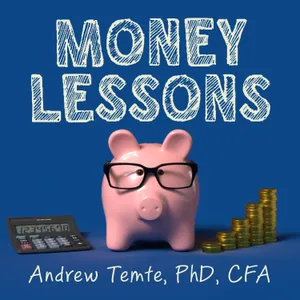
Free Daily Podcast Summary
Money Lessons with Andrew Temte, PhD, CFA: Daily Summaries Delivered
by Andrew Temte
Andrew Temte’s insights into personal and professional continuous improvement with a focus on improving financial literacy and financial decision-making.
Latest Episodes
The most recent episodes — sign up to get AI-powered summaries of each one.
- Yesterday15 min
Your Income Tax: Brackets, Withholding, and Your Refund
In this episode of Money Lessons, Andy explains how the federal income tax is calculated, starting with four definitions every taxpayer needs: taxable income, the tax bracket, the marginal rate, and the effective rate. He works a single filer's 2026 tax one bracket at a time to show why someone in the 22 percent bracket pays about 13 percent, and why a raise never leaves you with less after tax. From there he explains how an employer estimates withholding every payday, why a refund is your own money coming back without interest, and how the Form W-4 lets you change that estimate at any time. AndrewTemte.com
- 6 days ago37 min
Forty Trillion Dollars — What the National Debt Means for Your Household
In this special edition of Money Lessons, Andy takes the national debt's crossing of forty trillion dollars on August 18 and explains what the number is made of — the debt held by the public, and the money the federal government owes its own trust funds. He shows why interest now takes eighteen and a half cents of every dollar the government collects, and why "we'll grow our way out" and "inflation will take care of it" are the same answer. Ray Dalio's three-percent deficit target anchors the arithmetic, and the 2026 Trustees Reports show where the pressure lands next. Andy closes with what the debt means for your mortgage, your savings, and your benefits across three time horizons, and what you can do about it through three of the six jobs your money has. AndrewTemte.com
- 1 weeks ago14 min
Anatomy of a Pay Stub: The Deductions You Chose, the Ones You Didn't, and the Pay You Never See
In this episode of Money Lessons, Andy reads a pay stub for the lines most people skip past. He sorts every deduction into two types — the ones the law requires and the ones you elected, usually in the paperwork on your first day — and explains why a health premium, an HSA, and a retirement contribution come out of your pay before your taxes are figured, and why the federal taxes don't all treat those deductions the same way. Along the way he clears up the most common misunderstanding on the stub: the Social Security line is a tax paid to today's retirees, not a deposit into an account with your name on it, and the story of the first person ever to collect a monthly check shows why. He closes on the pay that never appears on the stub at all — the employer's share of the premium and the retirement match — and why two jobs with the same salary can pay very different amounts. AndrewTemte.com
- 2 weeks ago11 min
Nudge and Sludge: The Vocabulary of Everyday Money Decisions
In this episode of Money Lessons, Andy supplies the vocabulary behind three weeks of teaching on habits, defaults, and friction. Herbert Simon — who was never an economist — challenged his era's assumption that buyers decide with complete information, and won a Nobel Prize for finding those limits inside companies before anyone thought to look for them in customers. Richard Thaler named the arrangement of options in front of you choice architecture, and a decade after publishing Nudge with Cass Sunstein, he coined sludge for friction pointed at the person who has to get through it. AndrewTemte.com
- 3 weeks ago11 min
The Money Machinery Someone Else Built for You
In this episode of Money Lessons, Andy turns from the money machinery listeners build themselves to the machinery that gets installed before they arrive. He starts with the default — what happens if you do nothing — and shows how much of a household's money moves according to settings that somebody at a company chose in advance. The workplace retirement plan serves as the rare example of a default that works in the saver's favor, along with a caution that plenty of employers are still exempt from it. From there he takes up friction, the effort standing between wanting something and having it, and traces how the same business will strip every step out of a purchase and then build steps into the exit. AndrewTemte.com
- 3 weeks ago20 min
The Same Old Songs: What Musical Taste Reveals About Financial Change
In this special edition of Money Lessons, Andy takes on a question that sits underneath most of personal finance: why change is so hard. A complaint about his band's setlist leads to the research on why musical taste is set around age fourteen — and to the study showing that appetite for financial risk locks in the same way, set by whatever the markets were doing when a person first had money in play. Neither one was a decision. Both feel like one. AndrewTemte.com
- 4 weeks ago11 min
Habits and Money: Why You Can't Remember What You Spend
In this episode of Money Lessons, Andy opens up the machinery that moves money out of a household without ever passing through a decision. He starts with the narrow definition psychologists use for the word "habit" — a behavior repeated in the same surroundings until conscious decision-making drops out — and walks through the 2002 wristwatch studies that measured how often people's minds were somewhere else while they acted. He makes the case that habits are not a character defect but a feature that buys back mental energy, then shows why the same mechanism that makes a habit useful is what makes it nearly impossible to recall. AndrewTemte.com
- Aug 15, 202613 min
Present Bias: Why Your Future Self Keeps Losing the Argument
In this episode of Money Lessons, Andy turns from the map of your personal economy to the thing that moves money across it — decisions. He explains why good and bad decisions never arrive in the same size, and why one large mistake can undo a decade of quiet good ones. The centerpiece is present bias, the mental shortcut that treats anything happening right now as far more important than the same thing months from now, illustrated by a study of 7,752 health club members who left roughly six hundred of every fourteen hundred dollars on the table. Andy also revisits four biases from March 2025 that turn up constantly in money decisions, and hands listeners a question to carry through the rest of the series: what bias is this product designed to exploit? AndrewTemte.com
Get Money Lessons with Andrew Temte, PhD, CFA summaries in your inbox
Free AI-powered daily recaps. Key takeaways, quotes, and mentions — in a 5-minute read.
Get Free Summaries →Free forever for up to 3 podcasts. No credit card required.
You Might Also Like
Listeners also like.

NerdWallet's Smart Money Podcast
Personal finance experts break down budgeting, saving, investing, and credit to help listeners make informed money decisions.
How to Money
Two friends break down personal finance topics like debt payoff and investing in simple, practical terms for everyday listeners.

Your Money Guide on the Side
A practical guide to personal finance and investing, breaking down complex topics with expert insights and actionable advice.

Planet Money Summer School
A crash course in economics that teaches fundamental concepts through real-world examples in everyday life.

Afford Anything | Get Smarter With Money
A weekly discussion on financial freedom covering psychology, income, investing, real estate, and entrepreneurship with experts.

The Stacking Benjamins Show
Two friends discuss personal finance, investing, and money trends with humor and expert guests in a casual, accessible way.
The Money Mondays
Discusses investments, side hustles, and charity through interviews with entrepreneurs and celebrities in their homes and studios.
Money Making Conversations Master Class
Successful entrepreneurs and leaders share strategies for building businesses and creating wealth.

BiggerPockets Money
Financial experts discuss earning, saving, and growing wealth with guests who’ve achieved financial independence.
Money Stuff: The Podcast
A weekly discussion on Wall Street, finance, and related topics with Matt Levine and Katie Greifeld.
Merryn Talks Money
A financial podcast exploring markets, investing, and personal finance through in-depth conversations with experts and thought leaders.

Money Guy Show
Teaches wealth-building strategies to help listeners grow their assets and achieve financial goals efficiently.
Customized Recaps
AI-powered recaps with compact key takeaways, quotes, and insights.
Straight to Your Inbox
Get key takeaways from Money Lessons with Andrew Temte, PhD, CFA in a 5-minute read.
Save Hours Every Week
Stay current on your favorite podcasts without falling behind.
Frequently Asked Questions
What is Podzilla's Money Lessons with Andrew Temte, PhD, CFA daily summary?
It's a free AI-powered email that summarizes new episodes of Money Lessons with Andrew Temte, PhD, CFA as soon as they're published. You get the key takeaways, notable quotes, and links & mentions — all in a quick read.
How does the Money Lessons with Andrew Temte, PhD, CFA podcast summary work?
When a new episode drops, our AI transcribes and analyzes it, then generates a personalized summary tailored to your interests and profession. It's delivered to your inbox every morning.
Is this an official Money Lessons with Andrew Temte, PhD, CFA product?
No. Podzilla is an independent service that summarizes publicly available podcast content. We're not affiliated with or endorsed by Andrew Temte.
Can I get summaries of other podcasts too?
Absolutely! The free plan covers up to 3 podcasts. Upgrade to Pro for 15, or Premium for 50. Browse our full catalog at /podcasts.
How often does Money Lessons with Andrew Temte, PhD, CFA release new episodes?
Money Lessons with Andrew Temte, PhD, CFA publishes weekly. Our AI generates a summary within hours of each new episode.
What topics does Money Lessons with Andrew Temte, PhD, CFA cover?
Money Lessons with Andrew Temte, PhD, CFA covers topics including Education, Business, Investing. Our AI identifies the specific themes in each episode and highlights what matters most to you.
Start getting Money Lessons with Andrew Temte, PhD, CFA summaries tomorrow morning.
Free forever for up to 3 podcasts. No credit card required.
Free forever for up to 3 podcasts. No credit card required.